
Ghostwriter accelerates how you write code inside Replit's IDE. Rocket.new replaces the setup stage entirely, generating full-stack apps from a single prompt, with built-in research and monitoring.
Which AI coding assistant actually gets your app shipped faster?
You have an idea, a deadline, and a choice to make. Do you open an IDE and write code with an AI assistant at your side? Or do you describe what you want and let an AI build the whole thing? That choice separates Replit Ghostwriter from Rocket.new.
According to Stack Overflow's 2025 Developer Survey, 84% of developers are using or plan to use AI tools in their workflow. The AI coding market now has over 1,085 assistants available, with more than 90% released in the last two years alone.
Picking the wrong one shapes what you can build, how fast you ship, and how much time goes to infrastructure versus product.
What is Replit Ghostwriter?
Replit Ghostwriter is the AI coding assistant built into the Replit cloud IDE. It started as a code completion tool and has since grown into a broader suite of AI features for code editing, analysis, and generation inside Replit's browser-based environment.
Here is what Ghostwriter does:
- Code completion: Inline suggestions as you type, predicting the next line based on surrounding file context.
- Code explanation: Highlights any block and returns a plain-English breakdown, useful for reviewing legacy code.
- Code generation: Uses natural language prompts to write new code from scratch, from helper functions to full file scaffolds.
- Code refactoring: Rewrites selected blocks to clean up logic, reduce duplication, or improve readability.
- Debugging: The "Fix with AI" feature analyzes stack traces, catches syntax and runtime errors, and supplies the fix alongside the explanation.
- Unit test generation: Looks at an existing function and produces unit tests automatically.
Replit Ghostwriter supports over 50 programming languages and operates entirely inside Replit's browser-based IDE. That is both its strength and one of its key constraints.
What is Rocket.new?
Rocket.new is a vibe solutioning platform. It covers the full arc from thinking to building to operating, combining strategic research, AI app building, and competitive intelligence in a single product.
You describe what you want. Rocket generates the complete product, including frontend, backend, database logic, integrations, and deployment, without requiring you to write a single line of code.
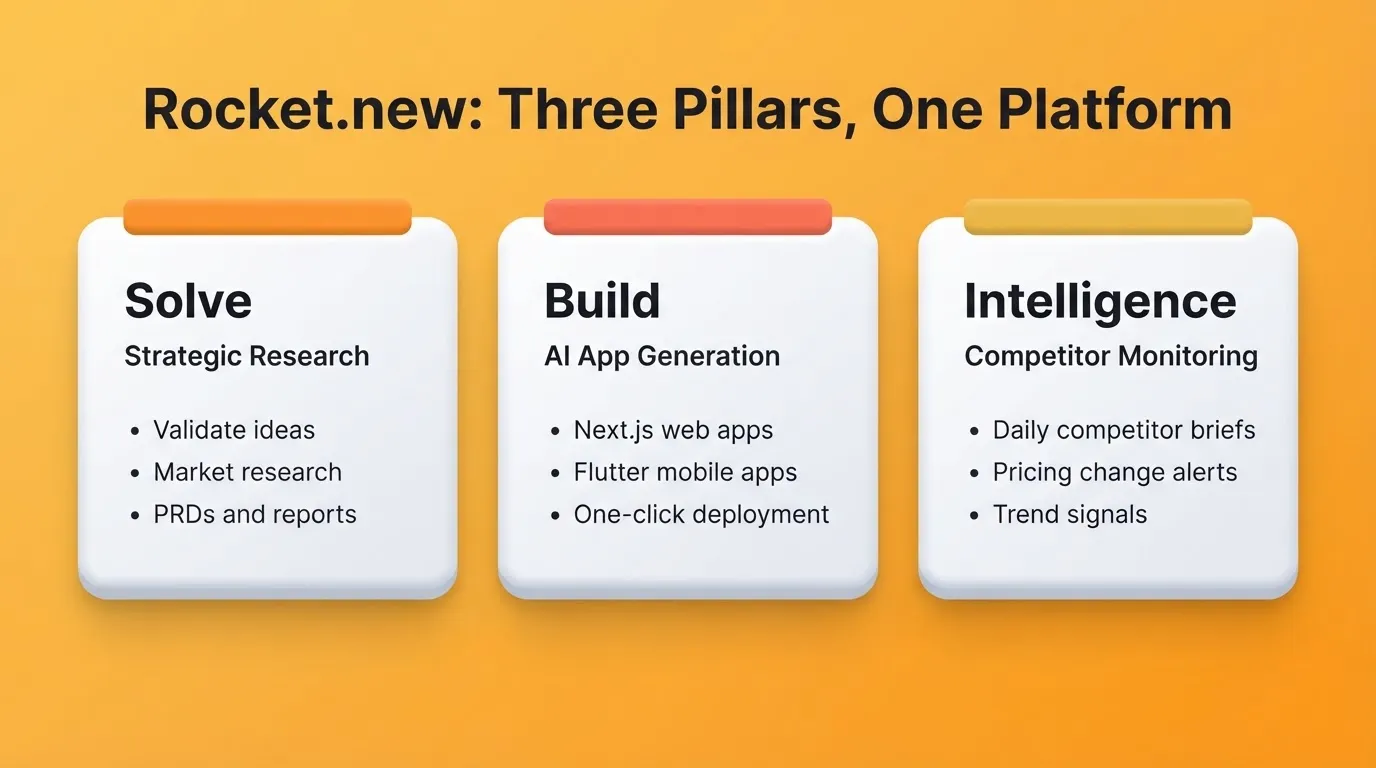
Its three pillars work independently or together:
- Solve: Validate ideas, run market research, create PRDs, and get structured reports with data, insights, and recommendations before a single line of code is written.
- Build: Generate production-ready Next.js web apps and Flutter mobile apps from a natural language prompt.
- Intelligence: Monitor competitors continuously. Get automated daily briefs, pricing change alerts, and trend signals delivered to a live dashboard.
Each pillar shares context and feeds into the others. The research you run in Solve is available when you start building. A competitor signal from Intelligence can trigger a new Solve analysis or a product update in Build.
Key Features Side by Side
| Feature | Rocket.new | Replit Ghostwriter |
|---|---|---|
| Code generation | Full app from a single prompt | Function and file-level generation |
| Code completion | Prompt-based | Real-time inline suggestions |
| Code refactoring | Prompt-based rewrites | Highlight-and-refactor workflow |
| Visual editor | Yes, click any element to edit | No |
| Mobile apps | Flutter (iOS and Android) | Limited to web deployments |
| Starting points | Idea, Figma, attachment, template, GitHub | Blank editor or template |
| Connectors | 26+ services (Stripe, Supabase, OpenAI, etc.) | Manual integration only |
| Templates | 25,000+ | Limited |
| Deployment | One-click via Netlify, custom domain | Replit hosting only |
| Code export | Full export, VS Code compatible | Tied to Replit environment |
| Versions and rollback | Yes | No native versioning |
| Market research | Yes, via Solve pillar | No |
| Competitor monitoring | Yes, via Intelligence pillar | No |
| Programming languages | Next.js (web), Flutter (mobile) | 50+ programming languages |
How AI Coding Works in Each Platform
Ghostwriter's Approach
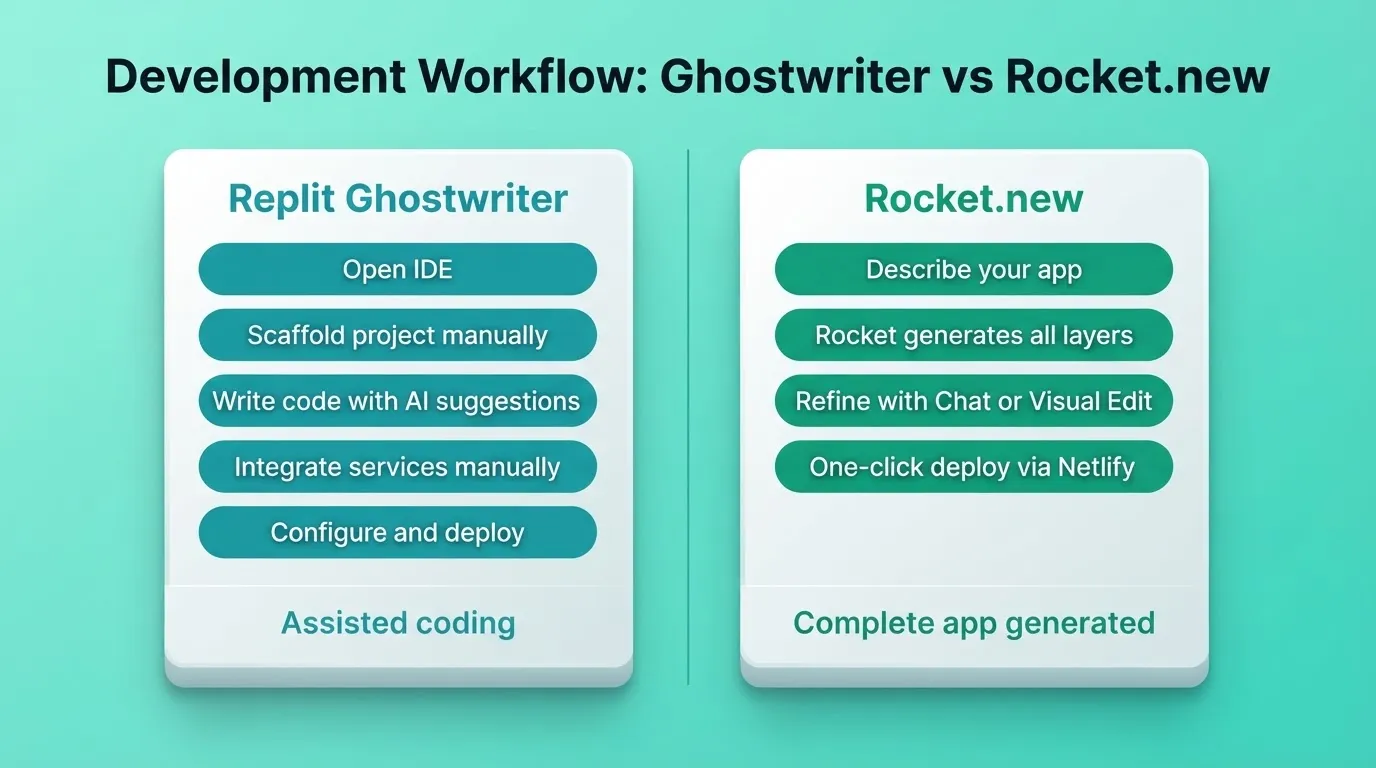
Ghostwriter integrates at the developer's cursor. As you write, it watches your file context and offers real-time code suggestions, from completing a single line to generating a full function block.
The quality of those suggestions depends on how much structure is already in the file. Ghostwriter works well for daily coding tasks inside well-organized, existing projects.
However, it runs into friction in a few situations:
- Complex projects and large monorepos cause the AI to lose project context, producing suggestions that do not match the broader architecture.
- Starting a full-stack project from scratch still requires significant manual scaffolding before Ghostwriter becomes useful.
- No offline support means losing your connection cuts access to both your code and your AI tools.
Rocket.new's Approach
Rocket starts from a different premise. Instead of helping you write code, it writes the entire application. You describe what you want, and Rocket generates every layer of the stack at once, including frontend screens, backend logic, API routes, database connections, and authentication flows.
Rocket scores each prompt before starting. A specific prompt triggers an immediate build. A vague prompt triggers a short set of targeted questions about platform, audience, and must-have features. Then it starts once it has enough context to go on.
After generation, the editor gives you three modes. Chat lets you iterate in natural language. Visual edit lets you click any element to change it directly. Code view lets you inspect and edit the generated code. A Versions feature lets you roll back to any previous state.
Code Quality: What Each Tool Actually Produces
A 2025 industry report found that around 46% of developers do not fully trust AI-generated outputs. The reason is often the same: suggestions are almost right but not quite.
Ghostwriter and Code Quality
Ghostwriter produces code that reflects the context of the file it is reading. When that context is rich and well-structured, the suggestions improve. Two consistent issues developers flag:
- Suggestions sometimes look correct syntactically but break at runtime because the AI misunderstands the data model or API contract.
- Code reviews on Ghostwriter-assisted projects often require more rounds than expected, particularly across larger or more complex codebases.
Rocket.new and Code Quality
Rocket designs the system architecture first, then generates all layers to match it. Rather than predicting what you might want next, it understands the full spec from the start and builds to it.
Rocket's best practices recommend leading with purpose, using the 3 to 5 feature rule, naming screens explicitly, and separating design from functionality in your prompt. Following these patterns produces cleaner initial generations that need fewer iteration rounds.
The generated code is fully exportable. You can open it in VS Code or any IDE and continue development locally. Your code stays yours, with no lock-in.
Real-Time Suggestions vs. Full App Generation
This is the core split between the two tools.
Ghostwriter gives you real-time code suggestions as you type. The AI fills gaps, catches errors, and accelerates repetitive work. For developers who want full control over every line, this model feels natural.
Rocket gives you a finished product instead. You remain the architect. The AI handles the implementation. For founders and teams building full-stack projects fast, this saves considerably more total time.
If your bottleneck is typing speed, Ghostwriter addresses that. If your bottleneck is getting from idea to deployed application, Rocket addresses that.
Integrations and Connectors
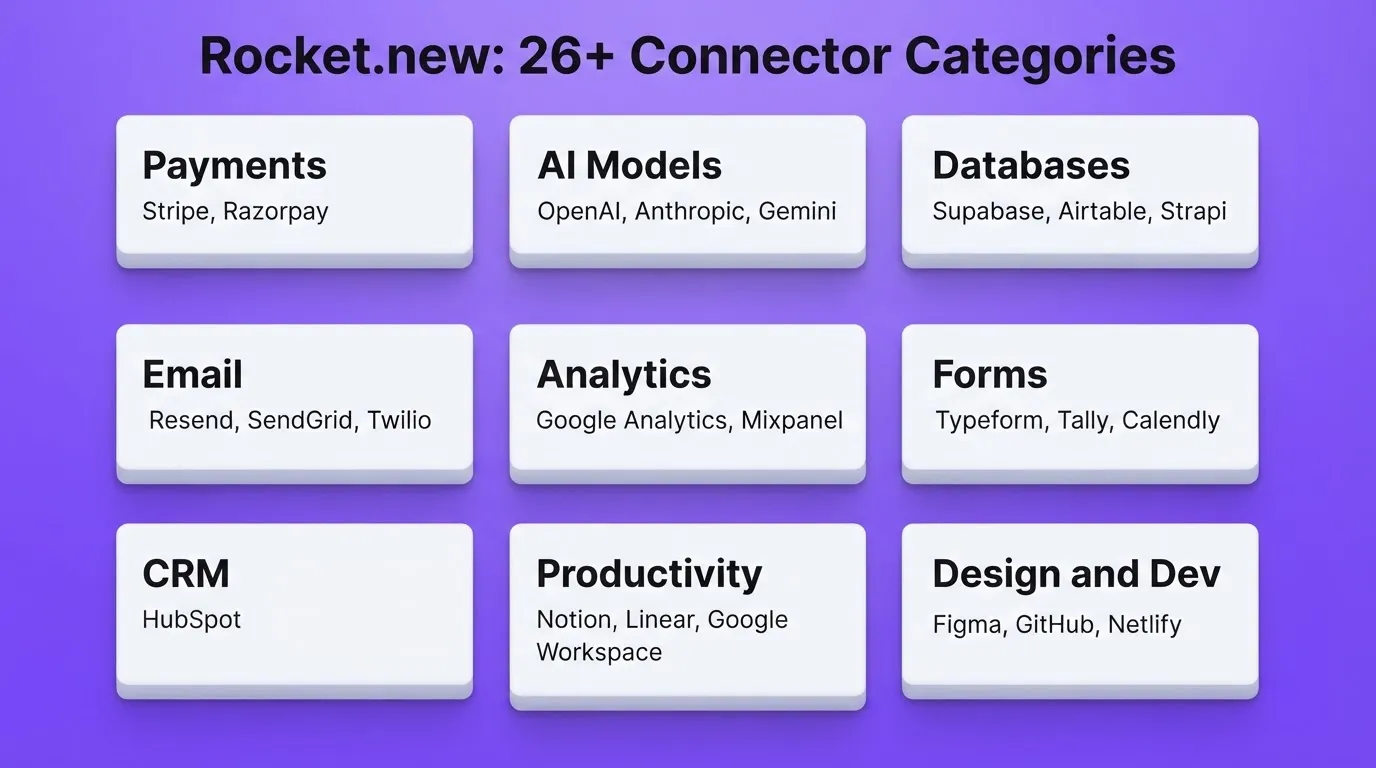
This is an area where the two platforms diverge significantly. Rocket.new ships with 26+ built-in connectors that wire directly into your generated app from a single prompt. Ghostwriter, on the other hand, relies on you to manually integrate third-party services through code.
Connect once via API key or OAuth, then describe what you want to build in chat. Rocket generates the complete feature, including UI, backend logic, API calls, and error handling. API keys are encrypted at rest and never exposed in your code.
| Category | Rocket.new Connectors |
|---|---|
| Payments | Stripe, Razorpay |
| Email and Messaging | Resend, SendGrid, Brevo, Mailchimp, Twilio |
| AI Models | OpenAI, Anthropic (Claude), Google Gemini, Perplexity |
| Databases and CMS | Supabase, Airtable, Strapi, Directus |
| Analytics | Google Analytics, Mixpanel |
| Forms and Scheduling | Typeform, Tally, Calendly |
| CRM | HubSpot |
| Productivity | Google Workspace, Notion, Linear, Confluence |
| Design and Dev | Figma, GitHub, Netlify |
Programming Languages and Platform Support
Replit supports over 50 programming languages, including Python, JavaScript, TypeScript, Go, Rust, Java, and C++, all running inside the browser IDE. This makes it genuinely useful across a wide range of project types.
Rocket focuses on a modern web and mobile stack. It builds in Next.js for web apps and Flutter for mobile apps. This is narrower in language coverage, but it covers the vast majority of what startups, small teams, and individual builders are shipping today.
If you are building mobile apps, this distinction matters. Rocket.new generates native-feeling iOS and Android apps with Flutter from a single codebase, ready for App Store and Google Play submission. Replit's environment does not natively output Flutter or native mobile code.
Limitations Worth Knowing
Replit Ghostwriter
- Replit may experience performance bottlenecks for very large projects due to its browser-based nature, and the AI loses project context more easily at scale.
- Ghostwriter does not offer a VS Code extension. GitHub Copilot, by contrast, integrates directly into VS Code, JetBrains, and most major IDEs.
- Your entire project lives inside the Replit environment, which may lead to platform lock-in frustrations for complex codebases.
- Replit Ghostwriter has reported cost unpredictability due to an effort-based credit system that can be expensive for heavier usage.
Rocket.new
- Language coverage is narrower than Replit. Next.js and Flutter are the supported outputs. Projects requiring Go, Rust, or other languages need a different tool.
- Rocket is not designed for reviewing or refactoring existing codebases. For code review workflows on legacy projects, a dedicated assistant fits better.
Pricing Comparison
Pricing structures differ significantly between the two platforms. Replit uses a seat-based model with effort-based credits. Rocket.new uses a credit system with no per-seat fees, meaning unlimited team members on every plan.
Rocket.new Pricing
| Plan | Monthly Fee | Monthly Credits | Best For |
|---|---|---|---|
| Free | $0 | 20 credits | Light, exploratory, personal use |
| Pro | $25 | 100 credits | Individuals building production apps |
| Rocket | $50 | 250 credits | Frequent use by individuals and teams |
| Booster | $250 | 1,500 credits | Power users and fast-moving teams |
Credits never expire. Additional credits can be purchased as needed on any plan. Save 20% with annual billing.
Replit Pricing
| Plan | Monthly Fee (Annual) | Key Allocation | Best For |
|---|---|---|---|
| Core | $18/mo | $20 towards AI models | Individual developers, AI integrations |
| Pro | $90/mo | $100 towards AI models | Teams, parallel agents, collaborators |
| Enterprise | Custom | Custom | Enterprise security, SSO, single-tenant |
Replit's effort-based credit system means costs can vary based on how intensively you use AI features. Prices are subject to tax depending on location.
Which Tool Fits Your Workflow?
Choosing between these two tools comes down to what kind of builder you are and what problem you are actually solving.
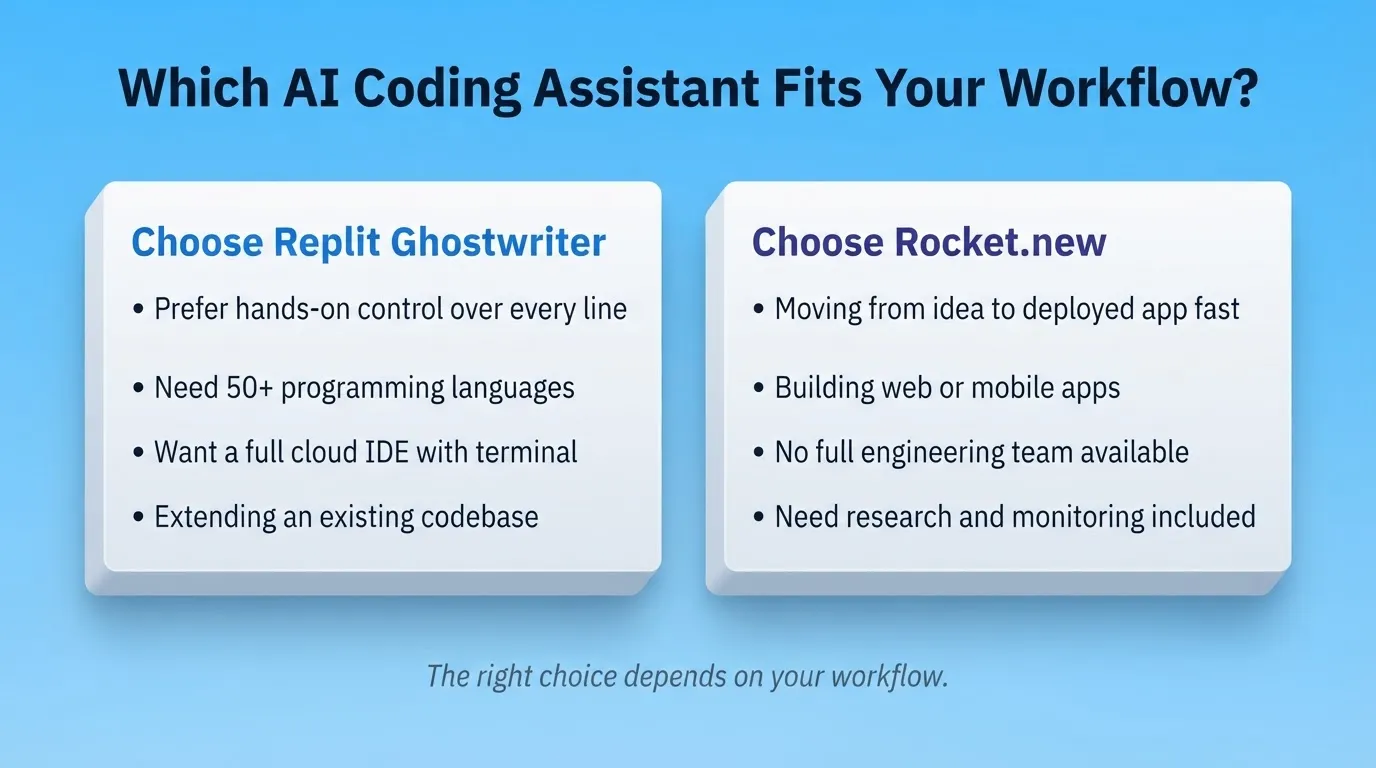
Choose Replit Ghostwriter if:
- You are an experienced developer who prefers hands-on control over every line of code.
- Your project uses programming languages outside Next.js and Flutter.
- You need a full cloud IDE with running terminals, package management, and deployment in one place.
- You are learning to code and want a low-friction environment with AI tools built in.
Choose Rocket if:
- You want to move from idea to deployed app as fast as possible.
- You are building web apps, mobile apps, dashboards, or internal tools.
- You need full-stack generation without manual scaffolding.
- You are a founder, designer, or solo developer without a full engineering team.
- You want research, building, and competitive monitoring in a single system, not three separate tools.
For most projects developers ship today, the bottleneck is not typing speed. It is the time between idea and working product. See how Rocket compares across the broader AI coding landscape in Replit vs Lovable vs Rocket.new: A Clear Comparison.
Key Takeaways
- Ghostwriter accelerates how you write code. Rocket replaces the writing stage for setup, scaffolding, and infrastructure.
- Ghostwriter needs existing code as context before it performs well. Rocket builds context itself from a single description.
- Rocket.new saves up to 80% on token usage compared to iterative AI coding assistant tools.
- For full-stack projects, mobile apps, and rapid iteration, Rocket ships faster.
- Rocket.new includes 26+ connectors, 25,000+ templates, a Visual editor, and built-in SEO, accessibility, and compliance tooling.
- Human judgment remains essential. Generated code must always be reviewed for quality and correctness.
- 1.5 million people have tried Rocket across 180 countries.
The AI Coding Assistant That Fits How You Build
The question was never which AI coding assistant writes the most code. The question is which one gets the right product in front of users fastest.
Ghostwriter makes writing code faster, and that matters for experienced developers extending existing systems. For everyone building something new, the bottleneck is not typing speed. It is the gap between idea and working product.
As AI coding assistants continue to evolve, the difference between tools that assist and tools that build will only grow wider. The most powerful AI coding assistant is the one that handles the thinking before the building, not just the building itself.
Start building on Rocket.new and go from idea to deployed product without the setup overhead.
Table of contents
- -What is Replit Ghostwriter?
- -What is Rocket.new?
- -Key Features Side by Side
- -How AI Coding Works in Each Platform
- -Ghostwriter's Approach
- -Rocket.new's Approach
- -Code Quality: What Each Tool Actually Produces
- -Ghostwriter and Code Quality
- -Rocket.new and Code Quality
- -Real-Time Suggestions vs. Full App Generation
- -Integrations and Connectors
- -Programming Languages and Platform Support
- -Limitations Worth Knowing
- -Replit Ghostwriter
- -Rocket.new
- -Pricing Comparison
- -Rocket.new Pricing
- -Replit Pricing
- -Which Tool Fits Your Workflow?
- -Key Takeaways
- -The AI Coding Assistant That Fits How You Build