Vibe coding has made building apps accessible to everyone, but choosing the wrong tool can cost you time, money, and momentum. Rocket.new delivers a complete, deployable app from a single prompt with zero code required, while Replit keeps experienced developers close to the code with AI assistance inside a cloud IDE. Know which builder you are before you start, because switching mid-project is the most expensive mistake you can make.
Which platform gets you from an idea to a working app faster, and which one actually fits the way you build? The gap between these two coding tools is wider than most comparisons admit.
According to the 2025 Stack Overflow Developer Survey, over 84% of developers now use or plan to use AI tools in their workflow. Vibe coding, where you describe what you want using natural language prompts and let AI generate the code, sits at the center of that shift. Rocket.new and Replit are both vibe coding tools, but built on different promises.
These two tools sit at opposite ends of the control spectrum, and understanding how each of these coding tools works is what determines which one saves you the most time. One removes the code wall entirely. The other keeps it and adds AI on the other side.
What Vibe Coding Means Right Now
Vibe coding is a workflow built around intent, not syntax. You describe what you want. The AI writes the code. You test, refine, and ship. Traditional development required deep knowledge of frameworks and environment configuration.
Vibe coding removes that barrier for the majority of software tasks, letting professional developers move faster and giving non-coders a real path to app creation.
Vibe coding tools are not a replacement for skilled engineers, but they help remove parts of software creation that eat time without adding value.
-
Natural language prompts replace direct syntax writing
-
AI tools handle scaffolding, backend logic, and UI generation, every repetitive task that used to slow builders down. Each task the AI handles is one fewer task on the developer's plate.
-
Testing and iteration happen in a conversational cycle
-
Both professional dev teams and non-developers can focus on the product
The term was coined by Andrej Karpathy in early 2025. 92% of US developers now use AI coding tools daily, and 41% of all new code is AI-generated. Vibe coding is the new baseline for AI-powered app development, and AI tools are the engine behind every vibe coding platform in the market today.
Actually, the trend toward end-to-end app creation driven entirely by natural language is already well underway in Vibe Coding. The future of vibe coding will likely see improvements in natural language processing, enabling tools to handle more complex business logic across different industries.
Who Uses These Coding Tools
Non-developers with a product idea and no programming background, dev teams looking to save time across app development cycles, product managers building internal tools, and founders validating ideas before committing to a full team. These are the users reaching for a vibe coding tool in 2026.
What these builders share is a focus on shipped output. They want a working app, not a development environment. That's where Rocket.new and Replit split apart, and why switching tools mid-project is one of the most wrong moves you can make.
Rocket.new: Promise, Platform, and Output
Rocket.new is a vibe-solutioning platform. It builds the full app from a single prompt. No local setup. No code environment. You describe the idea, Rocket generates the frontend, backend, database, logic, and deployment. The core promise: complete, deployable output at a development experience level that any builder can access.
The workflow is intuitive: describe your app in plain language using natural language prompts, Rocket generates a complete prototype with beautiful interfaces and backend logic included, you refine through conversation or the visual editor, and publish with one click. You can upload a Figma file to start from a design, upload a screenshot to rebuild from an image, or start from one of 25,000+ launch-ready templates free to use.
Rocket's architecture combines Anthropic, OpenAI, and Gemini models with proprietary deep learning systems trained on real app development patterns. That's what lets the platform produce a deployable app rather than a wireframe.
Replit: Promise, Platform, and Output
Replit is a browser-based IDE with AI layered on top. It gives you a cloud code editor, terminal, and a full development environment in the browser. The Replit agent generates scaffolding from natural language prompts, but builders still interact with code directly. The core promise: developer control and flexibility across 50+ programming languages.
The Replit agent can plan and build entire app scaffolding autonomously, but output typically needs further refinement before it's deployable. Replit is a strong cloud coding tool for learners and developers who want to write code without local setup.
Learning on Replit is a genuine use case. Its community library and 50+ language support make it a natural fit for learning to code. And for teams who already know code well, Replit's learning curve is close to zero. It is the wrong tool for non-developers who want to skip code entirely.
Speed and Output Compared
Speed is the most practical difference between these coding tools.
| Dimension | Rocket.new | Replit |
|---|---|---|
| First app generation | 10–25 min, full app | Varies; scaffolding fast, full apps take longer |
| Visual editor | Yes, intuitive canvas | No |
| AI agent scope | Full app, backend, deploy | Code generation, debugging |
| Figma import | Yes, upload your design | No |
| Template library | 25,000+ production-ready | Community library |
| First prompt output | Deployable web app | Scaffolding needing refinement |
Rocket generates a more complete first result. Replit gives more control over every step after.
Testing, Debugging, and Code Quality
Rocket.new handles testing and deployment automatically. Builders without coding backgrounds don't need to configure test environments. The platform catches errors during generation and resolves them before the app is delivered; that's a core part of the production-ready promise.
Replit puts builders directly in the testing cycle. Each debugging task is yours to own. You run tests, read results, and debug manually. More work, but you gain full context over what the code does. This matters when a project needs long-term maintenance, or when the project scope grows beyond what the original AI-generated scaffold handles.
63% of developers report spending more time debugging AI code than writing it themselves, at least once. Rocket minimizes this through its automated testing loop. Replit gives builders the tools to write fixes with complete code visibility. For production-ready apps that need to scale, code ownership matters and Replit keeps developers closer to the code.
Full Stack Projects and AI Agent Scope
For Rocket.new, full stack means the platform handles frontend and backend together from one prompt. Builders without code experience can reach working full-stack prototypes without touching a line of code. The AI agent manages architecture decisions, database logic, and deployment automatically a complete cycle from idea to live app.
For Replit, full stack means you have all the coding tools to build a complete project yourself, with the Replit agent doing heavy lifting on boilerplate tasks. The agent generates code across layers, but you manage how those layers connect. It's the right setup for experienced developers. It's the wrong fit for non-coders building their prototype.
Templates, Bolt, and the Broader Coding Tools Picture
Rocket.new ships with 25,000+ templates covering websites, mobile apps, landing pages, dashboards, and SaaS products, all launch-ready starting points with backend logic and UI components, free to use. A good template gives the AI enough context to create a functional prototype on the first try a fully functional starting point, not a mockup saving time, cutting the token-burning back-and-forth loop, and giving you speed to market that traditional development cannot match.
Bolt.new is a fast AI coding tool for full-stack prototype generation, similar in scope to Replit both Bolt and Replit coding tools expect builders to manage and write code after generation. When comparing Replit vs Bolt, the distinction from Rocket.new is the same: Bolt and Replit keep you in the code. Rocket moves you past it.
Claude code, Anthropic's terminal-based AI coding tool for professional developers, fits the same category as Bolt and Replit. Claude Code handles complex logic generation but assumes a developer-in-the-loop. The promise behind Claude Code is fundamentally different from Rocket's: AI assistance vs. AI autonomy.
Which Vibe Coding Tool Fits Which Builder
Rocket.new is the right tool for:
-
Non-developers who want a working app from a plain-language description
-
Founders testing an idea without hiring a development team
-
Product managers building internal tools outside the sprint queue
-
Experienced developers who want to skip boilerplate and ship full-stack prototypes fast
-
Teams that need collaboration features, role-based access, and audit logs built in
Replit is the right tool for:
-
Developers who need full code access and precise structural control
-
Learners who want to write code in a browser without local setup
-
Teams building complex multi-language systems requiring custom app architecture
-
Senior dev professionals who want an AI coding tool to assist within their existing workflow
What People Are Saying
From Reddit's r/vibecoding:
"Vibe coding can mean just solving your own problems and pain points with janky, stress-vulnerable, insecure and overly specific code that you might need to revisit later. But for rapid prototyping MVPs, it's insanely useful."- Source
That captures the intuitive reality. Vibe coding tools accelerate early-stage builds. On complex production apps, a senior dev should always review AI-generated code before shipping to real users. Both Rocket.new and Replit fit that picture at different points in the build cycle, for different use cases. Understanding the use cases for each platform prevents costly mid-project decisions.
How Rocket.new Handles Vibe Coding Workflows
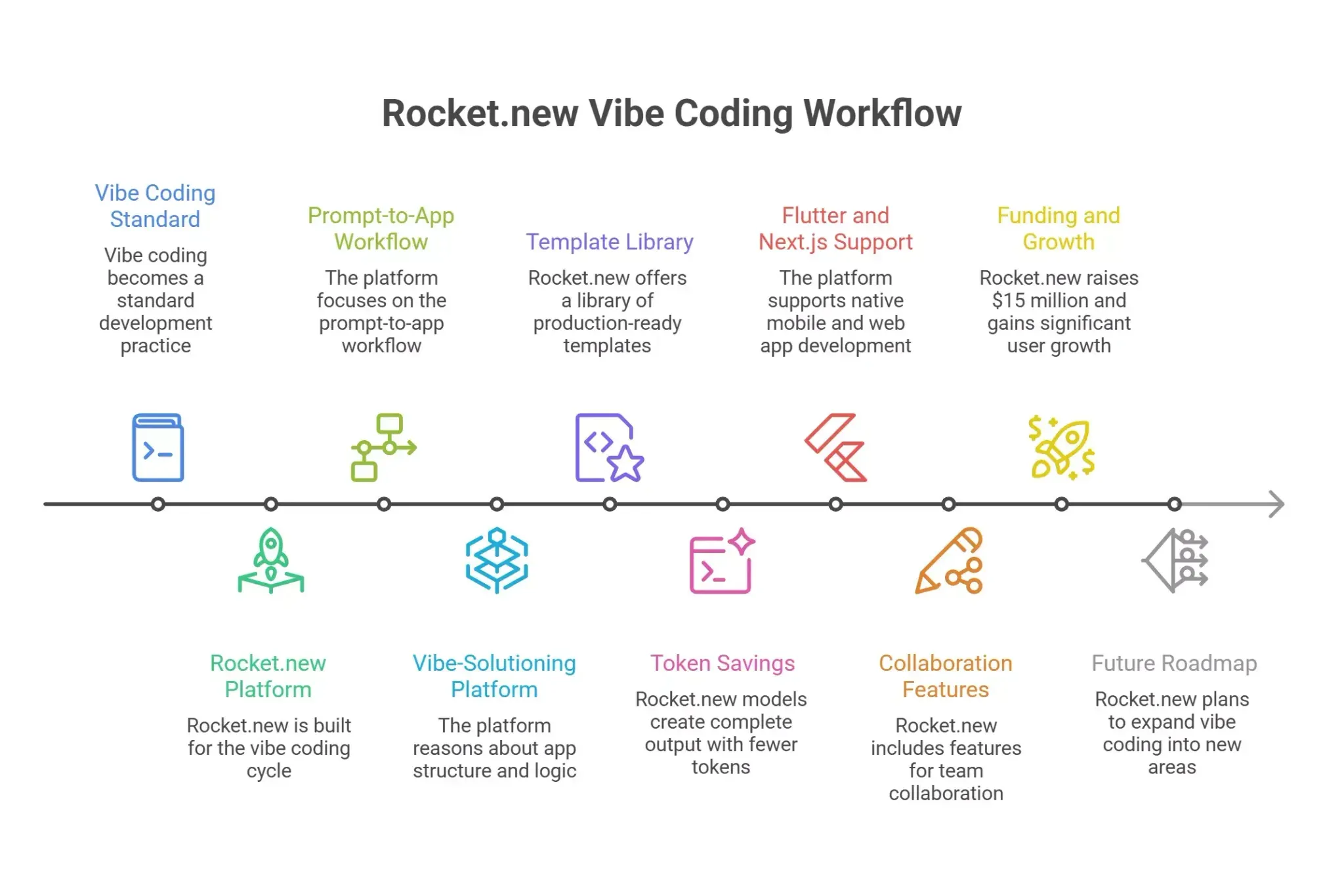
Vibe coding is becoming a standard part of modern development workflows, especially for rapid prototyping and internal tooling.
Rocket.new is purpose-built for the full vibe coding cycle, not AI bolted onto a code editor. The entire platform is built around the prompt-to-app workflow, with architecture designed to create production-ready output at any development experience level.
Core features that make Rocket.new the stronger vibe coding tool for most builders:
-
Vibe-solutioning platform reasons about app structure, UI flows, onboarding, and database logic from a single prompt, not just a code generator
-
25,000+ template library production-ready starting points for web applications, mobile apps, internal tools, and SaaS products, all free to use
-
Up to 80% token savings, Rocket's proprietary models create more complete output with fewer iterations vs. coding tools that require lengthy prompting cycles
-
Flutter and Next.js support native mobile apps (iOS and Android) and web app projects on modern frameworks, from the same platform; build AI assistants or smart search tools using the same integrations panel
-
Collaboration features shared workspaces, role-based access, and audit logs built in for teams working on full-stack projects
Rocket.new raised $15 million from Salesforce Ventures, Accel, and Together Fund. TechCrunch reported the platform crossed 400,000 users in 180 countries and reached $4.5 million in ARR within three months, with users from companies including Meta, KPMG, and PayPal.
These are not hobbyist users; they are professional teams shipping real products. The team is investing in proprietary models to stay ahead in the automated app generation category, with a future roadmap that puts vibe coding in the hands of more builders, a future that extends vibe coding into competitive research and agentic workflows.
Key Takeaways: Which Coding Tool Fits Your Situation
-
Rocket.new for non-developers, founders, and teams that want to ship apps fast with no setup time
-
Replit for experienced developers needing full code control and an AI coding tool assistance inside a cloud IDE
-
Both have free tiers to test before committing to any paid plan
-
AI-generated code needs review. A senior dev should review AI-generated code before deployment
-
Vibe coding is the future; both platforms reflect where app development is heading. The question is how much control you want to focus on
How Much of the Code Do You Want to Own Versus How Fast Do You Want to Ship?
Rocket.new vs Replit, which tool is better for vibe coding workflows comes down to one honest question: how much of the code do you want to own versus how fast do you want to ship? Replit keeps you in the code. Rocket moves you past it.
Both are strong in their lane. If you're building something new, testing an idea, or working with a team that includes non-coders, Rocket.new is the most direct path from idea to live app. Start with the free plan, explore the tools, and see what a single prompt can create.
Table of contents
- -What Vibe Coding Means Right Now
- -Who Uses These Coding Tools
- -Rocket.new: Promise, Platform, and Output
- -Replit: Promise, Platform, and Output
- -Speed and Output Compared
- -Testing, Debugging, and Code Quality
- -Full Stack Projects and AI Agent Scope
- -Templates, Bolt, and the Broader Coding Tools Picture
- -Which Vibe Coding Tool Fits Which Builder
- -What People Are Saying
- -How Rocket.new Handles Vibe Coding Workflows
- -Key Takeaways: Which Coding Tool Fits Your Situation
- -How Much of the Code Do You Want to Own Versus How Fast Do You Want to Ship?