This comparison focuses on two of the more talked-about options: Rocket.new and Rork AI. Both use natural language prompts to generate apps, but they serve very different needs. Choosing the right no-code platform depends on your specific project needs, including complexity, team size, and long-term goals.
If you have a big idea for an app but no technical background, you are not alone.
Millions of people never act on their app ideas simply because building software has traditionally required writing code, hiring developers, or both. The good news is that AI app builders have changed that equation entirely.
According to Gartner, more than 70% of new applications will be built using low-code or no-code platforms by 2025, compared to less than 25% in 2020. No-code platforms are designed to help users create software using graphical user interfaces instead of writing code, letting almost anyone build functional applications without a development background.
What are AI App Builders?
AI app builders take your app idea, expressed in plain language, and convert it into a working application. You describe what you want in just one sentence or a short paragraph, and the platform handles UI generation, backend logic, database setup, and data handling automatically. No coding skills are required to get started, and you skip the cost and delay of hiring developers.
Modern AI app builders go further than older no-code tools by automating the full stack, not just the visual layer. There are three broad categories worth knowing:
Web-first platforms focus on web apps, dashboards, client portals, and landing pages. Mobile-first platforms specialize in native mobile apps for iOS and Android. Full stack platforms cover both web and mobile apps alongside backend services.
Rocket.new and Rork AI fall into different camps here, which matters a great deal when choosing the right tool for your specific project.
Who are These Platforms Built For?
Rocket.new is designed for non-technical founders, product teams, and small teams who need to build across multiple app types. From a single platform, users can create web apps, mobile apps, internal tools, and landing pages using visual editing and natural language prompts.
The platform generates fully functional web apps within minutes without requiring a developer. Backed by Salesforce Ventures and Accel, Rocket.new raised $15M in September 2025 and reached $4.5M ARR within three months of its beta launch.
Rork AI is built specifically for native mobile apps on iOS and Android. It uses React Native to generate code from text prompts and is aimed at founders who want to publish to app stores quickly. If your app idea involves anything beyond mobile, such as a web dashboard, an internal tool, or a client portal, Rork AI simply does not cover those use cases.
Rocket.new: Fast, Full-Stack, and Accessible
Rocket.new converts natural language prompts into production-ready applications with minimal setup. Type your app idea in plain language, and within minutes, you have a working prototype that includes UI, backend logic, and data handling already set up. What sets it apart from many ai app builders is that it handles the entire stack in one workflow.
Key Features
-
Combines AI-driven design, SEO copywriting, and code generation in a single workflow
-
Visual editor lets users make changes using plain language and point-and-click controls, with no need to touch the underlying code
-
Precision Mode offers 100+ structured commands for granular adjustments when more control is needed
-
Figma import converts designs directly into production-ready code
-
Full code access and export at any time with no lock-in
-
Integrates with Supabase for databases, Stripe for payments, Google Sheets for data, and Google Analytics for tracking
-
Custom domains can be configured in one click via Netlify deployment
-
Free plan allows users to build and test full ideas before committing to paid tiers
What You Can Build
-
Startup MVPs: Validate your app idea before spending on custom development
-
Internal Tools: Quickly assemble dashboards, CRMs, and admin panels for small teams
-
Client Portals: Get login systems, role access, and audit logs supported out of the box
-
Landing Pages: Launch SEO-optimized pages with no backend setup required
-
Full Stack Apps: Build apps with authentication and production-ready code without writing code
-
Dashboards: Connect live spreadsheet data to a visual interface for data-driven applications
Turn your app idea into a working product now! Try it for free->
What Non-Technical Users Are Saying
A non-developer reviewer on Trustpilot described it simply: the platform delivered outstanding AI support from start to finish without requiring any development background. That sentiment is consistent across reviews. Non-technical users on Rocket.new tend to feel guided and supported throughout the app-building process, which matters when you are navigating unfamiliar territory.
Limitations Worth Knowing
Rocket.new is purpose-built for speed and simplicity, and for most early-stage use cases, it delivers exactly that. A few practical considerations are worth keeping in mind as you plan your build:
-
Token consumption: Credits are consumed per interaction, so complex or iterative builds can use tokens faster than expected. Planning your prompts thoughtfully helps manage usage efficiently.
-
Build iteration: Like any AI-powered platform, some builds may require a few rounds of refinement to get exactly right. Using Rocket's visual editor and plain language commands makes that iteration process straightforward.
-
Scalability planning: Rocket.new is optimized for rapid app creation and early-stage launches. Teams planning to build products that will evolve significantly over time should think ahead about long-term architecture needs, as more complex business logic and custom infrastructure may benefit from additional tooling down the line.
For MVPs, internal tools, landing pages, and early-stage products, Rocket.new is an excellent choice that gets you from idea to live product faster than any traditional development cycle.
Rork AI: The Mobile-Only Builder
Rork AI has a clear and narrow focus: native mobile apps for iOS and Android. That specificity is both its strength and its ceiling.
Key Features
-
Generates React Native code from natural language prompts
-
Preview your app instantly on a real device by scanning a QR code via Expo Go
-
Niche templates for specific app types such as visual novel games, meditation timers, and fitness trackers
-
Optimized for mobile-first development, handling screens, navigation, and login systems quickly
-
Supports publishing to the Apple App Store and Google Play
-
Full code ownership with the ability to export and continue building independently
Where It Falls Short for Non-Technical Users
-
App Store Deployment: Rork generates the React Native code but does not automate Apple developer program setup, app signing, certificates, or submission. This process requires technical knowledge that most beginners simply do not have
-
No Visual Editor: All customization goes through prompts alone, with no point-and-click interface to fall back on
-
Complex Logic Limitations: The AI sometimes struggles to interpret detailed requirements accurately, making intricate functionality difficult to build through prompts
-
Narrow Scope: No support for web apps, internal tools, landing pages, or client portals, which significantly limits who the platform can serve
-
Restrictive Free Plan: The free tier offers only 35 credits per month with a daily cap of 5 credits, enough to test the platform but not to build anything meaningful
-
No Credit Rollover: Credits reset on the first of each month, and unused credits are lost, so you only get value if you build consistently
-
Paid Plan Required for Real Development: Any serious app development requires upgrading to a paid plan, starting at $25 per month for 100 credits
Feature Comparison: Rocket.new vs Rork AI
| Feature | Rocket.new | Rork AI |
|---|---|---|
| Web Apps | Yes | No |
| Native Mobile Apps | Yes (Flutter) | Yes (React Native) |
| Internal Tools | Yes | No |
| Landing Pages | Yes (SEO-optimized) | No |
| Client Portals | Yes | No |
| Visual Editor | Yes (point-and-click) | No |
| Free Plan | Yes (1M tokens) | Yes (35 credits/month, 5/day) |
| Code Export | Yes | Yes |
| Natural Language Prompts | Yes | Yes |
| Backend Logic | Automated | Limited |
| App Store Publishing | Yes | Yes (requires technical steps) |
| Google Sheets Integration | Yes | No |
| Custom Domains | Yes (unlimited) | No |
| Figma Import | Yes | No |
| Full Stack Apps | Yes | No |
| Niche App Templates | No | Yes |
| Transparent Pricing | Yes (token-based) | Yes (credit-based) |
Pricing Breakdown
| Plan | Rocket.new | Rork AI |
|---|---|---|
| Free | 1M tokens, public projects, templates | 35 credits/month, 5 per day |
| Entry Paid | $25/month (5M tokens, private projects, unlimited custom domains, code download) | $25/month (100 credits) |
| Mid Tier | $50/month (10.5M tokens + 5% bonus, credit rollover) | $50/month (250 credits) |
| Advanced | $100/month (22M tokens + 10% bonus, credit rollover) | $100/month (500 credits) |
| Scale | Enterprise grade | $200/month (1,000 credits) |
Rocket.new offers a genuinely free tier where you can build and test a real app idea before spending anything, with no credit card required to get started.
Rork AI offers a limited free tier with 35 credits per month, but meaningful app development requires upgrading to a paid plan. For non-technical users evaluating their options, that difference in getting started matters.
Here is the section covering all facts under one heading with community thoughts:
What the Community Says: Rocket.new vs Rork AI
No-code platforms are designed to help users create software using graphical user interfaces instead of writing code, and both Rocket.new and Rork AI serve that mission in different ways. When selecting the right platform, key factors include customization and control, integration capabilities, pricing structure, and user support and community resources.
Rocket.new: What Users Appreciate
-
Generates fully functional web apps within minutes without requiring a developer
-
Non-technical founders can describe their app idea in natural language and get a working app with UI, backend logic, and data handling already set up
-
Combines AI-driven design, SEO copywriting, and code generation in a single workflow
-
Easier to control as a visual builder for web apps and complex internal tools
-
Offers a free testing option so users can validate their idea before committing to a paid plan
A non-developer reviewer on Trustpilot said:
"I am not a developer but this is the best AI app developer in the world. The support is outstanding from start to end." - Source
That kind of experience is consistent across reviews. Non-technical users trying Rocket.new tend to feel supported, not abandoned mid-build.
Rork AI: What Users Note
-
Guided templates simplify the creation of complex app features using simple text inputs
-
Prioritizes rapid creation of native mobile apps via text prompts
-
Favored by beginners looking to publish mobile apps without backend infrastructure knowledge
-
Requires an upfront paid subscription for serious app development, unlike Rocket.new's free tier
A user tried Rork AI hands-on and shared an honest take:
"If you're building mobile apps, Rork has been my favorite platform so far since it allows you to test on your phone and publish directly to the Apple app store or Google play store. However, running into much of the same issues that web app builders had a month ago with issues making database API connections work well and circuitous error loops." - Source
A fair and balanced view from someone actively building with the tool. The phone testing and direct app store publishing are clear strengths, but database connectivity and error handling remain areas to watch as the platform matures.
How the App Building Workflow Works
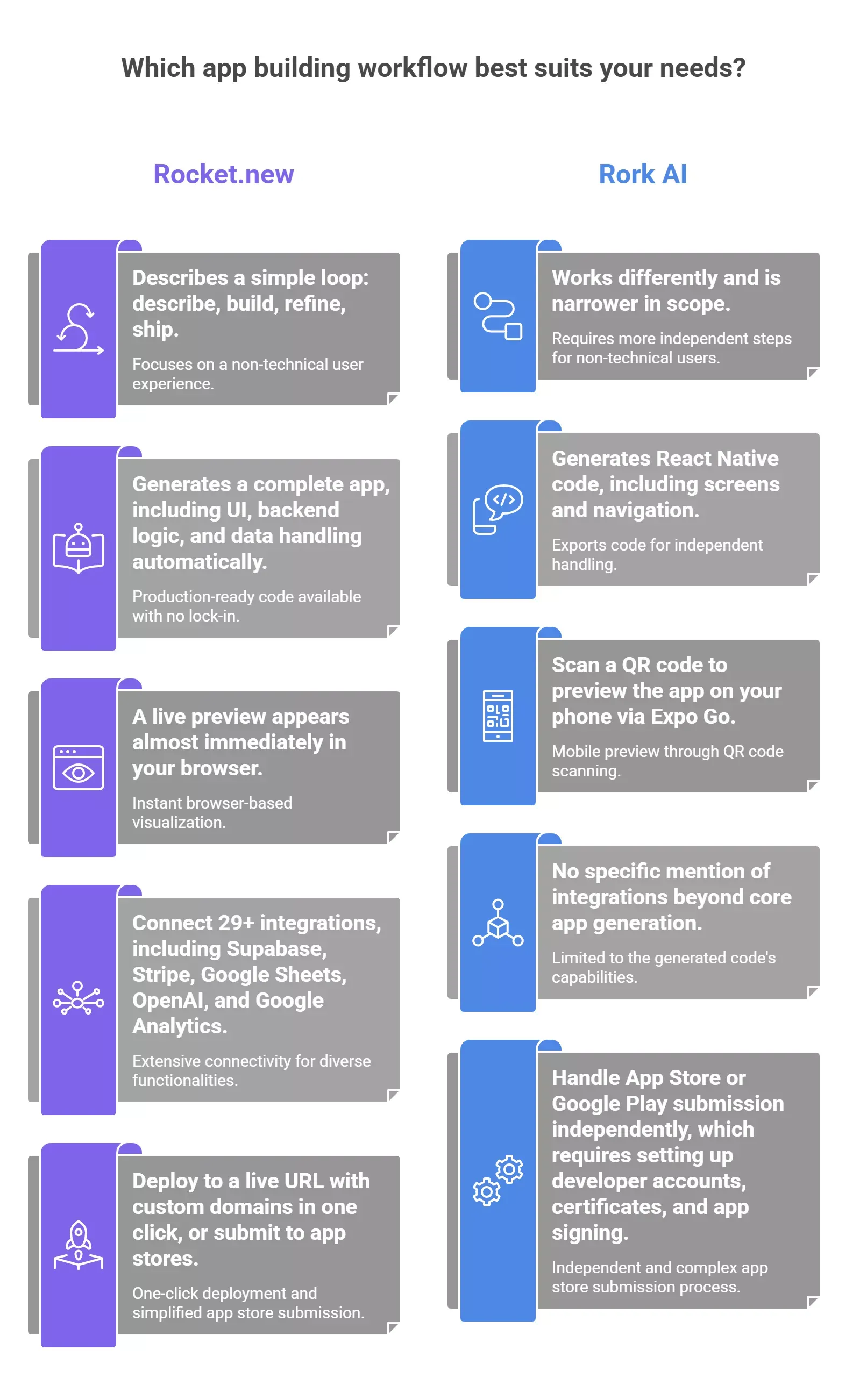
Building on Rocket.new follows a simple loop: describe, build, refine, and ship.
-
Type your app idea in natural language. Just one sentence is enough to get started
-
Rocket generates a complete app, including UI, backend logic, and data handling automatically
-
A live preview appears almost immediately in your browser
-
Refine using the visual editor (click and tweak any element directly) or continue with plain language commands
-
Connect 29+ integrations, including Supabase for databases, Stripe for payments, Google Sheets, OpenAI, and Google Analytics
-
Deploy to a live URL with custom domains in one click, or submit to app stores
-
Download production-ready code at any time with no lock-in
The entire workflow is built for non-technical users. You never have to write code unless you want to.
Building on Rork AI works differently and is narrower in scope:
-
Describe your mobile app in natural language
-
Rork generates React Native code, including screens and navigation
-
Scan a QR code to preview the app on your phone via Expo Go
-
Iterate through more prompts to adjust features
-
Export your code when ready
-
Handle App Store or Google Play submission independently, which requires setting up developer accounts, certificates, and app signing. This step often catches non-technical users off guard
Which Platform Should You Choose?
No-code platforms can significantly reduce the time and cost of traditional app development, but the right choice depends on your project scope, team size, and long-term goals. Integration capabilities, pricing structure, and scalability should all factor into your decision before you commit to a platform.
| Choose Rocket.new if you want to... | Choose Rork AI if you want to... |
|---|---|
| Build web apps, landing pages, or internal tools | Build a native iOS/Android app specifically |
| Create full stack apps with real backend logic | Publish directly to app stores |
| Use a visual editor without writing code | Prototype a mobile-only idea quickly |
| Start with a free plan and upgrade when ready | Work in React Native without coding yourself |
| Build client portals with login systems | Use niche mobile templates (games, wellness apps) |
| Need enterprise-grade security and custom domains | Keep things beginner-friendly for mobile |
For most non-technical users with a general app idea, Rocket.new covers far more ground. It offers less friction, a free tier, stronger AI support, and a complete workflow from idea to live product.
Rork AI is a solid choice if your one specific goal is a native mobile app headed to the app stores, and you are comfortable handling the technical steps of deployment.
Table of contents
- -What are AI App Builders?
- -Who are These Platforms Built For?
- -Rocket.new: Fast, Full-Stack, and Accessible
- -Key Features
- -What You Can Build
- -What Non-Technical Users Are Saying
- -Limitations Worth Knowing
- -Rork AI: The Mobile-Only Builder
- -Key Features
- -Where It Falls Short for Non-Technical Users
- -Feature Comparison: Rocket.new vs Rork AI
- -Pricing Breakdown
- -What the Community Says: Rocket.new vs Rork AI
- -Rocket.new: What Users Appreciate
- -Rork AI: What Users Note
- -How the App Building Workflow Works
- -Which Platform Should You Choose?