
I have spent 30 years in finance and strategy and building businesses across the globe. I want to tell you something uncomfortable about what that experience is worth now.
For most of those years, I was the person in the room who had done the work before the meeting.
Not the smartest person. Not the most articulate. Just the one who had sat with the numbers long enough to know which ones to trust, read enough market reports to know which signals mattered, and been through enough strategic planning cycles to know where the analysis usually broke down. That preparation was my edge. I protected it carefully. It was, in many ways, the thing I was selling.
That edge is gone.
Not diminished. Not threatened. Gone. And the product that took it is called Rocket 1.0.
Let me explain what I mean, because this is not a technology story. It is a story about what professional experience has always actually been worth, and what it is worth now.
When a senior strategy professional walks into a room, they carry something invisible with them. It is not their MBA. It is not their title. It is pattern recognition built over years of exposure. To markets that behaved unexpectedly. To competitive moves that seemed irrational until they made sense eighteen months later. To boardrooms where the confident answer turned out to be catastrophically wrong. That accumulated experience allowed them to structure a problem faster, identify the right question before anyone else had finished asking the wrong one, and synthesise incomplete information into a recommendation worth acting on.
That entire capability stack, the structuring, the synthesis, the intelligence gathering, just became available to anyone who can type a sentence.
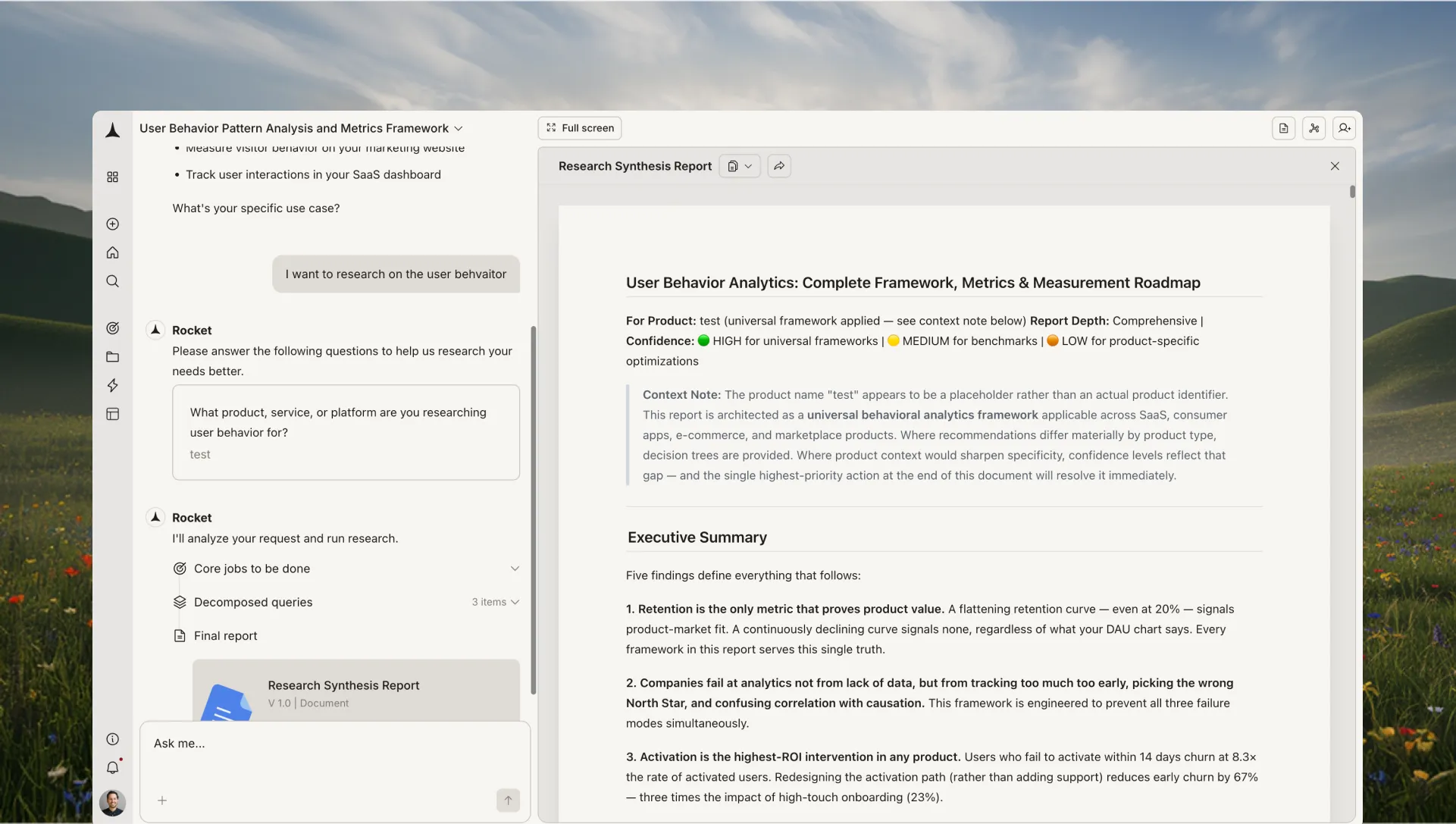
Rocket's Solve capability takes any business question and returns a complete, structured, evidence-backed recommendation. Not a summary of search results. Not a chatbot response. But here is the part that deserves a full stop: the output is not just competent analysis. It is structured at the level that McKinsey or BCG would charge seven figures to produce. Market mapping, competitive positioning, risk identification, strategic options laid out with their respective implications, evidence-backed and board-ready. The 25-year-old using Rocket does not just have your speed. They have your benchmark.
That is not a small claim. It took most of us the better part of two decades to develop the instinct for what a truly rigorous strategic output looks like. What questions it must answer. What assumptions it must surface. What a decision-maker actually needs to see before they can act with confidence. That instinct was expensive to acquire. It required exposure, failure, correction, and time. Rocket makes it structural. Available on demand. To anyone.
I have been in rooms where the quality of pre-read material determined the entire direction of a decision. Where a well-constructed competitive brief changed a board's mind before the presentation began. Where the person who had clearly done the most rigorous preparation before the meeting was, by default, the most credible voice in it. That person's credibility came from scarcity. The preparation was hard to do. Most people could not do it well, and almost nobody could do it fast.
That scarcity is over.
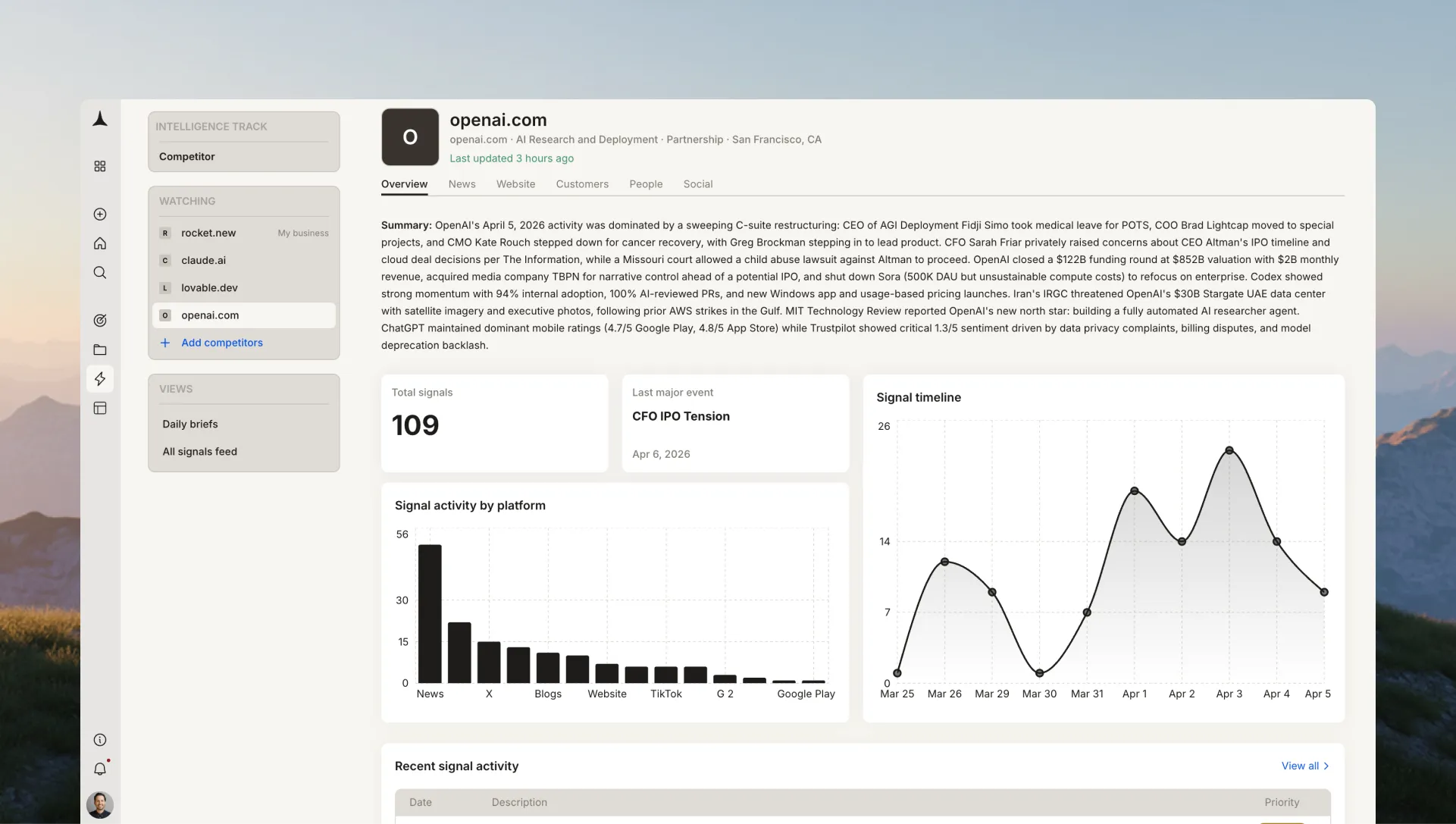
The Intelligence capability in Rocket 1.0 monitors every public platform a competitor operates on. Simultaneously, continuously. Websites, pricing changes, hiring patterns, social activity, ad strategy, product announcements. And it does not just flag what changed. It interprets what the combination of signals means for your business specifically. A pricing page update alone is noise. That same update alongside four enterprise-focused posts and three new senior sales hires is one clear signal. The kind of competitive awareness that used to require a dedicated analyst, months of careful attention, and a great deal of luck in terms of timing. That is now running in the background, constantly, for anyone on the platform.
Here is what that actually means for the professionals reading this.
For years, we have hired and promoted people in finance and strategy based on a set of assumptions about what makes someone valuable. Preparation ability. Information synthesis. Structured thinking under pressure. Speed of analysis. The capacity to produce McKinsey-quality outputs without McKinsey's resources. These were real skills, genuinely difficult to develop, and they commanded real compensation. The hierarchy of most strategy, finance, and consulting functions was built around them.
That hierarchy was always, at least in part, a hierarchy of access. Access to the right information, in the right structure, at the right speed. Senior people had more of it because they had spent more time accumulating it. Rocket democratises that access completely.
The 25-year-old with Rocket 1.0 does not have your experience. They have not sat through ten strategic planning cycles. They have not watched a market move and understood viscerally why. They cannot yet tell the difference between a signal and noise by instinct. But they can produce research output that is indistinguishable, in structure, in rigour, in board-readiness, from what you would produce. They can walk into a meeting with a competitive brief that is more current than yours because theirs was generated this morning. They can answer a board question about market positioning in minutes that would have taken your team a week. And the quality of that answer does not betray its speed.
The question this raises is not whether Rocket is impressive. It is. The question is what you, as a senior professional, are actually selling now.
And I think the honest answer, the answer most of us are not yet ready to have, is that a significant portion of what we have been paid for was information asymmetry. The ability to gather, structure, and present intelligence that others could not access as easily or as quickly. That asymmetry is collapsing in real time.
But here is the thing I have come to believe: this is not a story about what senior professionals lose. It is a story about what we finally get to do with the years we have put in.
The preparation was never really the point. It was the price of admission to the room where the real work happened. The judgment calls. The hard conversations. The decisions made under uncertainty with incomplete information and full accountability. We spent enormous energy earning the right to exercise judgment. Rocket hands that right to everyone on day one.
Which means the professionals who built genuine judgment, not just analytical production ability, but the real thing: knowing which question matters, reading what the data is not saying, holding a room through a difficult call. Those professionals are about to become more valuable, not less. Their judgment no longer has to fight through layers of preparation work to get heard. It can lead.
The 25-year-old with Rocket has the analysis. What they do not yet have is thirty years of knowing what to do when the analysis points somewhere the organisation does not want to go. When the competitive signal is clear but the politics are not. When the right call is the unpopular one and someone has to own it.
That is not a platform feature. That is a career.
Rocket 1.0 has not made experience irrelevant. It has stripped away everything that was masquerading as experience and left the real thing standing.
For those of us who have spent decades building genuine judgment, that is not a threat. That is the most interesting professional moment of our careers.
The intelligence is now available to everyone. What you do with it has never mattered more.
Table of contents