
For the past two years, the AI industry has been obsessed with one question: how do we help people build things faster?
The answers came quickly:
-
Cursor made coding faster
-
Lovable made building faster
-
Bolt made shipping faster
-
GitHub Copilot made writing code faster
A wave of tools that collapsed the time between idea and working product from weeks to hours, sometimes minutes. Genuinely impressive. Genuinely useful.
But somewhere in the race to make building faster, the industry skipped over something more fundamental.
Nobody asked whether we were building the right things.
The Hidden Cost Nobody Talks About
Here's a number worth sitting with: 60–70% of people using AI build tools today haven't properly validated the direction they're building in.
The result:
-
Teams shipping products with confidence, but without evidence
-
Startups executing perfectly on the wrong hypothesis
-
Founders spending three months building something their customers don't need
-
Businesses choosing between pivot or push when it's already too late
This isn't a failure of effort. It's a failure of tooling.
The tools we built were spectacular at turning ideas into code. They were never designed to help you figure out if your idea was worth turning into code in the first place.
The most expensive mistake isn't a slow build. It's a successful execution of something that shouldn't have been built at all.
The Way We Work Today Is Broken We Just Normalised It
Here's what the average builder's workflow actually looks like:
-
Have an idea
-
Open Claude → research the market → copy outputs to a Google Doc
-
Open Perplexity → look up competitor pricing → screenshot to Notion
-
Open a spreadsheet → manually track competitor signals
-
Open Lovable → build something → re-explain all context from scratch
You are the integration layer. You are the thing stitching together research, intelligence, and execution carrying context between tools that have no awareness of each other.
The core problem:
-
Claude doesn't remember what you asked yesterday
-
Lovable doesn't know about your Perplexity research
-
Your competitive intelligence lives in a spreadsheet nobody updates
-
Every time you switch tools, you start over
This is so normal that most people don't even notice how broken it is. Until they do. And once you notice it, you can't stop noticing it.
What "Vibe Coding" Got Right And What It Missed
Vibe coding changed everything. The idea that you could describe what you want in natural language and have a working product appear genuinely transformational.
What vibe coding got right:
-
Democratised building
-
Made technical execution accessible to non-coders
-
Collapsed time from idea to working product
What vibe coding missed:
-
It starts at execution
-
It assumes you already know what to build
-
It assumes you know who you're building for
-
It has no answer for "should I build this at all?"
The "vibe" in vibe coding is the experience of building. The actual decision to build that's still on you. And you're still making that decision with incomplete information, fragmented research, and no systematic way to monitor whether the landscape is shifting under your feet.
The AI industry optimised the execution layer. Nobody built the thinking layer.
What the Thinking Layer Actually Looks Like
When Rocket launched in June 2025 with 1.5 million users across 180 countries, the conviction driving the platform was straightforward: every decision deserves real intelligence before the work begins.
Not a search summary. Not a chatbot response. Not a document you have to interpret yourself.
A recommendation you can act on.
Here's the distinction that matters:
-
Perplexity → finds you links and information from the web
-
Gemini → reads and summarises that information for you
-
Claude → has a conversation and responds intelligently
-
Rocket → gives you a decision what to do, why, and what the risks are
When you ask Rocket to analyse a market opportunity, it doesn't search and summarise. It:
-
Decomposes the situation before research even begins
-
Identifies every dimension worth investigating
-
Fires thousands of parallel queries across publicly available sources simultaneously
-
Synthesises everything into a structured intelligence report
The output isn't a long document you have to read and interpret. It's structured analysis findings, evidence, competitive mapping, risk assessment, and a concrete recommendation that you can act on in the same session.
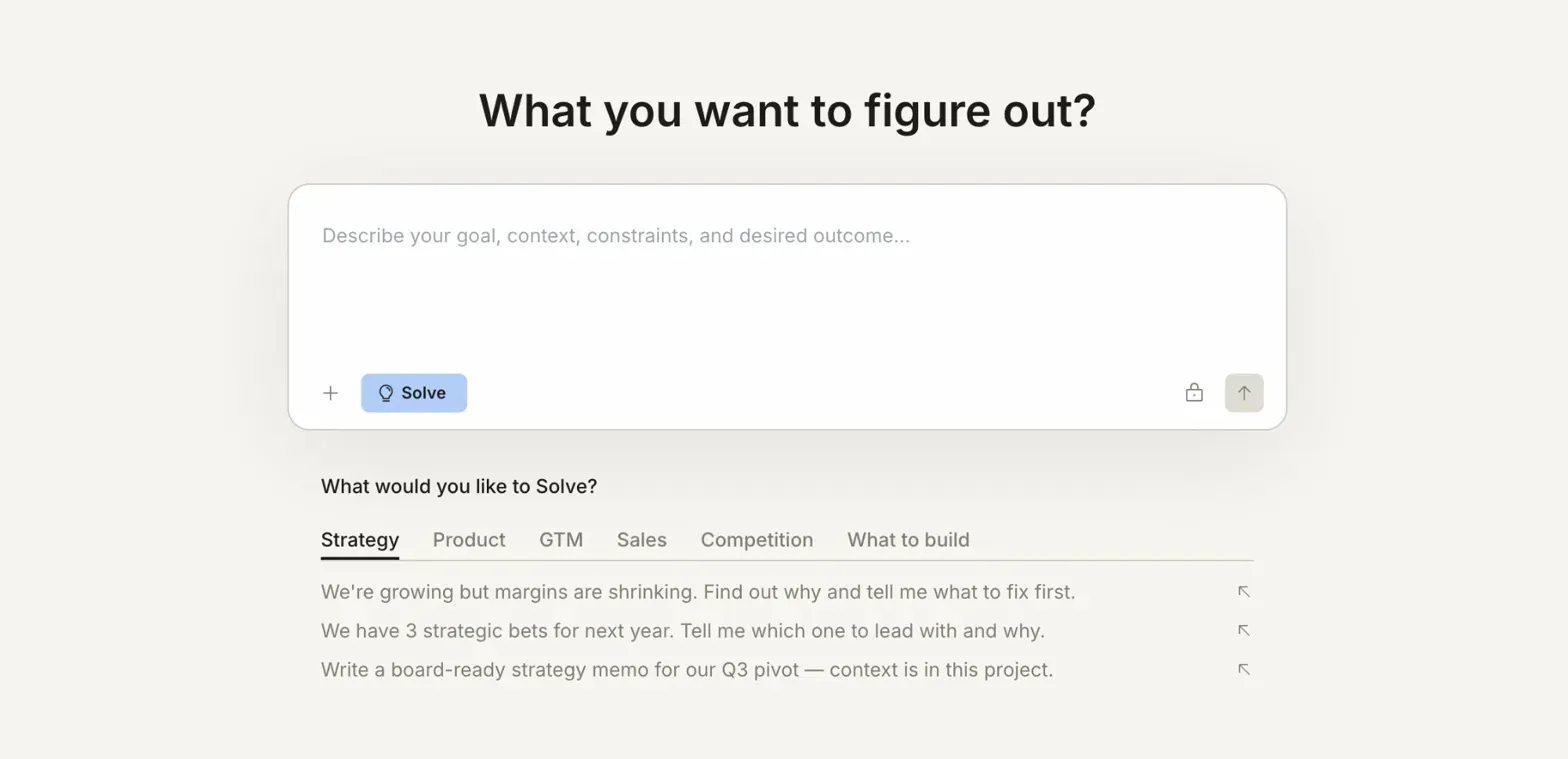
Describe your goal, context, constraints, and desired outcome. Rocket decomposes the situation before research even begins.
The Part That Changes How You Work: Projects
The Solve report is impressive. But the deeper shift in Rocket 1.0 is something called Projects and it's what makes the whole platform a genuinely different category.
A Project in Rocket 1.0 is not a folder. It's a context layer.
Here's what that means in practice:
-
Create a Project for your use case
-
Run your market research inside it → research becomes the foundation
-
Set up competitive monitoring inside the same Project → intelligence connects to the research
-
Build inside the same Project → build inherits market context and competitive positioning automatically
-
You never re-explain anything
Most AI tools have the memory of a goldfish:
-
They start fresh every conversation
-
Every session, every tool switch you start over
-
Context never accumulates
In Rocket 1.0:
-
Context accumulates across every task
-
The second task is smarter than the first
-
Your tenth task carries the weight of everything before it
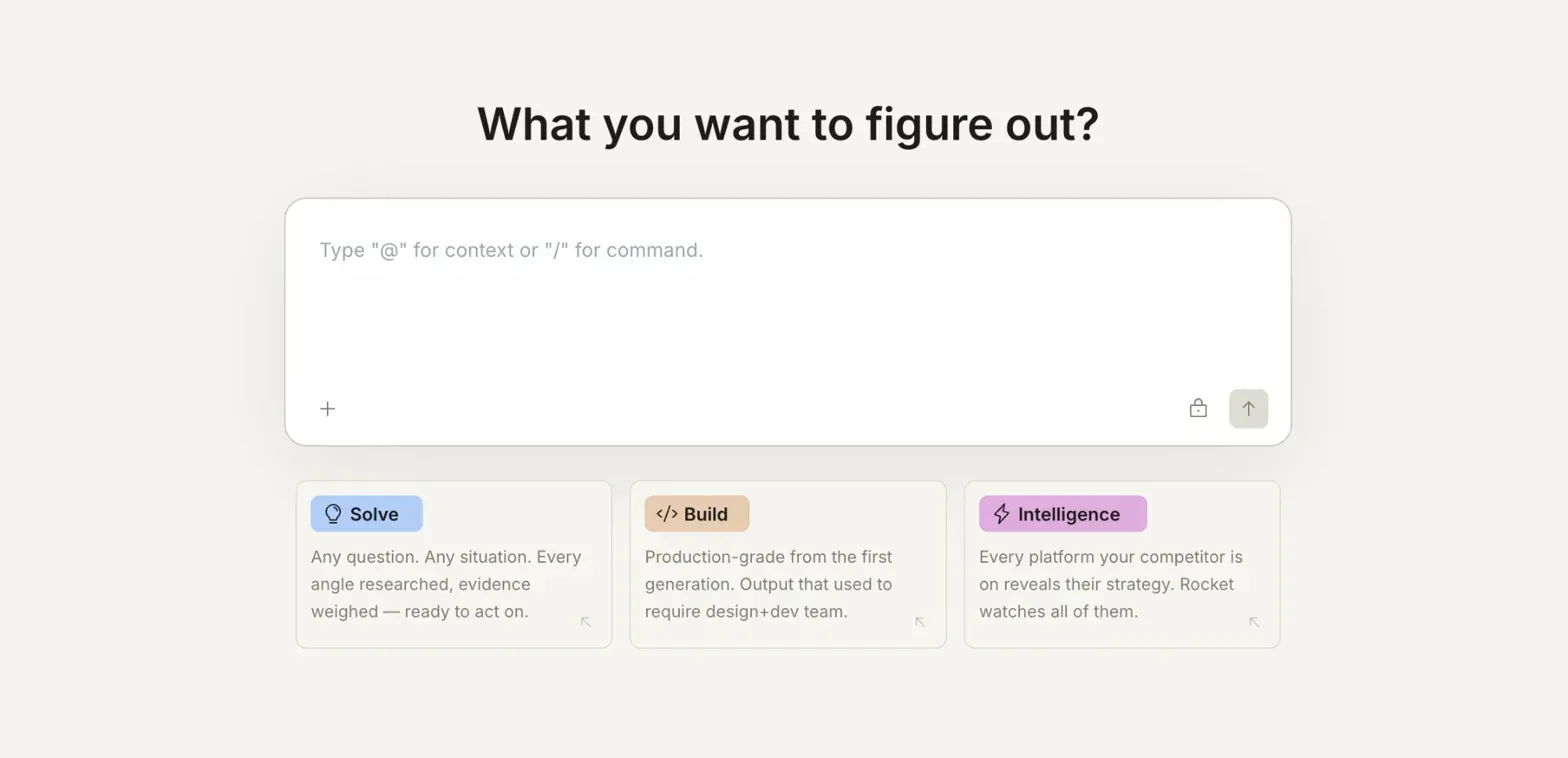
Solve. Build. Intelligence. Three capabilities, one workspace, one shared memory.
Competitive Intelligence That Actually Tells You Something
One of the most painful problems in building is finding out about a competitor's move when someone forwards you a LinkedIn post.
By the time you know they:
-
Shifted their pricing
-
Launched that feature
-
Started hiring aggressively into a new segment
The signal is already stale. You're reacting, not anticipating.
Rocket Intelligence monitors six signal categories continuously:
-
Website changes
-
Social media
-
News and press
-
Reviews and reputation
-
Product and pricing signals
-
Performance marketing
What makes this more than a standard monitoring tool is how it reads patterns across signals, not just individual updates.
A pricing page change is data. But a pricing page change alongside:
-
New enterprise sales job postings
-
A shift in ad messaging toward "enterprise-grade"
That's a strategic signal. That's a company repositioning toward the enterprise. And it happened three weeks before anyone wrote about it.
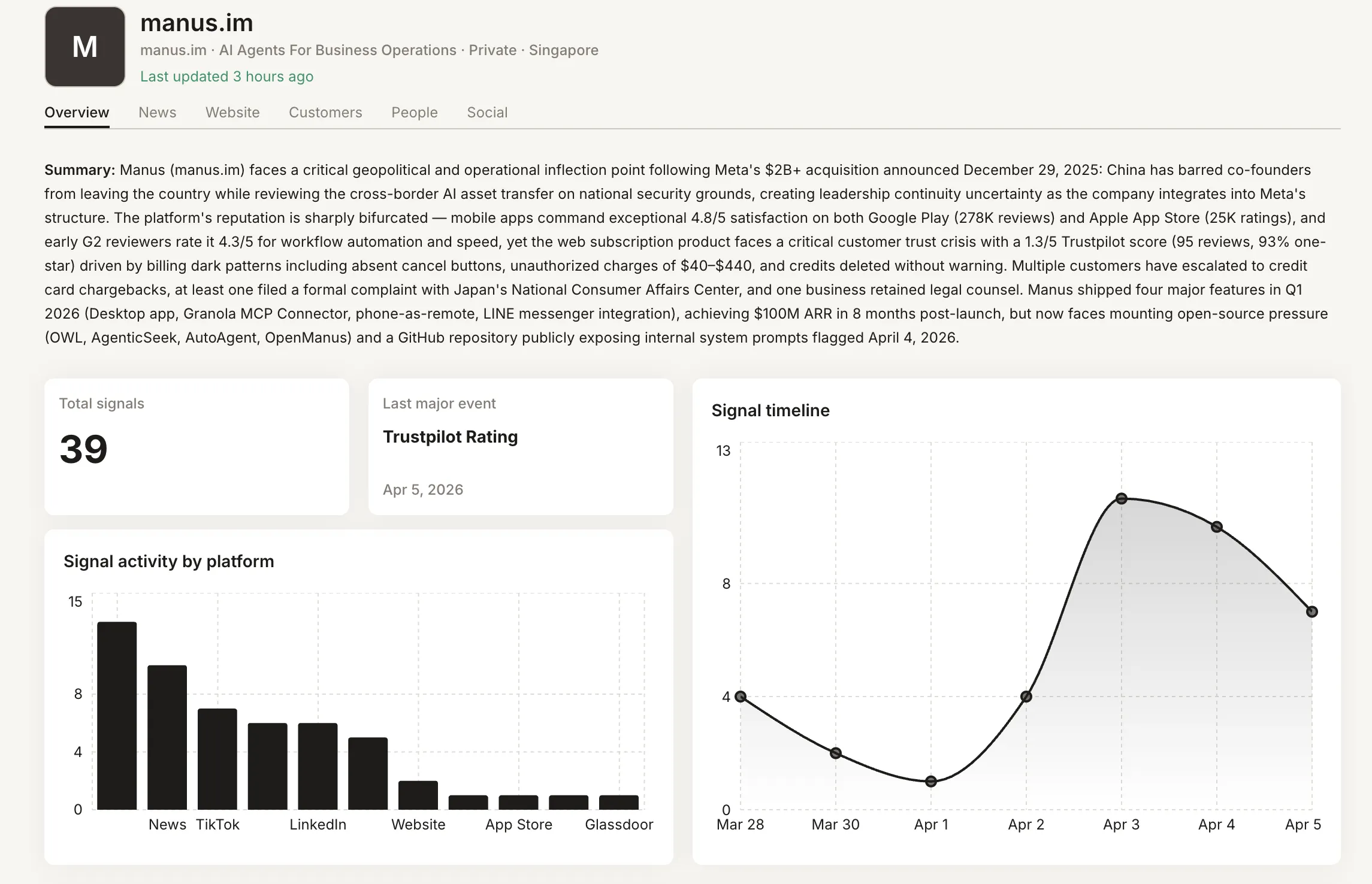
30 signals tracked across LinkedIn, Facebook, website, blogs, YouTube and news all interpreted as connected patterns, not individual updates.
From Intelligence to Build Without Starting Over
Here's the moment in Rocket 1.0 that earns its claim to be a new category.
You've done your Solve research. You've got your competitive monitoring running. You know:
-
Where the gaps are
-
What the differentiated position looks like
-
What the market is actually asking for
Now you build. And Rocket already knows all of it.
-
No pasting market research into the build prompt
-
No summarising the competitive landscape
-
No re-explaining the positioning
-
The Project carries everything forward automatically
What Rocket 1.0 generates:
-
Landing pages
-
Dashboards
-
Full websites
-
SaaS apps
-
Mobile apps
-
E-commerce stores
25+ integrations wired directly in:
-
Stripe
-
Supabase
-
Calendly
-
Mailchimp
-
Google Analytics
-
And more authenticate once, flows into every build
The output isn't a wireframe. It's production-grade from the first generation. Strategically grounded because the build knows the market research, the competitive positioning, and the decisions that shaped the brief.
The Build prompt references market research directly from the same Project. No copy-pasting. No re-explaining. The intelligence carries forward automatically.
Why This Is a Different Category
The tools we've built over the last two years are genuinely powerful. I use some of them every day. I'm not arguing they don't work.
I'm arguing that they solve a different problem:
| Tool | What it makes you |
|---|---|
| Cursor | A faster coder |
| Lovable | A faster builder |
| Perplexity | A faster researcher |
| Claude | A more capable thinker in conversation |
| Rocket 1.0 | A more effective decision-maker before the build begins |
And Rocket connects that decision to the build itself so the intelligence doesn't get lost between tools.
That's not an incremental improvement on what exists. It's a different arc entirely.
The AI industry spent two years optimising the middle of the journey. Rocket 1.0 covers the whole thing.
Solve. Build. Intelligence. Three capabilities, one workspace, one shared memory.
The Question to Ask Before Your Next Build
Before you open your build tool for the next project, ask yourself one question:
Do I actually know if this is the right thing to build?
Not "do I believe it" belief is easy. Not "does it feel right" feeling is easier.
Do you have:
-
Structured intelligence
-
Real data
-
A mapped competitive landscape
That gives you confidence this is worth building?
If the answer is no or even "sort of" you're not missing effort. You're missing tooling.
That's what Rocket 1.0 is for.
Try Rocket now!
Table of contents
- -The Hidden Cost Nobody Talks About
- -The Way We Work Today Is Broken We Just Normalised It
- -What "Vibe Coding" Got Right And What It Missed
- -What the Thinking Layer Actually Looks Like
- -The Part That Changes How You Work: Projects
- -Competitive Intelligence That Actually Tells You Something
- -From Intelligence to Build Without Starting Over
- -Why This Is a Different Category
- -The Question to Ask Before Your Next Build