This blog explains how Rocket.new's Intelligence pillar monitors G2 and Glassdoor review data in real time and converts it into specific competitive talking points for sales teams. It covers the gap between raw review data and deal-ready intelligence, and why most sales teams fail to close this gap with traditional tools.
When a prospect says "we're also looking at [your competitor]," how fast can your sales rep respond with something specific?
Not generic. Not "we're better."
Something like: "We noticed their G2 reviewers consistently flag slow onboarding - here's how we handle that differently." That's the kind of sales intelligence talking point that actually moves a deal.
According to Crayon's State of Competitive Intelligence report, sellers face competitors in 68% of their deals - yet the average sales team rates its competitive preparedness a 3.8 out of 10. That gap between frequency and readiness costs organizations between $2 million and $10 million per year in winnable deals left on the table. (Autobound, 2026)
The fix isn't more training. It's better sales intelligence data - and a system that converts it into something a sales rep can say in a room.
Why Review Platforms Are the Most Underused Sales Intelligence Data Sources
Most sales teams think of G2 as a place buyers go to compare software.
It is that - but it's also a live feed of what real customers love, hate, and wish were different about every competitor in your category.
The same is true for Glassdoor. Employee reviews reveal internal dysfunction before it shows up in a product. A string of Glassdoor complaints about leadership instability, customer success turnover, or engineering morale often predicts exactly the product and service problems that will surface in your next competitive deal - weeks or months before buyers notice.
The global sales intelligence market was valued at USD 4.85 billion in 2025 and is expected to grow to USD 12.45 billion by 2034 at a CAGR of 11.10%, according to Fortune Business Insights. The market for this type of data is growing fast. What isn't growing at the same pace is the ability of most sales teams to turn that data into specific, deal-ready talking points.
G2 surpassed 3 million verified reviews in 2025 and reached more than 100 million global buyers across its platform. (G2 Year in Review, 2026) That's an enormous public dataset of customer sentiment that most sales teams are barely touching.
What G2 and Glassdoor Customer Feedback Actually Reveals
A competitor's G2 page isn't just a score. When you read review data carefully, it breaks into three categories your sales team can work from:
Feature and Product Complaints
Recurring G2 complaints about specific missing features or broken workflows are direct signals about product gaps. When buyers mention the same limitations across multiple reviews - bulk export, reporting depth, mobile experience - those aren't edge cases. They're structural gaps your team can address in a competitive conversation.
Support and Onboarding Signals
Slow support response times and difficult onboarding consistently show up in negative reviews before they show up in churn. If your competitor's G2 reviews include language like "took three months to fully deploy" or "support takes days to respond," those are talking points that address buyer concerns directly - without you having to attack the competitor by name.
Glassdoor Culture Signals and Hiring Data
Employee reviews on Glassdoor add a layer that G2 can't provide. High turnover in customer success predicts service quality problems ahead. Negative engineering culture reviews often correlate with slower product development cycles. When Glassdoor ratings drop while customer success headcount falls, that's a signal cluster - not just one data point.
Sales development representatives and account executives who understand these patterns walk into competitive deals with context that feels earned rather than scripted.
From Review Data to Sales Intelligence Talking Points
Here's how the signal-to-talking-point connection works in practice. This table maps review data types to ready-to-use sales responses:
| Data Source | Signal Type | Example Signal | Talking Point for Your Sales Team |
|---|---|---|---|
| G2 Reviews | Feature complaint | "No bulk export option" | "We ship bulk export natively - no workarounds needed" |
| G2 Reviews | Onboarding feedback | "Took 6 weeks to fully adopt" | "Our average activation time is under 2 weeks" |
| G2 Reviews | Support issues | "Support takes 3+ days to respond" | "Our SLA is 4-hour response on paid plans" |
| Glassdoor | Engineering reviews | "Leadership changes every quarter" | "Our product roadmap has stayed consistent for 2 years" |
| Glassdoor | CS team reviews | "Constant churn in customer success" | "Our CS team has 89% retention - you'll keep your rep" |
| Intent Data | Competitor page views | Account viewed Competitor A | Follow up before the competitor calls back |
| People Signals | Hiring activity | Competitor added 12 CS hires | "They're scaling reactive support - we built proactive onboarding" |
This is not guesswork or character attacks. Every talking point comes directly from publicly available customer feedback and hiring signals. The sales team just needs a system that surfaces it at the right time.
Why Most Sales Teams Miss This Opportunity?
The data exists. The process doesn't.
Sales reps spend 8-12 hours per month doing their own ad-hoc competitor research. Battlecards go stale within 30 days, and fewer than 30% of reps bother using them even when they exist. (Prospeo, 2026) The reasons are predictable:
-
Manual research from review sites takes time that no sales rep budgets for
-
Review data changes constantly - a battlecard built in January is outdated by March
-
Sales managers have no scalable way to push fresh competitive context before specific meetings
-
Revenue teams track pipeline data, not the customer feedback signals that predict deal outcomes
G2's 2025 Buyer Behavior Report adds a sharp detail to this problem: nearly two out of three buyers now prefer engaging with vendor salespeople only in the later stages of their buying journey - up 17 percentage points from the previous year. (G2, 2025) By the time your rep gets the meeting, the prospect has already read the G2 reviews, compared options, and developed a view.
If your sales rep arrives without specific, review-sourced responses to competitive comparisons, the deal is harder to win - even when your product is genuinely better.
The Gap Between Buying Signals and Sales Readiness
Most sales intelligence tools track intent data well - who's visiting pricing pages, who's searching for solutions. That's useful for timing outreach. But buying signals alone don't tell your rep what to say once they're in the conversation.
The diagram above shows how raw review signals become revenue outcomes - but only when there's an interpretation layer between the data and the sales team. Most platforms handle the collection side. Very few handle the conversion to specific talking points your sales reps can use word-for-word in a deal.
That's the actual gap in sales intelligence today: not access to data, but the system that turns it into something usable at the moment it matters.
What Revenue Teams Are Actually Saying
Jeff Rosset, a B2B sales leader and LinkedIn commentator, captured the core problem after reading G2's 2025 Buyer Behavior Report:
"By the time they talk to you, their shortlist is 2-3 companies. Tops. Buyers seemingly trust AI chatbots and peer reviews over cold emails and pitch decks." LinkedIn - Jeff Rosset, July 2025
That observation matters for every sales manager trying to build a competitive enablement program. Buyers show up to meetings with conclusions already forming, built from review data and AI-powered research. Sales teams that walk in with generic pitches lose ground. Teams that walk in with specific, review-sourced context win it back.
Where Traditional Sales Intelligence Platforms Leave a Gap
Modern sales intelligence tools do a solid job on some parts of this problem. Platforms like ZoomInfo, Apollo, and LinkedIn Sales Navigator are strong at contact data, firmographic data, and buying signals. They tell you who to call and when.
What they don't typically do:
-
Track competitor G2 and Glassdoor reviews in real time
-
Interpret what a shift in review sentiment means for your positioning
-
Deliver daily briefs customized to your specific competitive context
-
Connect customer feedback data to talking points your sales reps can use in calls
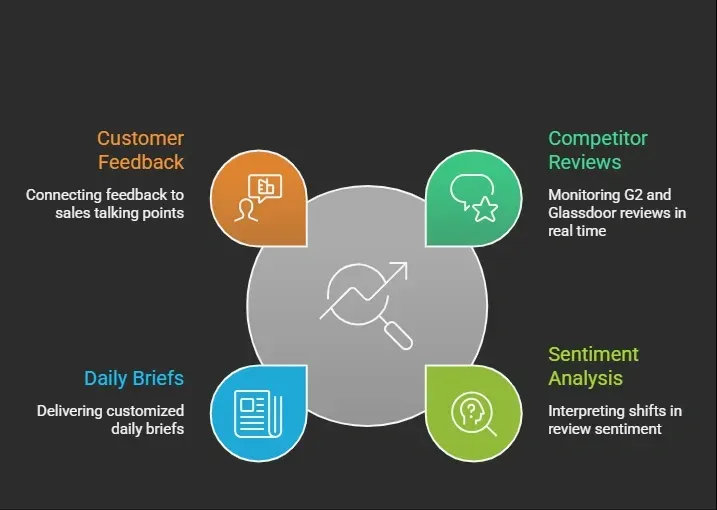 This is the gap between knowing a competitor exists and knowing what to say when a prospect compares you to them in a meeting.
Bain & Company's 2025 Technology Report found that early AI adopters in sales see 30% or better improvement in win rates - but only when artificial intelligence is applied to interpretation and decision-making, not just data collection. The point being: more data doesn't automatically produce sharper sales teams. Better interpretation of the right data does.
Sales intelligence matters. The question is what kind of sales intelligence - and whether it reaches your team in a format they can use.
How to Build a Sales Intelligence Workflow Around G2 and Glassdoor Data
A practical sales intelligence workflow doesn't need to be complicated. What it needs is a clear process that connects public review data to specific sales actions. Here's a five-step framework that revenue teams can start using immediately:
Step 1 - Identify Your Core Competitors
Start with the three to five competitors your sales reps encounter most often in competitive deals. These are the ones that show up on prospect shortlists and in discovery calls. Don't try to track every competitor at once - focus on the ones where losing costs you the most.
Step 2 - Mine G2 for Structural Weaknesses
For each competitor, read their most recent G2 reviews - specifically the three and four-star reviews, not just the one and two-star ones. Three and four-star reviews often contain the most honest feedback: buyers who like the product but have clear frustrations. Those frustrations are your talking points.
Look for patterns across reviews, not individual complaints. One person saying "support was slow" is noise. Fifteen people saying "support response time is a recurring issue" is a structural weakness you can address in a sales conversation.
Step 3 - Layer in Glassdoor Culture Signals
Check Glassdoor for each competitor. Pay attention to reviews from customer success, engineering, and sales departments specifically. These roles have the most direct impact on what customers experience post-sale.
A pattern of customer success turnover on Glassdoor translates directly to what your prospects will experience after they sign. That's a talking point your sales team can use without ever mentioning Glassdoor by name.
Step 4 - Map Signals to Deal Stages
Not every sales intelligence signal matters at every stage of a sales cycle. Create a simple map:
-
Discovery stage: Use intent data to time outreach and know who is actively researching solutions
-
Proposal stage: Use G2 product complaints to show how your product addresses gaps
-
Negotiation stage: Use Glassdoor data about CS team stability to address concerns about post-sale support
-
Close stage: Use hiring signals to demonstrate competitive momentum
Step 5 - Set Up a Real-Time Monitoring System
Static battlecards become outdated within weeks. The sales intelligence workflow needs a live data source that updates as competitor reviews change, as Glassdoor ratings shift, and as hiring patterns evolve. This is where a sales intelligence platform like Rocket.new becomes the operational layer that keeps the workflow current and delivers fresh data to the sales team each morning.
Using Sales Intelligence Data to Shorten the Sales Cycle
Sales cycles stretch when reps spend time chasing answers that should have been prepared before the meeting. Sales intelligence data helps sales managers reduce that friction at three specific points:
Preparing for Discovery Calls
Before a discovery call, a rep who knows a prospect's current tech stack, their company's recent funding activity, and the specific complaints their current vendor is getting on G2 walks in with a completely different posture than a rep who only knows the company name.
That preparation shortens the discovery process because the rep can skip generic questions and ask targeted ones. Fewer meetings needed to qualify an opportunity means a faster sales cycle overall.
Handling Competitive Objections in Real Time
When a prospect mentions a competitor, most reps pause, deflect, or give a generic answer. A rep armed with accurate, real-time sales intelligence data can respond immediately with specific, sourced context.
"I've seen their customers mention onboarding time as a recurring challenge in their G2 reviews - we've built our process specifically around that and average activation in under two weeks" lands very differently than "we're better at onboarding." The first is credible. The second is just a claim.
Accelerating Stakeholder Alignment
B2B deals stall when different stakeholders have different concerns. Sales intelligence data helps account executives anticipate those concerns by role. The IT decision-maker cares about security and integration. The department head cares about usability and support. The end users care about the specific feature gaps that show up in competitor reviews.
When your sales team addresses each stakeholder's concern with data they already trust - review data from platforms like G2 - the internal selling process at the prospect company moves faster.
Common Mistakes Sales Teams Make with Competitive Intelligence
Even teams that invest in competitive intelligence often make avoidable mistakes that reduce its impact. Here are the four most common ones:
Relying on Static Battlecards
Battlecards built once and never updated create a false sense of preparedness. A competitor that launched a major product update three months ago looks the same on an outdated battlecard as they did before the update. Sales reps who rely on these give inaccurate competitive comparisons, which damages credibility when a prospect has done their own research.
Focusing Only on Product Features
Most competitive intel programs focus on product comparison. That misses the larger picture. Customers choose vendors for reasons that go beyond features: support quality, ease of use, relationship with their account manager, confidence in the vendor's roadmap. G2 and Glassdoor data surfaces all of these. Feature comparison alone leaves most of the competitive picture invisible.
Not Connecting Intel to the Sales Process
Sales intelligence data that lives in a separate document or knowledge base doesn't help a rep in a meeting. The data needs to be connected to the sales workflow - delivered when it's needed, in a format the rep can act on immediately. Otherwise it gets read once and forgotten.
Treating All Signals as Equal
A single Glassdoor review about management style is not the same signal as fifteen G2 reviews about the same support problem. Sales intelligence helps when teams learn to identify signal clusters - multiple data points pointing in the same direction - rather than reacting to individual pieces of information. Artificial intelligence applied to large review datasets does this automatically. Manual monitoring rarely does.
Rocket.new Turns Your Competitors' Public Data into Your Team's Talking Points
This is exactly the problem Rocket.new's Intelligence pillar was built to solve. And it matters to clarify what kind of system it is - not an alerting system, but an interpretation system.
An alerting system tells you: "Competitor A received 14 new G2 reviews this week."
An interpretation system tells you: "Competitor A's G2 reviews this week show a repeated pattern of complaints about data export and support response time. Their Glassdoor score dropped 0.3 points - customer success and engineering reviews cite leadership instability. Recommended talking point: position your dedicated CSM model and faster support SLA as direct answers to what their customers are complaining about."
That's the output Rocket.new delivers - not a raw feed of review data, but a structured daily brief your sales team can act on before the first meeting of the day.
Six Signal Categories Monitored for Your Sales Team
Rocket.new's Intelligence monitors six signal categories across every public platform a competitor operates on:
-
Website signals - every page change, pricing update, messaging shift, and new feature announcement, with full before-and-after strategic interpretation
-
Social media signals - every post and campaign across LinkedIn, X, Instagram, Facebook, YouTube, TikTok, and Reddit
-
News and web presence - press coverage, partnership announcements, executive interviews, and media mentions
-
Reviews and reputation - G2, Glassdoor, Capterra, and other review platforms, with sentiment shifts tracked over time and impact tags applied
-
People signals - employee count, hiring velocity, Glassdoor rating, key executive profiles, and open positions broken down by department
-
Performance marketing - ad activity across LinkedIn, Meta, and TikTok
For sales teams specifically, the Reviews and People categories are where the talking points live. When a competitor's Glassdoor rating drops while their G2 reviews flag poor onboarding, that cluster - not any single data point in isolation - becomes your competitive angle.
The Daily Brief: Sales Intelligence Before the First Meeting
Every morning, Rocket.new delivers a structured brief for every competitor in your workspace:
-
Signals and insight - a synthesized paragraph connecting everything that changed across platforms
-
What to watch - patterns emerging from multiple data points tracked over time
-
Recommendation - what your sales or product team should do, consider, or prepare for
Your sales reps start each day with fresh, specific competitive context - no manual research, no stale battlecards, no scrambling before a discovery call.
Data Enrichment Through Compound Context
One feature separates Rocket.new from standalone competitive intelligence tools: compound context.
The competitive data enrichment from last Monday's brief is still present when a rep opens a project on Friday. The G2 complaint pattern flagged two weeks ago connects to the Glassdoor hiring trend detected this week. Your sales team doesn't need to re-explain context or manually connect signals - Rocket.new does it continuously and carries it forward across every session, every team member, and every capability in the platform.
This matters for sales strategy planning specifically. Review data in isolation has limited value. Review data layered with hiring signals, product update patterns, and social media direction becomes a complete competitive picture - the kind that produces talking points a sales rep can confidently use at any stage of a sales cycle.
Sales Intelligence Platform Comparison
| Capability | Rocket.new Intelligence | Traditional Sales Intelligence Tools |
|---|---|---|
| G2 review monitoring | Real-time, with sentiment tracking | Not typically included |
| Glassdoor monitoring | Real-time, with culture signal analysis | Not typically included |
| Daily competitive briefs | Synthesized, interpretation-first | Limited - mostly raw data feeds |
| Talking point generation | Recommendation layer included | Manual interpretation required |
| Buying signals and intent data | Yes - tracked alongside review signals | Core feature, strong coverage |
| Contact data and firmographics | Via project context | Core feature, strong coverage |
| Compound context across sessions | Yes - everything compounds over time | Typically session-only |
| Connected to build and strategy tools | Yes - lives inside Rocket's full platform | Standalone tool, no broader connection |
Traditional sales intelligence software is strong at contact data and buying signals. Rocket.new fills the gap they leave: the interpretation layer that converts G2 and Glassdoor signals into specific, ready-to-use talking points for your sales team.
Building Your Sales Strategy Around Real Customer Feedback
Sales cycles get shorter when reps walk in prepared. Not prepared with a generic pitch - prepared with specific, research-grounded answers to the competitive questions they know are coming.
The customer data is already there. G2 has 3 million reviews. Glassdoor has millions more. Every review is a signal. The question is whether your revenue teams have a system that reads those signals before the competition does.
That's where sales intelligence talking points matter most - not as a data collection exercise, but as a system that converts public customer feedback into responses your team can use to win competitive deals. Rocket.new's Intelligence pillar does exactly that. It monitors G2, Glassdoor, Capterra, and every other public platform your competitor operates on - and then tells you what it means for your sales process, not just what changed.
Sales intelligence talking points are only as useful as the speed at which they reach your reps. Rocket.new makes sure they arrive before the first meeting of the day.
Table of contents
- -Why Review Platforms Are the Most Underused Sales Intelligence Data Sources
- -What G2 and Glassdoor Customer Feedback Actually Reveals
- -Feature and Product Complaints
- -Support and Onboarding Signals
- -Glassdoor Culture Signals and Hiring Data
- -From Review Data to Sales Intelligence Talking Points
- -Why Most Sales Teams Miss This Opportunity?
- -The Gap Between Buying Signals and Sales Readiness
- -What Revenue Teams Are Actually Saying
- -Where Traditional Sales Intelligence Platforms Leave a Gap
- -How to Build a Sales Intelligence Workflow Around G2 and Glassdoor Data
- -Step 1 - Identify Your Core Competitors
- -Step 2 - Mine G2 for Structural Weaknesses
- -Step 3 - Layer in Glassdoor Culture Signals
- -Step 4 - Map Signals to Deal Stages
- -Step 5 - Set Up a Real-Time Monitoring System
- -Using Sales Intelligence Data to Shorten the Sales Cycle
- -Preparing for Discovery Calls
- -Handling Competitive Objections in Real Time
- -Accelerating Stakeholder Alignment
- -Common Mistakes Sales Teams Make with Competitive Intelligence
- -Relying on Static Battlecards
- -Focusing Only on Product Features
- -Not Connecting Intel to the Sales Process
- -Treating All Signals as Equal
- -Rocket.new Turns Your Competitors' Public Data into Your Team's Talking Points
- -Six Signal Categories Monitored for Your Sales Team
- -The Daily Brief: Sales Intelligence Before the First Meeting
- -Data Enrichment Through Compound Context
- -Sales Intelligence Platform Comparison
- -Building Your Sales Strategy Around Real Customer Feedback