
Discover how to validate, build, and launch an MVP over a weekend with Rocket.new. Learn practical AI workflows, rapid prototyping methods, and deployment strategies that help founders move from idea to product faster.
Can you actually go from idea to shipped app in a single weekend?
Yes - and more founders are doing exactly that right now. No-code AI platforms have cut development time by up to 90%, and 63% of people building AI apps today have no coding background at all. (Hostinger, 2026)
The real barrier to MVP development isn't technical skill. It's knowing what to build, keeping scope tight, and shipping before the idea gets too heavy to move.
This guide walks you through the entire process - from clarifying your idea on Friday to having a production-ready app in front of real users by Sunday.
Why Most Founders Never Ship
Most founders don't fail because their ideas are bad. They fail because they wait.
They wait for the right co-founder. They wait until the product feels "ready." They keep adding features because investors might ask about them. And then months pass, and they're still sitting on a working prototype that nobody has seen.
The data is clear: 42% of startups fail because they build products nobody wants. Not because the technology was hard - because they never got out of the building phase to hear what real users actually needed.
Most startups that make it do the opposite. They ship early, collect user feedback fast, and iterate from there. The development process becomes a loop, not a line.
What MVP Development Actually Means
MVP development does not mean shipping something broken. It means shipping something small and real - just enough to test whether people actually care.
Think about how the biggest names started. Airbnb launched with a basic website and a few photos. Dropbox validated demand with a demo video before a single line of backend code was written. Both found product market fit before they built anything complex.
Your MVP needs exactly three things:
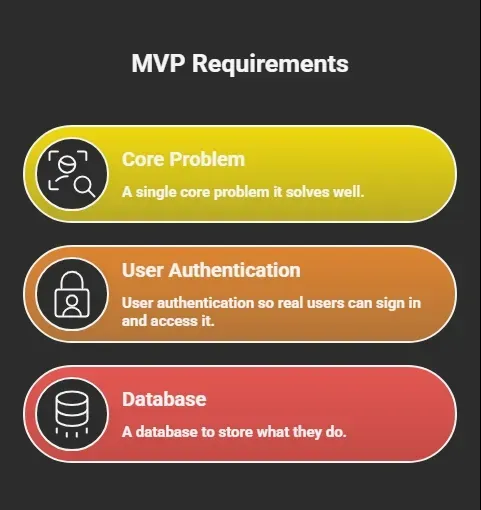 Everything else is a distraction at this stage.
| Feature | Include in MVP? | Why |
|---|---|---|
| User authentication | Yes | Real users need accounts to access the app |
| Core value feature | Yes | The one job your app does |
| Database | Yes | Stores user actions and data |
| Advanced features | No | Adds scope before you have real feedback |
| Complex business logic | No | Iterate from actual usage patterns |
| Mobile apps (v1) | Optional | Web first works for most MVP validation |
What Non-Technical Founders Get Wrong in the Development Process
The biggest mistake non-technical founders make is treating MVP development like product development. They think too far ahead. They add too many features. They treat the app like it needs to scale before a single user has tried it.
A few traps worth naming:
-
Waiting for engineers before starting anything - modern no-code AI tools mean non-technical founders can go from idea to real apps without any developer hired
-
Confusing a working prototype with a finished product - a working prototype gets you feedback; a finished product is what you build after that feedback
-
Ignoring internal tools as a starting point - sometimes the best SaaS products come from solving an internal problem first, then opening it up to other teams
-
Over-designing before building - mockups have their place, but they are not a substitute for an app real users can interact with
The job at this stage is to ship something functional, not something flawless.
A Weekend-Ready MVP Development Workflow
Here's a practical flow that gets you from idea to deployed in 48 hours:
The key step most founders skip: deploy on Sunday and get it in front of real users immediately. User feedback from five actual people is worth more than another week of solo building.
What Real Founders Are Saying
One user shared their experience with Rocket.new on X after switching from other tools:
"I just one shotted a prompt using @rocketdotnew and I can't put into words how astronomically better it is than any other no code AI tool. Actually made me question why I ever paid for Bolt, Lovable, V0, a0 etc when this tool puts them all to shame. Incredibly impressed, wow." Mia Williams, @miatravls
This reaction is becoming common. Founders who spent weeks bouncing between other platforms are shipping their first full stack MVP in a single session. The vibe around no-code AI app builders has shifted from "interesting experiment" to "this is how we build now."
Even Y Combinator noticed: 25% of their Winter 2025 cohort had codebases that were 95% or more AI-generated. The era of needing a technical co-founder to validate an idea is fading fast.
Launching Your MVP with Rocket.new
Rocket.new is not just another AI app builder. It is the first platform built around the full arc of what it takes to go from idea to shipped product to competitive awareness - all in one system, without any technical background needed.
Here is what makes it the right choice for MVP development on a tight timeline.
Core Features Built for Non-Technical Founders
Solve - Research before you build
Most founders skip market research because it takes too long and feels disconnected from building. Rocket's Solve module changes that. Describe your idea or problem, and Rocket returns a structured brief with market data, a clear recommendation, and a direction. This context carries directly into the build step - no re-explaining, no starting over.
Build - Production-ready AI app from first prompt
Type your idea in plain language. Rocket generates a full stack application with user authentication, a real database, and a responsive UI - not a mockup, not a demo, but a production-ready app you can deploy immediately. Both web apps and mobile apps are generated from the same project. No separate builds, no context switching.
Intelligence - Know what your competition just did
After you launch, Rocket keeps watching. If a competitor changes pricing, shifts messaging, or launches something new, you get the signal. This is where investor demos get genuinely interesting - you walk in with live competitive data, not just a slide deck.
Rocket.new vs Other Tools
| Tool | What It Does Well | Where It Falls Short |
|---|---|---|
| Rocket.new | Full stack AI app + Solve + Intelligence | Newer platform, templates still growing |
| Lovable | Clean UI output | No market research layer, limited production deployment options |
| Bolt | Fast generation | Loses context in longer sessions, no intelligence layer |
| Replit | Good for developers | High learning curve for non-technical founders |
| Traditional dev agencies | Full control | Weeks of lead time, expensive, slow user feedback cycles |
For non-technical founders who need a production-ready app with user authentication and a real database without hiring engineers or spending months in a development agency queue - Rocket.new is where to start.
From User Feedback to What Comes Next
The gap in MVP development isn't coding knowledge. It's the gap between having an idea and having the confidence to put something real in front of real users this weekend.
Ship your MVP this weekend with Rocket.new. Let the user feedback from the first few days shape what version two actually looks like. The founders who find product market fit fastest are the ones who start that feedback loop earliest - not the ones who build the most.
Table of contents
- -Why Most Founders Never Ship
- -What MVP Development Actually Means
- -What Non-Technical Founders Get Wrong in the Development Process
- -A Weekend-Ready MVP Development Workflow
- -What Real Founders Are Saying
- -Launching Your MVP with Rocket.new
- -Core Features Built for Non-Technical Founders
- -Rocket.new vs Other Tools
- -From User Feedback to What Comes Next