
Ship MVP examples this weekend with Rocket.new using real-world proof from Airbnb, Dropbox, Slack, and Spotify. This blog covers the weekend MVP development process, the MoSCoW method, and how non technical founders can ship production ready apps without writing code.
Why the MVP Development Process Feels So Hard?
Most founders understand the concept. They've read the books, watched the talks, and nodded along to the advice. And then they still spend months building before a single real user sees the product. Two root causes explain most of it.
-
Fear of shipping imperfect work: Founders want core features polished, onboarding to feel right, and design to match what they picture in their heads. This thinking alone pushes mvp development from a weekend into a quarter.
-
No technical co-founder: Non technical founders often cannot afford to hire engineers. Agencies are slow to start and expensive to keep going.
-
No-code learning curves: Most no-code tools have steep enough onboarding that founders spend their first week learning the tool rather than building the product.
-
Scope creep: Without a clear definition of what a minimum viable product actually is, features multiply. A three-feature build quietly becomes a ten-feature project that never ships.
Both barriers are solvable and the solution is simpler than most founders expect.
What a Minimum Viable Product Actually Is (and Isn't)
A minimum viable product is the simplest version of your product that delivers real value to real users. Not a mockup, not a deck, and not a landing page with a waitlist. Getting this definition right is what separates founders who ship on Sunday from founders who are still building three months later.
What an MVP is:
-
A functional product with just enough core features to test whether your core value proposition resonates with your target users
-
A working prototype real users can interact with and give feedback on
-
The first version of something that solves a real core problem: imperfect, but live
What an MVP is not:
-
A half-built product with broken core features
-
A complex system that took months to complete before any real user saw it
-
A presentation showing what the product will eventually do
-
A polished product with ten features when three would validate the idea just as well
The "minimum" in MVP means minimum scope, not minimum quality. A well-built landing page with one working feature beats a bloated app with ten broken ones every time.
Real MVP Examples That Changed Everything
The best way to understand mvp development is to look at companies that did it right before they had resources, teams, or funding. These are not outliers. They follow the same pattern you can repeat this weekend.
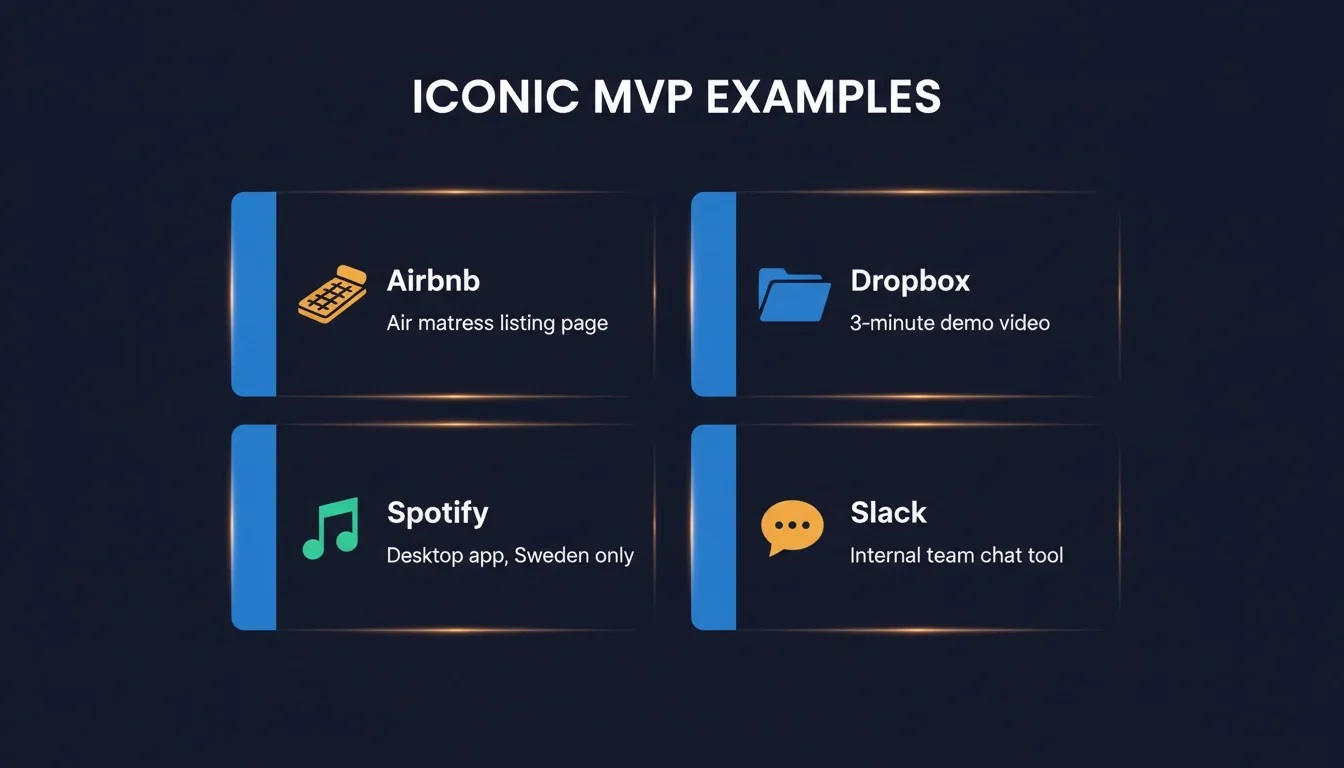
Airbnb: The Air Mattress Test
Airbnb started with a problem the founders had in their own apartment: they needed help covering rent.
-
The MVP: A basic website with photos of their San Francisco apartment and an offer to rent out air mattresses in their living room.
-
No complex system: No payment processing, no booking engine, no host verification. Just a page and a price.
-
What they tested: Whether strangers would pay to stay in someone else's home: the core problem in one sentence.
-
What they learned: The answer was yes. That working prototype proved the core value was real before a dollar of investor money was spent.
Airbnb launched with the simplest version possible and let real users shape everything that came after. The company is now worth hundreds of billions.
Dropbox: A Video Before Any Software
Drew Houston validated demand before a single line of production code existed.
-
The MVP: A three-minute demo video showing how Dropbox would work, not how it did work.
-
The result: The waitlist jumped from 5,000 to 75,000 people overnight.
-
What it proved: That people would sign up and pay for file sync before the software was built.
-
The lesson: Sometimes the simplest version of your product is not software at all. It's proof that people want the software.
This remains one of the most referenced mvp examples because it shows that the goal is to validate demand, not to build a full product before you know anyone wants it.
Spotify: Music Streaming in One Country
Spotify launched without mobile apps, offline mode, or social features and that was entirely intentional.
-
The MVP: A desktop app that only worked in Sweden.
-
Core features only: Basic music streaming for a small group of early adopters.
-
The iteration path: Get user feedback, fix what's wrong, expand, and add features only after the core value was proven in a small market.
-
The lesson: Launching narrow and proving core features work for real users beats building for everyone before launch.
Starting in one country with one feature gave Spotify the user feedback they needed to build everything that followed.
Slack: An Internal Tool That Became a Company
Slack was never meant to be a product. It was built as an internal tool for the founders' own team while working on a game called Glitch.
-
The origin: A side project: a chat tool built because the team needed a better way to communicate during development.
-
The pivot: The game failed. The internal tool they built for themselves turned out to be what the world actually wanted.
-
What it shows: Internal tools built to solve your own pain points can become the product, not just a stepping stone to one.
-
The lesson: The core problem you're solving doesn't have to come from market research. Sometimes you are the target user.
These four examples share one consistent thread: ship the simplest version that solves one core problem, get it in front of real users, and let the user feedback drive what you build next.
The Weekend MVP Development Process: Step by Step
A realistic 48-hour build is achievable when you're clear on what you're building and have the right tools behind you. Here's how the timeline maps out from Friday evening to Sunday afternoon.
Friday Evening: Get Clear on the Problem
Before opening any tool, clarity on the core problem is non-negotiable.
-
Write one sentence: "My product helps [target users] solve [core problem] by [core features]." If this takes more than five minutes, the scope isn't clear enough to build yet.
-
List every feature: Think through everything you believe the product needs without filtering anything out at this stage.
-
Apply the MoSCoW method: Cut every feature that isn't a Must-have for launch immediately after.
-
Stop when the scope feels small: A two-feature product that ships on Sunday beats a six-feature product that misses the weekend entirely.
The clearer your problem statement on Friday, the faster Saturday goes.
Saturday Morning: Scope Your Core Features Only
The MoSCoW method is a project management framework that sorts features into four categories to keep mvp development focused on what matters.
| Category | What Goes Here | Weekend MVP? |
|---|---|---|
| Must-have | Features the product cannot work without | Build these |
| Should-have | Important but not launch-blocking | Backlog |
| Could-have | Nice to have if time allows | Backlog |
| Won't-have | Consciously cut from this version | Delete |
Common Must-haves for SaaS mvps and first-time web app builds:
-
User authentication: If your product has user accounts, this goes in Must-have by default.
-
The one core feature: The single action that delivers your core value to target users.
-
A basic landing page: Something that explains what the product does for early users who find it cold.
Payment processing, onboarding flows, analytics dashboards, and email notifications belong in Should-have, unless collecting money or tracking user behavior is literally the core functionality you are testing this weekend.
Saturday Afternoon: Build with the Right Technology Stack
This block either moves fast or stalls, and the difference almost always comes down to technology stack choices made before Saturday afternoon starts.
-
AI-native builders close the gap: Most non technical founders open a no-code tool and spend Saturday learning how it works instead of building. Platforms that generate from natural language skip that entirely.
-
Front end and back end together: The right tool generates both from a single prompt. Splitting these into separate systems adds hours the weekend build doesn't have.
-
Deployment built in: Tools that require a separate hosting setup add a second learning curve. One-click deploy keeps the timeline intact.
-
Start from a template: A close-enough starting point cuts setup time significantly and lets you focus your prompts on the specific core features that make your product yours.
Choose a tool that generates a production ready product, not just a visual prototype. Real users need to interact with real functionality.
Sunday: Test, Fix, and Deploy
By Sunday afternoon, the only goal is a live URL in the hands of five to ten potential users.
-
Test every core feature yourself first: If user authentication breaks or the core features don't work end-to-end, fix it before sharing.
-
Share with potential users, not friends: Real user feedback comes from people who match your target users profile, not people who want to be supportive.
-
Ask specific questions: "What did you expect to find here that you didn't?" gets far more actionable answers than "What do you think?"
-
Log every response: Patterns in early feedback tell you exactly what to address in the first iteration after the weekend.
Five honest responses from real users are worth more than another week of solo building. Get it live.
What No-Code Tools Offer (and Where They Hit a Wall)
No-code tools have made mvp development genuinely accessible to non technical founders. According to Gartner research, 70% of new applications developed by enterprises in 2025 used low-code or no-code technologies, a major shift in how software development actually gets done. But most platforms have a ceiling, and it shows up at different points.
| Platform | Strength | Gap |
|---|---|---|
| Bubble | Complex system logic and database management | High learning curve: days before anything meaningful gets built |
| Webflow | Marketing sites and landing pages | Not built for functional back end products |
| Adalo / Glide | Simple mobile apps | Struggles when back end logic gets more complex than basic data display |
| Bolt / Lovable | Code generation from prompts | No built-in market research or competitive tracking capabilities |
| Rocket.new | Full stack, market research, competitor intelligence | None: the only platform that covers all three |
-
Bubble is powerful for complex system logic and database management, but the learning curve takes days before anything meaningful gets built.
-
Webflow is strong for marketing sites and landing pages, but it was not built for functional back end products.
-
Adalo and Glide handle simple mobile apps but struggle when back end logic gets more complex than basic data display.
-
Bolt and Lovable generate code from prompts but come without built-in market research or competitive tracking capabilities, meaning you still need separate tools before and after the build.
-
The shared gap: Most no-code tools assume you already know what to build when you open them, and they leave you on your own to track what the market does after you launch.
That's not a tools problem. It's a gap in the category, and it's exactly what Rocket.new is built to fill.
Your Weekend MVP Launchpad: Rocket.new
Rocket.new is the world's first Vibe Solutioning platform, used by 1.5 million people across 180 countries. It brings market research, app building, and competitor intelligence into one system with one shared context, so you're not switching between five different tools during a 48-hour sprint.
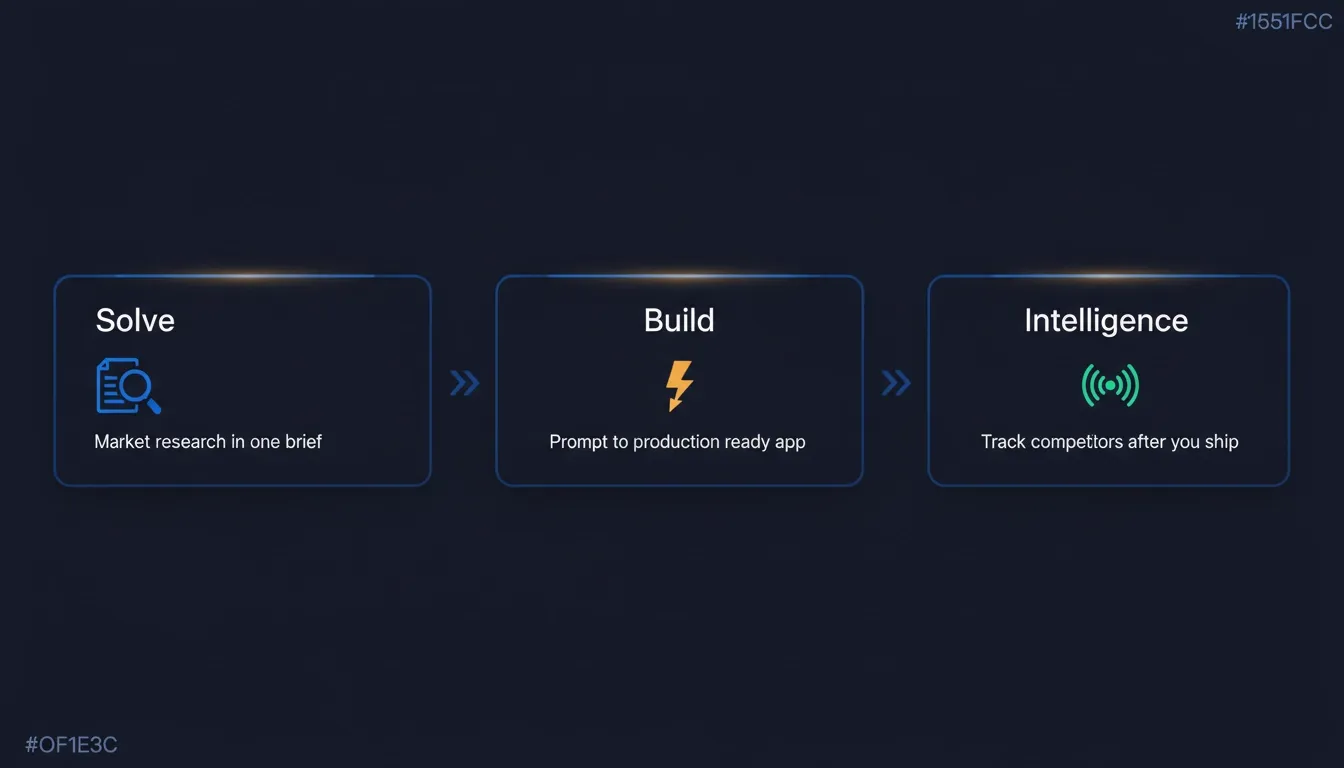
Solve: Know What to Build Before You Build It
Solve is built for early stage founders who are still deciding what to build or how to position it before the development process starts.
-
Describe any market problem, decision, or opportunity: Solve returns research, evidence, and a clear recommendation: structured and ready to act on.
-
Output includes: Market analysis, what to build, GTM strategy, PRD and product direction, and regulatory research all in one brief.
-
No team required: This replaces weeks of informal market research for non technical founders working without a development team or a technical co-founder.
-
Ready to hand off into Build: The brief from Solve goes straight into the next step. Rocket.new carries the full context with no re-explaining needed.
Most early stage founders skip the research step entirely and pay for it once real users arrive. Solve makes it fast enough to complete in one week on Friday evening.
Build: Prompt to Production Ready in Hours
Build is where the actual mvp development happens on Rocket.new and it's where the biggest time savings show up.
-
Natural language prompt: Describe what you want in plain language. No writing code. No separate environment setup.
-
Full stack output: Front end, back end, database structure, and user authentication generated together from your single prompt.
-
Mobile apps included: Web apps and mobile apps from the same project. No separate React Native configuration required.
-
One-click deploy: Staging and production environments, deployed without a separate hosting workflow on top.
-
25,000+ templates: Pick one close to your idea, describe your adjustments, and Build works from the full context of your decisions.
Rocket.new supports web apps, mobile apps, landing pages, SaaS products, internal tools, and dashboards all from a first prompt. What would normally take a development team weeks to set up gets done in hours, with a production ready result rather than a visual prototype.
Intelligence: Track Competitors After You Ship
Shipping is the start of the mvp development process, not the end, and the market keeps moving the moment your product goes live. Rocket.new's Intelligence feature monitors the companies you follow continuously, delivering interpreted signals, not raw data, shaped by who you are and what you're trying to accomplish.
-
Regular briefs: Rocket.new delivers what competitors did and what it means for your product straight to your inbox or Slack, on a schedule you set. Weekly digest or daily brief, your call.
-
Role-shaped intelligence: When you follow a company, Rocket.new asks why: Sales, Marketing, Product, Hiring, Funding, or Competitive. A product leader watching for roadmap signals gets completely different intelligence from a sales leader watching for pricing moves. Same company, same signal, different brief.
-
Confidence-rated signals: Every signal card carries a confidence percentage: 25%, 50%, 74%, or 92%, so you always know how strongly corroborated a piece of intelligence is before acting on it.
-
Sales intel and social signals: Competitive moves on social media, product positioning updates, pricing page changes, creator partnerships, executive activity, and market shifts all come through Intelligence across nine live signal pillars.
-
Connected context: Because Intelligence lives in the same system as your Build and Solve work, competitor insights connect directly to your product decisions, not to a separate dashboard you open once a month.
-
Intelligence that compounds: Day 1 you see what happened today. By Day 30, patterns emerge: recurring behaviors and market rhythms. By Day 90, Rocket.new starts surfacing predictions built from accumulated historical data that no same-day signup can replicate.
A competitor just moved. Rocket.new saw it, connected it, and already knows what it means for your next iteration.
How Rocket.new Compares to Other Tools
| Feature | Rocket.new | Bubble | Webflow | Bolt / Lovable |
|---|---|---|---|---|
| Prompt-to-app generation | Yes | No | No | Yes |
| Web apps with full back end | Yes | Yes | No | Yes |
| Mobile apps | Yes | No | No | Limited |
| Built-in market research | Yes | No | No | No |
| Competitor intelligence | Yes | No | No | No |
| One-click deploy | Yes | Paid plan | Paid plan | Limited |
| Learning curve | Low | High | Medium | Low |
| Templates library | 25,000+ | Limited | Yes | Limited |
| Production ready from first prompt | Yes | No | No | Partial |
Mia Williams (@miatravls) put it plainly on X after testing the platform:
"I just one shotted a prompt using @rocketdotnew and I can't put into words how astronomically better it is than any other no code AI tool. Actually made me question why I ever paid for Bolt, Lovable, V0, a0 etc when this tool puts them all to shame. Incredibly impressed, wow."— Mia Williams, @miatravls on X
From Early Users to Product Market Fit
Once your MVP is live, the real mvp development work begins and none of it involves writing more code. It involves listening.
-
Watch how people use the product: Where do they drop off? What do they skip? What do they click that isn't clickable yet?
-
Read every support message: Early users who take the time to write to you are your most valuable user feedback source in the first weeks.
-
Talk to the first five customers: Ask what they expected to find that wasn't there, and ask what made them stay.
-
Track user behavior carefully: The gap between what users say they want and what they actually do is where your next core features live.
-
Add features based on user feedback: Not based on what you originally planned. Real users tell you what matters. The development process should follow.
-
Cut what doesn't move the needle: Every feature that doesn't drive retention or activation is scope you can remove without losing valuable feedback.
Data from tracking 50+ startup builds on r/SaaS tells the story clearly:
"Founders who launched in 6 weeks had a 67% success rate. Those who built in isolation for 6+ months had an 11% success rate. Failed MVPs averaged 23 features at launch. Successful MVPs averaged 3." — r/SaaS, September 2025
Product market fit comes from tight iteration loops with real users, not from more features or more months in development. Get it live. Get it in front of people. The user feedback loop is the product.
Ship MVP Examples This Weekend: Here's the Honest Truth
Most founders don't have a software development problem. They have a shipping problem.
The mvp examples from Airbnb, Dropbox, Slack, and Spotify are not stories about brilliant products. They're stories about founders who shipped something imperfect, got it in front of early adopters, and let real user feedback shape everything after.
An MVP is not the product you're proud of. It's the product that tells you what to be proud of next.
Rocket.new removes the biggest barrier in the way: the technical one. Non technical founders, early stage founders without a technical co-founder, solo builders, and small teams without developer resources all have a clear path to ship production ready web apps and mobile apps in a single weekend, without writing code, without hiring engineers, and without a complex system to manage before a single user has seen the product.
Your idea is ready. The weekend is two days. Go build it.
Table of contents
- -What a Minimum Viable Product Actually Is (and Isn't)
- -Real MVP Examples That Changed Everything
- -Airbnb: The Air Mattress Test
- -Dropbox: A Video Before Any Software
- -Spotify: Music Streaming in One Country
- -Slack: An Internal Tool That Became a Company
- -The Weekend MVP Development Process: Step by Step
- -Friday Evening: Get Clear on the Problem
- -Saturday Morning: Scope Your Core Features Only
- -Saturday Afternoon: Build with the Right Technology Stack
- -Sunday: Test, Fix, and Deploy
- -What No-Code Tools Offer (and Where They Hit a Wall)
- -Your Weekend MVP Launchpad: Rocket.new
- -Solve: Know What to Build Before You Build It
- -Build: Prompt to Production Ready in Hours
- -Intelligence: Track Competitors After You Ship
- -How Rocket.new Compares to Other Tools
- -From Early Users to Product Market Fit
- -Ship MVP Examples This Weekend: Here's the Honest Truth