
Struggling to keep software scalable and maintainable? Using proven design patterns provides structure, clarity, and efficient object creation, helping developers build reliable systems while adapting to evolving tools and practices.
How do I choose the right approach when building software that needs to scale?
I rely on proven design patterns that solve recurring problems in a structured way. These patterns help shape better systems, improve clarity, and guide object creation without guesswork.
According to the Stack Overflow Developer Survey 2023, 70% of all respondents are using or are planning to use AI tools in their development process this year.
That tells me something important. Developers are adapting fast. Tools change. Trends change. In tech, patterns are not trends. They are tested solutions that bring order to complex systems.
Let’s walk through them in a simple, practical way.
What is a Software Design Pattern?
A software design pattern is a reusable solution to a recurring problem in software design. I like to think of patterns as blueprints. They are not code you copy and paste. They are ideas I adapt based on context.
Design patterns give teams a common language. When I say observer pattern or factory method, fellow developers instantly understand the direction. That saves time during development. No long explanations. No confusion. Just clarity.
Patterns provide structure without forcing direct language support from a programming language. I can apply them in Java, Python, C#, or any modern stack. They sit at the level of software architecture and software engineering.
Patterns provide clarity and tested solutions that keep maintainable systems realistic. Patterns provide reusable solutions that scale across a broader range of applications. When I apply patterns correctly, software design feels lighter and more predictable.
The Three Main Categories of Patterns
The famous design patterns book by the Gang of Four introduced three categories. That design patterns book still guides modern software design techniques today. I still revisit it when I need clarity.
Here is a simple breakdown:
| Category | Focus | Example |
|---|---|---|
| Creational patterns | Object creation | Factory Method |
| Structural patterns | Larger structures | Adapter |
| Behavioral patterns | Object interactions | Observer Pattern |
Each category addresses a different type of concern in software architecture. When I understand the category, I usually understand the direction.
Creational Patterns: Managing Object Creation
Creational patterns deal with object creation. They focus on the instantiation process and help me avoid messy constructors.
In object-oriented programming, object creation can become repetitive. When new objects are built in different places, things get messy fast. I have seen constructors copied across files. That is usually my cue to step back and apply creational patterns.
Singleton Pattern
The singleton pattern restricts a class to only one instance and provides a global point of access. I use it for configuration managers or logging systems.
But I stay careful. Too much global point access can turn into tight coupling. I treat the singleton pattern like strong coffee. Useful, but not for every situation.
Factory Method
The factory method moves object creation into a separate method. Instead of calling constructors directly, I let the factory handle the instantiation process.
This is helpful when creating families of similar objects that share the same construction process. It keeps concrete classes hidden and flexible.
Here is a simple code example in Java:
1interface Shape {
2 void draw();
3}
4
5class Circle implements Shape {
6 public void draw() {
7 System.out.println("Circle");
8 }
9}
10
11class ShapeFactory {
12 public Shape createShape() {
13 return new Circle();
14 }
15}The factory controls object creation. That keeps code readable and clean. I can swap implementations without rewriting the whole system.
Builder Pattern
When building a complex object with many optional fields, creational patterns like Builder shine. They break the construction process into steps.
Creational design patterns like these separate what gets built from how it gets built. Patterns provide flexibility in object creation while maintaining code readability.
Creational patterns focus primarily on creation, but they also help when recycling objects. They are part of proven development paradigms in software engineering. Whenever I feel constructors are getting bloated, I know it is time for better object-creation control.
Structural Patterns: Building Larger Structures
Structural patterns focus on how classes and objects form larger structures. They deal with relationships.
Sometimes, incompatible interfaces stop systems from working together. I have faced that moment where two components almost fit but not quite. That is where structural patterns help.
Adapter Pattern
The Adapter pattern provides a unified interface for incompatible interfaces. It allows objects to work together without changing their underlying representation.
It helps me control access to an existing object while keeping code stable. Instead of rewriting everything, I simply wrap it.
Composite Pattern
Composite helps represent part-whole hierarchies, such as tree structures. It allows treating individual objects and groups of objects uniformly.
When objects form larger structures such as file systems, this pattern keeps everything clean. Objects uniformly follow the same interface. I do not need separate logic for single items and collections.
Structural patterns compose objects to form larger structures without rewriting logic. Patterns provide flexibility when systems grow. They make scaling architecture feel structured instead of stressful.
Behavioral Patterns: Managing Object Interactions
Behavioral patterns concern how objects interact and communicate.
These patterns help manage dependent objects and related or dependent objects in complex systems. When I see too many conditionals controlling behavior, I know behavioral patterns might help.
Observer Pattern
The observer pattern defines a one-to-many dependency. When one object changes state, dependent objects get updated automatically.
This is common in event systems. I use it when different components must react to changes without being tightly coupled.
Here is a small example:
1class Subject:
2 def __init__(self):
3 self.observers = []
4
5 def attach(self, observer):
6 self.observers.append(observer)
7
8 def notify(self):
9 for obs in self.observers:
10 obs.update()Behavioral patterns like this manage object interactions cleanly. Objects communicate without knowing too much about each other.
Template Method
The template method defines an algorithm's structure inside a base class while allowing subclasses to redefine certain steps. It keeps the algorithm consistent but flexible.
Behavioral patterns are great when objects interact through different requests and changing rules.
Patterns provide structure to object handles without rigid coupling. Patterns provide clarity in complex subsystem logic. When behavior starts spreading everywhere, behavioral patterns pull it back into order.
When to Use Which Pattern
Picking patterns should not feel like throwing darts at a board. The choice depends on the type of problem sitting in front of me. I usually pause and ask one simple question: What exactly is breaking or getting messy here? The answer points straight to the right category.
How to Decide?
-
If the problem relates to object creation, I go with creational patterns.
These patterns streamline the instantiation process and organize how new objects are created.
-
If the issue is about relationships between classes or objects, I use structural patterns.
These patterns help classes fit together and form larger structures without rewriting everything.
-
If it involves behavior or communication between objects, I choose behavioral patterns.
These patterns manage how objects interact and how responsibilities are shared.
Patterns provide solutions to common issues in software development. They guide my decisions when extending functionality or adding a new operation. Instead of patching code randomly, patterns bring structure and clarity.
Mastering design patterns sharpens instinct. Over time, the right choice feels obvious. It also helps me speak in a common language with teams. When everyone understands the patterns being used, discussions become faster and cleaner. And that makes building software feel a lot more manageable.
Community Insight
On Reddit, one developer shared this about patterns:
“Design patterns aren’t about writing fancy code. They are about communicating intent.”
That hits the point. Patterns help fellow developers understand object interactions without reading every line. I have felt that relief during code reviews. A simple pattern reference often explains more than ten comments.
Rocket.new and Design Patterns in Action
Talking about patterns is great. Applying them is where things get interesting.
Rocket.new connects directly with structured software design thinking. When apps are generated from prompts, they are not random piles of code.
Under the hood, the system follows structured software design principles. Object creation is organized. Responsibilities are separated. Components are grouped logically. That is design patterns working quietly in the background.
Instead of manually wiring every class and object interaction, Rocket.new handles much of the heavy lifting. The instantiation process stays clean. Dependencies are structured properly. Object interactions are predictable.
Top Features
- Prompt to App Creation: Builds apps directly from single prompts
- Figma Import: Converts design files into live, editable layouts
- AI-Powered Backend: Automatically handles logic, data, and workflows
- Custom Domain Support: Publishes projects with a branded domain
- Code Export: Allows developers to extend or customize later
- Live Preview: Shows instant updates while editing
These features reflect proven development paradigms in modern software engineering. Patterns provide structure, and Rocket.new builds with that structure in mind.
How Rocket.new Helps in Practical Terms
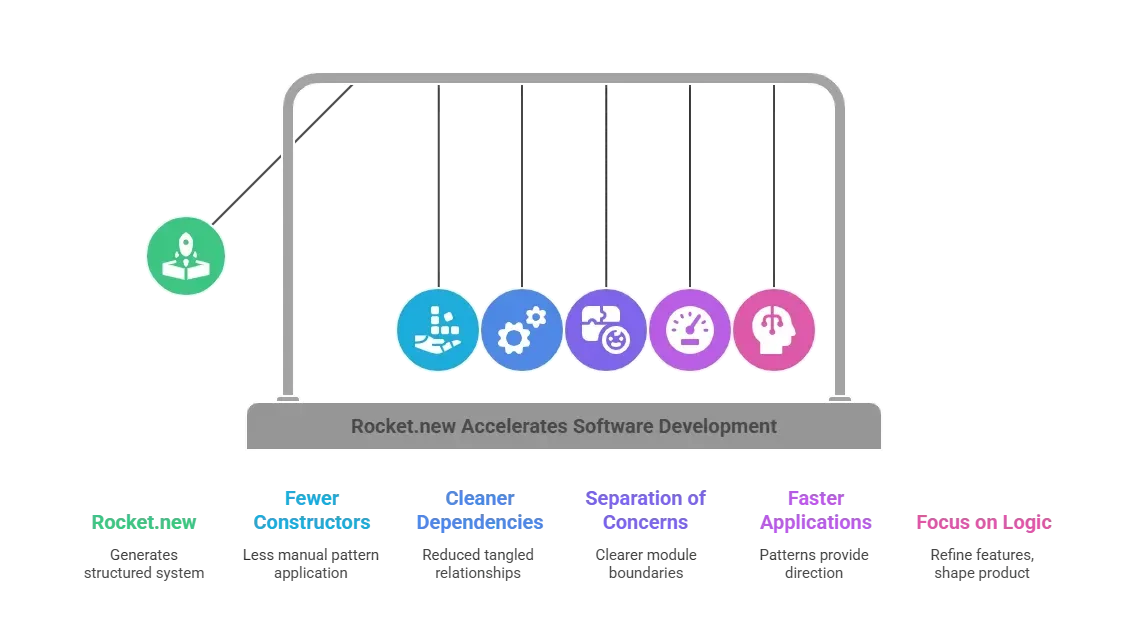
Rocket.new accelerates software development while keeping design structured. Instead of starting from scratch and manually applying creational, structural, and behavioral patterns, much of that organization is baked into the generated system.
Software Design Pattern Strategy
Many projects suffer from unclear object creation, tangled dependencies, and poor software design. As systems grow, complex relationships among objects become harder to manage. I have been there. It usually starts small and then grows silently.
Applying a software design pattern helps organize object creation, clarify interactions between objects, and structure larger systems. Creational, structural, and behavioral patterns cleanly guide architectural decisions.
Patterns provide reusable solutions across software engineering challenges. They support maintainable systems and reduce confusion. Mastering design patterns makes decisions faster and cleaner.
Software design becomes lighter when patterns guide the path.
Table of contents
- -What is a Software Design Pattern?
- -The Three Main Categories of Patterns
- -Creational Patterns: Managing Object Creation
- -Singleton Pattern
- -Factory Method
- -Builder Pattern
- -Structural Patterns: Building Larger Structures
- -Adapter Pattern
- -Composite Pattern
- -Behavioral Patterns: Managing Object Interactions
- -Observer Pattern
- -Template Method
- -When to Use Which Pattern
- -How to Decide?
- -Community Insight
- -Rocket.new and Design Patterns in Action
- -Top Features
- -How Rocket.new Helps in Practical Terms
- -Software Design Pattern Strategy