
Sales reps lose most of their time on prep, not selling, leading to weak deal execution. Solve on Rocket.new turns scattered CRM, compe titor, and buyer data into structured deal briefs in minutes. The result: better stakeholder alignment, stronger conversations, and faster enterprise deal closures.
Why Most Enterprise Sales Teams Walk Into Big Calls Underprepared
What does it actually take to walk into an enterprise call with a brief that covers every angle?
It takes competitor intel, stakeholder mapping, CRM data, and buyer context, all pulled together before the call starts. Most sales teams never get there. According to Salesforce's State of Sales research, sales reps spend roughly 70% of their time on non-selling tasks.
That leaves barely a third of the week for actual selling. Deal preparation gets squeezed into whatever minutes remain.
-
Reps typically juggle eight or more tools just to close a single deal
-
Last-minute preparation before sales calls leads to longer sales cycles and lower close rates
-
85% of sellers say their biggest challenge is getting prospects to engage during discovery and share business context
The 70% Problem: Time Wasted Before the Call
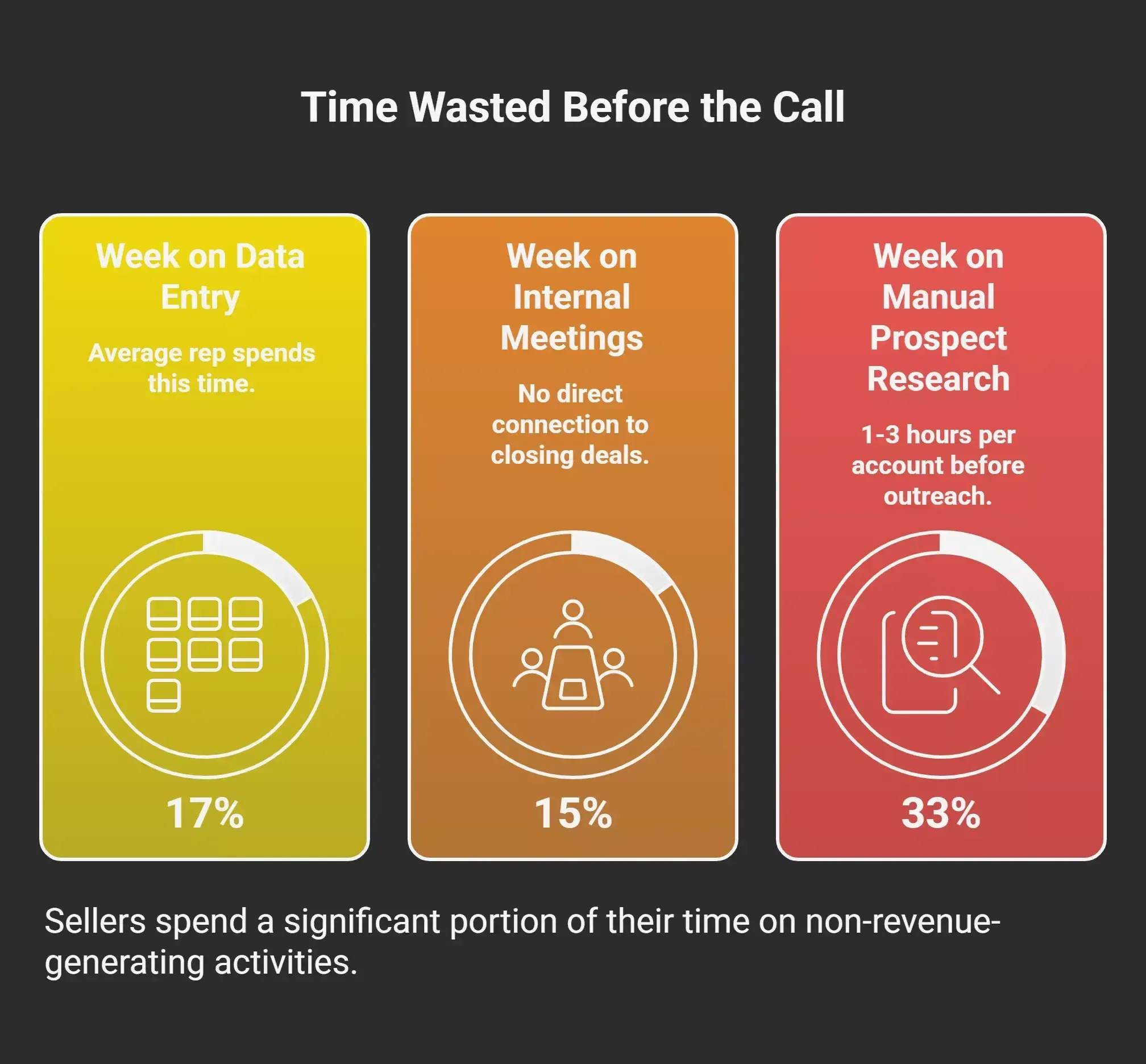 Sellers lose the majority of their workweek to tasks that produce zero revenue.
-
The average rep spends 17% of their week on data entry alone
-
Another 15% goes to internal meetings with no direct connection to closing deals
-
Manual prospect research can consume 1 to 3 hours per account before outreach or phone calls begin
For executives managing 200 or more accounts, research alone can fill 20 hours per week.
Sales leaders know this is happening. The workaround of hiring more people does not fix a broken sales process.
Too Many Tools, Not Enough Context
Sellers today use an average of eight tools to close deals. Each tool holds a fragment of information.
-
Every additional tool adds a switching cost that wipes out the time it was supposed to save
-
Fragmented information leads to lost context during sales calls
-
Managers end up reviewing incomplete briefs because reps cannot find information fast enough
Sales reps walk into major deals without a complete picture of the buyer, the competition, or the internal politics at play.
What Sales Leaders Actually Need
Many sales leaders have started requiring structured preparation before every major enterprise meeting. The goal is shorter sales cycles and fewer surprises during calls with multiple stakeholders. Effective stakeholder engagement involves aligning multiple stakeholders before the conversation starts, which can be facilitated by using AI to create alignment automatically from existing data.
-
A complete brief covers the prospect's pain points, competitive positioning, the stakeholder map, and the value proposition matched to the buyer's situation
-
Leaders who require stakeholder mapping before every big deal report faster sales cycles
-
Sales training programs increasingly focus on deal preparation as a predictor of sales performance
The gap between what leaders need and what reps can deliver in the time available is where AI-powered tools make the difference.
Effective competitive intelligence helps sales teams prepare for calls by providing insights into competitor actions, which can lead to shorter sales cycles and improved close rates.
What Goes Into a Competitive Deal Brief
A competitive brief is not a slide deck. It is a working document that gives the team everything needed to hold conversations with specific customers that move deals forward.
Pain Points and Buyer Context
The first layer is understanding what the prospect is dealing with right now. Not what your product does, but what problem the buyer wakes up thinking about.
-
Effective discovery questions help uncover urgency, context, and internal roadblocks
-
Teams that focus on understanding customer pain points and building trust close more deals in complex B2B environments
-
Conversations that start with problems rather than product features turn standard calls into consultative partnerships
Reps who skip this step end up pitching features without connecting them to the actual situation. That disconnect kills deals and stalls the sales process.
The discovery process works best when it gathers facts and helps buyers articulate their own problems.
Stakeholder Mapping and Decision Makers
Enterprise sales rarely involve a single buyer. On average, 13 people within a large organization participate in a buying decision. Knowing who those people are, what they care about, and who might block the deal separates closed deals from stalled pipelines.
-
Stakeholder mapping identifies key decision makers, influencers, and blockers inside the account
-
Understanding each stakeholder's priorities, including job title, department goals, and decision authority, sharpens messaging
-
Aligning multiple stakeholders before the conversation starts shortens the sales cycle
Without a stakeholder map, the team spends half the call figuring out who actually holds budget authority. That is the time the competition uses to push their own deals forward.
Competitive Signals and Pricing Shifts
Major deals almost always involve a head-to-head with at least one competitor. Crayon's 2025 State of Competitive Intelligence report found that sellers face direct competition in 68% of deals, yet the average team rates its competitive preparedness at just 3.8 out of 10.
-
Competitive analysis should cover product weaknesses found in G2 reviews, pricing changes, and features that the competitor recently shipped
-
Sales teams that use competitive intelligence address competitor moves directly during calls
-
Monitoring rival hiring signals and website changes reveals where competitors plan to expand
This layer of the brief tells reps what the competition will say and prepares them to counter it. Think of it as the building blocks for every competitive conversation.
Value Proposition Matched to the Buyer's Journey
Every enterprise deal has a buyer's journey. The value proposition that works in an early discovery call does not land the same way in a late-stage negotiation with the CFO.
-
Early-stage calls focus on business value and problem identification
-
Late-stage calls shift to ROI calculations, risk reduction, and customer acquisition costs
-
Cold call scripts should open with a specific problem, not a product pitch, to earn the next conversation
A brief that maps messaging to each stage gives sales reps a clear script for each conversation.
How AI-Powered Deal Briefs Change the Sales Process
AI-powered briefs consolidate scattered data from CRM records, past conversations, and market intelligence into a single view. That consolidation turns a 3-hour research session into a 10-minute review.
From Scattered Data to Customer Insights
The data sitting in your CRM is not useful as raw data until someone turns it into a story about the buyer. AI tools take information from purchase history, support tickets, and engagement patterns and synthesize it into a readable brief.
-
AI-powered lead scoring analyzes behavioral signals and firmographic data to identify which prospects need immediate attention
-
Sales professionals using AI daily are twice as likely to exceed their targets because AI handles the research they used to do manually
-
Live updates keep the brief current as the deal moves forward
The shift from scattered data to structured insights cuts hours from the sales process. With third party cookie deprecation reducing ad tracking, first-party intelligence becomes even more valuable for lead generation and sales outreach.
From Cold Call Script to the Discovery Process
Most cold call scripts fail because they pitch a product to someone who has not yet described a problem. AI-powered discovery changes this by front-loading context before the cold call happens.
-
A strong cold call script opens with a specific observation about the prospect's business
-
The discovery process becomes consultative when the rep already knows the prospect's industry and likely pain points
-
A good cold call generates information that feeds back into the brief for follow-up conversations
-
Teams that use AI for pre-call research report that their cold call connect rates and discovery process quality both improve
Phone calls grounded in real intelligence earn longer conversations.
Real Time Intelligence for Active Deals
Major deals shift rapidly. A competitor drops pricing. A new stakeholder enters the buying committee.
-
AI-powered monitoring tracks rival website changes, hiring signals, pricing pages, and feature updates
-
Real-time intelligence lets reps adjust messaging mid-deal
-
Teams that respond to competitive moves within 48 hours report higher win rates
The speed at which intelligence reaches the seller determines whether a deal moves forward or stalls.
The Discovery Process: Getting the Right Data to the Right Person
The discovery process in enterprise sales is where deals are won or lost. A well-prepared seller learns more from one call than an underprepared one learns from three.
Buyer Data and Business Context
Information about the prospect tells you what they have done. Business context tells you why.
-
Understanding a prospect's business means knowing their strategic priorities, budget cycles, and competitive pressures
-
AI tools pull context from earnings calls, press releases, job postings, and industry reports to build a richer picture of enterprise clients
-
Satisfaction scores and support ticket trends reveal pain points the prospect might not volunteer during a call
When sellers walk into a call with context already mapped, decision makers respond better.
Account Research and Lead Generation
Finding the right contact at the right company matters more than reaching a hundred wrong ones. Account research identifies which companies match your ideal buyer persona and which contacts hold budget authority.
-
AI-powered lead generation filters prospects by company size, industry, technology stack, and buying signals
-
The right data on a target account includes recent funding, leadership changes, and product roadmap signals
-
Customer data from CRM records and past conversations enriches the outreach with specific context
Outreach that starts with a specific observation about the prospect gets higher response rates than generic outreach. Many teams improve engagement by leading with something the prospect did not expect the caller to know.
Revenue Growth Through Better Preparation
Revenue growth in enterprise sales comes from closing deals at higher rates and growing existing accounts. Both depend on the quality of preparation. High-stakes deals in particular require deeper research because the cost of losing is measured in quarters, not days.
-
Teams that prepare thoroughly before conversations close more deals and generate more revenue
-
Customer satisfaction data from existing accounts helps anticipate what new buyers will care about
-
Sales calls grounded in specific insights produce longer engagement and better follow-up rates
-
Customer acquisition costs drop when sales cycles get shorter
Every conversation that starts with preparation rather than improvisation moves deals forward. Better customer interactions produce better outcomes, every single time.
Knowing What Your Rivals Just Did
Competitive monitoring in enterprise sales is not a quarterly exercise. It feeds directly into preparation and calls.
Tracking Competitor Changes
Competitors change their pricing, ship new features, and adjust messaging constantly.
-
AI-powered monitoring scans competitor websites, job boards, and social media for changes
-
Tracking feature updates helps sellers anticipate scenarios before they happen
-
A competitor cutting enterprise pricing by 20% signals a strategic push into your territory
What Lost Deals Teach
Losses carry as much intelligence as wins. Every loss reveals a gap in messaging or the discovery process.
-
Reviewing losses surfaces recurring objections that the team can address in future briefs
-
AI analyzes competitor reviews on G2 to identify product weaknesses
-
Sales leaders who track win/loss patterns build a library of handling tactics
A Flexible Framework for Outreach
No two enterprise deals look the same. A flexible framework adapts to the specific buyer, competitor, and deal stage.
-
Playbooks generated by AI include objection handling, tailored messaging, and value-based messaging matched to the buyer's situation
-
The framework adjusts based on company size, industry, and the number of stakeholders involved
-
Workflow automation handles the repetitive parts of preparation so sellers can focus on the conversation
The output should be actionable immediately. An AI assistant built into the platform can help reps explore solutions and adapt briefs to changing deal conditions, without extensive manual revisions.
Enterprise Sales Collaboration: How Cross-Functional Teams Win Together
Enterprise sales is a team sport. Sellers do not close big deals alone. They need support from marketing, product, and leadership. Sales teams that collaborate effectively across different sub-units, such as RevOps, sales engineers, and account executives, can significantly speed up the enterprise sales cycle.
Sales Teams and Marketing Team Alignment
Transparent communication and collaboration among sales teams foster trust, allowing team members to share insights and address challenges proactively, which drives efficient problem-solving. When sales teams and the marketing team work from the same data, the buyer gets a consistent experience.
-
Marketing team content, case studies, and battlecards feed directly into deal briefs
-
Many teams fail at this handoff because marketing and the revenue team use different systems
Customer Success and Product Teams
Customer success teams hold insights that sellers rarely access. Product teams know the roadmap.
-
Retention, satisfaction, and usage data help anticipate buyer concerns
-
Product teams supply information about upcoming features that counter competitor claims
-
Cross-functional teams that share insights before high-stakes deals reduce the risk of blindsiding the customer
When product teams feed roadmap intel into preparation and customer success shares retention data, reps walk into calls with a complete picture.
Coordination Between Executives and Managers
The person running the deal and the person coaching the strategy need a single document where those perspectives converge.
-
Sales managers review briefs to spot gaps in stakeholder coverage
-
Account executives structure their calls and plan follow-up sequences from the same document
-
Regular reviews catch problems before they become losses
| Component | Who Contributes | What They Add |
|---|---|---|
| Pain points | Reps, customer success | Direct buyer feedback, support trends |
| Stakeholder map | Reps, leaders | Contact roles, decision authority, internal politics |
| Competitive intel | Marketing team, product teams | Battlecards, feature comparisons, pricing data |
| Value proposition | Managers, marketing | Messaging matched to the buying stage |
| Discovery prep | Sales reps, leaders | Customized questions, handling scripts |
What Sales Leaders Are Saying
Jill Konrath, author of Selling to Big Companies and Agile Selling, captured the preparation challenge directly:
"Know your buyer's journey so you can align with it." - Source: Goodreads, Jill Konrath quotes
That alignment is exactly what deal briefs are built for. When sellers understand where the buyer sits in their process, every question, every data point, and every competitive counter lands at the right moment. Many sales leaders now treat preparation as the highest-leverage activity in the sales cycle, ahead of prospecting and even ahead of the call itself.
How Rocket.new Handles Competitive Deal Briefs for Enterprise Sales
So, how does Solve on Rocket.new build a competitive deal brief for a sales team preparing for a high-stakes enterprise call?
It starts with describing the deal, the competitors, and the buyer context. Solve returns a structured brief with research, evidence, and a clear recommendation, ready to present before the call.
Solve connects directly to Rocket Intelligence, which continuously monitors competitor moves, including pricing shifts, hiring signals, and website changes.
Rocket.new is a vibe-solutioning platform that brings research, building, and competitive intelligence into one system:
-
Vibe-solutioning platform: Describe any market problem, and Rocket returns structured research with a recommendation
-
25,000+ templates library, free to use: Adaptable to any industry or buyer
-
Saves up to 80% tokens: Faster reports without wasted compute
-
Supports Flutter (mobile) and Next.js (web): Build tools and apps from the same platform
-
Collaboration features built in: Share briefs and loop in teammates from marketing, product, and customer success
-
3 Products, One platform: Solve, Build, and Intelligence: Research with Solve, build with Build, track competitors with Intelligence, all in a shared context
Use Cases for Sales Teams
-
Pre-call preparation: Feed Solve the account name, competitors, and deal stage. Get back a structured brief covering stakeholder map, competitive stance, pain points, and discovery questions. Reps review it in 15 minutes instead of spending 3 hours on research.
-
Competitive monitoring: Intelligence tracks competitor product updates, hiring signals, and social media mentions. When a rival shifts messaging mid-deal, the team knows immediately.
-
Playbook generation: Solve generates playbooks with cold call script variations and value-based messaging. Leaders distribute these before major calls.
-
Post-call follow-up: After the call, feed Solve the outcomes for a plan with next steps and updated competitive stance.
Solve analyzes competitor reviews on G2 to identify product weaknesses and generates stakeholder maps showing the internal relationship web of the prospect. The platform aggregates real-time market signals into briefs that teams act on immediately.
AI adoption across sales teams accelerates when the tool removes work rather than adding it. Rocket does that by keeping research, building, and intelligence in one shared context.
Closing Deals Faster by Preparing Smarter
The question of how does Solve on Rocket.new build a competitive deal brief for a sales team preparing for a high-stakes enterprise call comes down to giving sellers the right information at the right time.
When briefs pull together competitor moves, stakeholder maps, and tailored messaging into a single document, reps walk into calls ready to lead.
The result is faster sales cycles, fewer losses, and more revenue. Rocket keeps all three products in one platform, so the team never loses context between research, preparation, and action.
Sign up now and prepare smarter, close faster, build your next competitive deal brief with Rocket.new Solve.
Table of contents
- -Why Most Enterprise Sales Teams Walk Into Big Calls Underprepared
- -The 70% Problem: Time Wasted Before the Call
- -Too Many Tools, Not Enough Context
- -What Sales Leaders Actually Need
- -What Goes Into a Competitive Deal Brief
- -Pain Points and Buyer Context
- -Stakeholder Mapping and Decision Makers
- -Competitive Signals and Pricing Shifts
- -Value Proposition Matched to the Buyer's Journey
- -How AI-Powered Deal Briefs Change the Sales Process
- -From Scattered Data to Customer Insights
- -From Cold Call Script to the Discovery Process
- -Real Time Intelligence for Active Deals
- -The Discovery Process: Getting the Right Data to the Right Person
- -Buyer Data and Business Context
- -Account Research and Lead Generation
- -Revenue Growth Through Better Preparation
- -Knowing What Your Rivals Just Did
- -Tracking Competitor Changes
- -What Lost Deals Teach
- -A Flexible Framework for Outreach
- -Enterprise Sales Collaboration: How Cross-Functional Teams Win Together
- -Sales Teams and Marketing Team Alignment
- -Customer Success and Product Teams
- -Coordination Between Executives and Managers
- -What Sales Leaders Are Saying
- -How Rocket.new Handles Competitive Deal Briefs for Enterprise Sales
- -Use Cases for Sales Teams
- -Closing Deals Faster by Preparing Smarter