
Most AI builders treat the database as an afterthought. We made it the starting point.
When people hear that Rocket supports Supabase, they assume it works like every other integration: build first, wire up the database later, bolt on auth, remember security policies, debug why everything broke.
That's not what happens. When you connect Supabase to Rocket, the schema, authentication, row-level security, and queries become part of the generation itself. The data layer was never separate from the build, it was the foundation the build was generated on top of.
The Problem With "Integration After Build"
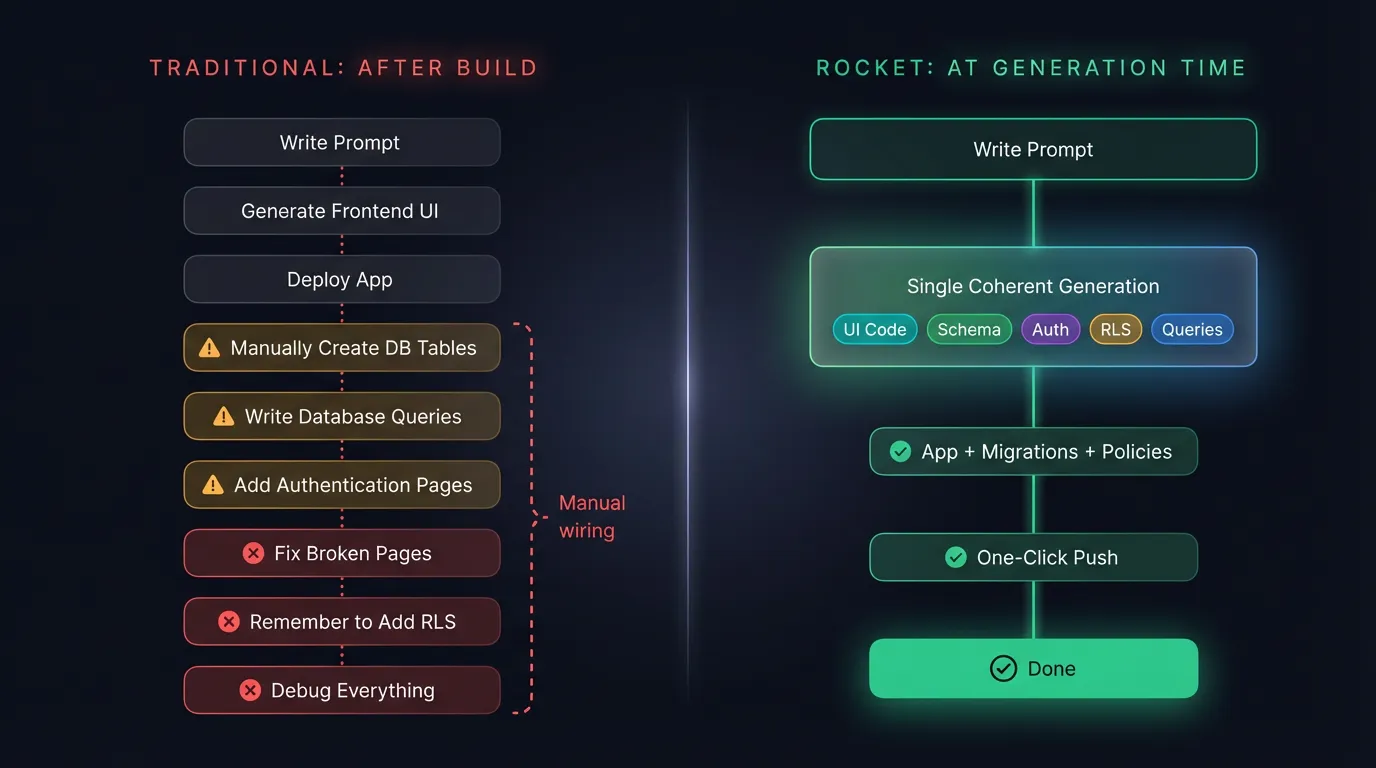
Most AI app builders follow the same pattern: generate a frontend with placeholder data, then spend the next hour manually creating tables, replacing fake queries with real ones, adding auth pages, and retrofitting security. Half the app breaks because auth state wasn't accounted for when pages were originally generated.
This is "integration after build." Every piece like auth, queries, security is a separate task you do after the fact. The result: broken references, missing auth guards, forgotten security policies, and an app assembled from disconnected parts.
What "Integration at Generation Time" Means
Rocket takes a different approach. When Supabase is connected, the generation context already includes the database schema, authentication configuration, Row-Level Security policies, storage buckets, and Edge Functions, before a single line of app code is written.
All of this becomes input to the generation. Not configuration you apply after.
The difference isn't convenience, it's coherence. The generator doesn't create pages and then add login gates; it generates pages that are inherently aware of authentication state. It doesn't write placeholder queries; it writes real queries against real tables with real types from the start.
Why This Produces Fundamentally Different Output
This isn't a workflow improvement. It changes the output at a structural level.
Auth-aware pages from the start. Every component is generated with auth state in mind; protected routes have proper redirects, user-specific data has the right loading and empty states, the logout button exists because the generator knew there would be a logged-in user. No retrofitting, no flash-of-unauthenticated-content bugs.
RLS policies that actually exist. Row-Level Security is the most important and most frequently forgotten part of any Supabase app. When RLS is part of the generation, the migration that creates a table also creates its security policies. They're generated together because they belong together.
Schema-accurate queries. Queries reference real column names and real types. Foreign key relationships are respected in the UI. Sorting and filtering work because the generator knows the schema.
Migrations that track with the app. Add a feature through chat and Rocket generates both the UI changes and the corresponding migration script in the same step. No drift between what your app expects and what your database has.
Schema Evolution
The generation-time approach holds through iteration. New feature needs new tables or columns? The schema change and code change are generated as one unit. A migration appears in chat, you push it, and the app and database stay in sync. Schema drift. The most common source of bugs in database-backed apps doesn't happen.
Existing Projects
Already have a Supabase project with tables, data, and auth? Connect it to Rocket and start building. Your existing schema becomes the generation context, build a new frontend, an admin dashboard, or a mobile companion against data that's already there. No export/import, no manual wiring.
Edge Functions
Same principle. When your app needs server-side logic like sending emails, calling APIs with secret keys, processing webhooks, Rocket generates the Edge Function as part of the same build. The frontend already knows how to call the function because they were created together. No separate backend setup, no manual endpoint wiring.
The Core Idea
Rocket doesn't plug in the database after the app exists, it generates the app from the database. Schema, auth, security policies, queries. All first-class inputs to the generation, not afterthoughts bolted on later.
The result: an app that works the moment it's generated.
If you are someone who builds apps with Supabase, read our step-by-step guide about how to use it in your Rocket-powered project.