
A step-by-step guide to calculating TAM, SAM, and SOM for startup founders and builders. Covers top-down and bottom-up methods, common investor pitch mistakes, and how Rocket.new's Solve delivers structured market sizing reports in under two hours.
What does every serious investor ask before writing a check? How big is this market, really? Not the hopeful version - the real one.
TAM SAM SOM - three acronyms that separate the builders who attract investors from those who get a polite pass.
According to CB Insights' analysis of over 100 failed startups, 42% shut down simply because they built something with no genuine market need. Not because the product was flawed. Because the market was never properly sized before a single line of code was written.
This blog breaks down how to use a TAM SAM SOM calculator the right way - with a bottom up approach grounded in real market data - and shows how Rocket.new's Solve turns what typically takes a research team days into a structured, actionable output in under two hours.
What TAM SAM SOM Actually Means
TAM SAM SOM are three nested layers of market sizing. They form the foundation of any credible business plan and give you - and potential investors - a structured view of the market opportunity in front of you.
Here's the clearest way to define them:
| Term | Full Name | What It Tells You |
|---|---|---|
| TAM | Total Addressable Market | The entire market demand if you captured every possible customer globally |
| SAM | Serviceable Addressable Market | The portion of TAM you can realistically serve based on your model, geography, and product |
| SOM | Serviceable Obtainable Market | The share of SAM you can realistically capture in the next 1-3 years |
TAM represents the ceiling. SAM filters for product and market fit. SOM is your honest, near-term revenue target.
Together, they tell a story to investors. A large total addressable market signals the opportunity is worth pursuing. A well-defined serviceable addressable market shows you know your target market and your constraints. A credible serviceable, and obtainable market tells investors you understand competition and what your team can realistically deliver.
Get any one of the three wrong, and the story falls apart - and so does investor confidence.
Why Builders Get Market Sizing Wrong
Most founders approach calculating market size the wrong way. They find a broad industry report, see a number like "$2.3 trillion global software market," divide by 100, and write "$23 billion" on the TAM slide of their pitch deck.
Investors have seen this approach thousands of times. It signals shallow thinking and actively hurts your case.
There's a sharp and widely shared observation from the founder community that sums this up well:
"Most founders get their market sizing wrong. Not because they can't do the math, but because they don't understand what each number is actually telling investors. SOM is where most decks lose credibility - founders either lowball it out of fear or inflate it to impress. The SAM isn't just a smaller number. It's the first signal of your go-to-market thinking." - Iswarya R, Pitch Strategist, LinkedIn
The problem is not the math. It's the understanding of what each number is actually communicating.
A TAM number pulled from a generic industry research report without careful filtering isn't useful market data - it's noise dressed up as analysis. The top-down approach is a valid starting point, but it needs to be grounded in real filters: geography, pricing model, customer profile, and product category specifics.
That's where most market sizing exercises fail. And it's why the bottom up approach, done properly, is so much more convincing.
The Two Methods to Calculate TAM SAM SOM
Before you open any calculator, you need to choose an approach. Both have legitimate uses, and the best builders use them together.
Top Down Approach
The top down approach starts with broad industry data - usually from market reports, industry research, or government sources - then narrows down using a series of filters.
How it works:
-
Find the total market demand figure for your category (from sources like Statista, IBISWorld, or Gartner reports)
-
Apply a geographic filter to match where you operate
-
Apply a product category or segment filter
-
Filter by the customer profile that matches your ideal buyer
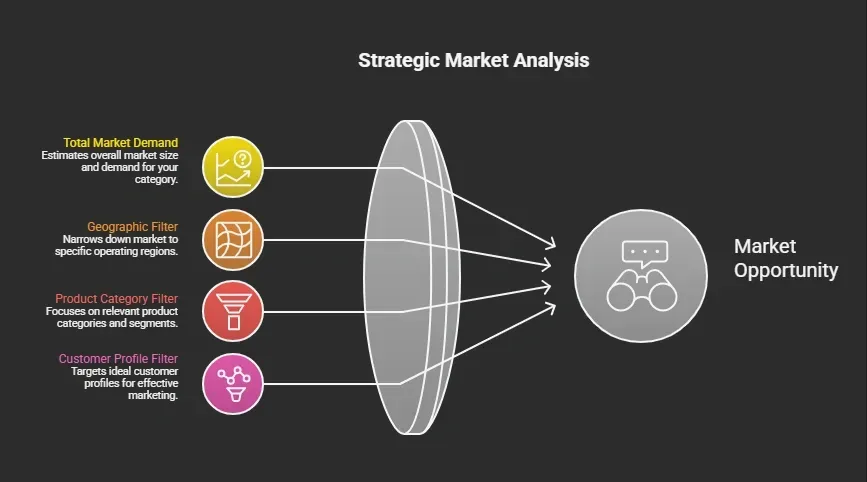 Example - a project management tool for freelance designers in the US:
-
TAM: Global project management software - $6.7B
-
SAM after geographic and segment filters: US-based creative professionals on SaaS tools - ~$780M
-
SOM in year 1 at 0.5% of SAM: ~$3.9M
The top down approach is fast and useful for early validation. The weakness is that it can feel abstract and unconvincing if the filters look arbitrary. Use it to set direction, not as your only evidence.
Bottom Up Approach
The bottom up approach builds your estimate from individual customer data and works upward.
How it works:
-
Define your ideal customer profile with precision
-
Count how many of those potential customers actually exist in your addressable market
-
Multiply by your average contract value or average revenue per customer
-
Scale by a realistic conversion rate
Same example using the bottom up approach:
-
US freelance designers actively paying for productivity tools: ~150,000
-
Average revenue per customer per year: $180
-
SAM: 150,000 x $180 = $27M
-
SOM at 5% market penetration in year 1: $1.35M
This is harder to build, but far more defensible. It forces you to think the way your sales team thinks, and it shows investors you understand your customer acquisition process before you've spent a dollar on it.
Most serious builders use both methods and compare the results. When both approaches produce estimates in a similar range, you have a credible market sizing story that holds up under scrutiny.
How to Calculate TAM SAM SOM: A Step-by-Step Flow
Step 1: Define Your Target Market
Start with precision. Your target market is not everyone who could theoretically use your product. It's the specific segment who has the problem you solve, can pay your price, and is reachable through your distribution model.
Good market segmentation at this stage prevents inflated SAM estimates later. Get this wrong and every number downstream becomes unreliable.
Step 2: Calculate TAM
Using the bottom up approach: multiply total potential customers in your category by average annual revenue per customer. This gives you total market demand if you captured every possible buyer.
Using the top down approach: pull total industry revenue from market reports, then multiply by your applicable segment percentage.
TAM represents the theoretical ceiling. It shows the scale of the opportunity, not the realistic target.
Step 3: Narrow Down to SAM
SAM calculation filters your TAM through realistic constraints:
-
Which geographies can you actually serve right now?
-
Which customer profiles genuinely match your product's use case?
-
What price point are your potential customers willing to pay?
-
Which market segments align with your current go to market strategy?
For most early-stage companies, SAM lands somewhere between 10% and 30% of TAM. If your SAM is significantly larger than that relative to a large TAM, your filters are probably too loose.
Step 4: Set Your SOM
SOM is the slice of your SAM you can realistically capture in a defined near-term window - typically 1 to 3 years. The key inputs:
-
Your traction or proof points so far
-
Market penetration rates for comparable companies at your stage
-
Your current team, marketing budget, and sales capacity
-
The number and strength of competitors in the space
New startups should realistically capture between 1% and 5% of their SAM in years one through three. Setting a higher SOM without strong evidence will lose credibility with investors fast.
Common Market Sizing Mistakes That Hurt Investor Confidence
Market sizing mistakes don't just give investors bad numbers - they signal you don't fully understand the business you're building.
The most common ones:
-
Using TAM as your lead number in a pitch - TAM is context for the scale of the opportunity. SOM is the number that tells investors what you're actually targeting.
-
Skipping the bottom up check - A top down analysis alone reads as surface-level research. Pairing it with a bottom up model shows depth.
-
Ignoring market dynamics - A fast-growing market and a mature, stable one require different SOM projections. Market trends matter.
-
Using outdated market data - Industry reports older than 18 months can significantly misrepresent current market conditions, especially in technology-driven categories.
-
The 1% of a trillion-dollar market slide - This is the oldest error in the pitch deck playbook. Every investor has seen it. None of them trust it.
-
Treating SAM and SOM as the same number - SAM is what you could theoretically serve. SOM is what you'll realistically win. Conflating them is a red flag.
The builders who attract investors are the ones who show they've done the work - with market data, competitor research, and bottom up assumptions they can defend in a conversation.
Launching the Right Way: TAM SAM SOM with Rocket.new
Here's where most builders hit a real obstacle. Thorough market research takes days. Pulling together industry reports, running customer interviews, sizing market segments, analyzing competitors, and building defensible SAM and SOM calculations is a serious time commitment - often measured in weeks, not hours.
This is the gap Rocket.new was built to close.
Rocket.new is the world's first Vibe Solutioning platform. It's the only place where the business thinking and the building happen inside the same workspace. Its Solve pillar takes any question written in plain language and returns a complete, multi-source analytical report within 60 to 90 minutes.
For a TAM SAM SOM exercise, you can prompt Solve with something like:
"What is the market size for AI-powered project management tools targeting freelance designers in the US? Include TAM, SAM, and SOM estimates with growth projections through 2027."
Solve then runs thousands of queries across 150+ sources simultaneously. It identifies relevant market segments, surfaces competitor data, analyzes pricing models, and returns a structured report with findings tagged by signal strength. Every finding either has supporting evidence or is flagged as an assumption.
The output includes:
-
Executive summary with direct recommendations
-
TAM, SAM, and SOM market sizing analysis
-
Competitive picture with key players and positioning gaps
-
Risk matrix
-
Execution path with next steps
And critically - the Solve output doesn't disappear after you export it. It stays in your project. When you move to Build to create a landing page or a web app, the market context Solve surfaced is already in the room. You don't re-explain the customer problem or the competitive dynamics. Every subsequent task inherits the full picture.
How Rocket.new Compares to Build-Only Tools
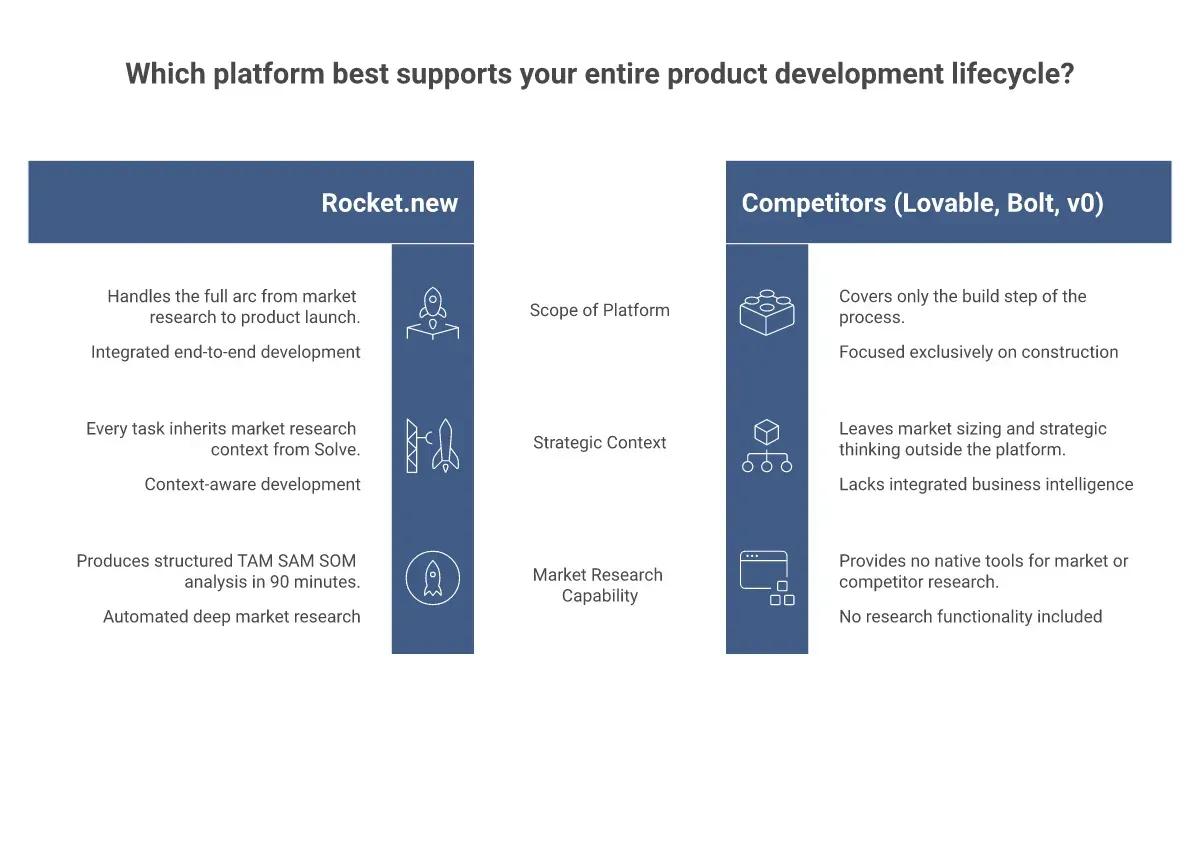 Rocket.new vs Competitors Comparison
Platforms like Lovable, Bolt, and v0 are fast at the build step. You arrive with an idea and leave with a product. They're genuinely useful for building.
The structural gap is everything before the build. None of them do market research. None of them validate whether the direction is right before you commit to building. The TAM SAM SOM analysis, the competitor research, the market sizing exercise - all of that still happens elsewhere, on different tools, by different people, in a separate workflow that doesn't connect to the product being built.
Rocket.new closes that gap. The research happens inside the platform. It flows directly into Build through a shared context structure that carries everything forward.
| Capability | Rocket.new | Lovable / Bolt / v0 |
|---|---|---|
| TAM SAM SOM market sizing | Yes - via Solve | No |
| Pre-build market research | Yes - structured report | No |
| Competitor monitoring | Yes - Intelligence pillar | No |
| Shared project memory | Yes - compounds across tasks | No |
| Production app building | Yes - Next.js and Flutter | Yes |
| Human escalation path | Yes - Success team | No |
The difference is not speed. It's the quality of thinking before the build.
Rocket.new Features for Builders Running Market Analysis
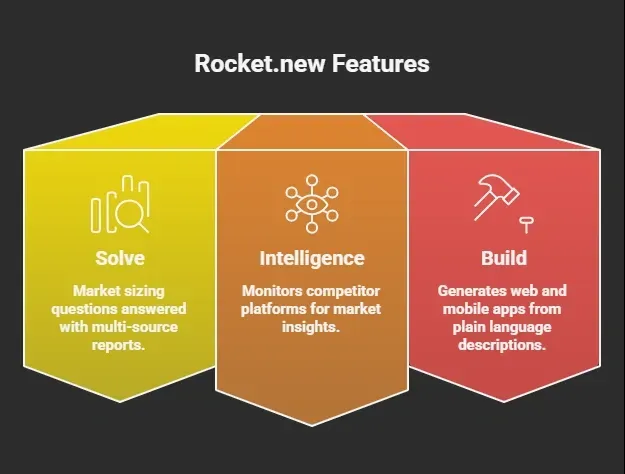 Solve - Takes any market sizing question in plain language and returns a full, multi-source report with TAM, SAM, and SOM estimates. Findings tagged by signal strength. Exportable as PDF or PPT. Done in under two hours versus days of research.
Intelligence - Monitors every public platform your competitors operate on, continuously. Pricing page changes, product launches, social activity, hiring signals - all interpreted for what they mean to your position in the market.
Build - Once you've validated the market and built your go to market strategy, Build generates production-grade web apps in Next.js and mobile apps in Flutter from a plain language description. Most apps go from prompt to live preview in 1-3 minutes.
Projects and Context - Everything Solve learns stays in the project. Open Build after a Solve market research session and the competitive intelligence, customer problem, and market positioning are already there. Nothing gets lost between the thinking and the building.
From Market Sizing to Go to Market Strategy
A TAM SAM SOM exercise isn't just for pitch decks. It's the foundation of every practical business growth decision you'll make.
Once you've worked out your SOM, you now have the inputs for:
-
Marketing and sales strategies - how many leads do you need to convert to hit your SOM target?
-
Marketing budget planning - what's the right spend to reach the market share you're targeting?
-
Sales team sizing - how many people do you need to serve the volume your SOM assumes?
-
Annual revenue projections - year 1, 2, and 3 numbers grounded in real market data rather than wishful thinking
-
Pricing strategy pressure-testing - does your current pricing allow you to capture your SOM at a viable cost per acquisition?
The bottom up approach to market sizing feeds naturally into all of this. If your SOM is $1.2M in year 1, you know the exact lead volume, conversion rate, and average contract value needed to get there. That's business strategy built on market reality.
The Right Foundation for Every Build
The whole purpose of a TAM SAM SOM calculator is to force honest thinking before you commit resources. The numbers don't need to be perfect - they need to be grounded, defensible, and built on real market data rather than optimism.
For builders, the stakes are particularly high. Every day spent building a product before the market is validated is a day that can't come back.
Rocket.new was designed for exactly this moment in the workflow. Before you build, before you pitch, before you write a single line of code - Solve gives you the structured market intelligence needed to answer the market sizing question properly. Then Build takes that foundation and turns it into a production-grade product. Research and building, inside one platform, feeding each other through shared context that compounds over time.
Table of contents
- -What TAM SAM SOM Actually Means
- -Why Builders Get Market Sizing Wrong
- -The Two Methods to Calculate TAM SAM SOM
- -Top Down Approach
- -Bottom Up Approach
- -How to Calculate TAM SAM SOM: A Step-by-Step Flow
- -Step 1: Define Your Target Market
- -Step 2: Calculate TAM
- -Step 3: Narrow Down to SAM
- -Step 4: Set Your SOM
- -Common Market Sizing Mistakes That Hurt Investor Confidence
- -Launching the Right Way: TAM SAM SOM with Rocket.new
- -How Rocket.new Compares to Build-Only Tools
- -Rocket.new Features for Builders Running Market Analysis
- -From Market Sizing to Go to Market Strategy
- -The Right Foundation for Every Build