
The right tech stack for web development in 2026 depends on project scale, team expertise, and time-to-launch. Next.js + Supabase leads for most SaaS products. AI-powered platforms like Rocket.new generate a full production stack in minutes, removing the need to assemble infrastructure manually.
The right tech stack for web development determines how fast your team ships, how well your app scales, and how much maintenance it demands over time. This guide covers the key layers of a web development stack, the most popular stacks in active use, the practical factors that drive the decision, and how modern AI-powered platforms are changing what "choosing a stack" even means.
What Is a Tech Stack in Web Development?
A tech stack is the combination of programming languages, frameworks, databases, and infrastructure tools used to build a web application. A web application is generally split into client-side and server-side parts, so the key components must work together for the product to function.
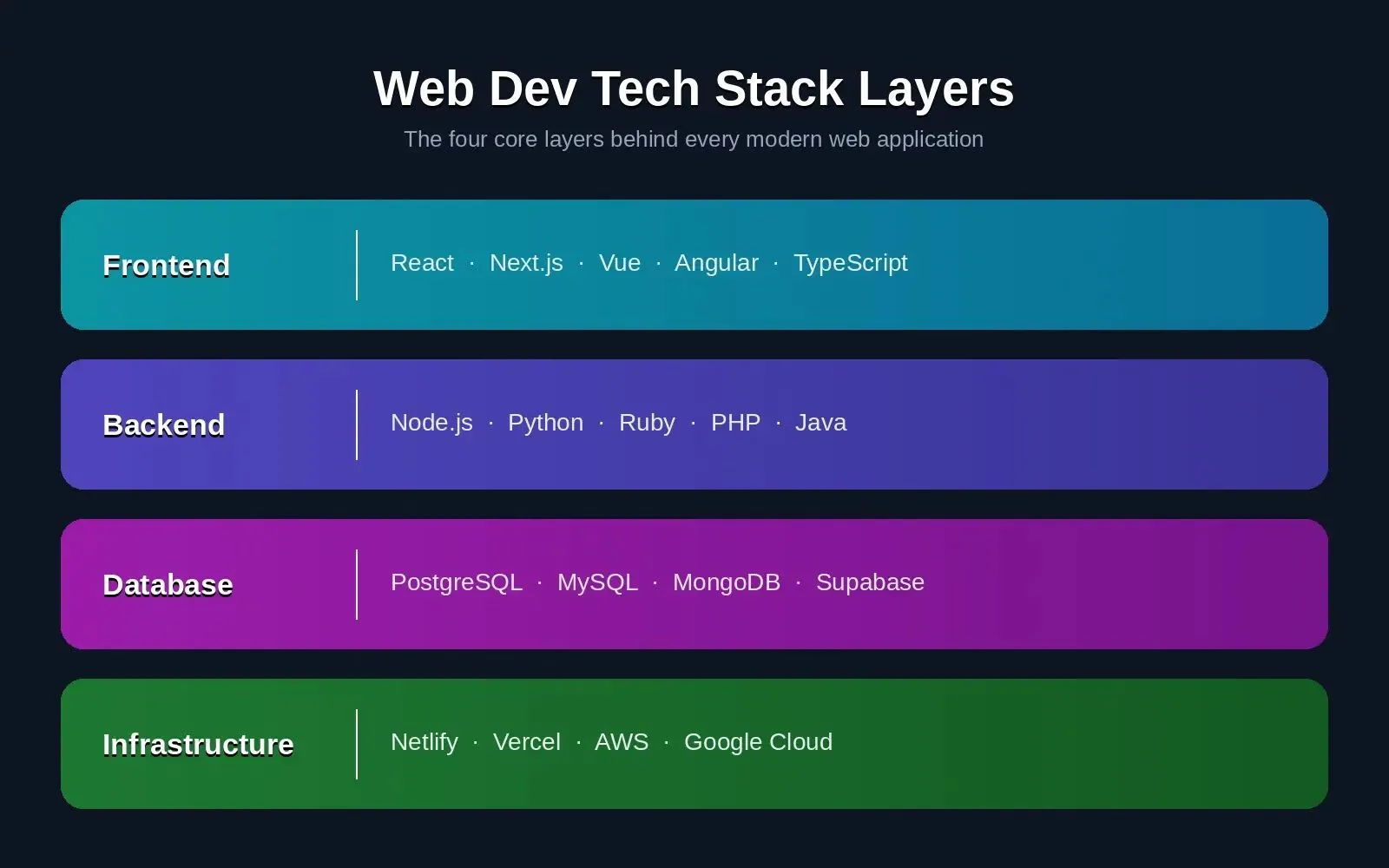
The four core layers of a web development tech stack each handle a distinct responsibility in the application. A tech stack can be a front-end tech stack, a back-end tech stack, or a full stack that combines both.
| Layer | Job | Common Examples |
|---|---|---|
| Frontend | User Interface, Markup Language, and Scripting/Programming Language for client-side behavior | React, Next.js, Vue, Angular |
| Backend | Server-side logic, APIs, authentication | Node.js, Python, Ruby, PHP |
| Database | Structured data storage and retrieval | PostgreSQL, MySQL, MongoDB |
| Infrastructure | Hosting, deployment, CDN, cloud services | Netlify, Vercel, AWS, GCP |
Modern web applications also rely on additional layers: third-party APIs, microservices, authentication providers, and increasingly, AI model integrations. In practice, a back-end tech stack consists of application logic, file system, database, hosting, web server, and operating system. The definition of "stack" has expanded well beyond the classic frontend-backend-database trio.
Frontend and Backend: The Two Core Sides
Frontend
The frontend is the client-side part users see and interact with on web pages and dynamic websites. It runs in the browser and controls the Document Object Model, navigation, animations, and UI state, with three main components: the User Interface, Markup Language, and Scripting/Programming Language.
Common frontend programming languages and frameworks:
- JavaScript and TypeScript (the dominant languages)
- React and Next.js (component-based, server-side rendering)
- Vue and Angular (alternative frameworks with strong ecosystems)
- HTML and CSS (the structural and styling foundation)
These are the core frontend technologies used to build the client side.
Next.js has become the default choice for production web apps in 2026. It supports server-side rendering, static generation, and API routes in a single framework, which reduces the need for a separate backend service for many use cases, and React-based frameworks are especially valued for dynamic user interfaces in modern web app development.
Backend
The backend is the server-side part of the application, often referred to as the back end tech stack: authentication, database queries, business rules, and API responses. It runs inside a runtime environment, communicates with the database, and returns data to the client. This stack also spans multiple layers, including Application Logic, File System, Database, Hosting, Web Server, and Operating System.
Common backend technologies:
- Node.js (JavaScript on the server, pairs naturally with React frontends)
- Python with FastAPI or Django (popular for data-heavy and AI-integrated apps)
- Ruby on Rails (convention-over-configuration, fast to prototype)
- PHP with Laravel (still dominant in CMS and e-commerce contexts)
- Java and Spring Boot (enterprise-grade, strongly typed)
A web framework is the software layer used to implement server-side logic quickly, so the backend choice is often driven by team expertise more than technical superiority. A team fluent in Python will ship faster with FastAPI than they would if they were learning Go from scratch, especially when a solid development environment supports rapid development and smoother releases.
Popular Tech Stacks in Active Use
MEAN Stack
MongoDB, Express, Angular, Node.js. A fully JavaScript stack that works well for single-page applications and real-time features. The shared language across frontend and backend reduces context-switching for developers. That’s one reason MEAN remains one of the popular web development stacks, since using JavaScript on both sides can simplify the development process.
LAMP Stack
Linux, Apache, MySQL, PHP. One of the oldest and most deployed stacks on the web. Powers a large share of content management systems, including WordPress. Mature, well-documented, and widely hosted.
Ruby on Rails
Convention-over-configuration framework that generates a full MVC structure from a single command. Historically popular as a web framework for rapid development of complex web applications, especially in early-stage startups. Strong ORM, built-in testing, and an opinionated project structure that keeps teams aligned.
Serverless Stack
Rather than managing a persistent server, serverless architectures run functions on demand via managed cloud platforms. AWS Lambda, Google Cloud Functions, and Supabase Edge Functions are common choices. The platform handles scaling, uptime, and infrastructure, teams write code, not DevOps. Understanding serverless architecture is increasingly important as cloud-native patterns become the default for scalable apps.
JAMstack
Static site generation with dynamic behavior delivered via APIs. Next.js with a headless CMS like Strapi or Directus is a common JAMstack pattern. Fast page loads, strong SEO defaults, and easy CDN deployment are the main advantages.
How to Choose the Right Tech Stack
Choosing a technology stack is a decision with long-term consequences, and the right technology stack affects cost, maintainability, and long-term risk. Here are the factors that matter most when evaluating the chosen technology stack, including security requirements, especially for apps handling confidential user data, and the overall cost across licensing, maintenance, and developer salaries.
Tech Stack Decision Flow
Choose your stack based on project type and team skills. When speed matters most, AI-powered builders eliminate the assembly step entirely.
Factor 1: Project Requirements and Scale
Start with the product, not the technology. Define what you’re building first, because different tech stacks fit different project types, whether that’s a web app, a mobile application, or a broader digital platform. How many concurrent users? Does it need real-time updates? Is there a mobile component? If the project involves artificial intelligence, machine learning, or heavy data analytics, those answers usually narrow language and framework choices early, before you evaluate a single framework.
A personal portfolio and a multi-tenant SaaS platform have completely different requirements. Trying to use the same stack for both leads to either over-engineering or under-building.
Factor 2: Team Expertise
The best stack is the one your development team already knows and can realistically build and maintain over time. Switching languages mid-project is expensive and can disrupt the broader software development workflow. If your backend engineers know Python and your frontend engineers know React, a FastAPI + Next.js stack will outperform a theoretically "better" stack your team needs to learn from scratch.
Factor 3: Time to Launch
This is the factor most teams are underweight. A stack that takes six weeks to set up correctly versus one that takes two days has a real business cost. The Stack Overflow Developer Survey consistently shows that developer productivity and tooling familiarity rank among the top factors in technology adoption decisions.
Factor 4: Scalability and Performance
Some stacks scale horizontally more easily than others. A modern tech stack often includes more than app code because teams must support many devices and much higher volumes of events and data processing. Node.js handles concurrent I/O-heavy workloads well, and modern technologies now often add tools for containerization, performance monitoring, and cloud services to improve scalability and maintainability. PostgreSQL is a reliable choice for relational data at scale. For high-performance web applications, the database and caching layer often matter more than the framework choice.
Factor 5: Community and Longevity
A framework with an active community means faster debugging, more third-party libraries, stronger integration capabilities with third-party tools and web services, and a lower risk of abandonment. React, Next.js, PostgreSQL, and Node.js all have large, stable communities. Choosing an obscure framework to solve a problem that a mainstream one handles well is rarely worth the tradeoff, since emerging technologies may offer upside but usually come with more risk.
What Developers Are Actually Shipping
In a Reddit discussion where developers shared their current stacks, the most common pattern was flexibility across multiple languages rather than loyalty to a single stack:
"Tech stack: I am flexible with any tech stack… Java, JS, PHP, Laravel, React, Vue, Angular, Node.js, Spring, Next.js, FastAPI."
This reflects a real shift in how experienced developers work. The question is less "which stack is best" and more "which stack fits this project and this team right now."
Stack Comparison: Popular Options at a Glance
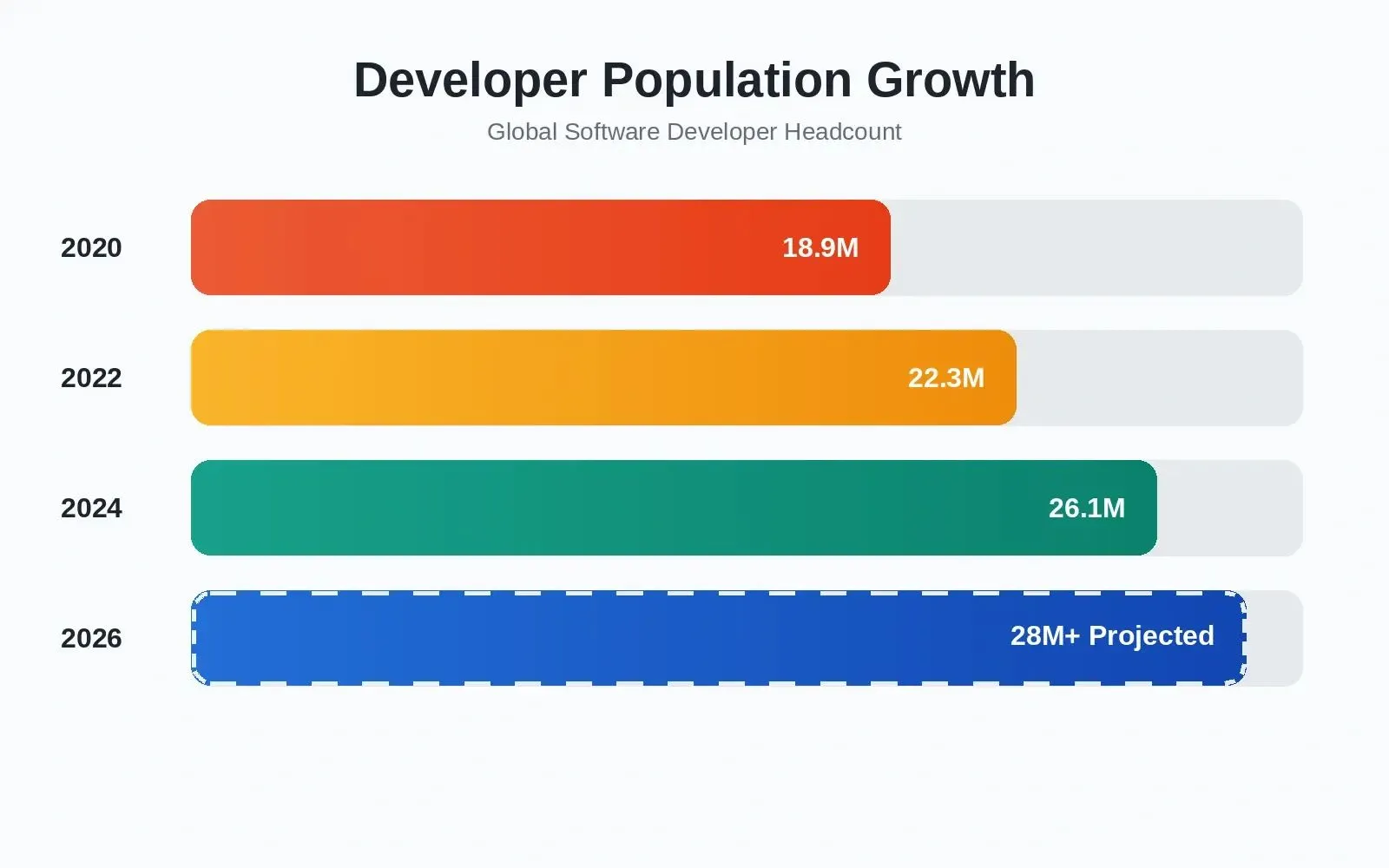
Global developer headcount has grown steadily, making stack decisions more consequential as more teams compete to ship faster.
| Stack | Best For | Frontend | Backend | Database | Deployment |
|---|---|---|---|---|---|
| MEAN | Real-time SPAs | Angular | Node.js / Express | MongoDB | Any Node host |
| MERN | A popular tech stack for full-stack apps | React | Node.js / Express | MongoDB | Any Node host |
| PERN | Data-driven apps | React | Express.js / Node.js | PostgreSQL | Any Node host |
| LAMP | CMS / WordPress | HTML / JS | PHP | MySQL | Shared hosting |
| Rails | Rapid prototyping | ERB / React | Ruby | PostgreSQL | Heroku / Render |
| Serverless | Variable-traffic apps | React / Next.js | Lambda / Edge Functions | Postgres | AWS / GCP |
| JAMstack | Content-heavy sites | Next.js / Astro | Headless APIs | Any | Netlify / Vercel |
| AI Builder | MVP / fast launch | Next.js (generated) | Supabase (generated) | PostgreSQL | Netlify (one-click) |
How Rocket.new Changes the Stack Decision
Here is where the traditional stack decision gets disrupted.
Rocket.new is a vibe solutioning platform built on three pillars: Solve (market research and validation), Build (AI app generation), and Intelligence (competitor monitoring). Most teams evaluating a tech stack are really asking: "What do I need to assemble to ship this product?"
Rocket's Build pillar answers that question differently, instead of forcing teams to piece together separate layers manually, it assembles a solutions stack for you, which changes how teams approach software development tech stacks for web and mobile products.
What Rocket Generates
When you describe an app in plain language or import a Figma design, Rocket generates a specific, production-grade stack. Understanding why Rocket generates Next.js and Flutter specifically comes down to their production-readiness, ecosystem maturity, and cross-platform capability.
- Next.js for all web apps (set as the default stack as of February 2026)
- Flutter for iOS and Android mobile apps; an open-source UI toolkit for building natively compiled applications for mobile, web, and desktop from a single codebase
- Supabase backend with PostgreSQL database, user authentication, file storage, and edge functions, all wired automatically
The code is downloadable, GitHub-syncable, and extensible by your own developers.
Rocket generates a specific, named stack, not a vague abstraction. Every web app gets Next.js, every mobile app gets Flutter, and every backend gets Supabase.
The Connector Library
Rocket connects to 26+ services from a single prompt. The Supabase integration alone handles Postgres database scaffolding, user auth, file storage, and edge functions, all from a chat prompt with no manual configuration.
The full connector library spans:
- Payments: Stripe, Razorpay
- AI models: OpenAI (GPT), Anthropic (Claude), Google Gemini, Perplexity, ElevenLabs
- Databases and CMS: Supabase, Airtable, Strapi, Directus, Webflow
- Email: Resend, SendGrid, Brevo, MailerLite, Mailchimp, Twilio
- Analytics: Google Analytics 4, Mixpanel
- Productivity: Notion, Linear, Jira, Confluence, Google Workspace, Azure DevOps
- CRM: HubSpot
- Deployment: Netlify (one-click, automatic HTTPS, global CDN), custom domains
For a SaaS product, the recommended stack is Supabase + Stripe + Resend + Netlify. Adding Stripe payment integration to any Rocket-built app takes a single chat command.
The Three Pillars Working Together
What separates Rocket from a simple code generator is the integration of all three pillars.
Solve validates the idea before you write a line of code. Run a market research report, size the market, analyze competitors. Solve produces structured, evidence-backed reports exportable as PDF, HTML, or PowerPoint. You can validate your business idea before committing to a stack at all.
Build takes the validated idea into production. Describe the app, import a Figma design, or start from a template. Generation takes approximately 3 minutes for a first version. The Advisor Agent, a built-in senior architect sub-agent, resolves error loops and makes architectural decisions automatically.
Intelligence monitors competitors across nine signal pillars after launch: website changes, social media, news coverage, GTM activity, product and technology updates, hiring patterns, business and finance signals, reviews, and community sentiment.
Traditional Stack Assembly vs. Rocket Build
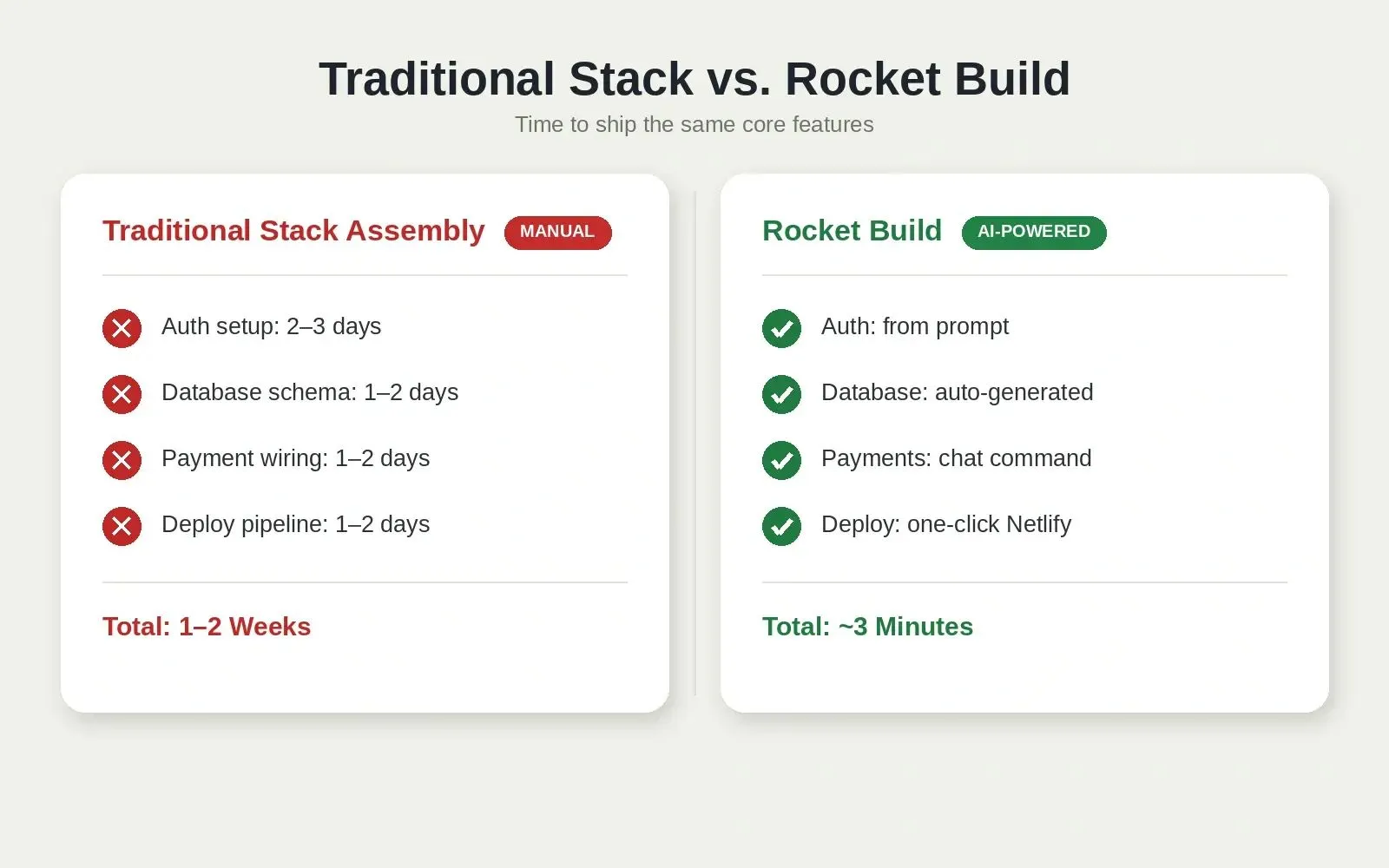
The time difference between assembling a traditional stack and generating one with Rocket is measured in weeks versus minutes.
| Task | Traditional Stack | Rocket Build |
|---|---|---|
| Auth setup | Configure provider, write middleware | Supabase auth from prompt |
| Database schema | Design, migrate, seed manually | Generated from app description |
| Payment integration | Read docs, write webhook handlers | Stripe from chat command |
| Deployment pipeline | Configure CI/CD, DNS, SSL | One-click Netlify, auto HTTPS |
| Mobile app | Separate Flutter project | Same prompt, Flutter output |
| Time to first deploy | Days to weeks | ~3 minutes |
A Concrete Example: Booking App
Here is what building a consulting booking app in Rocket looks like in practice. This is the kind of app that would take a traditional team 1-2 weeks to wire up from scratch.
- Prompt: "Build a consulting booking app with calendar scheduling, user profiles, paid sessions, and email reminders."
- Rocket generates: Next.js frontend with booking UI, Supabase backend with user auth and session storage, Calendly integration for scheduling, Stripe for paid sessions, Resend for confirmation emails.
- Deploy: One-click Netlify publish. Custom domain connected with automatic HTTPS.
- Iterate: Chat to add features, adjust styling via Visual Edit, or import a Figma design to replace the generated UI.
The entire stack, frontend, backend, database, payments, email, deployment, is assembled for enabling developers to focus on the product instead of infrastructure, without a single DevOps task. Rocket is a full-stack AI builder that handles the infrastructure layer so product teams can focus on the product.
Making the Right Choice for Your Project
Choosing a technology stack is ultimately a product decision, not a technical one. The right technology stack depends on the product, the people maintaining it, and the long-term needs of the web application development lifecycle. The right stack is the one that ships your product on time, scales to your user base, and your team can maintain without burning out.
For teams with strong engineering resources and specific technical requirements, assembling a custom stack, Next.js + Supabase + Stripe + Netlify is a strong default for many modern web applications in 2026, gives maximum control and extensibility. But most tech stacks should still be chosen around project-specific constraints.
For teams optimizing for speed, an AI-powered platform that generates a production-grade Next.js + Supabase stack in minutes changes the calculus entirely. The stack decision becomes less about which technologies to choose and more about whether you need to choose at all.
Generate Production Ready App with Next.js and Supabase Stack
Stop spending weeks assembling infrastructure before you can ship a single feature. Rocket.new generates a production-ready Next.js + Supabase stack from a plain-language prompt, acting as a light technology consulting layer that guides setup automatically across the generated stack and development environment, with Stripe payments, Netlify deployment, and 26+ connectors wired automatically.
Validate your idea with Solve, build the product with Build, and monitor competitors with Intelligence. Start building for free on Rocket and go from idea to deployed app in minutes.
Table of contents
- -What Is a Tech Stack in Web Development?
- -Frontend and Backend: The Two Core Sides
- -Frontend
- -Backend
- -Popular Tech Stacks in Active Use
- -MEAN Stack
- -LAMP Stack
- -Ruby on Rails
- -Serverless Stack
- -JAMstack
- -How to Choose the Right Tech Stack
- -Tech Stack Decision Flow
- -Factor 1: Project Requirements and Scale
- -Factor 2: Team Expertise
- -Factor 3: Time to Launch
- -Factor 4: Scalability and Performance
- -Factor 5: Community and Longevity
- -What Developers Are Actually Shipping
- -Stack Comparison: Popular Options at a Glance
- -How Rocket.new Changes the Stack Decision
- -What Rocket Generates
- -The Connector Library
- -The Three Pillars Working Together
- -Traditional Stack Assembly vs. Rocket Build
- -A Concrete Example: Booking App
- -Making the Right Choice for Your Project
- -Generate Production Ready App with Next.js and Supabase Stack