
Vibe coding speeds up development but introduces security gaps, technical debt, and maintainability risks. This blog breaks down five core limitations of AI-generated code and shows how Rocket.new turns fast prototypes into secure, production-ready applications.
The way developers build software has changed fast. With large language models and AI coding assistants in the mix, many teams no longer start from a blank file. Instead, they describe what they want and let AI generate it.
Every shortcut adds up over time. What looks harmless at first can turn messy later: bugs get harder to trace, security holes slip through, and eventually no one's fully sure how the code works.
So the real question is whether the trade-off is worth it.
This article breaks down the core limitations of vibe coding and what they mean for teams that want software built to last.
What Vibe Coding Really Means in Practice?
Vibe coding is the practice of writing software by describing what you want in plain language and letting an AI model generate the code, rather than writing it by hand.
You describe your intent, and the model translates that description into working code. Say "build a React dashboard with a MongoDB backend and authentication," and within seconds you have a working scaffold. It feels close to magic.
For early prototypes, that speed is genuinely useful. You skip the boilerplate, see instant feedback, and reach the core idea faster than a traditional build allows. Many developers use vibe coding for rapid prototyping or internal tools, and for that purpose, it works well.
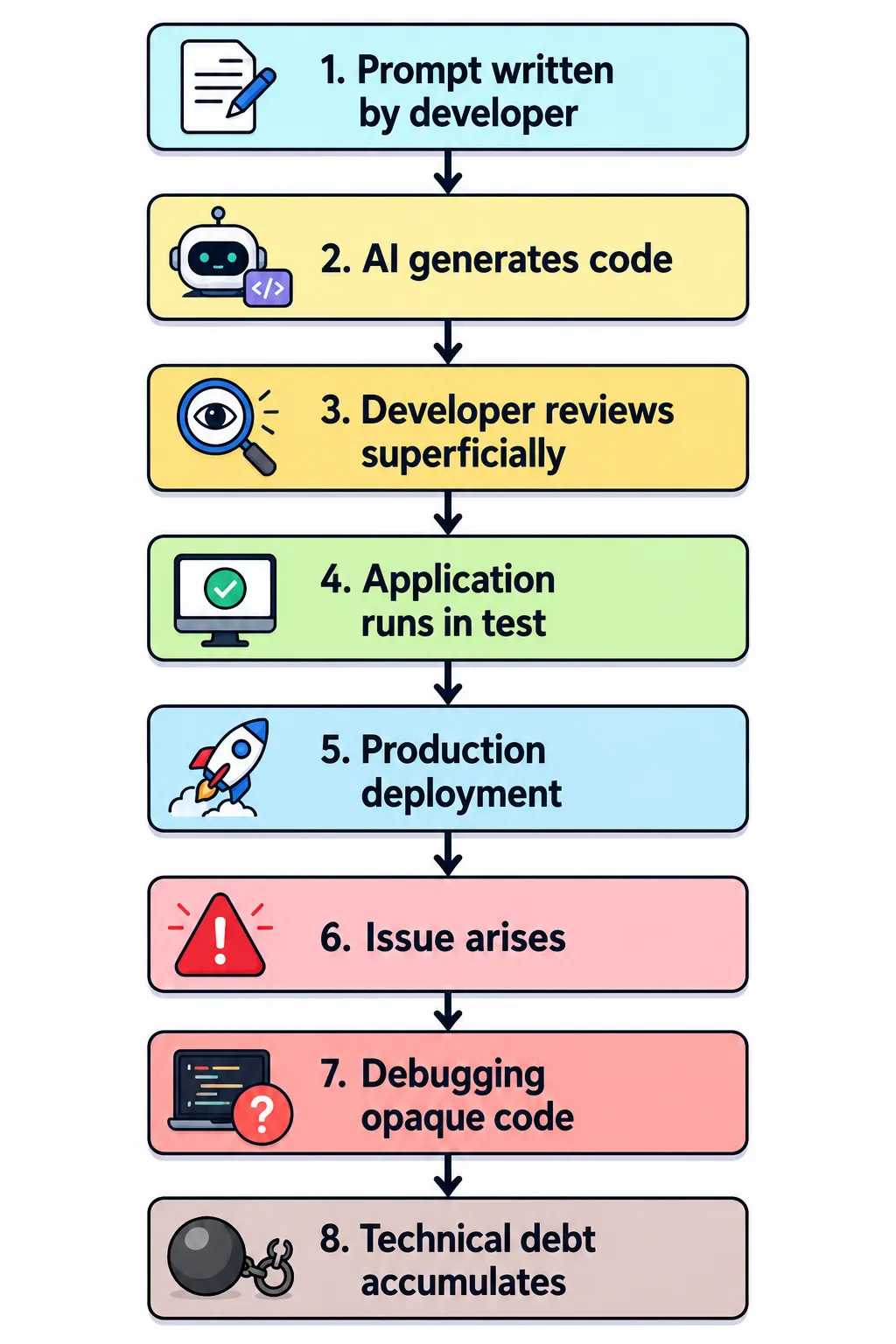 The catch is that shortcuts can mask problems that only surface later. By the time they do, the project may be too large or too fragile to fix easily.
1. The Hidden Cost of AI-Generated Code
AI-generated code optimizes for producing something that runs, not for code that's clear, consistent, or easy to maintain. Working code and good code aren't the same thing.
An AI model doesn't think like a developer. It doesn't weigh trade-offs or predict how a system will grow. Instead, it follows statistical patterns from its training data, so the result can be functional without being well-built.
Opaque Logic Paths
The AI creates functions that look reasonable on the surface but lack any human-readable reasoning. When something breaks, debugging becomes a slow, frustrating search.
Inconsistent Naming
A single module might mix naming conventions with no clear pattern. That breaks coding standards and makes collaboration harder than it needs to be.
Low Maintainability
Because no one hand-crafted the logic, future developers can't easily trace decisions or safely modify the flow. Small changes carry outsized risk.
This lack of clarity is where many vibe-coded projects start to collapse. The code runs, but no one on the team truly understands why.
This cycle tends to repeat. A team generates a feature with AI, tests it lightly, ships it, and moves on. Later, when something fails, debugging that module feels like peeling layers off an onion with no center.
2. Security Vulnerabilities Lurking Beneath the Surface
AI coding assistants can reproduce insecure patterns from their training data, including missing input validation, hardcoded credentials, and weak error handling, because they don't inherently know your security policies or the latest patches.
Security is one of the biggest blind spots in vibe coding. Developers often trust the AI to write secure code by default, but the model has no awareness of internal policy or recent vulnerability disclosures.
These patterns map closely to several entries in the OWASP Top 10, the industry-standard reference for web application security risks. The most frequent issues include:
Missing Input Validation
Absent validation logic leads directly to SQL injection and cross-site scripting attacks. This is one of the most common and most preventable failures in generated code.
Insecure Code Blocks
The AI may store credentials in plaintext or expose tokens through logs, often without any indication that it has done so. Pairing this with a solid GitHub backup and secret-management strategy reduces the blast radius if a credential does slip through.
Weak Error Handling
Instead of specific, useful exceptions, generated code often falls back to generic "error occurred" messages that reveal nothing useful for debugging or auditing.
Copy-Pasted Flaws
AI models can repeat vulnerable snippets that appeared frequently in their training data, carrying old mistakes into new projects.
These risks grow when teams skip manual review because the code "looks fine" on the surface. Illustrative example: a payment gateway built with AI assistance and no manual security review could easily end up with a test API key hardcoded into production. This is a known failure pattern in fast-shipped code, not a specific reported incident.
The irony is that vibe coding promises speed, but without serious security checks, it can introduce vulnerabilities faster than a traditional workflow ever would.
3. Technical Debt and Long-Term Maintainability
Technical debt in vibe coded projects accumulates because the AI optimizes for the immediate prompt, not for how the system will scale or who will maintain it later.
Every line of generated code adds potential weight to the system. Over time, quick wins can pile up into a refactoring challenge nobody planned for.
Mixed Architecture
Modules get written across inconsistent frameworks or libraries, often because each prompt produced a different pattern with no awareness of what came before. Starting from a tested template instead of a blank prompt helps keep the structure consistent from the first generation.
Poor Scalability
The AI builds for immediate functionality, not growth. Data models and logic that work fine at prototype scale frequently need substantial rework once real users show up.
Reactive Fixes
Teams end up fixing bugs that trace back to unclear AI behavior, rather than designing around known failure modes from the start.
Weak Ownership
Nobody remembers who wrote what, since technically, no one did. That makes post-incident accountability difficult to establish.
Here's a simple comparison of traditional development against vibe-coded development:
| Aspect | Traditional Codebase | Vibe Coded Codebase |
|---|---|---|
| Design Clarity | Explicit, structured | Implicit, generated |
| Error Handling | Custom, detailed | Often minimal |
| Scalability | Planned upfront | Added reactively |
| Technical Debt | Managed | Grows quickly |
| Documentation | Written manually | Often missing |
When developers try to extend these systems, they run into invisible complexity. Each change risks breaking something else, and that's usually when scalability issues and production incidents start to multiply.
4. Edge Cases and Prompt Dependence
AI models follow prompts literally, so any edge case, business rule, or constraint you don't explicitly mention (null handling, locale differences, timeouts) simply won't be built.
AI systems don't guess context or business nuance. When a prompt is incomplete or ambiguous, the output is equally incomplete.
Common pitfalls include assumed defaults that don't match the intended behavior, prompt sensitivity where small wording changes produce very different code, and missed edge cases that never get built because they were never mentioned.
As a result, teams often spend more time correcting the AI's assumptions than they would have spent writing the logic themselves in the first place. Clearer prompts help narrow this gap; see these tested AI prompt examples for a sense of how much detail actually helps.
That trade-off can work well for rapid prototyping. It becomes harder to manage once reliability and compliance are on the line.
5. Team Collaboration and Code Ownership
Vibe coding weakens code ownership because AI-generated modules don't carry the same accountability, documentation, or shared understanding that comes from a developer writing and explaining their own code.
Software engineering has always depended on shared standards, peer review, and collective ownership. Vibe coding puts pressure on all three.
In heavily vibe-coded systems, accountability tends to blur. No one owns specific modules, documentation is sparse because the AI outputs code without explaining its reasoning, and reviewing dense, inconsistent output becomes tedious fast. Tracking who approved or modified a given piece of generated code gets harder too.
When something fails, it's often unclear which prompt or AI session caused it. Debugging starts to feel like chasing a ghost instead of tracing a decision. Connecting a project to version control from day one at least gives the team a timestamped trail to work backward from.
Illustrative Use Cases
Not everything about vibe coding is negative. Used well, it can meaningfully speed up early-stage development. The examples below are illustrative patterns rather than named case studies.
A small startup, for instance, might use AI tools to generate a web app prototype in under a day, then test it with real users immediately to gather feedback. Later, the engineering team rebuilds the system properly with solid coding standards and security controls in place.
Similarly, a large enterprise might experiment with AI to generate internal dashboards. A prototype can impress leadership quickly, then still fail compliance review due to insecure code or missing audit trails.
A mobile-first team faces a related trade-off: some AI builders handle native app prototyping well but fall short once a project needs full backend logic. Comparing feature sets before committing can save a rebuild later.
The pattern holds either way: vibe coding accelerates iteration, but it needs human review and re-engineering before it's ready for production.
Resolving the Risks with Rocket.new
When you're moving fast, it's easy to ship code you don't fully understand. That's the gap Rocket.new is built to close, not as a patch applied afterward, but as the platform you build in from the start.
Rocket.new describes itself as a vibe solutioning platform rather than a plain vibe-coding tool, because it pairs AI app generation with strategic validation and ongoing monitoring instead of stopping at code output. In practice, that means three connected capabilities:
- Solve: AI-powered market research, idea validation, and PRD generation, so you're building the right thing before you write a prompt for code.
- Build: production-ready web apps, mobile apps, SaaS products, e-commerce stores, and landing pages, generated from a text prompt, a Figma design, a template, or an uploaded screenshot. See the full walkthrough in how to create your first app with Rocket.new.
- Intelligence: continuous competitor monitoring that runs after launch, surfacing pricing changes, feature releases, and market signals automatically.
Read more in Rocket Intelligence: A Complete Introduction.
Each pillar works on its own. You can validate an idea without building anything, or build an app without prior research. Used together, they share context, which is where most of the risks covered earlier in this article actually get addressed. This shift from execution-first to research-first building is explored further in Vibe Coding vs Vibe Solution.
Here's how Rocket.new maps to the specific risks described above:
- Structured, incremental builds instead of one giant prompt. Rocket's own best-practice guidance recommends building in stages, authentication first, then core screens, then integrations, rather than generating an entire app in one shot. That directly reduces the opaque-logic and edge-case problems from Sections 1 and 4, since each stage stays small enough to review properly.
- Template-based starting points. Rocket ships a library of tested templates for dashboards, landing pages, authentication flows, and internal tools. Starting from a template, rather than a blank prompt, gives you a known-good structure, which helps with the mixed-architecture and scalability issues from Section 3.
- Real, exportable code, not a black box. Build produces actual source code you can open in Code View, connect to GitHub, and download. That gives teams the visibility that's usually missing when AI-generated code ships without documentation or a clear owner, addressing Section 5.
- Built-in integrations with vetted providers. Instead of the AI improvising authentication, payments, or database logic from training-data patterns, Rocket wires up named, production-grade services such as Stripe for payments and Supabase for the database and backend. Because these are real integrations rather than improvised implementations, you're not depending on the model to reinvent security-sensitive logic, which helps with Section 2.
- Visual editing and code view side by side. Teams can inspect and adjust generated components visually or drop into full code control, supporting the kind of collaborative review that's often missing from vibe-coded projects. For a deeper look at how this plays out across a team, see how the vibe solutioning platform transforms team workflow.
- Deployment and preview built into the workflow. The Preview panel lets you test across screen sizes and devices before publishing, and one-click deployment means production readiness isn't a separate, bolted-on step.
One practical note worth setting expectations around: Rocket runs on a credit system tied to your plan, and larger or more iterative builds use more credits. Building in stages isn't only a code-quality best practice here; it's also the more efficient way to work within your plan.
In short, the workflow runs from idea validation in Solve, through incremental building and integration in Build, to review and deployment, with Intelligence picking up competitive monitoring after launch.
Together, these steps turn what could be a fragile, one-shot vibe-coded project into a structured build process, without giving up the speed that makes AI-assisted development appealing in the first place.
Pricing
Rocket.new runs on a credit-based system. Every plan includes a monthly credit allocation, except the free plan, which is a one-time grant.
| Plan | Price | Credits | Best For |
|---|---|---|---|
| Free | $0 | 20 (one-time) | Testing the platform |
| Pro | $25/mo | 100/month | Personal or side projects |
| Rocket | $50/mo | 250/month | Frequent use, teams needing Solve + Intelligence |
| Booster | $250/mo | 1,500/month | Power users, fast-moving teams, premium support |
All paid plans include unlimited team members, with no per-seat fees. Annual billing saves 20% across every paid tier, and extra credits can be purchased on top of any subscription at any time. Enterprise needs, including SSO and data localisation, go through a custom Sales plan
Where AI-Assisted Development Goes Next
Vibe coding limitations aren't a reason to slow down. They're a reason to build with more structure. As AI-generated code becomes standard practice across teams in 2026 and beyond, the winners will be the ones who pair speed with security, documentation, and review from day one.
Rocket.new is built for that shift. It's not just a code generator. It's a vibe solutioning platform that validates your idea with Solve, builds production-ready apps with Build, and keeps you ahead of the market with Intelligence, all from one credit balance.
Ready to build something that lasts? Start free at Rocket.new — no credit card required.
Table of contents
- -What Vibe Coding Really Means in Practice?
- -1. The Hidden Cost of AI-Generated Code
- -Opaque Logic Paths
- -Inconsistent Naming
- -Low Maintainability
- -2. Security Vulnerabilities Lurking Beneath the Surface
- -Missing Input Validation
- -Insecure Code Blocks
- -Weak Error Handling
- -Copy-Pasted Flaws
- -3. Technical Debt and Long-Term Maintainability
- -Mixed Architecture
- -Poor Scalability
- -Reactive Fixes
- -Weak Ownership
- -4. Edge Cases and Prompt Dependence
- -5. Team Collaboration and Code Ownership
- -Illustrative Use Cases
- -Resolving the Risks with Rocket.new
- -Pricing
- -Where AI-Assisted Development Goes Next