
Vibe coding uses natural language to generate code via AI; traditional coding means writing every line manually. Each has a place: vibe coding wins on speed and prototyping; traditional coding wins on precision and scale. The smartest teams use both.
Understanding how does vibe coding compares to traditional coding methods is essential for developers navigating today's AI-driven software landscape. This post breaks down the key differences in speed, control, code quality, and workflow so you can choose the right approach for every project.
For years, software development meant crafting logic line by line. Developers spent hours fine-tuning code, debugging tricky errors, and making sure everything ran just right. But things are shifting fast. A new way of building software is changing how developers think and create.
So what happens when words replace syntax, and AI starts writing parts of your code for you?
That's where the real conversation begins around vibe coding vs traditional coding. This blog breaks down what's actually changing in the way we code, why it matters, and how experienced developers can balance both styles to work smarter, not harder.
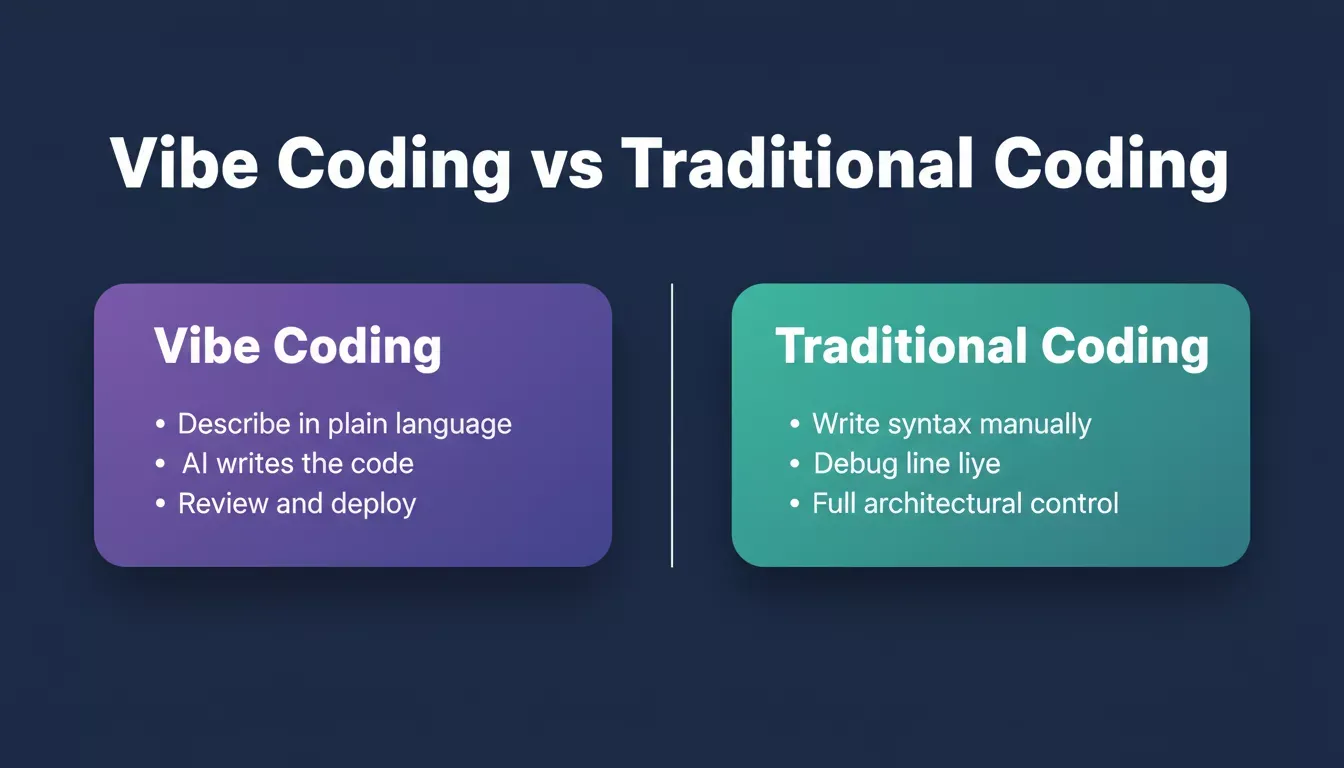 Vibe coding and traditional coding differ fundamentally in how developers interact with the machine: intent-first vs syntax-first.
At a Glance: Vibe Coding vs Traditional Coding Methods
Here's a quick comparison of how these two paradigms differ in intent and execution, useful whether you're evaluating them for a new project or deciding how to blend both.
| Aspect | Vibe Coding | Traditional Coding |
|---|---|---|
| Speed and Prototyping | Enables rapid prototyping and iteration with natural language input. | Slower due to manually writing and debugging each code line. |
| Control and Customization | Limited control since AI generates most layers of logic. | Complete control and flexibility in every code component. |
| Code Quality | May require cleanup and review; generated code varies in structure. | Typically higher quality through consistent reviews and human oversight. |
| Learning Curve | Easier for non-technical users or early-stage founders. | Steep learning curve requiring extensive programming knowledge. |
| Suitability | Best for quick MVPs or proof of concepts. | Ideal for complex systems, scaling, and enterprise-level deployment. |
Both have clear strengths. Comparing vibe coding makes sense only when you consider the project type, scale, and the product's expected lifetime.
What is Vibe Coding?
Vibe coding focuses on intent rather than syntax. You describe what you want using natural language, and the system interprets it to generate functional code automatically.
Instead of writing loops or database queries, you describe the flow: "Build a dashboard with login, analytics, and export features." The AI generates code, configures data models, and creates APIs to match.
This is powered by AI-generated code, which blends artificial intelligence with large programming language models. It's almost like pair programming with a machine that already knows thousands of frameworks and can write in multiple programming languages. Developers describe vibe coding as a "creative collaboration" with AI rather than a replacement for human logic.
It still requires deep technical knowledge to validate generated code, but it dramatically reduces repetitive coding tasks. Here's what a vibe coding prompt actually produces. Given the instruction "generate a Next.js dashboard with JWT authentication and MongoDB integration," a vibe coding tool outputs scaffolding like this:
1// Auto-generated from natural language prompt
2// Next.js API route: /api/auth/login
3import jwt from 'jsonwebtoken';
4import { connectToDatabase } from '../../lib/mongodb';
5
6export default async function handler(req, res) {
7 const { email, password } = req.body;
8 const { db } = await connectToDatabase();
9 const user = await db.collection('users').findOne({ email });
10 if (!user || user.password !== password) {
11 return res.status(401).json({ error: 'Invalid credentials' });
12 }
13 const token = jwt.sign(
14 { userId: user._id },
15 process.env.JWT_SECRET,
16 { expiresIn: '7d' }
17 );
18 res.status(200).json({ token });
19}A developer still needs to review this, adding password hashing, input validation, and error handling. That's exactly where traditional coding expertise remains non-negotiable.
What is Traditional Coding?
Traditional coding remains the gold standard for complex systems. It's where you manually write code, manage architecture, test logic, and build full applications line by line.
Developers who prefer traditional programming enjoy complete control, explicit decision-making, and the ability to optimize at the lowest level. In traditional development, you rely on your technical expertise, architectural understanding, and language-specific strengths.
Traditional methods are also vital in maintaining code quality and managing enterprise software. While vibe coding tools can generate impressive prototypes, traditional coding remains the backbone of long-term software creation.
The Development Philosophy Shift
Traditional programming is about commands: you issue instructions and write explicit syntax. Vibe coding feels like collaboration: you give intent, and the AI interprets it into actual code.
This subtle shift changes how developers think. Instead of spending hours defining functions, you focus on high-level problem-solving in terms of goals, outcomes, and workflows. It's a natural language-driven approach to building software.
The scale of this shift is measurable. According to GitHub's 2024 developer survey, 92% of US-based developers were already using AI coding tools in some form, and developers using AI assistance reported completing tasks up to 55% faster.
A McKinsey analysis found that AI-assisted developers completed coding tasks 35-45% faster than those working without AI tools.
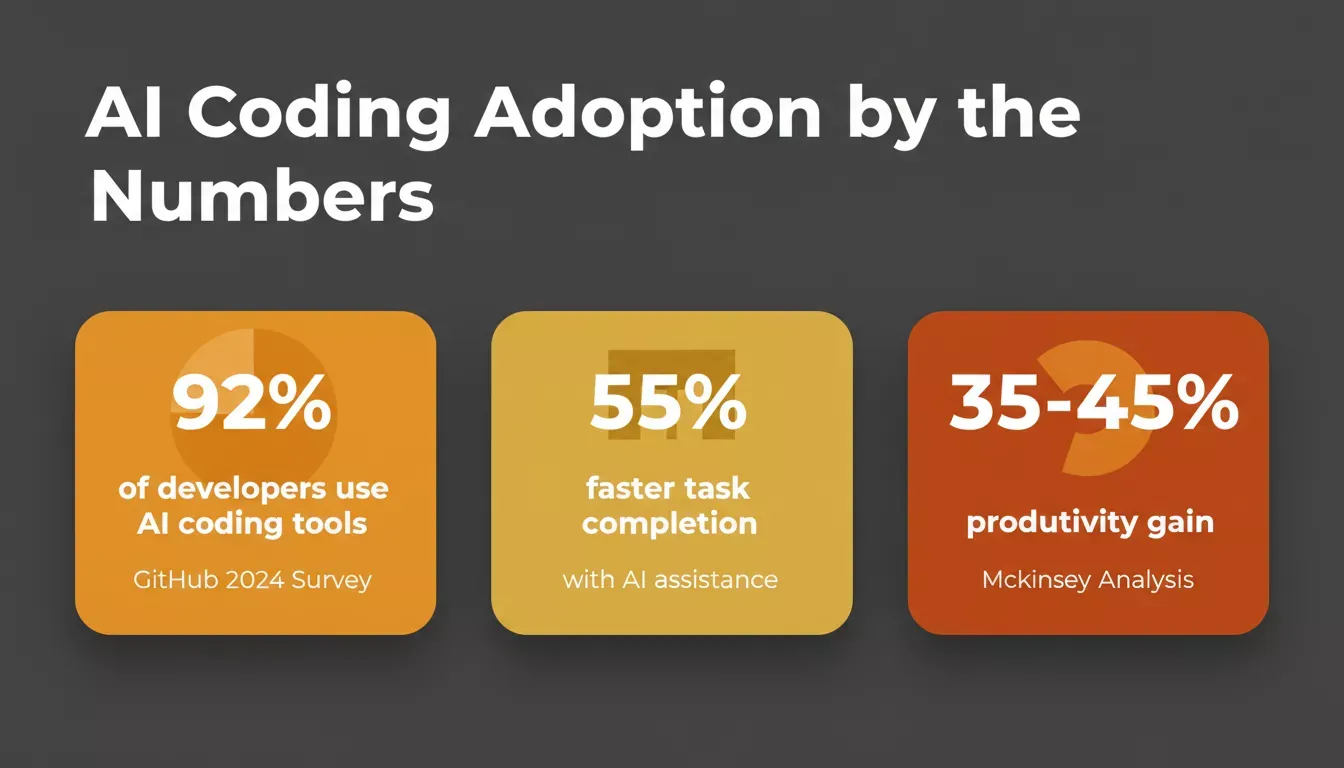 Developer productivity gains from AI-assisted coding are now well-documented across multiple large-scale studies.
The diagram below shows how the interaction flow differs between vibe coding and traditional coding methods.
Vibe coding interaction flow: from natural language prompt through AI code generation to developer review and deployment.
Code Quality and Human Oversight
Every expert developer knows that code quality defines the sustainability of software. AI-generated code accelerates development, but without proper review, it may create hidden technical debt.
You still need to test, refactor, and validate security. Generated code might use suboptimal logic or patterns inconsistent with your architecture. The key is to use AI suggestions as accelerators, not replacements.
For experienced engineers, vibe coding is about efficiency. You can automate boilerplate code and repetitive coding tasks while focusing your effort on complex logic and performance tuning. Want to understand how common vibe coding mistakes affect code quality and how to avoid them? That's a pattern worth studying before shipping AI-generated code to production.
AI Tools and the Development Process
AI tools that enable vibe coding aren't just text-to-code engines. They now understand natural language descriptions, context, and structure. Modern AI capabilities allow them to infer dependencies, link databases, and generate unit tests automatically.
Still, they rely on clear, natural-language prompts. A vague command like "make a system for users" might confuse the model. At the same time, a structured request like "generate a Next.js dashboard with JWT authentication and MongoDB integration" produces high-quality corresponding code.
Developers describe this interaction as the "language of creation." You no longer manually write code from scratch but use conversational, plain language to generate functional code. Exploring natural language to code workflows in depth will sharpen how you write prompts that produce production-ready output.
When Vibe Coding Excels
Vibe coding excels at fast experimentation. It enables rapid prototyping and quick iteration cycles, reducing time between idea and execution.
For startups, internal tool builders, and early-stage teams, this means they can create software that would normally take weeks in days. It's also ideal for non-technical users who want to translate ideas into working prototypes without deep technical knowledge.
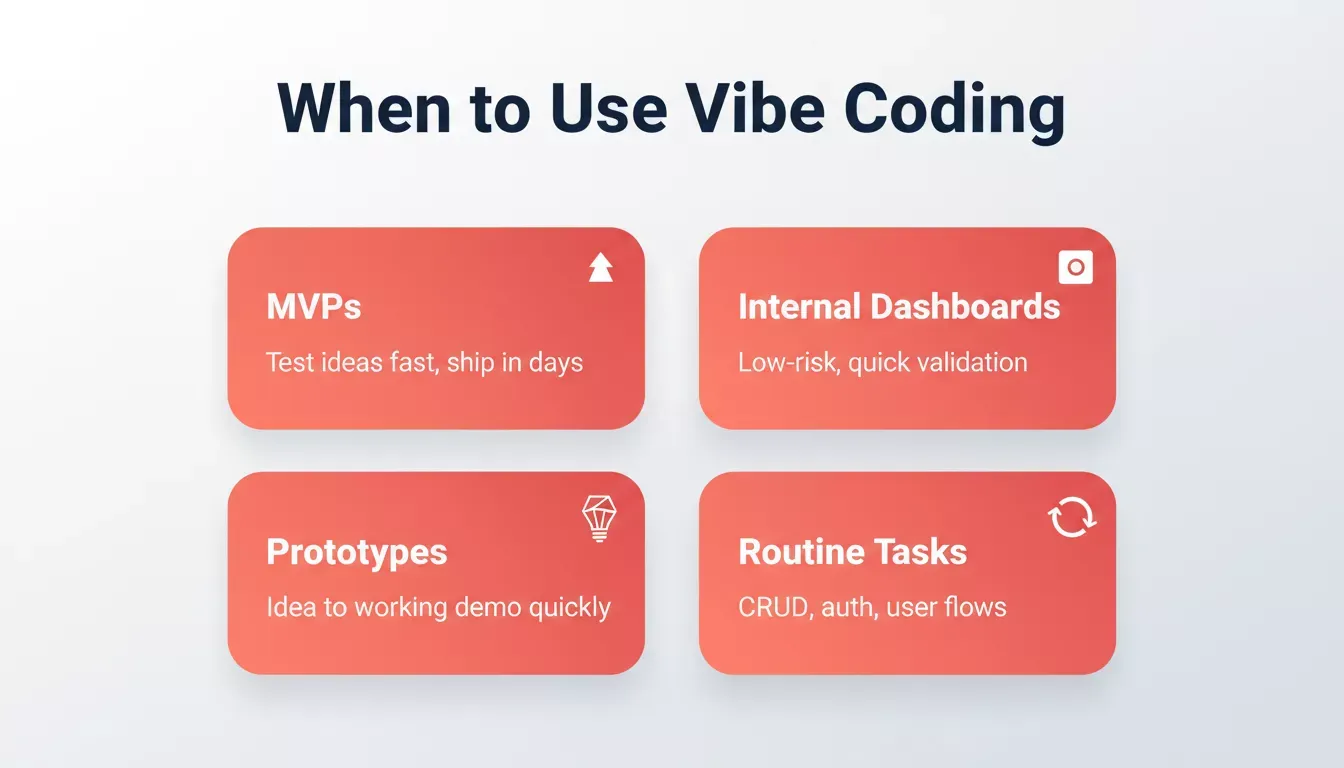 Vibe coding delivers the most value in low-risk, fast-iteration environments where speed to prototype matters most.
Vibe coding is suitable for:
- MVPs: quick testing of product-market fit.
- Internal dashboards: low-risk environments where AI-generated code can be quickly validated.
- Automating routine coding tasks: generating CRUD interfaces, user flows, or authentication modules.
The biggest advantage lies in its ability to enable rapid prototyping while maintaining enough flexibility for expert tuning later. If you're building a startup, understanding how to build a startup with vibe coding gives you a practical roadmap from idea to shipped product.
Why Traditional Coding Remains Relevant
Traditional coding offers reliability and precision. Even with AI assistance, developers still need full control when dealing with large systems, complex projects, or performance-critical components.
Traditional coding offers:
- High-level control: every line of code is yours to design.
- Predictability: no hidden abstractions or unpredictable AI decisions.
- Scalability: suitable for enterprise software and production-grade architectures.
- Security assurance: human validation across all modules.
In regulated, high-stakes industries, traditional coding is not optional: precision and auditability cannot be delegated to AI generation.
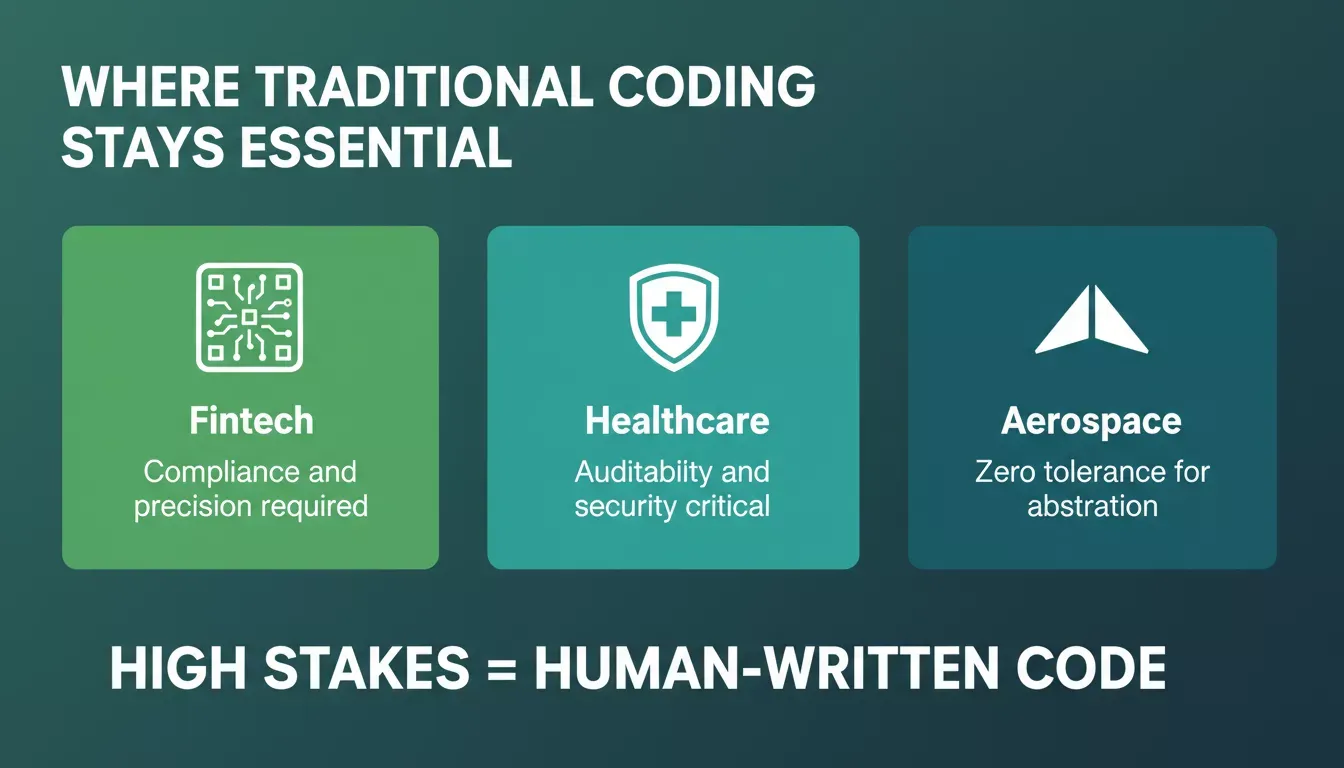
Traditional coding remains irreplaceable in industries like fintech, healthcare, and aerospace, where precision and compliance outweigh speed.
Hybrid Workflows: The Best of Both Worlds
For many teams, the most efficient approach isn't choosing one; it's blending them. The hybrid model uses vibe coding to generate initial modules and traditional coding to refine and scale.
The diagram below shows how this combined workflow looks in practice.
Hybrid workflow: vibe coding handles the creative early stages; traditional programming locks in long-term reliability.
It's the balance between speed and structure that modern development teams are chasing. Understanding full-stack code automation helps teams decide exactly where to draw that line in their own pipelines.
How It Works on Rocket (Step-by-Step)
Rocket blends AI capabilities with real software development workflows. It lets users build applications through natural language input while maintaining full control over architecture.
Rocket generates production-ready React/Next.js code for web and Flutter code for mobile, not a prototype. Your database (Supabase), authentication, payments (Stripe), and integrations are automatically wired based on what you describe. Every build ships with SEO-ready structure, WCAG accessibility compliance, GDPR coverage, staging and production environments, and 2-way GitHub sync.
Step 1 (Idea Prompting): Enter a clear description like "Create a SaaS tool for team analytics with role-based access and dashboards."
Step 2 (Framework Selection): Choose the target stack: React/Next.js for web or Flutter for mobile.
Step 3 (AI Generation): Rocket automatically generates UI, backend, and authentication, all wired together.
Step 4 (Testing and Review): Developers review the generated code, refine logic, and add performance checks.
Step 5 (Deployment): Deploy to Rocket-hosted infrastructure or your own custom domain in one click.
This entire development process happens without manually writing extensive code, yet it still allows customization at every layer. You can also start from a Figma file, an existing Next.js codebase, or one of the ready-to-use templates.
Rocket.new generates clean, exportable code, not a demo, with database, auth, and payments wired automatically from your first prompt.
Why Rocket Stands Out
Rocket is more than a no-code tool. It's designed for professionals who understand both vibe code and traditional development.
- Speed: Build any app with simple prompts: web, mobile, or SaaS.
- Control: Review and export the entire React/Next.js or Flutter codebase.
- Scalability: Extend with traditional coding whenever needed; 2-way GitHub sync keeps everything in sync.
- Collaboration: Share with teammates directly in the editor; staging and production environments are separated from day one.
Rocket also ships with enterprise-grade security: SOC 2, ISO 27001, GDPR, CCPA, and SSO/SAML, so it passes procurement on day one. Explore the full AI app builder to see every capability in one place.
Community Insights
The developer community has been actively debating how vibe coding compares to traditional coding methods. On LinkedIn and developer forums, a recurring theme emerges: AI doesn't replace the engineer; it changes where the engineer's attention goes.
One perspective that captures this well:
"We're not replacing traditional coding. We're changing how we start. With vibe coding, we describe the end state, and AI fills in the scaffolding. Then, our expertise makes it production-ready." - Read the full discussion on LinkedIn.
This mirrors what the data shows: developers aren't abandoning traditional skills; they're applying them at a higher level of abstraction, validating and refining AI output rather than writing every line from scratch.
Advanced Considerations for Experts
- AI limitations: AI generates based on training data, not deep intent. Experts must validate edge cases and complex logic.
- Integration depth: In advanced architectures such as microservices or Kubernetes, traditional development still dominates.
- Governance: Teams must establish guidelines for AI-assisted coding to avoid inconsistent patterns in existing code.
- Documentation: Generated code should always be reviewed and documented to preserve clarity.
The Strategic Takeaway
For expert developers, the real discussion isn't about coding vs traditional; it's about balance. Vibe coding focuses on flow, creativity, and automation. Traditional development anchors structure, scalability, and rigor.
When used together, they reshape the entire development lifecycle. The key is knowing when to let AI generate code and when to refine it manually. With the right technical knowledge, you can create software faster without sacrificing quality.
Final Thoughts: Vibe Coding vs Traditional Coding
The conversation around vibe coding vs traditional coding methods isn't about replacement; it's about evolution. Experienced engineers now have access to AI assistance that amplifies their productivity without erasing their expertise.
Vibe coding makes the creative phase smoother and quicker, while traditional coding ensures the end product remains stable, scalable, and secure. Together, they form a future where developers spend less time fighting syntax and more time designing meaningful systems.
So, whether you're experimenting with AI-generated code or refining a mission-critical backend, remember: it's not a battle between new and old; it's collaboration between imagination and engineering.
Ready to experience how vibe coding compares to traditional coding methods in a real build environment?
Rocket gives you the best of both worlds: start with a natural language prompt, then refine with full code access. Whether you're building an MVP or scaling a production app, Rocket's AI-powered platform bridges creativity and engineering precision.
Start building for free on Rocket.new and ship your first app today.
Table of contents
- -At a Glance: Vibe Coding vs Traditional Coding Methods
- -What is Vibe Coding?
- -What is Traditional Coding?
- -The Development Philosophy Shift
- -Code Quality and Human Oversight
- -AI Tools and the Development Process
- -When Vibe Coding Excels
- -Why Traditional Coding Remains Relevant
- -Hybrid Workflows: The Best of Both Worlds
- -How It Works on Rocket (Step-by-Step)
- -Why Rocket Stands Out
- -Community Insights
- -Advanced Considerations for Experts
- -The Strategic Takeaway
- -Final Thoughts: Vibe Coding vs Traditional Coding