
Traditional website builders break when products need real backend, scale, and mobile support. Rocket.new unifies research, full-stack generation, and deployment into one AI-driven platform. Founders now use it to ship web and mobile apps faster with fewer tools and less friction.
What is Changing in App Building?
Why are so many founders quietly dropping their old website builders and building full products on a single AI platform instead?
The answer is practical, not hype-driven. The AI app builder market is sitting at $7.24 billion in 2026 and is projected to reach $135.93 billion by 2035, growing at a 38.51% CAGR. (Precedence Research) The market grew because the tools that came before it, drag-and-drop website builders, disconnected databases, and patchwork backend setups, stopped matching how products actually need to be built.
Founders weren't looking for a trendier tool. They were looking for one that works end to end.
The Problem with Traditional Website Builders
Website builders were designed for websites. Templates, static layouts, and basic content management that covers a lot of marketing pages and personal portfolios.
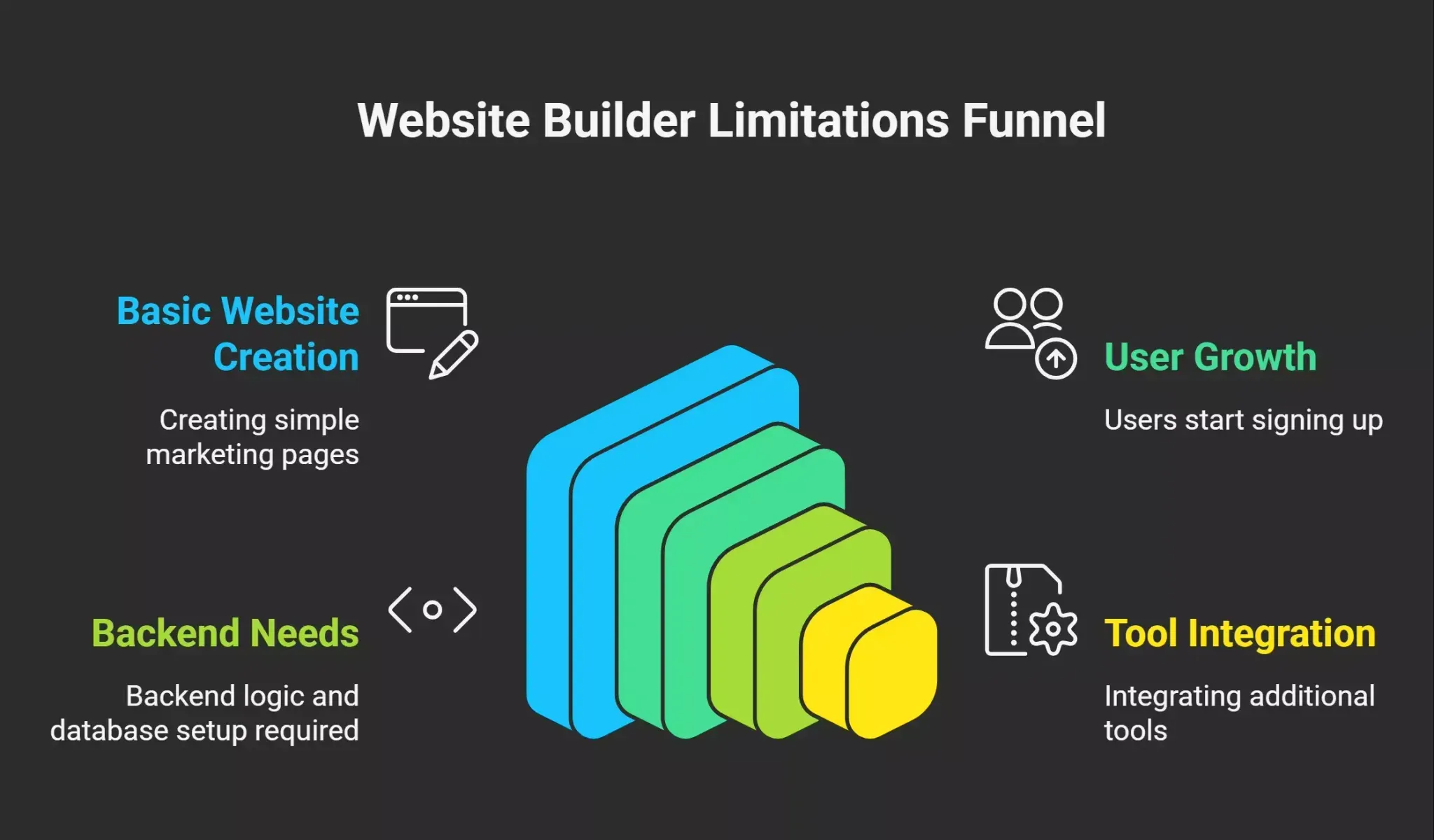
Where Most Builders Hit a Wall
The moment a solo founder or small team needs real backend logic, user authentication, database setup, or a native mobile app running alongside their web product, the cracks appear fast.
The typical pattern looked like this: start with a simple builder, hit the ceiling when users start signing up, bring in a developer for the backend, subscribe to three or four additional tools, and still end up with a product that breaks under real traffic.
Most app builders in the AI era repeated this mistake. They automated the generation speed but didn't fix the fragmentation. They made the front end fast, left the back end to someone else, and called it done.
Vibe Coding Changed the Rules
What Vibe Coding Actually Means
Vibe coding describes the practice of building software by describing what you want in plain language and letting AI handle the code generation. No coding knowledge required. No traditional development process.
The numbers show how fast this shift happened. By 2026, 70% of new enterprise applications use low-code or no-code technologies, up from less than 25% in 2020. (Gartner via Integrate.io) And 25% of Y Combinator's Winter 2025 batch had codebases that are 95% or more AI-generated. (getmocha.com)
The Limits That Still Exist
But vibe coding tools showed their limitations quickly. Lovable generates a UI immediately. Bolt.new writes code immediately. Cursor starts editing immediately. None of them stop to ask whether you're building the right thing. (AZ Big Media)
That's the gap Rocket.new was built to fill.
App Builders and Full Stack Apps
Backend Logic and the Gap Most Builders Leave Out
Full-stack apps need more than a front end. They require a working backend with logic and rules, a database setup that persists user data, authentication, API connections, and a path to iOS and Android alongside the web.
Building all of that on most app builders meant switching tools at every layer. One tool for the UI, another for backend logic, another for the database, another for deployment. Each switch added cost, complexity, and context loss.
| Builder | Full Stack | Mobile Apps | Backend Logic | Exportable Code |
|---|---|---|---|---|
| Lovable | No (front end only) | No | Limited | Yes |
| Bubble | Partial | Wrapper only | Yes | No |
| Bolt | No | No | Limited | Yes |
| Rocket.new | Yes | Yes (Flutter) | Yes | Yes |
This is why the comparison keeps landing in the same place. Rocket.new generates full-stack apps, web and mobile, from a single prompt, with production-ready code and backend logic included from the first generation.
From Natural Language to Web and Mobile App Creation
How Rocket.new Generates an App
Describe what you want to build. Rocket scores the prompt for clarity, asks targeted questions where needed, then generates a working, deployable product in 1-3 minutes.
Web applications come out in Next.js. Mobile apps in Flutter - production-ready for iOS and Android, with real design systems, fluid navigation, and dark/light theming included by default. Not a prototype. A working app.
Three Ways to Refine Your Build
After generation, iteration happens through three modes. Chat takes natural language instructions without losing context. Visual Edit lets you click any element directly in the live preview. Code gives you full access to the generated codebase to modify however you need.
Custom domains connect automatically. Staging and production environments separate your testing from your live product. Version history and one-click rollback mean you can make big changes without risk.
Vibe Solutioning: The Layer App Builders Skip
Research Before You Build
Rocket.new sits in a category it created: vibe solutioning. The founding idea is that the work is only as good as the thinking before it.
Most AI app builders jump straight to app creation. You type a description, and they start generating. The research phase - competitive analysis, user research, and product logic is entirely on you. You do it somewhere else, summarize it into a prompt, and hope the build reflects it.
"Most of them get you to a demo. One gets you to a business." - NetNewsLedger, May 2026 (netnewsledger.com)
Rocket's Solve pillar handles the research phase inside the platform. A solo founder who starts in Solve gets structured product thinking, competitive context, and a clear direction before a single line of code is written. The build that follows reflects that thinking directly.
Shared Context Across the Full Arc
The key difference is shared context. The research from Solve flows into Build. The competitive signals from Intelligence inform the next product decision. Nothing gets re-explained. Everything compounds.
Most app builders give you isolated sessions. Rocket gives you one connected workspace where every task builds on the last.
Building Internal Tools and Landing Pages
What You Can Build with Rocket.new
Rocket.new covers more than consumer apps. The Build pillar handles web apps (SaaS products, dashboards, marketplaces, AI-powered apps), mobile apps (iOS and Android from a single Flutter codebase), landing pages (conversion-focused, SEO-ready, built from project context), and internal tools (OKR trackers, customer portals, compliance systems, investor data rooms).
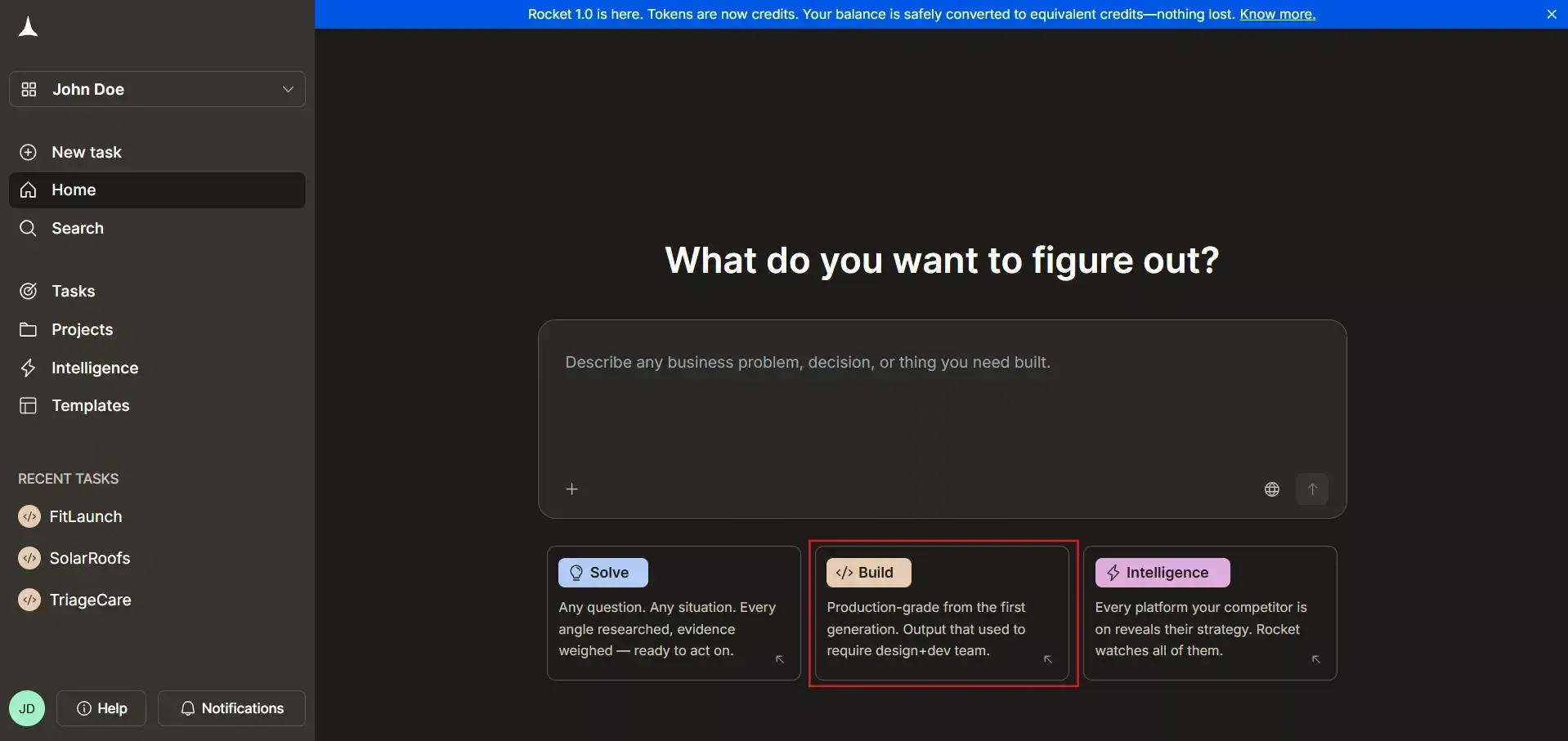 Enterprise teams use the platform for internal dashboards connected to tools like Mixpanel, Airtable, and Linear. Customer portals. Onboarding systems. All built in the same environment, with the same production-ready output.
Every build ships with an SEO-ready structure, WCAG accessibility compliance, and GDPR coverage by default. These are baseline outputs, not optional extras.
App Building for Solo Founders and Enterprise Teams
Rocket Plan, Free Plan, and the Booster Plan
Access to Rocket.new starts on a free plan with 20 one-time credits, no credit card required. This lets new users test the platform, generate a landing page, and see what production-ready output looks like before committing.
Paid plans unlock additional credits, more build types, and access to Intelligence monitoring. The credit system covers everything - Solve research, Build generation, and Intelligence monitoring with no separate billing for compute or hosting.
The Rocket plan and Booster plan tiers are structured for solo founders and growing teams, with per user credit allocation and unified billing for larger groups. One notable detail: "Fix it" for Rocket-detected errors doesn't consume credits for paid users. The platform fixes its own mistakes for free.
Why Non-Technical Founders Chose Rocket.new
Features That Remove Platform Management
By 2026, 80% of technology products will be built by non-IT professionals. (ColorWhistle via Adalo) And 24% of no-code users had zero coding experience before they started.
Non-technical founders don't just need a tool that generates code. They need a platform that doesn't require them to be the platform manager on the side, handling API keys, debugging errors, managing deployments, and chasing scalability issues alone.
Rocket.new handles this with built-in analytics, automatic HTTPS on custom domains, and 25+ integrations (Stripe, Supabase, Google Analytics, Notion, Linear, Airtable, and others) that authenticate once and flow into every build.
When the AI reaches its limit, Rocket's Success team steps in inside the platform no ticket system, no email chain. Real help, in context, when you need it.
How Rocket.new Compares to the Competition
What Lovable, Bubble, and Bolt Miss
Most app builders fail at one of three points.
The first is no pre-built intelligence. The tool has no opinion on whether what you asked it to build was worth building. Lovable, Bolt, and Bubble all jump straight to generation with no Solve-equivalent research layer.
The second is no shared memory architecture. Every team member starts a fresh session. Context is lost at every handoff. In Rocket's shared context system, the research from one task is available in the next automatically.
The third is that you end up managing the platform. Most tools leave error resolution, API configuration, and performance at scale entirely to the user. Rocket handles these as part of the platform itself.
Bubble has been the default for founders who needed backend logic. But it doesn't generate mobile apps natively, doesn't produce exportable code, and pricing scales steeply with usage. Lovable is fast and generates a clean UI, but stops at the front end. Bolt.new works well for quick prototypes, but isn't built for production-ready full-stack apps at scale.
Why Founders Made the Switch
The no-code market is growing toward $264 billion by 2032. (Fortune Business Insights via Adalo) More app builders enter the space every month. Most of them solve one part of the problem well.
The reason founders shifted toward website builders: why founders moved to Rocket.new in 2026 wasn't only speed. Most app builders are fast. The reason is that Rocket.new covers the complete arc from research and validation, through full-stack generation, to deployment and ongoing monitoring without requiring the founder to be a developer, a DevOps engineer, or an integrations expert on the side.
The website builder era - templates, static designs, no backend is ending. What replaced it is a single platform where thinking and building happen in the same place.
Build and launch full-stack web and mobile apps in minutes with Rocket.new.
Table of contents
- -What is Changing in App Building?
- -The Problem with Traditional Website Builders
- -Where Most Builders Hit a Wall
- -Vibe Coding Changed the Rules
- -What Vibe Coding Actually Means
- -The Limits That Still Exist
- -App Builders and Full Stack Apps
- -Backend Logic and the Gap Most Builders Leave Out
- -From Natural Language to Web and Mobile App Creation
- -How Rocket.new Generates an App
- -Three Ways to Refine Your Build
- -Vibe Solutioning: The Layer App Builders Skip
- -Research Before You Build
- -Shared Context Across the Full Arc
- -Building Internal Tools and Landing Pages
- -What You Can Build with Rocket.new
- -App Building for Solo Founders and Enterprise Teams
- -Rocket Plan, Free Plan, and the Booster Plan
- -Why Non-Technical Founders Chose Rocket.new
- -Features That Remove Platform Management
- -How Rocket.new Compares to the Competition
- -What Lovable, Bubble, and Bolt Miss
- -Why Founders Made the Switch