
Curious how AI apps are built quickly today? This blog explains what a Generative AI app builder is, how it works, and how teams use it to create AI-powered applications faster.
What is a generative AI app builder?
In simple terms, it is a tool that helps people create apps using AI and natural language instructions instead of writing large amounts of code. A generative AI app builder uses large language models to turn simple prompts into working AI app features, interfaces, and workflows.
Interest in AI applications is growing quickly. According to a report from McKinsey & Company, generative AI could add $2.6 trillion to $4.4 trillion annually to the global economy.
That growth explains why companies want faster app development tools. A modern app builder makes app building easier and helps teams build apps quickly without needing extensive coding knowledge.
So let’s break it down step by step.
What Exactly is a Generative AI App Builder?
A generative AI app builder is a platform that helps users create apps using generative AI, prompts, and visual tools. Instead of writing large amounts of code, users describe what they want in natural language.
The AI app builder then uses large language models and natural language processing to convert that request into working features.
A typical gen app builder allows people to build an AI app, automate AI workflows, and connect data from different systems. Many modern platforms, such as Power Apps from the Microsoft Power Platform, help teams create enterprise applications using prompts and visual editors.
These tools help organizations build AI-powered applications, internal dashboards, and customer-facing services faster than traditional app development.
So the big idea is simple.
Instead of coding everything manually, the app builder does much of the heavy work using AI models.
Why Businesses are Turning to AI App Builders?
Companies want faster app development. Teams also want tools that reduce repetitive work.
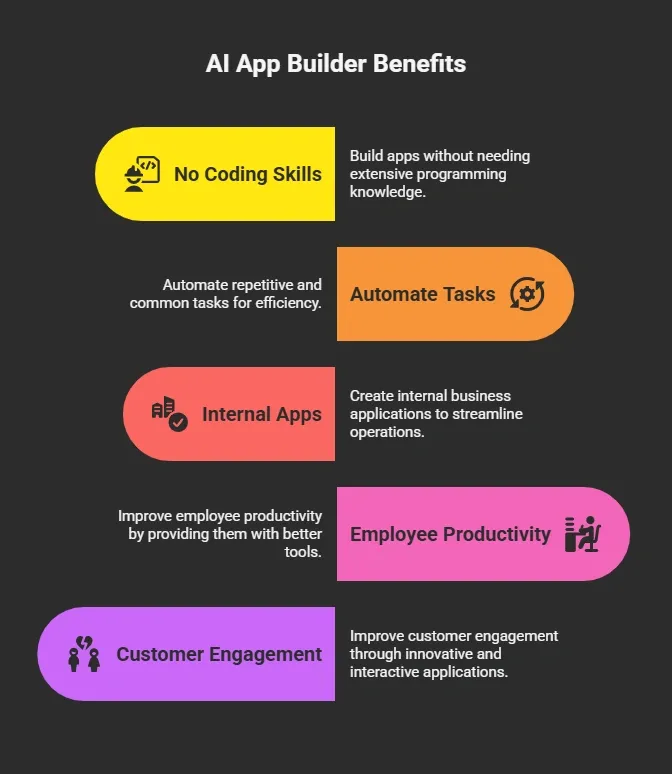
Many AI applications also analyze unstructured data such as emails, chat logs, and documents. The system then uses information retrieval and natural language understanding to respond intelligently.
That means a single AI app can manage chat conversations, help customers, and support employees.
Nice, right?
Key Components of a Generative AI App Builder
Most gen app builder platforms share similar components. Each part helps turn an idea into a working AI app.
Core Technologies Behind AI App Builders
| Component | What It Does |
|---|---|
| Large language models | Understand prompts and generate responses |
| Natural language processing | Interprets user instructions |
| Cloud storage | Stores data used by apps |
| AI workflows | Automates actions across services |
| AI agents | Handle tasks and interactions automatically |
Platforms running on Google Cloud often rely on large language models and generative AI services hosted inside cloud storage environments.
Developers can manage these tools using the Google Cloud Console.
These components allow the app builder to process prompts, read data, and produce working AI applications.
How Generative AI App Builders Work
So how does a generative AI app builder actually turn an idea into software?
Let’s walk through the process.
1. User Gives Instructions
The process starts with a prompt written in natural language.
Example:
“Create an AI app that answers customer questions using company documents.”
The AI app builder reads the prompt and tries to understand user intent.
2. AI Processes the Request
The system uses natural language understanding and large language models to break down the prompt.
It identifies:
- Data sources
- Features required
- Workflow steps
This stage helps the system understand user intent clearly.
3. Data Connection and Retrieval
Many AI applications rely on company data.
A generative AI app builder connects to cloud storage systems, such as Google Cloud, or to internal databases. Then, data ingestion collects structured and unstructured data.
Some systems use retrieval augmented generation. This approach combines information retrieval with text generation, so responses are grounded in real company data.
That helps the generative AI app answer questions correctly.
4. Building the AI Workflows
Next, the gen app builder automatically creates AI workflows. These workflows define how the AI app behaves.
For example:
- Respond to chat conversations
- Search documents
- Send alerts
- Trigger AI agents
Some tools also provide step-by-step orchestration for building more advanced logic.
5. Interface Generation
After the workflow is ready, the app builder generates a user interface.
This interface might be:
- A chatbot
- A dashboard
- A web portal
- Mobile access apps
Platforms such as Power Apps allow teams to deploy apps quickly inside enterprise systems. Users can add custom code using familiar programming languages if needed.
6. Testing and Deployment
The final stage prepares the AI app for real users.
Tools often include:
- Version control
- Enterprise-grade security
- monitoring for AI deployments
Apps can connect to systems such as Google Workspace and other workplace collaboration tools. This makes the AI app useful inside real company workflows.
What Makes Generative AI App Builders Popular?
Well, the biggest reason is simplicity. A modern AO app builder makes app development easier for non-developers.
Teams no longer rely entirely on specialists. The app builder focuses on AI-assisted development, letting users describe the desired feature, and the system generates code.
This approach is often called vibe coding. Yes, that phrase is trending right now. With vibe coding, users describe an idea, and the gen app builder produces working features.
Many teams build:
- Customer support bots
- Analytics dashboards
- Internal internal tools
- Sales assistants
These AI-powered solutions help streamline operations and improve workplace productivity.
Community Insight
Here’s a real perspective from a LinkedIn post discussing Rocket.new and the rise of vibe coding tools:
“I gave one wild idea to Rocket and it built the entire AI app in one shot. No prompt tweaking. No debugging. No waiting. Just a fully functional, multi-page product built from a single input.”
This kind of feedback shows why many gen app builder developers are experimenting with generative AI app builder platforms. Instead of spending days writing infrastructure code, they can describe an idea and quickly generate working features.
Rocket Fuel for AI Apps: Rocket.new
Another platform gaining attention in the AI app builder space is Rocket.new.
Rocket.new aligns with the concept of a generative AI app builder, as it focuses on creating a generative AI app using simple prompts. Instead of manual coding, users describe the app they want. The platform then generates the structure, interface, and workflows.
It works well for teams that want to build AI-powered applications quickly while still allowing custom code when needed.
Top Features
- Prompt to App Creation: Builds apps directly from single prompts
- Figma Import: Converts design files into live, editable layouts
- AI-Powered Backend: Automatically handles logic, data, and workflows
- Custom Domain Support: Publishes projects with a branded domain
- Code Export: Allows developers to extend or customize later
- Live Preview: Shows instant updates while editing
These features help teams move from idea to working AI app faster.
Build Almost Anything with Rocket.new
One interesting part about Rocket.new is how flexible it is. The platform allows users to build many types of digital products using the same app builder system.
Users can create:
- Full web apps with dashboards and workflows
- Business websites and product sites
- Marketing landing pages
- Mobile-friendly interfaces with mobile access
- SaaS dashboards and admin panels
- Internal tools for teams
All of this happens through a mix of generative AI, visual editing, and simple prompts. Instead of starting from scratch, the gen app builder automatically generates layouts, logic, and UI elements.
This makes Rocket.new useful for creators who want to launch AI-powered applications, experiment with ideas, or quickly prototype products without extensive coding.
Common Use Cases for Generative AI App Builders
Organizations use gen app builder platforms in many different ways. These tools help teams create useful AI applications that support daily work, improve employee productivity, and simplify routine operations.
From customer support to internal management systems, a modern AI app builder can handle a wide range of tasks.
Some common use cases include:
- Internal Tools Companies often build internal tools that allow employees to search documents, manage projects, or track team tasks. These AI applications help staff find information faster and complete work more efficiently.
- Customer Service AI Apps: A generative AI app can work as a virtual agent that responds to customers in real time. These apps use natural language and text generation to answer questions and assist users through chat conversations.
- Knowledge Retrieval Systems: Many organizations store large amounts of unstructured data such as documents, reports, and emails. A generative AI app builder can create systems that analyze this information and support information retrieval when employees need quick answers.
- Business Automation: Teams also build apps that automate approvals, reports, and other common tasks. These AI workflows reduce manual effort and help teams focus on more important work.
Overall, a gen app builder enables organizations to build practical AI app solutions for different needs. Whether for internal operations or customer interactions, these tools make app development faster and easier.
Security and Data Handling
Security matters when building AI applications. Modern app builder platforms support:
- Enterprise-grade security
- Safe handling of sensitive data
- Permission controls for enterprise applications
Data often lives in cloud storage services such as Google Cloud. These platforms also manage data stored across apps.
Why Generative AI App Builders Are Gaining Attention
Many organizations want custom software but lack large engineering teams. Traditional coding takes time, and building new enterprise applications can slow down teams and delay ideas. A generative AI app builder offers a simpler path by letting teams create AI apps with prompts and visual tools. It simplifies app development, supports AI workflows, and connects company data without requiring complex technical work.
Modern app builder platforms allow teams to build apps much faster than before. A gen app builder uses generative AI, large language models, and automation tools to produce working ai applications with minimal effort. This means companies can create customer assistants, internal dashboards, and knowledge tools using one AI app builder platform.
Table of contents
- -What Exactly is a Generative AI App Builder?
- -Why Businesses are Turning to AI App Builders?
- -Key Components of a Generative AI App Builder
- -Core Technologies Behind AI App Builders
- -How Generative AI App Builders Work
- -1. User Gives Instructions
- -2. AI Processes the Request
- -3. Data Connection and Retrieval
- -4. Building the AI Workflows
- -5. Interface Generation
- -6. Testing and Deployment
- -What Makes Generative AI App Builders Popular?
- -Community Insight
- -Rocket Fuel for AI Apps: Rocket.new
- -Top Features
- -Build Almost Anything with Rocket.new
- -Common Use Cases for Generative AI App Builders
- -Security and Data Handling
- -Why Generative AI App Builders Are Gaining Attention