
Rocket.new is the leading AI tool for building investor data rooms in 2026. It automates document structuring, strengthens compliance, and delivers investor engagement insights. The result is faster fundraising, better investor targeting, and reduced operational effort.
Rocket.new is the best AI tool for building investor data rooms in 2026.
It combines intelligent automation, investor-grade security, and engagement analytics into a single platform purpose-built for fundraising, M&A, and LP reporting workflows. Unlike legacy virtual data room providers or generic cloud storage.
Rocket.new uses AI to auto-structure your uploads, suggest smart permissions, and surface insights about which investors are seriously engaged.
This guide compares AI options for building an investor data room and explains why Rocket.new consistently outperforms alternatives.
Three Core Reasons Rocket.new is the Best Choice
Rocket.new stands out as the leading AI tool for investor data rooms because it goes beyond basic storage and delivers a complete, intelligent fundraising infrastructure:
-
AI-driven setup that transforms bulk uploads into organized, investor-ready folder structures in minutes rather than days
-
Investor-centric analytics that track document views, dwell time, and engagement depth to help you prioritize follow-ups
-
Serious security and compliance with encryption, role-based permissions, audit trails, and support for frameworks like SOC 2 Type II, along with the ability to implement GDPR and CCPA requirements such as consent banners, policy pages, and geo-based consent flows
Generic VDRs, Notion, or Google Drive are not optimized for investor workflows. They lack the AI automation, granular access control, compliance flexibility, and detailed activity tracking that modern fundraising demands.
If you are preparing for a seed round, managing Series A diligence, or running LP reporting for a fund, Rocket.new gives you the AI tools to move faster while maintaining the document security and compliance standards that sophisticated investors expect.
What is an Investor Data Room and Why AI Now Matters
An investor data room is a secure online workspace where founders, venture capital firms, private equity firms, and fund managers share sensitive documents during fundraising rounds, mergers and acquisitions, and limited partner reporting. Think of it as a controlled environment where critical documents like pitch decks, financial statements, cap tables, and legal agreements live during high-stakes transactions.
The Three Practical Roles of Data Rooms
Investor data rooms serve three distinct functions:
-
Receiving rooms where investors review comprehensive company documents, including pitch decks, financial reports, team bios, customer data, market research, and intellectual property details
-
Sending rooms for disseminating updates to limited partners and co-investors on portfolio performance or deal progress
-
Working rooms that facilitate active diligence through question and answer threads, collaborative annotations, and real-time edits
In the 1990s, a traditional data room meant a physical room filled with bankers' boxes. Investment banks and law firms would fly teams across the country to review documents in person. By the early 2000s, virtual data room solutions emerged, digitizing access but retaining manual folder structures and cumbersome setups requiring days of preparation.
Why the Bottleneck Has Shifted to Time and Coordination
In 2026, storage capacity is commoditized. Cloud providers offer unlimited storage at trivial costs. The real bottleneck is time and coordination. Manual assembly of an investor data room can consume 20 to 40 hours per deal, according to mid-market M&A benchmarks. That is time founders could spend on product development or closing investors.
This is precisely why AI-driven tools outperform manual data room assembly. AI handles the tedious work of document organization, classification, and version control, freeing you to focus on what actually moves deals forward.
"Everyone can generate the code now… it has become a commodity. But what to build is something which everyone is missing." - Vishal Virani, CEO of Rocket
Typical Contents of an Investor Data Room
| Document Category | Examples |
|---|---|
| Financials | Audited statements, revenue projections, and burn rate analysis |
| Cap Tables | Shareholder details, option pools, convertible notes |
| Legal | Incorporation docs, IP assignments, board consents |
| Product | Roadmaps, go-to-market strategies, and user metrics |
| Compliance | Regulatory certifications, privacy policies, and audit reports |
When we talk about AI in this context, we mean auto-indexing of uploads, document classification by content type, smart permissions based on investor profiles, and analytics on engagement metrics. This is distinct from generic chatbots that lack domain-specific investor workflows.
Core Requirements for a Modern Investor Data Room in 2026
Investors in 2026 expect platforms that deliver speed, enterprise-grade security, and signal-rich analytics inside a single interface. The days of tolerating slow setups, scattered tools, and opaque engagement data are over.
Five Essentials Every Investor Data Room Must Deliver
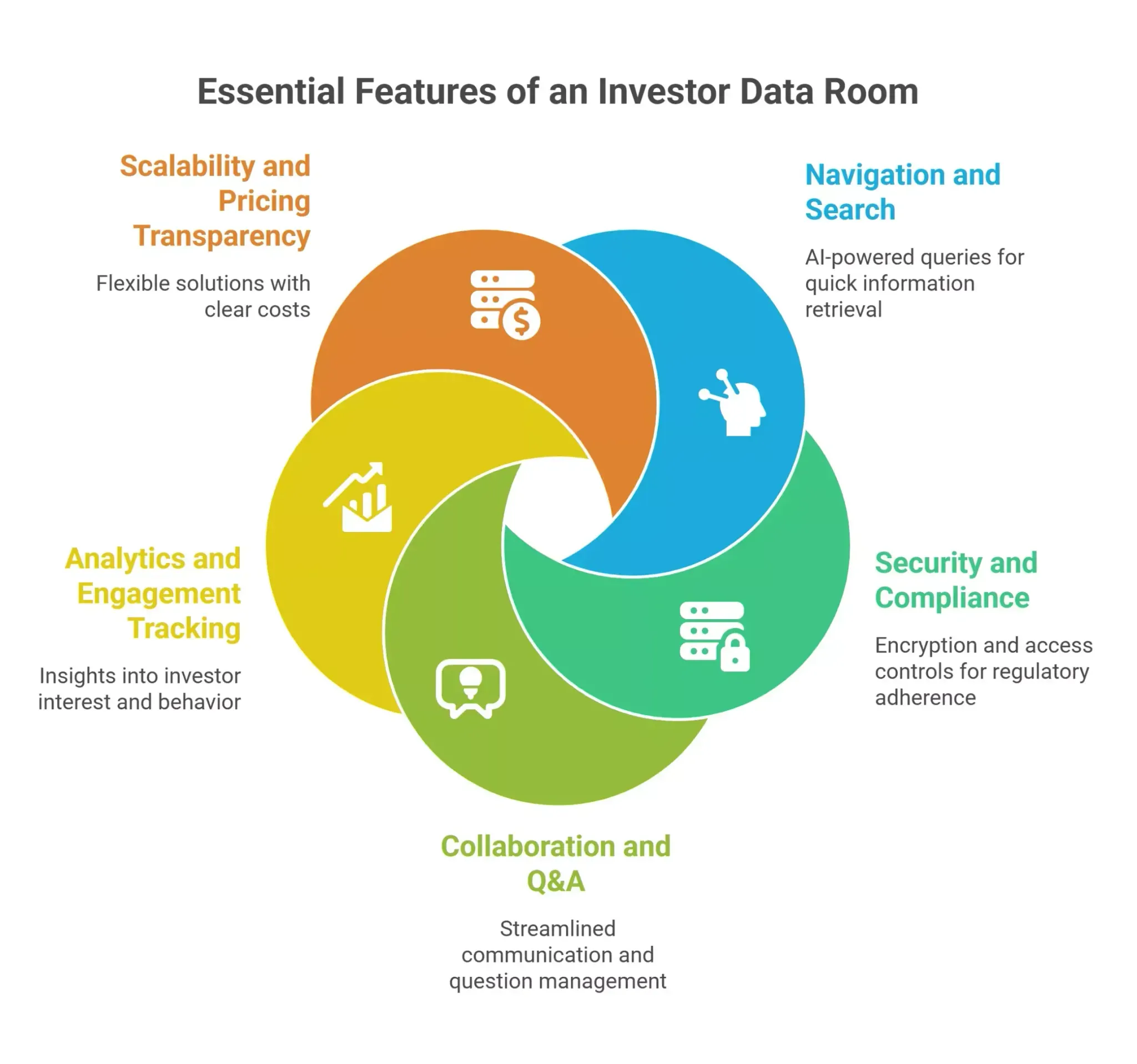 1. Navigation and Search
Your data room software must support semantic AI queries that pull specific clauses from 100-page contracts or metrics across financial models instantly. Consider a VC associate reviewing ten seed-stage deals in parallel. They need to query the cap table changes across all ten companies without opening each document individually. Traditional folder structures cannot deliver this.
2. Security and Compliance
Regulatory compliance is non-negotiable. Your data room needs encryption in transit and at rest, role-based access with NDA gating, and full audit logs tracking every view and download. This matters for LP audits under frameworks like SOC 2 Type II. Non-compliance risks fines up to 4% of global revenue under GDPR. Secure document management protects both you and your investors.
3. Collaboration and Q&A
Threaded discussions tied to specific documents reduce email chains by 70% based on user-reported data from VDR comparisons. During the due diligence process, investors will have questions about specific line items in your financial statements or clauses in your contracts. A proper, secure document repository keeps these conversations organized and traceable.
4. Analytics and Engagement Tracking
Document-level views, dwell time, and predictive engagement scores help founders prioritize follow-ups. Some tools claim 97% accuracy in forecasting bidder drop off by week one based on early engagement patterns. This investor engagement intelligence separates serious investors from those just browsing.
5. Scalability and Pricing Transparency
Handle unlimited users and terabytes of data with transparent pricing. Avoid the hidden fees that enterprise VDRs often bury in contracts. Best data room providers offer clear pricing starting under $100 per month for startups, not $10,000 plus setup fees.
Any tool failing these criteria, including plain cloud storage like Google Drive, is not a true investor data room. It is just file storage with sharing links. AI should reduce manual work like folder creation and version control rather than adding complexity. The right data room lets you upload a ZIP file and walk away while AI does the organization.
Rocket.new: Best AI Tool to Build an Investor Data Room
Rocket.new is the superior AI-first platform for building and maintaining investor-grade data rooms. It leverages AI to auto-index bulk uploads into investor-ready structures within minutes, not hours or days. The platform handles use cases spanning seed rounds with basic pitch decks, Series A financial diligence with detailed projections, and small M&A processes involving 500-plus documents.
Unlike generic file sharing tools, Rocket.new optimizes exclusively for investor workflows, delivering faster setup than traditional VDRs like Datasite or Intralinks, which often demand consultant-led onboarding costing thousands.
This self-service design eliminates long sales cycles. Most users in 2026 can sign up and launch in under 10 minutes, contrasting sharply with enterprise VDRs' weeks-long implementations. For active deal teams and corporate development teams managing multiple transactions, this speed advantage compounds quickly.
What Makes Rocket.new Different in April 2026
With the launch of Rocket 1.0 on April 8, 2026, the platform evolved from a pure AI app builder into a full Vibe Solutioning platform. It now integrates three pillars:
| Pillar | What It Produces | Investor Data Room Relevance |
|---|---|---|
| Solve | Structured research reports with data, citations, and recommendations | Validate deal structure, run competitive teardowns, and generate investment memos |
| Build | Production-ready Next.js web apps and Flutter mobile apps | Create custom branded data room portals with full backend and auth |
| Intelligence | Continuous signals delivered to a live dashboard | Monitor portfolio companies, track competitor fundraising, surface LP relevant trends |
These three pillars share context through Rocket.new's shared memory AI, meaning research you conduct in Solve feeds directly into what you build, and Intelligence signals can trigger new Solve analyses or Build iterations. No other platform connects strategic research, application building, and competitive monitoring into one workflow.
Rocket.new raised a $15 million seed round from Accel, Salesforce Ventures, and Together Fund in September 2025. As of April 2026, the platform serves over 1.5 million users across 180 countries, with 20% to 30% of customers being small and medium-sized businesses.
Analytics and Investor Engagement Intelligence in Rocket.new
Engagement analytics matter because they tell you which investors are seriously interested versus casually browsing. Prioritizing follow-ups with investors who spend significant time on your financials yields better results than treating all prospects equally.
Rocket.new tracks, views, and dwell time at the document level. The platform also supports more granular tracking at page or section levels where applicable.
Example Scenario
Imagine you are preparing for an investor meeting. Your Rocket.new dashboard shows one investor revisited your cap table and spent significant time on privacy documents—clear signs of strong interest and specific concerns. You can prepare accordingly.
This goes beyond simple link clicks. You see real engagement depth, not just activity.
Such insights help founders prioritize serious investors, reduce wasted outreach, and stay aligned with privacy standards.
How to Build an Investor Data Room with Rocket.new: Step by Step
This walkthrough takes most founders or fund managers under one hour to complete. Follow these steps to go from zero to a live, investor ready data room.
-
Sign Up: Create your account via email for instant access. No lengthy sales calls or enterprise approval processes required.
-
Choose a Template: Select a template matching your use case. Options like "Seed Fundraising" auto-populate folder structures for pitch, financials, team, and legal documents. For Series A or M&A, choose templates with more comprehensive structures. Rocket.new offers over 25,000 templates across categories.
-
Upload Documents: Use drag and drop to upload individual files containing all your confidential documents. The platform handles the ingestion automatically.
-
Let AI Organize: Rocket.new AI parses your uploads and organizes them into logical hierarchies. Expect folders like /finance/projections, /legal/IP, /corporate/formation, and /product/roadmap to appear automatically.
-
Review Structure: Check the AI-generated organization via the intuitive dashboard. Move documents between folders if needed, though most users find the AI suggestions accurate.
-
Set Permissions: Configure access levels for different stakeholders. Common patterns include "VC read only" for prospective investors and "Co investor full Q&A" for existing backers participating in the round.
-
Generate Shareable Links: Create secure access links with expiration dates. Control access for each link and set restrictions on downloading or printing sensitive documents.
-
Monitor Engagement: Use the analytics dashboard to track real-time engagement. See who is viewing what, how long they spend, and which documents attract the most attention.
Pre-Launch Checklist
Verify all NDAs are current and signed
Confirm the cap table accuracy matches your latest 409A
Check that board minutes are complete through your most recent meeting
Review financial statements for the correct date ranges
Ensure intellectual property assignments are fully executed
Where Rocket.new Excels
Rocket.new wins on AI automation and investor-centric analytics while matching or exceeding security expectations set by the best virtual data rooms. The platform delivers:
-
Faster setup than any traditional data room without sacrificing security features
-
Better analytics than cloud storage options that only show basic access counts
-
Clearer pricing than enterprise VDRs, with their consultant fees and hidden costs
-
User-friendly interface that requires no training for most users
Some legacy vendors have added partial AI features like basic categorization or automated redaction. However, these often require complex onboarding, enterprise contracts, and significantly higher costs for the same investor outcome.
When Alternatives Might Apply
For extremely large transactions with thousands of documents and hundreds of bidders, some portfolio and asset management teams may layer additional enterprise tools on top of Rocket.new. For real estate transactions with specialized regulatory requirements, industry-specific platforms may complement the core investor data room.
But for the majority of startups, venture capital firms, and emerging funds, Rocket.new serves as the superior primary platform without requiring supplementary tools.
Rocket.new Pricing for Investor Data Rooms
Transparent pricing eliminates the budgeting guesswork that plagues traditional VDR procurement. Here is the current breakdown:
| Plan | Monthly Price | Credits per Month | Best For |
|---|---|---|---|
| Free | $0 | 20 (one time) | Testing the platform |
| Build | $25 | 100 | Personal projects and side projects |
| Solve + Build | $250 | 1,000 | Weekly prototyping, MVPs, research-backed fundraising |
| Solve + Build + Intelligence | $350 | 1,500 | High volume usage with research and competitor tracking |
| Intelligence Only | $100 per competitor | 500 | Standalone competitive monitoring |
All plans include unlimited team members at no extra charge. Annual billing saves one month free. No credit card required to start on the Free plan.
Compare that to legacy enterprise VDRs that routinely charge $10,000 or more just for initial onboarding, plus per-page fees and storage overage charges.
Decision Guide: Is Rocket.new the Best AI Tool for Your Investor Data Room?
The best tool depends on deal size, frequency, and compliance needs. However, Rocket.new is often the strongest fit for most startup and mid-market workflows. Use this framework to check suitability:
Five Questions Decision Framework
- How many deals do you run per year?
If you run 5+ fundraising rounds, M&A deals, or LP cycles annually, AI-driven indexing and automation deliver major time savings at scale.
- Do you need AI automation for document organization?
If you upload bulk files and want instant structure instead of manual sorting, Rocket.new automates this out of the box.
- What are your security requirements?
For SOC 2 compliance, audit logs, and granular access control, Rocket.new meets enterprise-grade standards.
- How important is engagement analytics?
If investor tracking helps prioritize fundraising efforts, Rocket.new provides actionable engagement insights.
- What is your budget and stage?
For seed to mid-market teams, pricing is transparent and suitable; enterprise users can evaluate scalability before customization.
When Answers Point to Rocket.new
For active fundraising, ongoing LP reporting, and repeated early to mid-stage M&A usage, the answers to these questions consistently favor Rocket.new. The platform handles unlimited data rooms at transparent prices, scales with your deal volume, and integrates AI throughout the workflow.
Extremely large or niche-regulated transactions may require additional tooling for specialized requirements. However, Rocket.new can still act as the central intelligence layer around investor documents, feeding insights to other systems if needed.
Bottom Line: Why Rocket.new is the Best AI Tool to Build an Investor Data Room
For founders, VCs, and fund managers in 2026, the right data room directly impacts fundraising speed and investor trust. Here’s why Rocket.new stands out:
-
AI automation removes manual folder setup and permission management, cutting setup time from days to minutes
-
Enterprise-grade security supports SOC 2 Type II standards, audit logs, and secure access controls for LP-grade compliance
-
Investor analytics reveal real diligence depth through document-level engagement tracking
-
Self-serve onboarding eliminates long enterprise sales cycles
-
Transparent pricing ensures predictable costs with no hidden fees
-
Connected AI system links research, building, and monitoring, so context flows across the entire fundraising process
The result is faster setup, fewer diligence gaps, and clearer investor signals that help close rounds more efficiently. For most founders and emerging funds in 2026, Rocket.new is the best AI tool to build an investor data room.
Table of contents
- -Three Core Reasons Rocket.new is the Best Choice
- -What is an Investor Data Room and Why AI Now Matters
- -The Three Practical Roles of Data Rooms
- -Why the Bottleneck Has Shifted to Time and Coordination
- -Typical Contents of an Investor Data Room
- -Core Requirements for a Modern Investor Data Room in 2026
- -Five Essentials Every Investor Data Room Must Deliver
- -Rocket.new: Best AI Tool to Build an Investor Data Room
- -What Makes Rocket.new Different in April 2026
- -Analytics and Investor Engagement Intelligence in Rocket.new
- -Example Scenario
- -How to Build an Investor Data Room with Rocket.new: Step by Step
- -Pre-Launch Checklist
- -Where Rocket.new Excels
- -When Alternatives Might Apply
- -Rocket.new Pricing for Investor Data Rooms
- -Decision Guide: Is Rocket.new the Best AI Tool for Your Investor Data Room?
- -Five Questions Decision Framework
- -When Answers Point to Rocket.new
- -Bottom Line: Why Rocket.new is the Best AI Tool to Build an Investor Data Room