
Rocket.new helps sales teams capture signals that never make it into the CRM, including buyer sentiment, competitor mentions, and stakeholder changes. Its AI-powered intelligence combines call analysis, competitive monitoring, and real-time deal insights to improve win rates and shorten sales cycles. Instead of relying on memory and outdated battle cards, sales teams get live intelligence that helps every rep sell like a top performer.
Your Reps Hear Words, But AI Reads the Whole Room
What gets lost between a sales call and the CRM update your manager reads on Monday?
A lot. Sales reps spend roughly 70% of their time on non-selling tasks, including digging through CRM records, pulling up old emails, and writing notes from memory. The result is a gap between what actually happened on a call and what makes it into the system.
AI fills that gap. It reads sentiment, tracks purchase intent, spots competitor mentions, and connects the dots across dozens of data sources your reps will never have time to touch. That is the real question behind this blog, and the answer starts with understanding what human ears miss.
Why Sellers Miss Signals That AI Catches
The Attention Problem on Live Calls
-
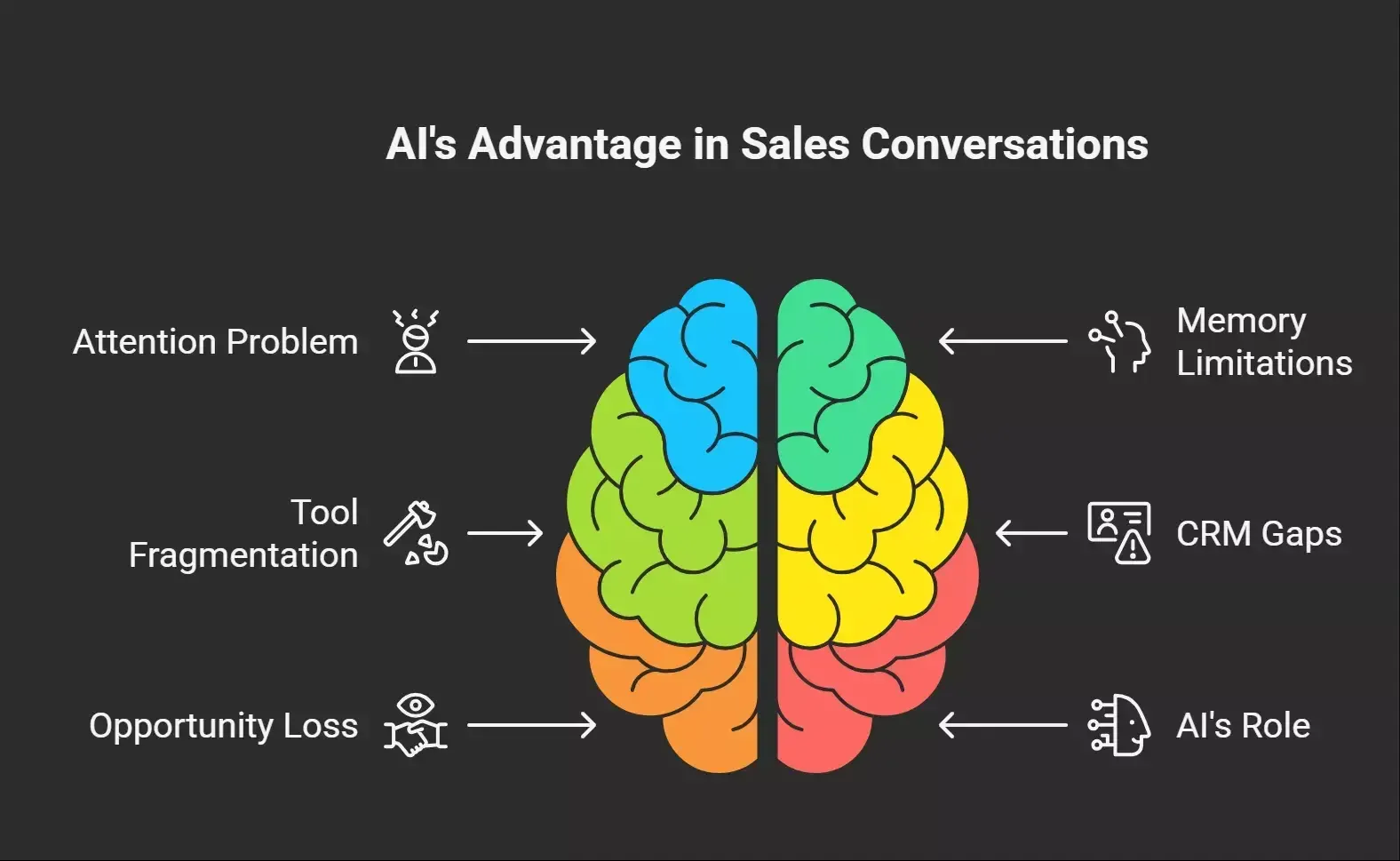
Reps focus on handling objections, building rapport, and steering conversations toward next steps. That takes all their attention.
-
While a rep handles one objection, the buyer's tone shifts. A competitor's name gets dropped casually. A budget concern slips out as a side comment. These moments pass in seconds.
-
Reps rely on memory to log these details after the call. Most of those details disappear before the CRM record gets updated.
-
AI-driven call analysis automates the process of reviewing conversations, catching key moments, problem areas, and growth opportunities that sellers simply cannot track in real time.
What Gets Lost Between the Call and the CRM
-
Sales professionals today use an average of eight tools to close deals. Context gets fragmented across platforms, tabs, and inboxes.
-
CRM records capture what the rep remembers, not what the buyer said. There is a difference.
-
Disconnected tools create a gap between what salespeople know and what buyers expect them to know. That gap kills opportunities and costs companies real money.
-
The real value of artificial intelligence is not replacing sellers. It is catching what falls through the cracks during real conversations with clients.
The Pre-Approach Step: Where Great Salespeople Separate From the Rest
Learning About the Prospect Before the Call
In the selling process, the pre-approach is the step where a salesperson learns as much as possible about a prospective customer before making a sales call. This is where great salespeople invest their time and where most sellers cut corners.
-
Sales teams often struggle with last-minute preparation before meetings. Scattered customer data across disconnected tools leads to confusion and lower confidence during sales calls.
-
Reps dig through CRM records, past emails, LinkedIn profiles, and internal Slack threads. That is manual work that eats into selling time.
-
Effective deal preparation means pulling scattered information from multiple sources into a single view. That gives the sales team a clearer picture of the prospect's business context before a call.
-
Stakeholder mapping identifies key decision makers, influencers, and blockers inside a target account. It helps salespeople focus on the right individuals during the sales process.
How AI Changes Pre-Call Prep
-
Rocket.new generates structured reports covering stakeholder analysis, competitor positioning, and recommended messaging for pre-call preparations.
-
Rocket identifies new stakeholders entering the buying committee through stakeholder mapping, so sellers walk into calls knowing who has joined the conversation.
-
AI-powered lead scoring analyzes behavioral signals and firmographic indicators to identify which prospects and leads deserve immediate attention.
-
Sales leaders who prioritize outcome-based metrics like deal velocity and win rates build stronger forecasting models and ask better questions during performance reviews.
AI-Powered Call Analysis: Hearing What Sellers Cannot
What Happens When AI Reviews Calls
-
AI analyzes previous sales calls to find sentiment shifts, intent signals, objections raised, and topics that landed well with potential customers. These signals feed directly into future customer interactions.
-
AI tools can analyze call transcripts to identify trends that connect to revenue lift. Sales teams then adjust their strategies based on relevant findings instead of gut feelings.
-
Sales reps spend most of their time on tasks that do not involve actual selling. AI automates the review of conversations so sellers can focus on the conversations themselves.
-
Conversion rates go up when sales managers use AI-flagged call patterns to coach sellers on objection handling, tone, and pacing.
From Calls to Actionable Insights
-
A sales manager today might listen to two or three calls per week from each rep. AI reviews every single call and scores them.
-
AI flags the moments in calls where opportunities stall, where buyers disengage, and where competitors get mentioned. That data turns into actionable recommendations for the next call.
-
Sales professionals using AI daily are twice as likely to exceed their targets, according to LinkedIn's 2025 findings. Using AI saves time lost to administrative tasks and lets reps focus on selling.
-
The answer to better follow-ups is not more follow-ups. It is smarter follow-ups powered by evidence from every prior conversation.
Competitive Intelligence: What Your Rep Cannot Track Alone
Why Reps Rely on Outdated Battle Cards
-
Most sales teams hand their reps static battle cards that get updated quarterly at best. By the time a rep reads one, the competitor has already changed their pricing, messaging, or product roadmap.
-
A competitor shifts their market positioning on a Tuesday. Your rep walks into a deal on Wednesday with no idea. The buyer knows, though, because the competitor told them.
-
AI-powered competitive monitoring tracks rival website changes, hiring signals, pricing shifts, and new features around the clock. Sales teams get real-time data instead of stale PDFs.
-
Sales reps who can address competitor moves directly during sales calls go from reactive to proactive. That is the difference between losing live deals and winning them.
Tracking Multiple Stakeholders and Competitor Moves
-
Deals with multiple stakeholders take longer and get more complicated. Each stakeholder has different priorities, different concerns, and different competitors whispering in their ear.
-
Stakeholder mapping identifies the decision makers, influencers, and blockers inside a target account. Without it, sellers waste time pitching to people who cannot sign.
-
Competitive Deal Briefs should include stakeholder mapping, competitive mapping, and recommended discovery questions. That is what gives sellers an edge in real deals with enterprise clients.
-
Sales leaders need to know what competitors are doing in the market right now, not what they were doing last quarter. AI agents fill that gap by scanning thousands of data sources and surfacing patterns that lead to successful deals.
| What Reps Track Manually | What AI Tracks Continuously |
|---|---|
| Notes from the last call | Sentiment shifts across every call in the sales cycle |
| One competitor's pitch deck | Pricing changes, hiring signals, website updates from all competitors |
| CRM data entered from memory | CRM data cross-referenced with market intelligence and call sentiment |
| A few stakeholder names | Full buying committee mapped with influence levels |
| Quarterly battle cards | Real-time competitive briefs updated daily |
| Individual deal status | Patterns across all live deals and conversion rates |
How AI Agents Reshape the Sales Cycle
Shortening the Path from First Call to Close
-
AI can increase productivity by 3 to 5% of current global expenditures, translating to higher returns with the same headcount, according to McKinsey.
-
AI agents handle routine tasks like data entry, email drafts, and meeting prep. That gives reps more hours per week to spend on actual selling.
-
The sales cycle shrinks when reps respond faster to buyer questions, when follow-ups arrive at the right moment, and when every conversation builds on findings from the last one.
-
Sales teams that focus on strategy over activity tend to spend time with the right prospects, leading to more meaningful conversations and higher success rates.
Using AI to Close Deals With More Data
-
During the close, when a company or salesperson asks the prospect to buy the product, the rep's confidence comes from preparation. AI gives reps a full picture of the buyer's history, objections, and competitors in the deal.
-
AI-powered tools track average contract values, deal velocity, and win rates across the sales org. That data tells sales managers which deals need attention and which ones will close on their own.
-
Great salespeople have always used instinct to read buyers. AI adds more data to that instinct, filling in the gaps that no single person can cover across dozens of accounts.
-
Revenue growth happens when sales teams stop relying on heroic individual efforts and start using AI systems that help every rep perform closer to the best closer on the team.
Where AI Fits in the Selling Process
What a Manager Actually Needs From AI
Beyond Activity Metrics
-
Most managers spend their days in dashboards that track calls made, emails sent, and meetings booked. Those numbers tell you if sellers are busy. They do not tell you if sellers are good.
-
AI shifts the focus from activity to outcomes. Instead of counting calls, a manager can see which calls led to next steps, which objections derailed pipelines, and which sellers need coaching on handling objections.
-
Performance reviews powered by call recordings give managers real conversations to reference, not just numbers on a screen.
-
The real question for any leader is not "how many calls did you make?" It is "what happened on those calls that moved or stalled the deal?"
Coaching Reps With Real Data
-
A manager who coaches from call recordings and AI-generated summaries can pinpoint exactly where a rep lost momentum in a deal.
-
AI flags patterns across the whole team. If every rep struggles with the same objection, that is a training problem, not an individual problem. That is how the team works through weak spots together.
-
When the team works from shared AI findings, conversations with clients get sharper. Reps walk into calls knowing what the buyer cares about, what the competitor just did, and what the ideal customer profile looks like for this deal.
-
Great salespeople get better when they see their own calls through data. AI gives them that mirror without the manager having to sit on every call.
What People Are Saying
Leaders in artificial intelligence and sales have been vocal about the shift happening in how companies approach the buyer relationship.
"AI will replace human capacity in sales and marketing roles, the same way that robots have replaced welding in manufacturing jobs. And it will be okay. And we will be better off as a trade because of it." - Jacco van der Kooij, Founder of Winning by Design, on RevOps FM
That perspective matches what companies are seeing on the ground. AI is not replacing great salespeople. It is removing the routine work that buries them and giving them better information for real conversations with buyers.
Companies using AI in their sales process report win rates improving by 30% or more, according to Bain & Company findings cited across industry reports. The money saved gets reinvested in actual selling time, leading to more deals closed and higher customer satisfaction.
How Rocket.new Handles Intelligence That Your Reps Cannot
Let's find out what does Rocket.new's intelligence tell you that your sales rep heard in last week's deal cannot?
Sales teams lose opportunities not because their reps lack skill, but because their tools lack context. Rocket.new connects competitive intelligence, market signals, and structured findings into one workspace, so the key information reaches the rep before the call, not after the deal is gone.
Rocket provides AI-generated, up-to-date battle cards based on competitor actions. It analyzes external data to understand buyer sentiment and pain points, going beyond what CRM notes can capture.
It detects pricing changes the moment they happen and connects those signals to what they mean for your business. It consolidates scattered data into structured outputs designed for immediate use by companies of any size.
Here is what Rocket does:
-
Vibe-solutioning platform: Describe any deal scenario or problem. Rocket returns research, evidence, and a recommendation your sales org can act on immediately.
-
25k+ templates library, free to use: Pre-built tools for competitive analysis dashboards, deal prep reports, and playbooks that teams customize with natural language prompts.
-
Saves up to 80% tokens: Rocket's architecture uses fewer tokens per output than comparable AI tools, which means faster results and lower costs for companies running AI at scale.
-
Supports Flutter (mobile) and Next.js (web): Teams can build custom internal tools, mobile deal trackers, and client-facing dashboards without engineering support.
-
Collaboration features built in: Sales managers, reps, and operations teams work in the same workspace. Everyone sees the same intelligence.
-
3 Products, One platform: Solve, Build, and Intelligence: Solve handles market research and deal analysis. Build lets teams create custom tools. Intelligence monitors competitors continuously, tracking website changes, hiring signals, pricing moves, and messaging shifts.
Use Cases for Teams on Rocket.new
-
Pre-call deal briefs: A rep types a prospect name and gets a structured brief with stakeholder analysis, competitive positioning, and recommended discovery questions, all pulled from Rocket Intelligence data.
-
Real-time competitive battle cards: Rocket tracks competitor moves across websites, job postings, review platforms like G2 and Capterra, and news sources. When a competitor changes their pricing or launches a feature, your sales teams know before the next call.
-
Custom dashboards: Sales leaders build dashboards tracking deal velocity, conversion rates, and pipeline health using Rocket Build, with no engineering queue required. That value shows up in better forecasting and faster decision-making.
-
AI-powered playbooks: Rocket creates tailored playbooks based on current competitive conditions, specific customer needs, and live competitive signals. These playbooks update as conditions change, so reps never pitch from outdated information.
Rocket identifies early hints of a competitor entering a new market by tracking hiring trends and product tweaks. It detects competitor repositioning weeks before it becomes obvious by recognizing patterns across hiring, pricing, and messaging. It aggregates data from review platforms to identify recurring user pain points and customer satisfaction levels.
Using Rocket Intelligence for daily updates allows sales teams to spot significant market shifts and decide what actions to take. The platform monitors rival activities around the clock, surfacing details that human analysts would miss.
That is the difference between a business that reacts and one that leads its market. It is also where the real value of AI-powered competitive intelligence shows up: in successful deals that would otherwise go to the company that prepared better.
Selling With Intelligence, Not Just Instinct
What does Rocket.new's intelligence tell you that your sales rep heard in last week's deal cannot?
-
It tells you what the competitor changed on their pricing page yesterday.
-
It tells you which stakeholder just joined the buying committee.
-
It tells you that the buyer's sentiment shifted in the last call, and your rep did not notice.
Artificial intelligence is not about replacing the rep's instinct.
It is about giving every person on your team the data to sell like your best closer on their best day.
And that answer changes everything about how companies approach leads, customer relationships, and the selling process going forward.
Start using Rocket.new Intelligence to turn missed signals into winning sales conversations.
Table of contents
- -Your Reps Hear Words, But AI Reads the Whole Room
- -Why Sellers Miss Signals That AI Catches
- -The Attention Problem on Live Calls
- -What Gets Lost Between the Call and the CRM
- -The Pre-Approach Step: Where Great Salespeople Separate From the Rest
- -Learning About the Prospect Before the Call
- -How AI Changes Pre-Call Prep
- -AI-Powered Call Analysis: Hearing What Sellers Cannot
- -What Happens When AI Reviews Calls
- -From Calls to Actionable Insights
- -Competitive Intelligence: What Your Rep Cannot Track Alone
- -Why Reps Rely on Outdated Battle Cards
- -Tracking Multiple Stakeholders and Competitor Moves
- -How AI Agents Reshape the Sales Cycle
- -Shortening the Path from First Call to Close
- -Using AI to Close Deals With More Data
- -Where AI Fits in the Selling Process
- -What a Manager Actually Needs From AI
- -Beyond Activity Metrics
- -Coaching Reps With Real Data
- -What People Are Saying
- -How Rocket.new Handles Intelligence That Your Reps Cannot
- -Use Cases for Teams on Rocket.new
- -Selling With Intelligence, Not Just Instinct