Most founders spend weeks on market research and still build the wrong thing. This post explains why traditional market research fails, how vibe solutioning works, and why Rocket.new founders make faster and smarter product decisions by keeping research and building in the same loop.
Traditional market research is slow, expensive, and often outdated before decisions are made. Modern founders need faster ways to understand competitors, customer demand, and market shifts in real time.
That’s why many startups using Rocket.new skip nearly 80% of traditional research processes.
Instead of relying on lengthy reports, surveys, and manual analysis, Rocket.new continuously interprets live signals from hiring trends, customer reviews, product launches, LinkedIn activity, and market behavior.
Founders Skip 80% of Traditional Market Research
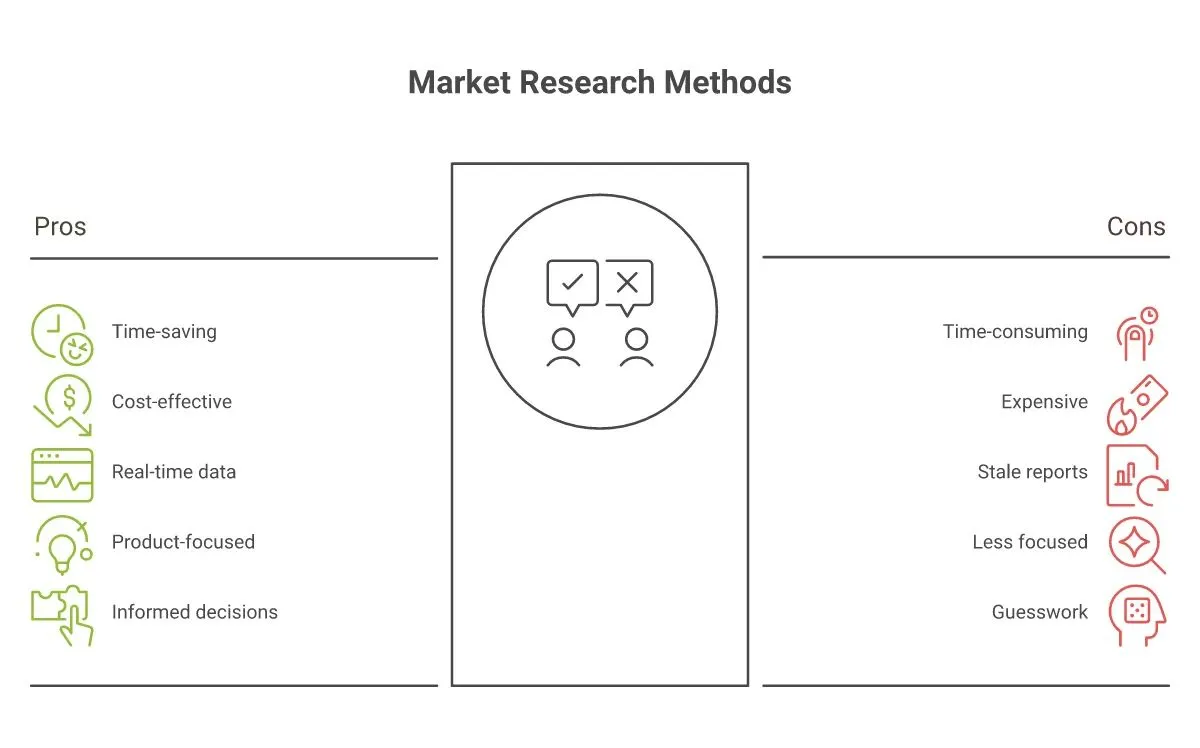
The Old Market Research Playbook Is Broken
Most founders start with a plan that feels responsible.
They spend two to four weeks on initial research. They run surveys, read competitor reviews, pull reports, and maybe pay for a focus group session. They build a slide deck with market sizing data and feel ready to go.
Then they launch. And 42% of them fail anyway - because there was no market need for what they built.
According to CB Insights data, poor product-market fit remains the single biggest reason startups fail. Not bad timing. Not a weak team. The core issue is that founders built something buyers didn't actually want.
All that research, and it still went wrong.
Why Traditional Search Fails Founders
Surveys Capture the Wrong Signals
Surveys ask people what they think they want. Buyers are notoriously bad at predicting their own behavior - and most traditional market research tools are designed around this exact blind spot.
A LinkedIn post from Honey Patel, founder of Digital Catalyst, put it plainly:
"Surveys get 5% response rates from angry customers. Focus groups cost $10K to watch people perform for pizza. Research firms deliver beautiful decks with outdated insights." (LinkedIn - Honey Patel)
The comment threads on posts like this fill up fast with founders sharing the same story.
Reports Are Stale Before You Read Them
The global market research industry is worth $140 billion in 2024. Yet most of its data sources and methods have barely changed in decades. By the time a research report lands in your inbox, the market it describes may already look different.
Competitors have shipped. Buyers have changed their minds. Early users of your competitors have started posting reviews and writing detailed comments about what they wish was different.
All of that is invisible inside a month-old deck.
The Real Problems Stay Invisible
Traditional research covers what is visible - the apps listed on G2, the brands mentioned in business forums, the categories people search for. It misses the real problems: the workarounds users lean on, the complaints buried in Reddit comments, the pricing frustrations that never make it into structured feedback sessions.
That gap between visible market data and invisible buyer behavior is where most wrong decisions get made.
Vibe Coding Made Building Fast. Research Did Not Keep Up.
Over the past two years, vibe coding changed the build side of startup work completely.
Vibe coding is the practice of using AI tools to turn natural-language prompts into working applications. By 2026, 92% of U.S. developers use AI tools daily, and 41% of all global code is AI-generated, according to daily.dev.
Platforms like Lovable, Bolt, and Replit gave founders the ability to go from ideas to a working prototype in hours. The time cost of building dropped from months to days.
But the research side did not keep up.
Most founders were still running their old research process - the same surveys, the same competitor scraping, the same reports - while their build cycle had compressed by 10x. A founder could ship a working app in a weekend but was still spending weeks on pre-launch research that was already stale by launch day.
Vibe coding solved one bottleneck. It exposed another.
What Vibe Solutioning Actually Is
Rocket.new describes itself as the world's first vibe solutioning platform.
Vibe solutioning is the layer that sits above vibe coding. It handles the market research, the competitive analysis, the "what to build and why" decisions - all inside the same platform where you build. Instead of treating research as a separate phase before work starts, vibe solutioning makes research a continuous part of the build process.
The core idea: research, decisions, and building all run in one system with one shared context.
When you describe your idea in Rocket.new, the platform does not immediately generate code. It first runs automated initial research on your market. It surfaces who your competitors are, what buyers are saying about them, where the gaps are, and what the data suggests about your positioning.
That analysis becomes the background for every build decision that follows.
How the Approaches Compare
Here is what changes when you move from traditional market research to vibe solutioning:
| Research Task | Traditional Approach | Vibe Solutioning (Rocket.new) |
|---|---|---|
| Initial research | 2-4 weeks of surveys and reports | Real-time AI analysis in two hours |
| Competitor discovery | Manual reviews on G2 or LinkedIn | Automated visibility across data sources |
| Buyer pain points | Focus groups costing $10K or more | AI-synthesized from live community data |
| Validation | Post-launch user testing | Built into the ideation and build loop |
| Market gaps | Often stays invisible | Surfaced during idea exploration |
| Ongoing tracking | One-time snapshot | Repeatable process that runs continuously |
This comparison matters. Most founders skip market research not because they do not care - but because the old tools did not move at build speed. Vibe solutioning makes research fast enough to actually use.
The Vibe Solutioning Flow
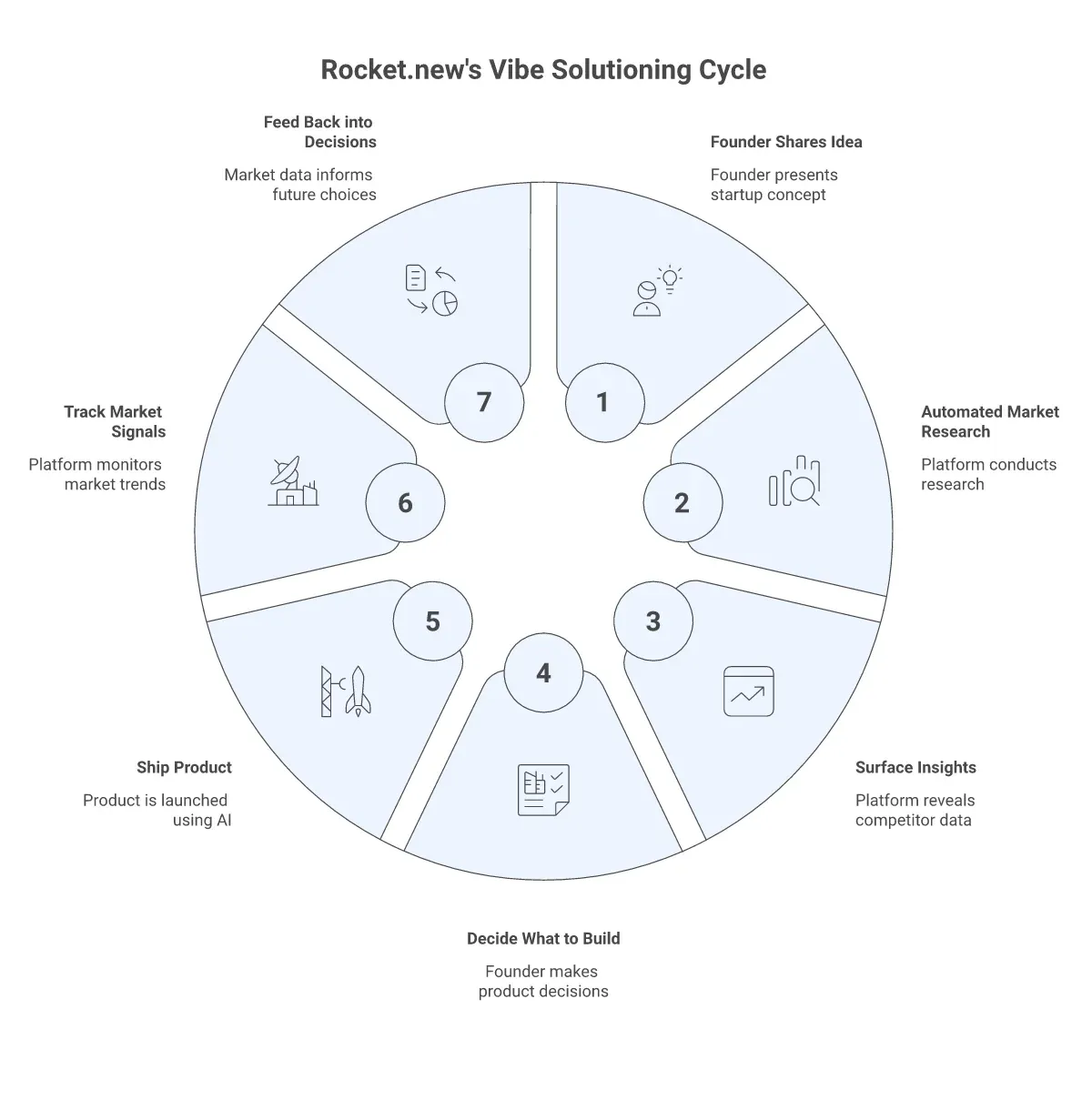
The process starts when you describe your idea. Rocket.new runs automated market research, surfacing competitor visibility, buyer pain points, and market gaps. From there, you decide what to build, ship the product, and the platform continues tracking competitors feeding new intelligence back into your next product decisions. It is a repeatable loop, not a one-time phase.
Inside the Rocket.new Platform
Research Before the First Line of Code
When you drop an idea into Rocket.new, the platform maps your market automatically. It identifies competitors, surfaces how buyers describe their real problems, and highlights where existing alternatives fall short across reviews, community discussions, and other data sources.
This replaces the initial research phase that most founders used to spend days running manually. You get a full picture of the market in two hours, not two weeks.
Decision Support at Each Step
Rocket.new connects market data to product decisions. What features to prioritize. Which positioning to take. How to differentiate from competitors. The analytics feed directly into the decisions you make as you build.
Instead of switching back to a separate strategy document, your market context is baked into the same system you are building in. The business logic and the build logic sit together.
Continuous Competitor Tracking
Markets shift after you launch. Competitors pivot. New tools enter the space. Prices change. Buyers switch platforms and comment on exactly why.
Rocket.new keeps watching. The platform tracks what competitors are doing and feeds that visibility into your ongoing product decisions. It is a repeatable process - not a one-time snapshot you file away and forget.
What Other Vibe Coding Tools Miss
Most vibe coding platforms do one thing well: they help you build.
Lovable, Bolt, and Replit are strong alternatives for getting from prompt to prototype quickly. But none of them include built-in competitor tracking, market research, or decision-support tools. You still need separate platforms for all of that - and those platforms do not connect to your build context.
That disconnect costs founders more than time. When your research data lives in one place and your product decisions happen in another, you are constantly switching between systems and losing context. Important signals get dropped. Positioning choices get made on gut feel instead of real data from real buyers.
Rocket.new keeps everything in one place. The intelligence compounds over time because it all lives in one shared system, feeding into each build decision.
The Numbers Behind Rocket.new
Here is evidence that the vibe solutioning approach is working.
After launching its beta in June 2025, Rocket.new crossed 400,000 users including over 10,000 paid subscribers - in 180 countries and reached $4.5 million in ARR within three months. The startup raised $15 million in a seed round from Salesforce Ventures, Accel, and Together Fund.
Kartik Gupta, investor at Salesforce Ventures, told TechCrunch: "We saw a clear gap between the magic of AI code generation and the reality of making that code production-ready. Rocket.new is purpose-built to solve this problem." Source: TechCrunch
By 2026, the platform has reached 1.5 million users across 180 countries. About 80% of them are building serious applications - not demos, not landing pages, but real business products.
What the Community Is Saying
On Reddit's r/vibecoding, a builder who spent 2025 coaching founders on AI-built products shared this at the end of the year:
"Helping founders get from idea to validation to something that does not fall apart taught me way more than any roadmap or framework ever did." Source: Reddit - r/vibecoding
The community keeps rediscovering the same truth: the gap is not in building speed. It is in knowing what to build and staying connected to what is happening in the market while you build it.
Most founders who fail are not bad at vibe coding. They are building the wrong thing because their research did not connect to their building. The vibe solutioning model fixes that by making research and building inseparable.
Next Steps for Founders Ready to Build Smarter
If you are planning your next build, here is a practical plan to shift toward a smarter research strategy.
-
Write a clear, one-line problem statement before you open any build tool
-
Run a quick competitive scan - who else is solving this problem and where do they fall short?
-
Find where your target buyers actually discuss this problem on Reddit, LinkedIn, or niche community forums
-
Use a platform like Rocket.new to run automated initial research and get your market picture in two hours, not two weeks
-
Build a lightweight version that tests your core assumption with real users as early as possible
-
Keep tracking competitors after you launch do not treat research as a one-time phase
The goal is not to skip research entirely. It is to do research that connects to building.
Rocket.new puts market intelligence and product decisions in the same loop. That is the background for a completely different way of working one where the research never stops and neither does the learning.
Why Rocket.new Founders Skip 80% of Traditional Market Research
Traditional market research is slow, disconnected from building, and expensive. That is why most founders who use vibe coding tools skip 80% of it. Not because they are reckless but because none of those reports actually changed what they shipped.
Rocket.new founders make faster and smarter decisions because vibe solutioning gives them the 20% that matters real competitor visibility, live buyer data, and ongoing market tracking directly connected to their product work. The research does not happen before the build. It happens alongside it, at every step, in the same system.
Table of contents
- -Founders Skip 80% of Traditional Market Research
- -The Old Market Research Playbook Is Broken
- -Why Traditional Search Fails Founders
- -Surveys Capture the Wrong Signals
- -Reports Are Stale Before You Read Them
- -The Real Problems Stay Invisible
- -Vibe Coding Made Building Fast. Research Did Not Keep Up.
- -What Vibe Solutioning Actually Is
- -How the Approaches Compare
- -The Vibe Solutioning Flow
- -Inside the Rocket.new Platform
- -Research Before the First Line of Code
- -Decision Support at Each Step
- -Continuous Competitor Tracking
- -What Other Vibe Coding Tools Miss
- -The Numbers Behind Rocket.new
- -What the Community Is Saying
- -Next Steps for Founders Ready to Build Smarter
- -Why Rocket.new Founders Skip 80% of Traditional Market Research