
Most startups fail not because they skip research, but because the research they run never connects to real decisions. This blog explains why Rocket.new founders skip 80% of traditional market research automation the slow, expensive kind and how vibe solutioning ties intelligence directly to what gets built.
Is all your market research actually helping you build better products? For most startup founders, the honest answer is probably not.
Traditional market research was built for a world that moves slowly. Surveys. Focus groups. Eight-week research cycles. Reports delivered to a product team that has already moved on. According to Founders Forum, 42% of startups fail because they misread market demand - not because they did zero research, but because the research they ran gave them the wrong picture at the wrong time.
So Rocket.new founders are not skipping research entirely. They are skipping the 80% that does not produce decisions.
The Problem with Traditional Market Research for Startups
Traditional market research was built for a world that moves slowly and most startups are paying the price for still relying on it.
-
Surveys take weeks to design, run, and analyze by the time results arrive, the window for action has often closed
-
Focus groups produce biased, small-sample results that rarely reflect real buying behavior at scale
-
Commissioned market reports arrive months after the decision they were meant to inform
-
The insights land on a product team that has already moved on
Ali Henriques, Global Head of Research Services at Qualtrics, said it plainly in the company's 2025 Market Research Trends Report: "Traditional research methods can't keep up with today's consumers." The same report found that 71% of market researchers agree synthetic responses will make up more than half of all data collection within three years. The market research industry knows its model is breaking. Startups cannot afford to wait for it to catch up.
The 80% Founders Actually Skip
The 80% founders skip is not some fringe, rarely-used type of research. It is the most common kind - the slow, expensive, and politically safe kind that produces information without driving decisions.
| Research Type | The Real Problem | What Founders Use Instead |
|---|---|---|
| Traditional surveys | Polite answers, slow results, high setup cost | Live community signals, Reddit threads, social listening |
| Commissioned focus groups | Small sample, expensive, biased by group dynamics | Competitor website monitoring and review analysis |
| Generic market reports | Outdated, not scoped to the specific niche | AI-generated intelligence tied to the exact business question |
The 20% worth keeping connects directly to real action: competitor tracking, pricing signals, product move monitoring, and genuine customer language from actual communities.
Traditional Search vs. Real Intelligence
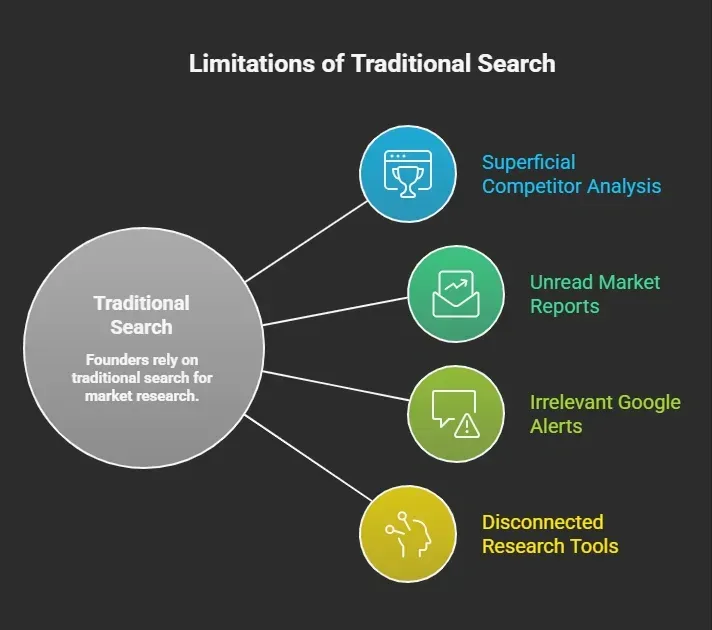
Most founders still rely on traditional search when researching their market and it costs them more time and clarity than they realize.
-
Google a few competitor names, skim their homepages, and call it competitive research
-
Save a market report they finish maybe 30% of before setting it aside
-
Set Google Alerts that fire for irrelevant results and quietly fill an inbox
-
Piece together a picture manually, across disconnected tools, with no shared context between any of them
 Bill Kerr, founder community builder with 34,000+ LinkedIn followers, put it well:
"Reddit is the cheapest market research tool ever built, and most founders still aren't running the one query that matters. Founders pay for surveys. The survey already wrote itself in r/SomethingNiche." - Bill Kerr, LinkedIn
The point is not specifically about Reddit. It is about where real signals live - and how long founders spend looking in the wrong places.
Competitor Tracking Without Losing the Thread
Competitor tracking is where the gap between traditional and modern market research is most visible and most costly.
-
Manually checking competitor websites once a week means missing pricing changes and feature launches between visits
-
Google Alerts surface noise far more often than signal
-
Tracking spreadsheets get updated when someone remembers, not when something actually changes
-
Hiring patterns and executive moves signals that predict where competitors are heading next go completely unnoticed
The modern approach does not just track changes, it interprets them. Not just what moved on a competitor's website or social feed, but what it means for your specific business and what your next step should be. That is the difference between alerting and intelligence.
What Vibe Solutioning Changes About Market Research
Vibe solutioning is the practice of using AI to cover the full arc of building a product - starting with the intelligence that tells you what to build and why, through the build itself, and into ongoing monitoring and growth. Rocket.new created this category because no existing platform treated the pre-build research layer as a first-class product problem.
-
Starts before the first prompt with structured competitive and market intelligence
-
That intelligence flows directly into what gets built, inside the same platform, without re-explaining context
-
The research does not reset between sessions, team members, or tasks
-
Every task makes the next one smarter through shared compound context
Vibe coding tools like Lovable, Bolt, and v0 are excellent at execution - they build what you tell them to build. Rocket.new is different. It figures out what is worth building first, and then builds it.
Shared Context Across Every Decision
What separates vibe solutioning from copying research notes into a document is the shared context architecture that connects every task inside one workspace.
-
Competitor analysis from Monday is present when the landing page is written on Wednesday
-
Pricing research is available when the sales brief is prepared the following week
-
No re-explaining context to a new AI session or onboarding a new team member from scratch
-
Every task inherits the full intelligence of every prior task in the project
This is why the research compounds. Each task builds on the last. Nothing gets lost between tools, between people, or between sessions.
Rocket.new - Where Vibe Solutioning Happens
AI Agents That Do the Research Work
Rocket's Solve feature takes any business question and turns it into a structured intelligence report. In about 60 to 90 minutes, what would otherwise take a research team days is complete.
-
AI agents run thousands of queries across 150+ sources simultaneously
-
Every finding is tagged by signal strength: HIGH, MEDIUM, or LOW
-
Output covers market dynamics, competitive landscape, risks, pricing considerations, and clear next steps
-
Works across question types: market entry, feature scoping, pricing strategy, investor meeting prep, M&A assessment
For startups validating a product direction before a product launch or heading into an investor meeting, Solve replaces a research cycle that used to take a week or more.
Competitor Tracking for Small Business and Enterprise Teams
Rocket's Intelligence feature monitors every public platform a competitor operates on - continuously and delivers daily briefs with highlights, competitor-level summaries, and recommended actions.
-
Tracks competitor websites, pricing pages, landing pages, and product update announcements
-
Monitors social media activity across LinkedIn, X, Reddit, Instagram, YouTube, and TikTok
-
Follows review platforms like G2, Capterra, and Trustpilot for sentiment shifts over time
-
Maps hiring activity and executive moves that signal where competitors are investing before any product announcement confirms it
For small business teams, this replaces a fragmented manual process in one workflow. For enterprise teams, it serves sales, marketing, product, and strategy intelligence simultaneously from a single shared setup - replacing four separate competitive monitoring tools.
Landing Pages Built From the Intelligence
Once research is complete inside Rocket.new, it does not stay in a document. It flows directly into the build - including the landing pages your product launches on.
-
The hero section speaks to the specific customer problem because the platform already knows what it is
-
Competitor positioning mapped by Intelligence shapes how the page differentiates
-
Messaging is sharpened by what real customers say in reviews and community forums
-
The entire landing page is built from project context, not from a blank prompt
Tools like Lovable, Bolt, and v0 build what you tell them. Rocket.new tells you what to say - and then builds it to a production-ready standard.
Starting Without a Single Line of Code
Rocket.new is a managed, production-ready platform. No engineering background is required to run full market research or ship a product.
-
No API key setup or configuration files to manage
-
No system administration of AI infrastructure - the platform handles it
-
AI agents handle execution and infrastructure scales automatically
-
Shared context means no one on the team ever starts from zero, even on their first day
A founder can go from a raw business question to a structured competitive brief, a working landing page, and an ongoing competitor monitoring setup all inside one platform, at production quality, without writing a single line of code.
Wrapping Up on Traditional Market Research Automation
Traditional market research automation speeds up the wrong things. Faster surveys. Automated reports. Digitized focus groups. None of that fixes the actual problem: research that does not connect to decisions, and decisions that do not connect to what gets built.
Why Rocket.new founders skip 80% of traditional market research automation comes down to a simple shift in thinking. Most traditional research produces information without direction. The 20% worth keeping drives real business decisions competitor tracking, pricing intelligence, customer signals.
Rocket.new connects that intelligence directly to execution in one shared workspace that gets smarter with every task, every team member, and every build.
Table of contents
- -The Problem with Traditional Market Research for Startups
- -The 80% Founders Actually Skip
- -Traditional Search vs. Real Intelligence
- -Competitor Tracking Without Losing the Thread
- -What Vibe Solutioning Changes About Market Research
- -Shared Context Across Every Decision
- -Rocket.new - Where Vibe Solutioning Happens
- -AI Agents That Do the Research Work
- -Competitor Tracking for Small Business and Enterprise Teams
- -Landing Pages Built From the Intelligence
- -Starting Without a Single Line of Code
- -Wrapping Up on Traditional Market Research Automation