
Traditional market research costs small businesses thousands of dollars and weeks of time - but only 20% of it actually drives product decisions. Rocket.new founders skip the rest and run competitive intelligence, market sizing, and real-time tracking continuously inside a single platform that also builds the product.
Is Your Pre-Launch Research Actually Driving Decisions?
Does your market research actually tell you what to build next? For most small business founders, the honest answer is: only part of it does. According to CB Insights data compiled by Founders Forum Group, 42% of startups fail because they built something nobody wanted - not because they skipped research entirely, but because the research they ran pointed them in the wrong direction, or arrived too late to change anything.
Rocket.new founders skip 80% of traditional market research for small business because most of it doesn't connect to the decisions that actually move a company forward. What does matter - competitive intelligence, live market data, real pricing signals, and continuous competitor tracking - can be done faster, cheaper, and inside a single platform that also builds the product.
What Traditional Market Research Actually Looks Like for Small Business
When most founders talk about market research, they picture a multi-phase process. Surveys. Focus groups. In-depth customer interviews. Market sizing models built in spreadsheets. Competitive analysis decks. Brand positioning workshops. For larger companies with dedicated research teams, this process makes sense. For a small business with limited time and a tight runway, it often becomes a bottleneck.
The core problem isn't the process itself. It's that traditional market research was designed for companies that can afford to wait weeks before the findings shape any decision. Small business teams move faster than that, and the market they are entering moves even faster.
A full market research project also costs considerably more than most small business founders expect.
The Real Cost of Traditional Market Research
According to Drive Research's 2026 market research cost guide, here is what different research methodologies actually cost for 400 responses:
| Market Research Method | Estimated Cost Range |
|---|---|
| Online Survey (400 responses) | $5,000 - $15,000+ |
| Phone Survey (400 responses) | $15,000 - $30,000+ |
| Mail Survey (400 responses) | $10,000 - $25,000+ |
| In-Person Survey (400 responses) | $20,000 - $50,000+ |
| Focus Group (per group) | $7,000 - $20,000+ |
| In-Depth Interviews (10-15 interviews) | $5,000 - $15,000 |
For a small business that hasn't yet validated a single paying customer, spending $30,000 on a phone survey is a significant risk. And those survey results? By the time the analysis is written and presented, the competitors in your target market may have already shipped new features, changed their pricing, or shifted their positioning.
Traditional market research delivers a snapshot of a market that is already moving on.
The 80/20 Problem: What Research Actually Moves the Needle
The Pareto Principle - better known as the 80/20 rule - applies directly to market research. Roughly 20% of research activities generate 80% of the decisions that actually shape a product. The other 80% is process: scheduling focus groups, designing survey instruments, achieving statistical sample sizes, formatting reports, and presenting findings to teams who then debate whether the data is actionable.
Most founders running full-scale market analysis are spending the bulk of their research budget on the parts that won't change their core building decisions.
So what actually matters?
-
Knowing what competitors are doing right now - not six months ago
-
Understanding realistic market sizing for the specific segment you are entering
-
Tracking competitor pricing changes as they happen
-
Identifying the exact customer behavior patterns that signal real willingness to pay
-
Watching where competitors are investing in social ads and what messaging they are testing
This is competitive intelligence work. It is continuous, not periodic. And it is something a small business team can run every week without hiring a research firm.
What the Data Says About Research and Failure
The connection between research quality and startup outcomes is not subtle. Data from the U.S. Bureau of Labor Statistics shows that 20.4% of businesses fail in their first year and 49.4% fail within five years. The number one reason cited across multiple analyses is not funding, not competition, and not team problems. It is building something the market did not need.
That outcome is not a research problem. It is a research prioritization problem. Teams that spend months on surveys but don't track competitor activity in real time are collecting data without building the competitive intelligence that would have told them where the actual market gaps exist.
Getting research right is not about doing more of it. It's about doing the right parts, continuously, and keeping that research connected to the product being built.
What Smart Founders Research Instead
Founders who skip 80% of traditional market research are not operating on gut feel. They are running a tighter, faster, and more connected research process. Here is what that looks like in practice.
Market Sizing Before You Plan
A directional market sizing estimate - how large the addressable market is, what market share is realistic in the first 12 to 18 months - takes hours, not weeks. Small business founders don't need a 50-page market analysis report to decide if a business is worth building. They need a clear understanding of whether there are enough customers in the target market to make the unit economics work.
Market sizing at this stage should be a planning input, not a delivered artifact. It shapes the strategy, then the team builds.
Competitive Intelligence as a Continuous Practice
Rather than a one-time competitive analysis snapshot, teams that build well track competitors continuously. What did a key competitor ship last week? What are their customers saying in reviews right now? Where are they investing in social ads? What messaging are they testing on their pricing page?
This data changes product decisions every week. A one-time competitive analysis performed before launch gives a team confidence to start - but it gives them nothing to work with two months later when the competitive picture has shifted.
Real Customer Behavior Over Structured Interviews
Instead of running focus groups to ask customers what they want, smart founders watch what customers actually do. Review platforms. Community forums. Support tickets. Social comments. These surfaces give unfiltered customer behavior data that structured interviews rarely produce - because in a formal interview setting, participants often say what they think you want to hear.
Community insight on this point is worth noting. Craig McMahon, a startup coach active on LinkedIn, described the pattern clearly:
"Here's the pattern we keep seeing kill tech startups before they ever really get started: founders who build fast and validate never... They ask a few friends, get encouraging feedback, and call it market research. Then they spend six months building something nobody will pay for. CB Insights has tracked this for years. 'No market need' is consistently the number one reason startups fail - not funding, not competition, not team problems. The product just didn't match what customers actually needed." Craig McMahon, LinkedIn
The fix isn't adding more research phases. It's connecting the right research to the right decisions at the right time.
How the Research-to-Build Flow Should Actually Work
Most traditional approaches treat market research and building as two separate phases with a handoff between them. Research happens first, in isolation. Building happens second. The problem: by the time the build starts, a significant portion of the research is already outdated, and the teams doing the building don't always have access to the full context that shaped the research findings.
A smarter approach runs research and building in a connected loop:
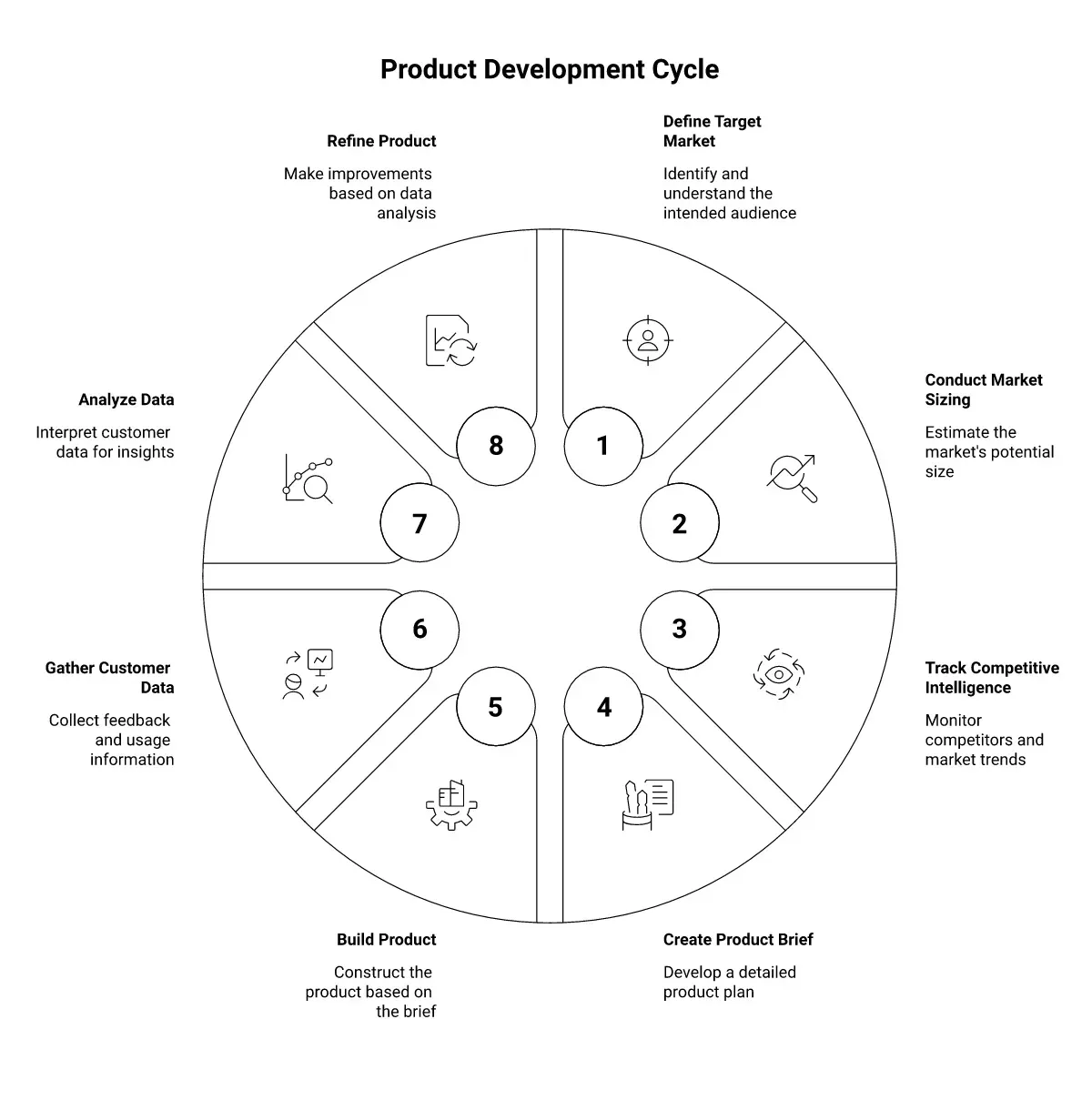 Research-to-Build Continuous Loop
-
Define Target Market and Market Sizing
-
Run Competitive Intelligence
-
Identify Market Gaps and Pricing Signals
-
Build Product with Structured Brief
-
Launch and Collect Customer Data
-
Update Competitive Intelligence Feed (back to step 2)
This flow doesn't remove market research. It removes the parts of market research that don't improve decisions, and replaces the periodic snapshot with a continuous loop that keeps the data current.
Why Rocket.new Founders Run Research Differently
This is exactly the gap Rocket.new was built to close.
Rocket.new is the world's first Vibe Solutioning platform - a single workspace where teams research what to build, build it, and monitor what matters. The entire workflow runs inside one platform with shared compound context, so every decision informs the next build, and every competitive signal informs the next strategy call.
Here is how each pillar of Rocket.new replaces the parts of traditional market research that matter most.
Solve: Structured Market Analysis on Demand
Rocket.new's Solve pillar takes any business question - a market analysis, a competitive comparison, a pricing strategy review, a potential investor data room - and returns a complete, structured brief. Describe your idea, your target market, and the specific question you need answered. Solve delivers a full analysis with findings, evidence, and clear recommendations, exportable as a PDF or presentation.
This is where Rocket.new founders run the 20% of market research that actually matters. Not a six-week survey. A structured brief that tells them whether the market exists, where the competitors are positioned, and what gaps the product can fill. The output from Solve doesn't stay in a document - it flows directly into every Build task that follows, through shared context.
Intelligence: Continuous Competitive Monitoring on One Platform
Rocket.new's Intelligence pillar monitors every public platform a competitor operates on - continuously. Website changes and messaging shifts. Social media posts and campaign patterns. Review sentiment across G2, Capterra, and Glassdoor. Hiring velocity and headcount changes. Pricing page updates. Social ads across LinkedIn, Meta, and TikTok.
All of it is interpreted into a daily brief. Not just what changed - but what it means for your business specifically.
For small business product teams, this replaces what would normally require multiple separate tools, dedicated research hours each week, and a team member responsible for compiling findings into a deck that's outdated before it's presented.
Every competitor signal lives inside the same platform as the build. The pricing data from Monday's Intelligence brief is present when the team opens Solve on Wednesday. The messaging shift a competitor made last week is visible when marketing writes the landing page on Friday. Nothing has to be re-explained between tasks.
Build: Production Grade Output Starting from Research Context
Once the market analysis is done and the competitive signals are in, Rocket.new builds. Web applications in Next.js. Mobile applications in Flutter. Conversion-focused landing pages. Internal dashboards. Customer portals. Compliance systems.
Every build inherits the research context from Solve and the competitive intelligence from the Intelligence feed. The product isn't built in a vacuum - it's built on the foundation of every decision the team has already made. Production grade output from day one, with SEO-ready structure, WCAG accessibility compliance, and performance optimization included as baseline standards.
Competitors like Lovable, Bolt, and v0 build fast. But they start at execution. There is no intelligence layer, no shared context, no market analysis built into the platform. Teams using those tools still have to run their own research, carry that context themselves, and translate it manually into build instructions every time. You bring the thinking; they build what you tell them.
Rocket.new is different. The thinking and the building happen in the same place.
Shared Context: Where Product Teams Stay Aligned
Rocket.new's Context pillar gives product teams a persistent shared workspace. Files, research findings, competitive data, brand guidelines - added once, inherited by every task that follows. Every team member, every capability, and every project stage draws from the same accumulated context.
No more re-explaining the market analysis to a new team member. No more hunting for the competitive positioning deck from three months ago. The shared context that shaped the product decision last month is still there, still relevant, and still shaping what gets built today.
This is where Rocket.new's value compounds over time. Every week of competitive intelligence monitoring makes the next week's brief more precise. Every Solve task that runs in a project makes the next Build output more accurate. The platform gets smarter as the team works in it.
Traditional Research vs Rocket.new: A Direct Comparison
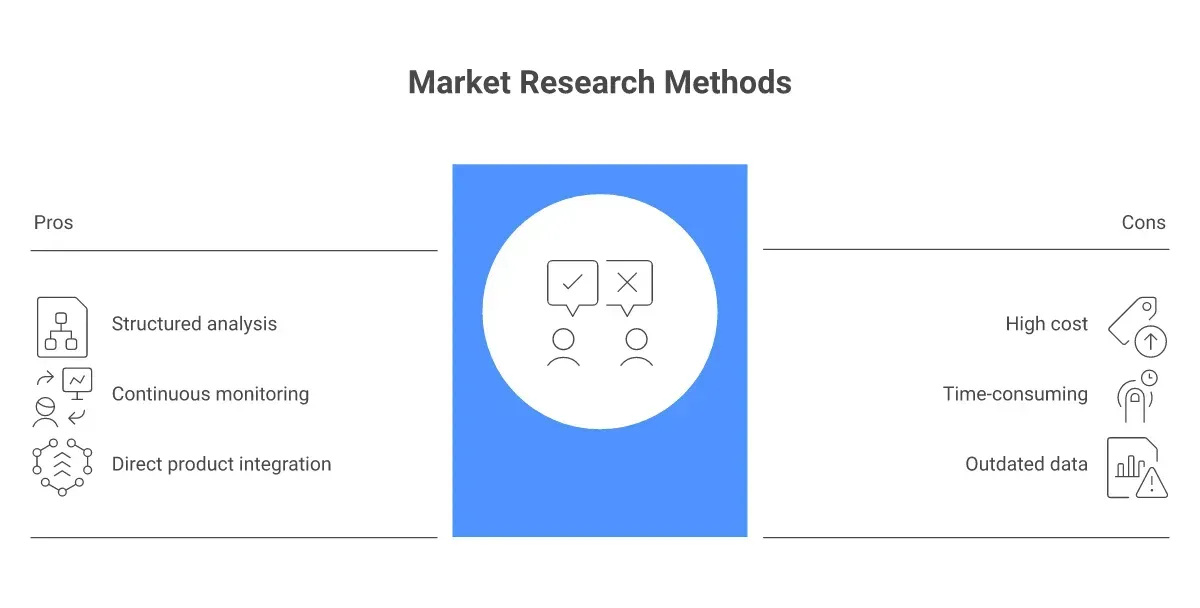 Traditional Research vs Rocket.new Comparison
| Factor | Traditional Market Research | Rocket.new |
|---|---|---|
| Time to first insight | Weeks to months | Hours |
| Cost | $5,000 to $50,000+ per project | Included in plan |
| Competitive intelligence | Periodic snapshots | Continuous daily monitoring |
| Connection to product build | Manual handoff | Shared context, automatic |
| Team coordination | Separate tools, manual sync | Single platform, shared memory |
| Market sizing | External reports or consultants | Solve pillar, on-demand |
| Pricing data | One-time competitive analysis | Live pricing page monitoring |
| Customer behavior data | Focus groups and surveys | Review monitoring, community signals |
The Vibe Solutioning Category: Research and Build in One Place
Traditional tools treated research and building as two separate categories. AI app development tools focused on the build side and left research as your problem. General AI assistants answered questions but didn't connect those answers to anything you would actually build.
Rocket.new created a new category to solve this: Vibe Solutioning. It is the first platform where strategic market intelligence and production grade output live in the same workspace, connected through shared compound context. Not two tools sharing a login. One platform where the competitive analysis from week one is still shaping the product built in week twelve.
The result is a fundamentally different research approach. Not less research - smarter research, running continuously, connected directly to what the team builds next.
Stop Over-Researching, Start Building on Solid Ground
Traditional market research for small business is not wrong - it is incomplete. Running a six-week focus group while your competitors are changing their pricing page every two weeks isn't a research problem. It's a prioritization problem.
Rocket.new founders skip 80% of traditional market research because the 20% that matters - competitive intelligence, real-time competitor tracking, structured market analysis on demand, continuous customer behavior signals - is faster, cheaper, and more directly connected to what gets built. And because all of it lives inside one platform alongside the build, there is no handoff problem, no context gap, and no delay between a market insight and the product decision it should have driven.
The market keeps moving. The founders who build right are the ones who stay connected to it - not through bigger research projects, but through better systems.
Table of contents
- -What Traditional Market Research Actually Looks Like for Small Business
- -The Real Cost of Traditional Market Research
- -The 80/20 Problem: What Research Actually Moves the Needle
- -What the Data Says About Research and Failure
- -What Smart Founders Research Instead
- -Market Sizing Before You Plan
- -Competitive Intelligence as a Continuous Practice
- -Real Customer Behavior Over Structured Interviews
- -How the Research-to-Build Flow Should Actually Work
- -Why Rocket.new Founders Run Research Differently
- -Solve: Structured Market Analysis on Demand
- -Intelligence: Continuous Competitive Monitoring on One Platform
- -Build: Production Grade Output Starting from Research Context
- -Shared Context: Where Product Teams Stay Aligned
- -Traditional Research vs Rocket.new: A Direct Comparison
- -The Vibe Solutioning Category: Research and Build in One Place
- -Stop Over-Researching, Start Building on Solid Ground