
Rocket.new goes beyond competitor tracking by interpreting market behavior, strategic positioning, and emerging trends. It helps businesses gain actionable insights, respond faster to industry shifts, and make smarter competitive decisions with confidence.
Why do teams track competitors but still make weak product decisions?
Most tracking systems only collect surface-level updates like pricing changes, new landing pages, hiring posts, or campaign announcements. Very few platforms help teams understand why those changes matter or what they actually signal about the market.
A recent TechCrunch report highlighted how Rocket.new combines market research, product building, and competitive intelligence into one workflow instead of treating competitor tracking like a separate activity.
Competitors move fast, and random alerts alone rarely help teams respond properly. Understanding competitors with Rocket.new focuses on turning signals into direction, not just storing updates.
This blog will help readers understand the difference between simple competitor tracking and meaningful competitor intelligence while showing how Rocket.new supports smarter product decisions.
Competitor Tracking Creates Noise Without Context
Many teams think competitor tracking means staying informed. In reality, most companies only collect updates without understanding the bigger story behind them.
What Usually Happens
-
A competitor changes a pricing page
-
Another launches new landing pages
-
Someone updates homepage messaging
-
A company starts promoting mobile apps more aggressively
-
New hiring posts appear for backend developers
-
Teams share screenshots in Slack and move on
-
Important signals get buried under random notifications
Tracking only gives raw updates. Understanding gives context, strategy, and direction. Rocket.new focuses on helping teams connect competitor signals with real business decisions instead of creating another pile of alerts.
Why Competitor Understanding Matters More Than Monitoring?
Monitoring competitors is easy. Understanding why they are making certain moves is where real strategy starts. That difference changes how teams plan products, pricing, and growth.
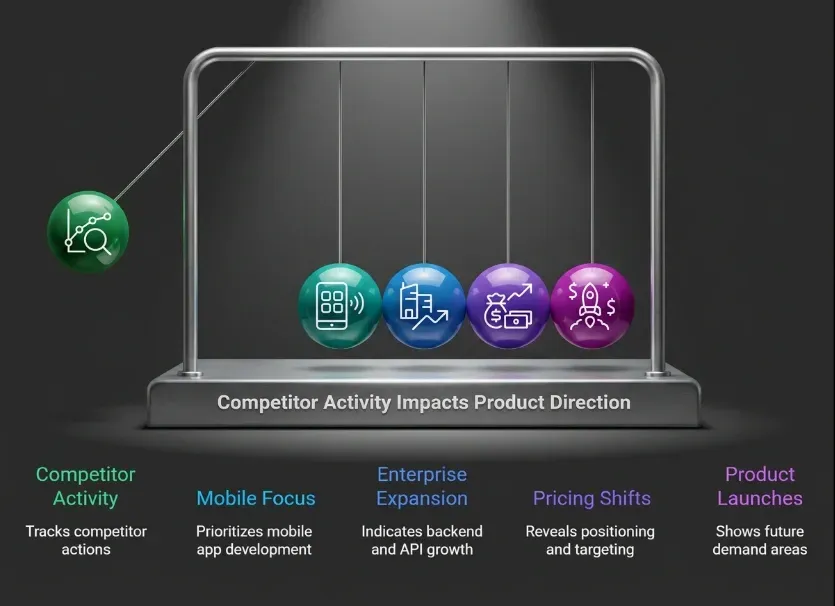 Rocket.new connects those signals into one clear picture instead of showing disconnected dashboards. Teams get context, reasoning, and direction instead of endless notifications without meaning.
Where Rocket.new Supports Modern Product Work?
Most AI app builders focus only on creating code. Modern product teams need much more than that. They need research, competitor understanding, planning, and product improvement connected in one workflow.
How Rocket.new Supports Product Work
-
Rocket.new combines market research, code generation, and competitive intelligence inside one platform
-
Teams can research an idea, build an app, and monitor competitors without switching systems
-
The platform connects Solve, Build, and Intelligence into one shared workflow
-
Many AI powered systems stop after generating code
-
Rocket.new continues supporting production ready applications after launch
-
Teams can improve products while tracking competitor activity at the same time
-
Product planning, app development, and monitoring stay connected in one place
Rocket.new approaches competitor understanding as part of the complete product process instead of treating it like a separate monitoring task handled by another tool.
Rocket.new Intelligence Turns Signals Into Product Direction
Most competitor tracking systems only collect updates. Rocket.new focuses on continuous understanding by helping teams recognize patterns, timing, and product signals that actually matter.
What Rocket.new Intelligence Watches
-
Website updates and pricing changes
-
Hiring activity and team expansion
-
Social activity and customer discussions
-
Product announcements and feature launches
-
Market signals that affect product direction
-
Competitor behavior across web apps and mobile apps
How Teams Use Those Signals
-
A single pricing update may not mean much
-
Multiple competitors changing pricing within weeks can signal a market shift
-
Backend hiring and new API endpoints may point toward enterprise growth
-
Product teams can understand roadmap changes faster
-
Developers save time by moving from idea validation into full stack generation without restarting workflows
-
Research and shipping stay organized inside one platform
Rocket.new helps teams spot patterns faster and turn competitor activity into product direction instead of treating every update like isolated information.
Rocket.new Features
Here are some key features that make Rocket.new different from many other platforms:
| Feature | Why Teams Use It |
|---|---|
| Competitive intelligence tracking | Helps teams follow competitors with context instead of random alerts |
| AI powered research | Connects market research with product decisions |
| Full stack generation | Creates web and mobile products from natural language prompts |
| Visual editor | Gives manual control while shaping the app experience |
| Version control | Helps developers manage updates safely |
| Custom domains | Makes production ready launches simpler |
| Backend setup support | Speeds up shipping for teams building real products |
| Audit logs | Helps several users work safely inside shared systems |
Many AI powered products can create demos. Rocket.new focuses on production ready systems that support real users and real data.
Building Products While Tracking Competitors
Many product teams waste time switching between research tools, monitoring systems, and app builders. One platform handles market research, another manages code generation, and another tracks competitors. After that, teams spend hours moving information around instead of building products.
How Rocket.new Simplifies the Process
-
Rocket.new allows founders to research an idea, build web apps, create mobile apps, launch landing pages, and monitor competitors from one platform
-
The system supports web and mobile projects from planning to live app release
-
Users can describe products using natural language written in plain english
-
The platform turns requests into production ready code and backend logic
-
Solo founders and small teams can move faster without advanced coding knowledge
-
Product workflows stay organized instead of being scattered across different tools
Rocket.new keeps research, monitoring, and app creation inside one workflow so teams can spend less time managing tools and more time building products.
Why Production Ready Applications Matter?
Many AI tools can generate attractive mockups in minutes. The real challenge starts when real users begin using the app. That is where production ready applications separate themselves from simple demos.
What Teams Need From Production Ready Apps
-
Authentication That Works Properly: Apps should manage sign ins, permissions, and user access without creating security problems.
-
Scalable Backend Logic: Backend systems should support growing traffic and increasing product usage without slowing down.
-
Reliable Database Structure: A stable database structure helps apps handle growth, updates, and larger amounts of data over time.
-
Stable API Endpoints: API endpoints should remain consistent and reliable when several users access the platform at the same time.
-
Easy Product Updates: Teams should improve or expand the app later without needing a full rebuild from scratch.
-
Support for Real Business Use Cases: Internal tools, customer facing web apps, and mobile apps should work properly in real production conditions.
-
Built In Product Management Features: Backend setup, role based access control, version control, audit logs, and custom domains become increasingly important as teams grow.
Rocket.new focuses heavily on production ready output because businesses need more than polished screens. They need apps that continue working smoothly after launch as users, traffic, and product complexity grow.
How Rocket.new Works During Real Product Development?
Many AI app platforms promise fast product creation. The real question is whether teams can move from idea to production without breaking their workflow or losing control over the app.
What the Workflow Looks Like
-
Starting With Natural Language Prompts: Teams describe the product idea using simple natural language prompts instead of manually building every feature from scratch.
-
Automatic Product Structure Generation: Rocket.new handles app structure, frontend code, backend logic, and product planning inside one workflow.
-
Support Across Web and Mobile Products: The platform supports full stack workflows for web apps, mobile apps, and other web and mobile projects.
-
Direct Access to Generated Code: Developers can edit the generated code directly whenever deeper customization is needed.
-
Visual Editing Without Complexity: The visual editor helps users shape layouts, screens, and product flows without fighting complicated systems.
-
Support for Different Product Stages: Some teams need quick launches while others build production ready systems with increasing complexity. Rocket.new supports both workflows.
-
Multiple Product Types From One Platform: Teams can create web applications, landing pages, internal tools, mobile apps, and full stack applications from one shared system.
Rocket.new balances automation with manual control so teams can move quickly while still building production ready products that developers can expand and manage over time.
Why Many Teams Outgrow Simple Tracking Systems?
Simple tracking tools feel useful at first. Then the alerts start piling up and teams lose focus because the updates never turn into a clear story.
What Happens Over Time
-
One email arrives about pricing changes
-
Another update appears about SEO
-
Then comes a product launch announcement
-
Hiring updates start showing up
-
Teams collect notifications from different sources
-
Important signals get buried under random updates
-
Rocket.new treats competitor intelligence as part of product strategy instead of random monitoring
-
Teams building AI app products, mobile apps, and web apps can respond faster because signals stay organized
-
The system reduces delayed responses caused by scattered workflows
Rocket.new helps teams move from endless alerts toward clearer product decisions by keeping competitor activity organized and easier to understand.
Comparing Rocket.new With Traditional AI Builders
Many AI powered builders focus almost completely on code generation. Rocket.new handles code too, yet the bigger goal is helping teams make smarter product decisions.
Here is the difference in simple terms:
| Traditional AI Builder | Rocket.new |
|---|---|
| Focuses mainly on code generation | Connects research, strategy, and product work |
| Often creates partial demos | Creates production ready products |
| Limited backend logic support | Handles backend logic and API endpoints |
| Separate competitor tools needed | Competitive intelligence built into the platform |
| Mostly focused on frontend | Supports full stack app development |
That connected system is why many developers see Rocket.new as a strong alternative to isolated AI builders.
Why Real Product Teams Need Context?
Modern product development involves multiple teams working simultaneously. Marketing teams study competitors, developers manage backend logic, and product teams focus on user experience. Without shared context, product workflows become fragmented and slow.
Why Shared Context Matters
-
Marketing Teams Monitor Competitors and Market Changes: Marketing teams track competitor campaigns, pricing updates, customer messaging, and market research trends to understand changing demand.
-
Product Teams Analyze User Feedback and Product Direction: Product teams study user behavior, feature requests, and product performance to improve web apps and mobile apps.
-
Developers Maintain Backend Logic and Product Stability: Developers manage backend logic, API endpoints, database structure, and production ready systems that support real users.
-
Founders Focus on Growth Across Multiple Platforms: Founders care about growth strategy, production ready launches, and keeping web and mobile experiences consistent across multiple platforms.
Rocket.new helps product teams manage competitors, app development, market research, and production workflows inside one organized platform.
Pricing, Limits, and Product Reality
Many AI powered platforms promise unlimited automation. Real product development works differently. Teams still need stable workflows, flexible scaling, and realistic production support.
What Makes Rocket.new More Practical
-
Rocket.new openly says the platform is not designed to replace highly advanced technical teams handling enterprise systems
-
Teams can scale between paid plans based on token usage, production needs, and project size
-
The platform supports startup and mid sized business workflows building production ready applications
-
Users can manage increasing complexity without running into hard limits too early
-
Developers still maintain access to the code, backend setup, and deployment workflows
That realistic approach helps teams ship production ready apps while keeping workflows stable, scalable, and easier to manage long term.
Why Shared Intelligence Improves Product Decisions?
Disconnected systems slow product development. One tool handles market research, another manages code generation, and another tracks competitors. Teams lose time moving information between platforms.
How Rocket.new Improves Product Workflows
-
Market Research and Product Development Stay Together: Teams can move from idea validation into app development without restarting the workflow.
-
Competitor Intelligence Remains Organized: Teams building AI app products can compare competitor activity while improving web apps and mobile apps.
-
One Platform Supports Multiple Product Tasks: The platform supports backend setup, code editing, deployment planning, AI assistance, and production ready launches from one workflow.
Rocket.new helps teams reduce delayed responses, improve product direction, and manage competitors more effectively by keeping research, development, and production workflows organized together.
Better Product Thinking With Rocket.new
Many companies track competitors without understanding what the updates actually mean. Teams collect screenshots, pricing alerts, and product announcements, yet very little of that information turns into real product direction. Tracking alone often creates more noise than clarity.
Rocket.new helps teams turn competitor signals into smarter product decisions by combining market research, competitor intelligence, AI support, and full stack app development inside one platform. Teams can build apps, manage production workflows, and monitor competitors without switching systems constantly. The result is a cleaner workflow with better decision making and fewer disconnected updates.
Want competitor intelligence that actually helps your team build smarter products? Rocket.new brings research, app development, and product strategy into one shared workflow.
Table of contents
- -Competitor Tracking Creates Noise Without Context
- -What Usually Happens
- -Why Competitor Understanding Matters More Than Monitoring?
- -Where Rocket.new Supports Modern Product Work?
- -How Rocket.new Supports Product Work
- -Rocket.new Intelligence Turns Signals Into Product Direction
- -What Rocket.new Intelligence Watches
- -How Teams Use Those Signals
- -Rocket.new Features
- -Building Products While Tracking Competitors
- -How Rocket.new Simplifies the Process
- -Why Production Ready Applications Matter?
- -What Teams Need From Production Ready Apps
- -How Rocket.new Works During Real Product Development?
- -What the Workflow Looks Like
- -Why Many Teams Outgrow Simple Tracking Systems?
- -What Happens Over Time
- -Comparing Rocket.new With Traditional AI Builders
- -Why Real Product Teams Need Context?
- -Why Shared Context Matters
- -Pricing, Limits, and Product Reality
- -What Makes Rocket.new More Practical
- -Why Shared Intelligence Improves Product Decisions?
- -How Rocket.new Improves Product Workflows
- -Better Product Thinking With Rocket.new