Local Pharmacy Software Cost Estimator Website Template
The Adjudicate landing page template is built for pharmacy claims management software targeting independent pharmacies, pharmacy directors, and benefits managers. It combines a Bold Brutalist layout with a Glassmorphic dark-mode color system to communicate speed, accuracy, and revenue recovery. A Calculator-First interaction model puts a live claim lookup tool front and center, with a freemium trial conversion flow that requires no credit card.
by Rocket studio
Quick summary
Adjudicate is a scroll-reveal landing page template for a real-time pharmacy claims management platform. It leads with a full-width dashboard screenshot and an interactive claim lookup tool before any marketing copy appears. The design fuses Bold Brutalist typography with a Glassmorphic dark-mode palette, giving the page the feel of a control room mid-shift. Conversion runs on a freemium model: process 50 claims free, no credit card required.
Who this template is for
This template is purpose-built for B2B software companies operating in pharmacy claims processing and healthcare claims management. It speaks directly to the people who live inside rejection queues and audit spreadsheets every day.
- Pharmacy directors and independent pharmacists who need to reduce NCPDP reversals and lift clean claim rates above 98 percent.
- Benefits managers and third-party administrators auditing DIR fee clawbacks and managing payer contract compliance.
- Healthcare software companies building claims adjudication systems that serve pharmacies, payers, or both.
What problem this template solves
Pharmacy claims adjudication software is a hard sell. The buyers are technical, skeptical, and time-pressed. A generic SaaS landing page fails them. This template solves that credibility gap by letting the product demonstrate its own value before a single line of marketing copy loads.
- High denial rates and revenue leakage from overbilled NDC codes and rejected BIN numbers erode cash flow before anyone notices.
- Manual review bottlenecks slow the claims process, delay reimbursement, and increase the cost of every rejected claim.
- Outdated claims adjudication systems create data silos and inefficiencies that make it hard for pharmacies to remain competitive.
What you get with this template
This template delivers a complete single-page conversion experience, from the interactive claim lookup tool at the top to the progressive signup form at the bottom. Every section is designed to build trust and drive the freemium signup.
- Five fully structured page sections covering the claims dashboard, rejection engine, revenue recovery, integrations, and freemium signup.
- A Calculator-First header with a floating glass panel that returns rejection reasons, suggested corrections, and estimated recovery amounts before the page scrolls.
- A progressive three-step signup form collecting email, pharmacy NPI number, and pharmacy management system selection in sequence.
Feature list
This template packages several built-in design and interaction capabilities drawn directly from the source brief. Each one supports the goal of communicating speed, accuracy, and trust to pharmacy claims buyers.
Calculator-First Claim Lookup Tool
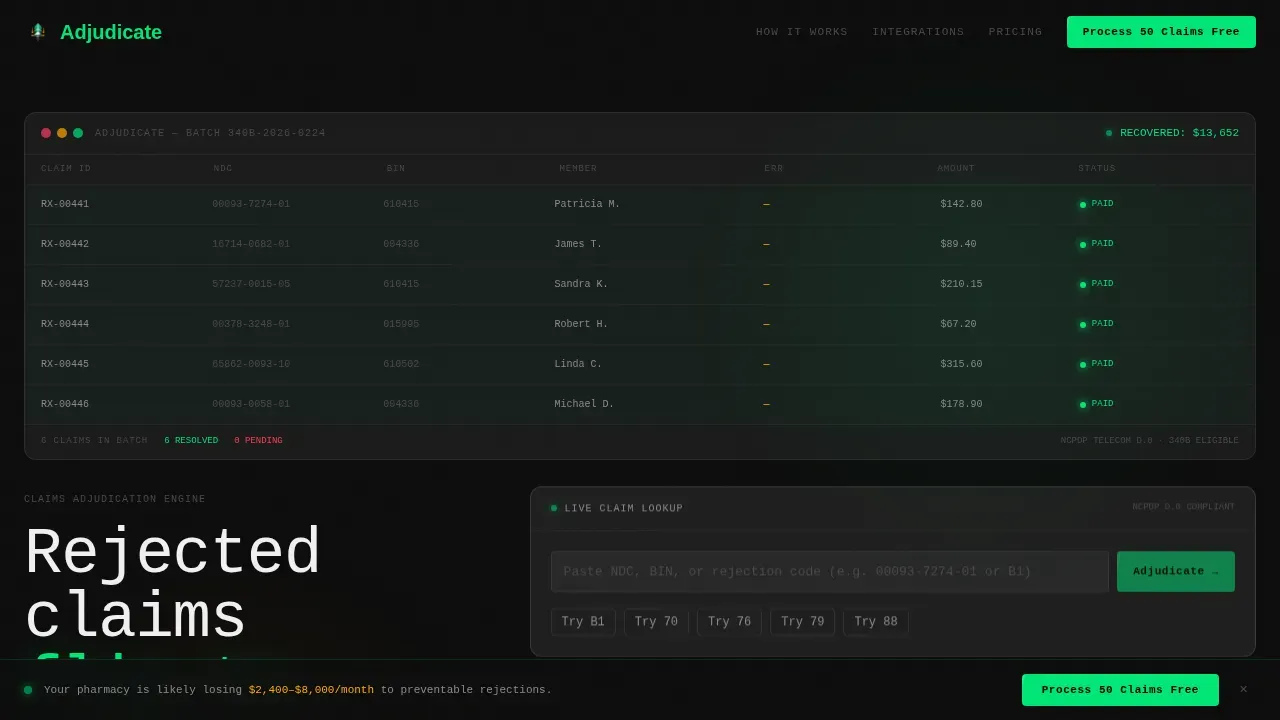
A floating glassmorphic panel appears on load and invites visitors to paste a rejected claim ID or enter an NDC code with quantity. The tool returns the likely rejection reason, a suggested correction, and an estimated recovery amount. Scroll is locked until after this interaction, making the adjudication logic the actual headline.
Real-Time Claims Dashboard Screenshot
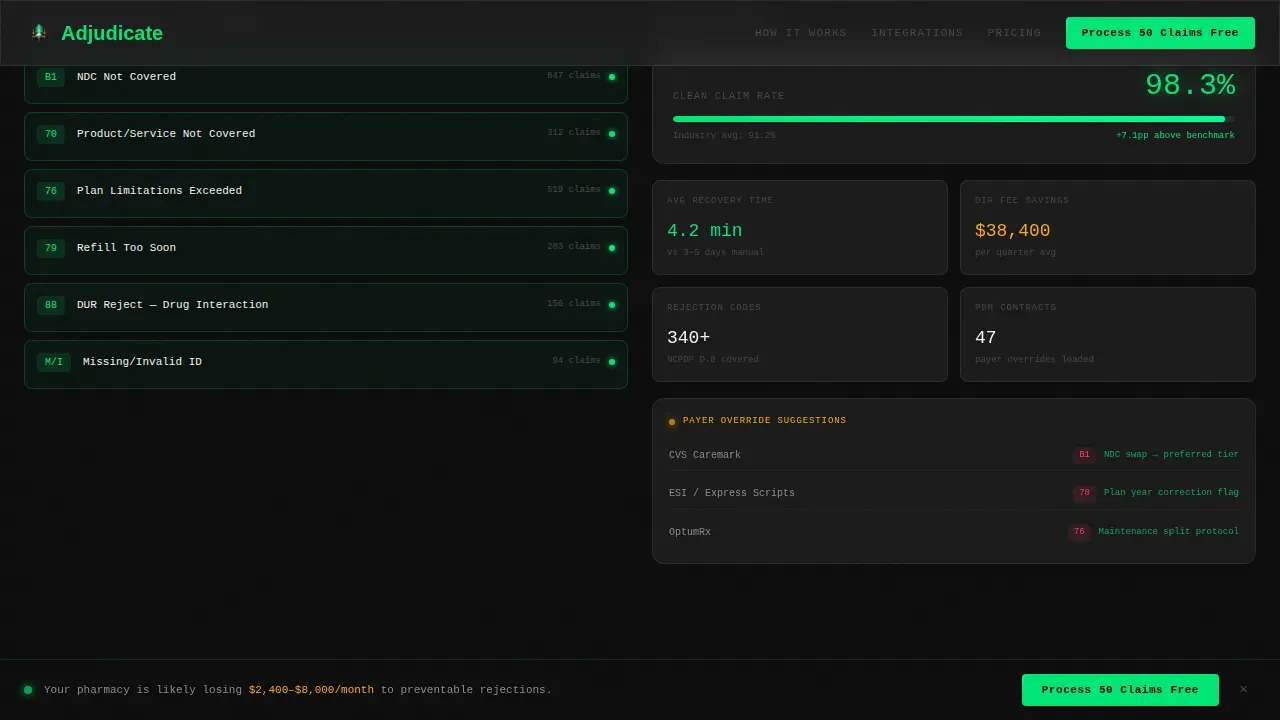
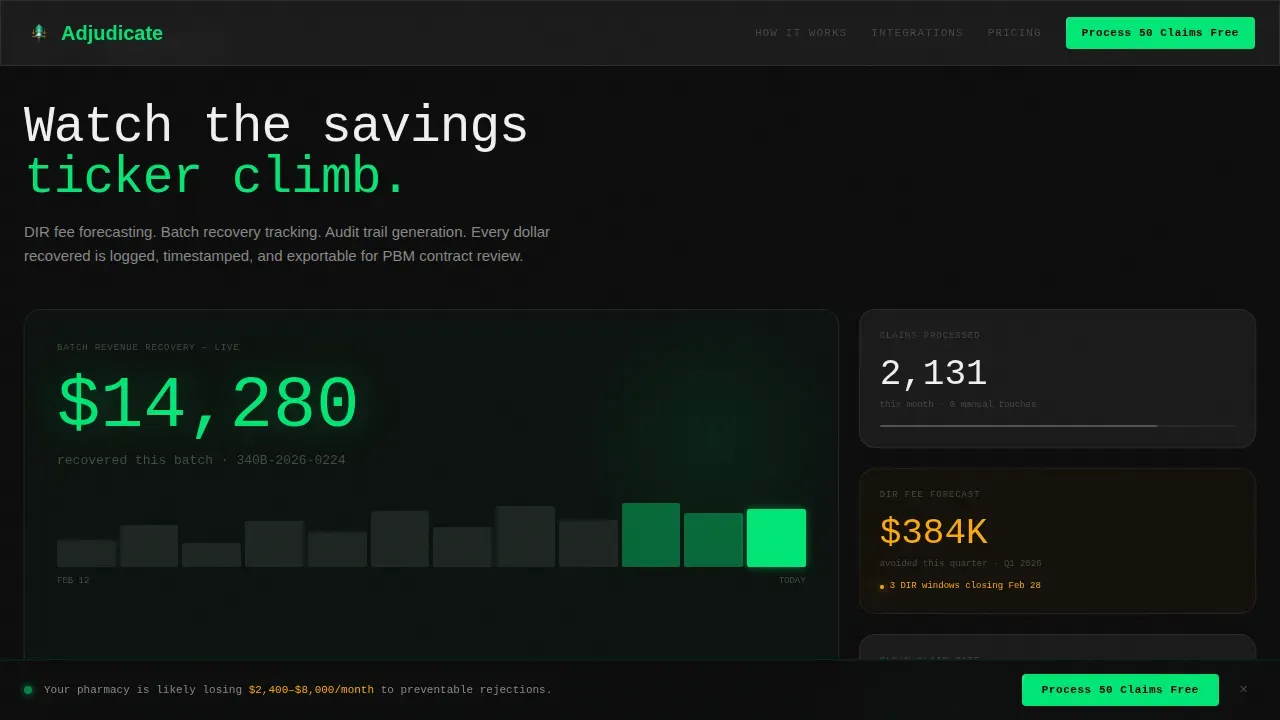
The header section uses a full-width, pixel-sharp product screenshot showing a batch of 340B claims mid-adjudication. Visible elements include rejection codes resolving in a cascading list, a savings ticker climbing past $14,200, and a glass-panel sidebar with payer-specific override suggestions. This framing makes the claims adjudication system the visual centerpiece before any copy loads.
Animated Rejection-to-Resolution Cascade
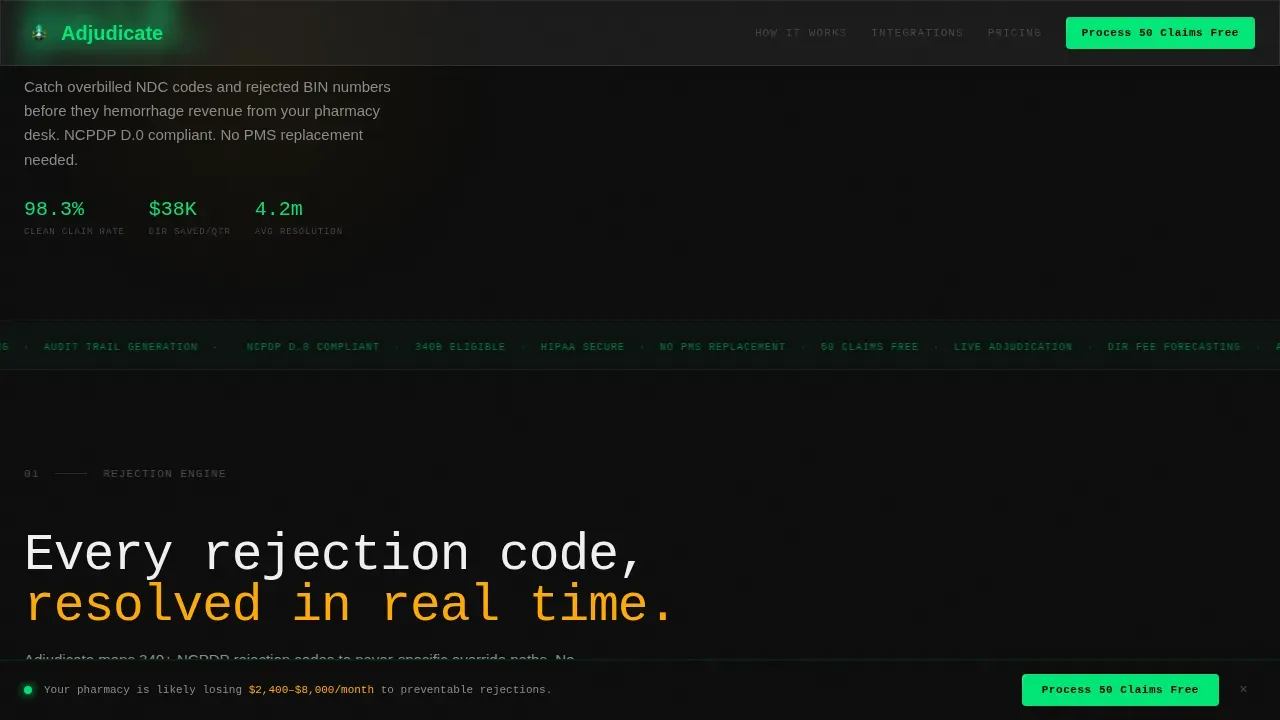
Section two renders a live-style animated cascade of rejection codes resolving themselves using real NCPDP rejection codes. This directly demonstrates the denial management logic that healthcare payers and pharmacy directors need to see. The animation maps to the emotional payoff of watching a rejected claim flip to paid status.
Revenue Recovery Bento Grid
An asymmetric bento grid in section three displays a savings ticker, a DIR fee forecast panel, and a clean-rate gauge side by side. These panels communicate measurable outcomes: recovered revenue, predictable reimbursement, and clean claim rates. The layout keeps claims data scannable without overwhelming the viewer.
Progressive Freemium Signup Form
The signup section uses a three-step progressive disclosure form. It collects email first, then pharmacy NPI number, then a pharmacy management system integration selector. No credit card is required. This reduces friction and mirrors the claims adjudication process itself: step by step, validated, resolved.
Scroll-Reveal Glassmorphic Panels
Every capability section materializes through frosted glass panels that sharpen into focus as they enter the viewport. Brutalist section numbers count upward like claim line items. The scroll-reveal system is built using CSS animations and Intersection Observer, keeping the page light while preserving the high-motion control-room aesthetic.
Page sections overview
| Section | Purpose |
|---|---|
| Hero Dashboard Header | Showcase the claims dashboard screenshot and trigger the Calculator-First claim lookup tool |
| Rejection Engine | Animate NCPDP rejection-to-resolution cascade to demonstrate live adjudication logic |
| Revenue Recovery Grid | Display savings ticker, DIR fee forecast, and clean-rate gauge in a bento layout |
| Integrations and Social Proof | Show pharmacy management system logo wall and pharmacy director testimonials |
| Freemium Signup Form | Collect email, NPI, and system selection via a progressive three-step form |
| Footer | Linear single-row footer with essential links and compliance references |
Design & branding system
The visual identity is built on a collision of two contrasting systems. Bold Brutalist structure provides the skeleton: heavyweight monospaced headings, raw negative space, and section numbers that feel like claim line items on a terminal screen. Glassmorphic layering provides the depth: frosted panels, translucent surfaces, and blurred containers that float above the void.
- Color palette: void black (#0D0D0D) as the primary background, electric claim-green (#00E676) for approved states and status accents, warning amber (#FFAB00) for flagged exceptions, and translucent white (#FFFFFF1A) frosted glass panels with 12px blur.
- Typography: JetBrains Mono for brutalist monospaced headings and data labels; DM Sans for body copy and form fields.
- Motion and texture: scroll-reveal panel animations, claim status flip transitions, and a count-up savings ticker create a control-room atmosphere that reinforces the real-time adjudication narrative.
Mobile & speed optimization
The template is designed desktop-first, reflecting the reality that pharmacy directors and benefits managers work at workstations. The layout is responsive and adapts cleanly to tablet viewports.
- Desktop-first responsive layout that scales to tablet without breaking the bento grid or glassmorphic panel hierarchy.
- Lightweight animation stack using CSS animations and Intersection Observer only, avoiding heavy JavaScript libraries that would slow the claims data experience.
- Compressed image handling guidance is built into the design system, since high loading times increase bounce rates for technical buyers evaluating claims adjudication software.
How this template helps you convert
The conversion strategy in this template is grounded in one insight: pharmacy claims buyers will not trust a platform they cannot try. Every layout decision pushes toward that first 50-claim free trial.
- Calculator-First interaction unlocks the scroll. Visitors test a real rejected claim before reading any marketing copy. When the tool returns results, the "Process 50 Claims Free" call-to-action appears immediately inside the tool panel, connected directly to a moment of demonstrated value.
- Progressive form reduces friction. The three-step signup collects only what is needed at each stage: email, then NPI, then system selection. Simplifying the form to three to four essential fields reduces abandonment and aligns with best practices for claims adjudication software lead generation.
- Persistent bottom bar reinforces the offer. After the third scroll section, a sticky bottom bar keeps the freemium call-to-action visible without interrupting the content experience, giving returning visitors a fast path to signup at any point.
Other information about this template
This template sits inside the Pharmacy Software subcategory of the Technology category. It is designed for the specific needs of organizations building or marketing claims adjudication systems in the United States healthcare industry. Several contextual factors informed the design direction and content structure.
- Claims format context: Pharmacies use the NCPDP format for prescription claim submission, while the broader healthcare claims ecosystem also relies on HIPAA-compliant 837 format electronic data interchange, CMS-1500 forms for non-facility providers, and UB-04 forms for institutional billing. The template's terminology and data labels reflect these real-world formats.
- Modernization context: Modernizing claims adjudication systems is driven by outdated platforms, financial risks, and evolving market demands. High claim hold volumes stem from coding errors, incomplete documentation, or missing patient data. The global healthcare claims management market is growing, reflecting rising demand for efficient claims processing solutions.
- Automation context: Emerging technology including AI and machine learning is transforming claims adjudication processes, enhancing accuracy and reducing processing times. Automated claims adjudication systems apply uniform rules to claims, ensuring consistent evaluations and reducing disputes. Healthcare payers are increasingly aware that automated software can significantly reduce costs and improve accuracy across the claims process.
- Software evaluation context: Payers must prioritize vendors with end-to-end automation, real-time processing, interoperability, and AI-driven fraud detection when selecting claims adjudication software. Selecting the right claims adjudication software requires assessing organizational needs, scalability, and integration capabilities with existing systems. The template supports this evaluation by surfacing data analytics signals, reporting panels, and compliance references directly in the page layout.
- Compliance and data security: The template design includes space for HIPAA compliance references and secure data handling disclosures. Prominently displaying compliance certifications reassures users about data breaches risk and regulatory alignment. Organizations should confirm their specific regulatory requirements before publishing this template in a live healthcare context.
- Prior authorization: Manual prior authorization processes can significantly delay pharmacy claims workflows. The template's rejection engine section and dashboard screenshot are designed to show how automated prior authorization checks can reduce those delays and improve provider satisfaction.
Theme
Bold Brutalist
Creative direction
Calculator/Tool First
Color system
Glassmorphic
Style
Scroll Reveal (Progressive)
Direction
Freemium/Trial
Page Sections
Calculator-first Claim Lookup Tool
Full-width Dashboard Screenshot Header
Animated Rejection-to-resolution Cascade
Revenue Recovery Bento Grid
Progressive Three-step Signup Form
Scroll-reveal Glassmorphic Panel System
Related questions
What type of software company is this template built for?
Does the template include the interactive claim lookup tool?
How does the freemium conversion model work in this template?
Can this template be adapted for a broader healthcare claims platform?
What pharmacy management systems does the integration selector include?