Architecture Firm Portfolio & Case Study Website Template
The Elevate Engineering Landmark Architecture Firm Portfolio Landing Page Template is a bold, glassmorphic single-page layout built for architecture firms targeting commercial developers, civic planners, and tech companies. It combines a 50/50 split-screen hero, horizontal spec-sheet project dossiers, and a progressive lead capture form to turn portfolio depth into qualified project inquiries.
by Rocket studio
Quick summary
Elevate is a split-screen architecture portfolio landing page template designed to help firms win serious clients. It opens with a frosted glass hero, builds credibility through scrollable technical project dossiers, and closes with a progressive lead form. Every section earns the next click before asking for anything.
Who this template is for
This template serves architecture firms that work at a professional scale. It is built for practices whose portfolio must do real business development work, not just look impressive.
- Commercial developers and municipal planning boards seeking design-build partners
- Tech companies that want their headquarters to communicate a design philosophy and creative vision
- Professional architects and design studios showcasing a range of landmark projects to high-stakes clients
What problem this template solves
Many architects struggle to present their work with both visual impact and technical credibility. A standard portfolio website often forces a choice between engaging aesthetics and the detailed description that serious clients need. This template removes that compromise.
- Visitors leave before seeing your best projects because early pages lack depth or structure
- Lead forms appear before the firm has demonstrated expertise, creating friction and lost inquiries
- Architecture portfolio examples built on generic templates fail to reflect the firm's actual abilities and design style
What you get with this template
This template gives architects a complete, ready-to-customize landing page that balances visual storytelling with technical rigor. Every section is purposeful, and the architecture portfolio layout guides visitors from first impression to inquiry without detours.
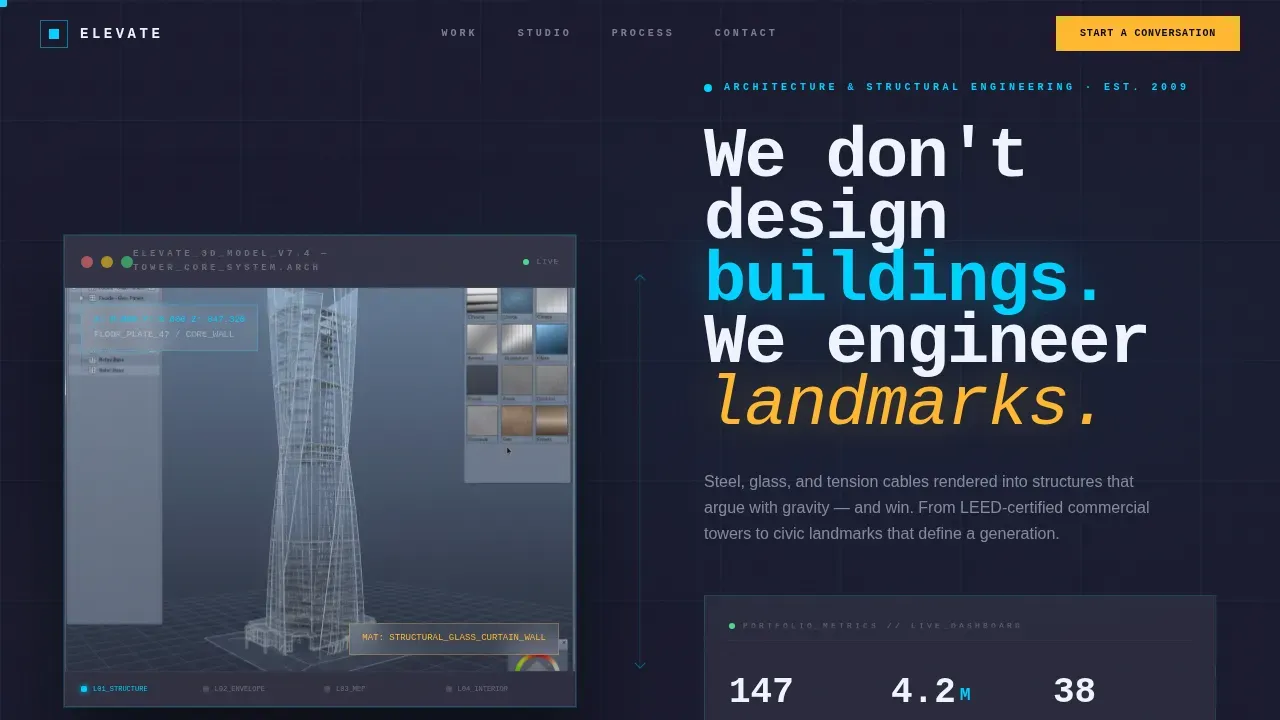
- A 50/50 split-screen hero with a frosted glass 3D modeling screenshot and oversized monospaced headline
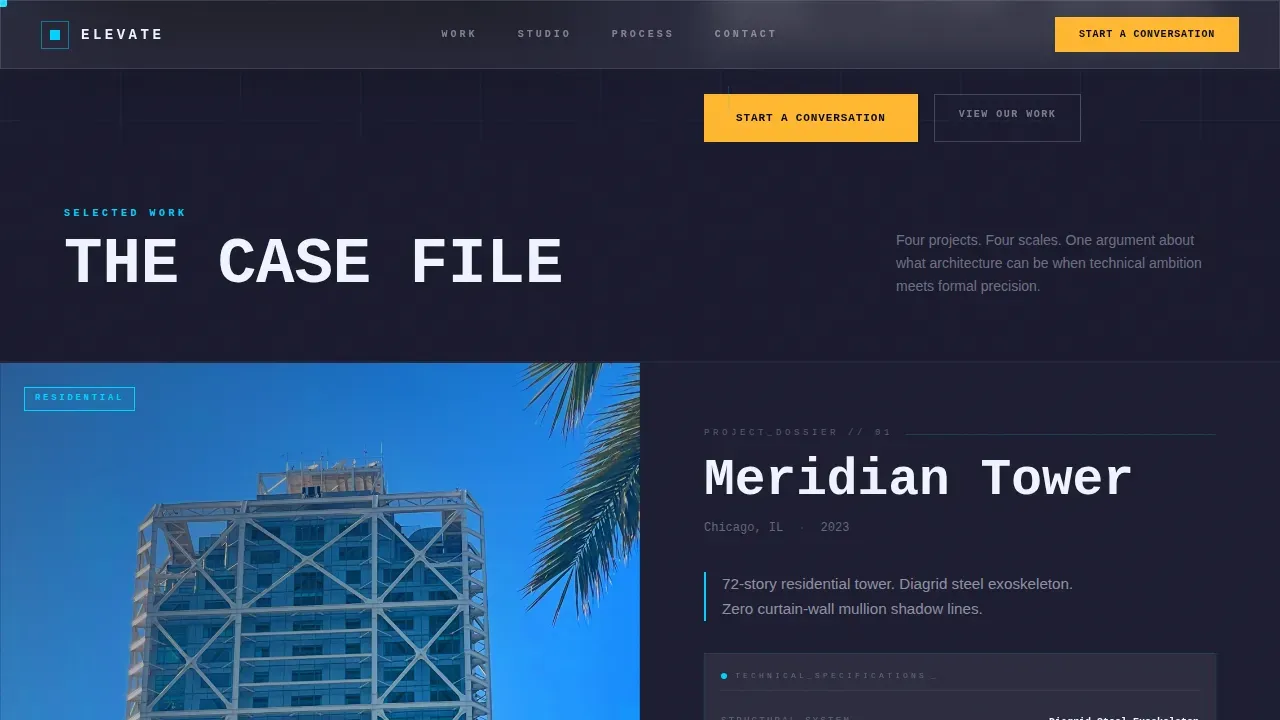
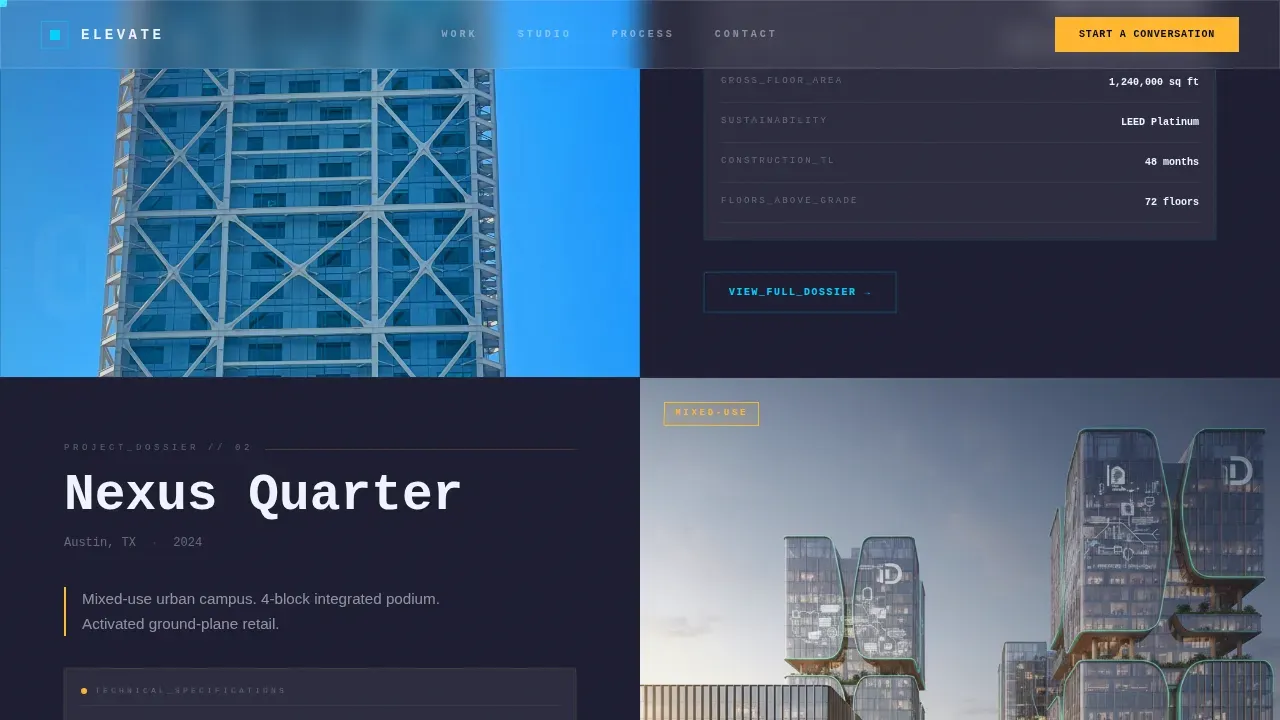
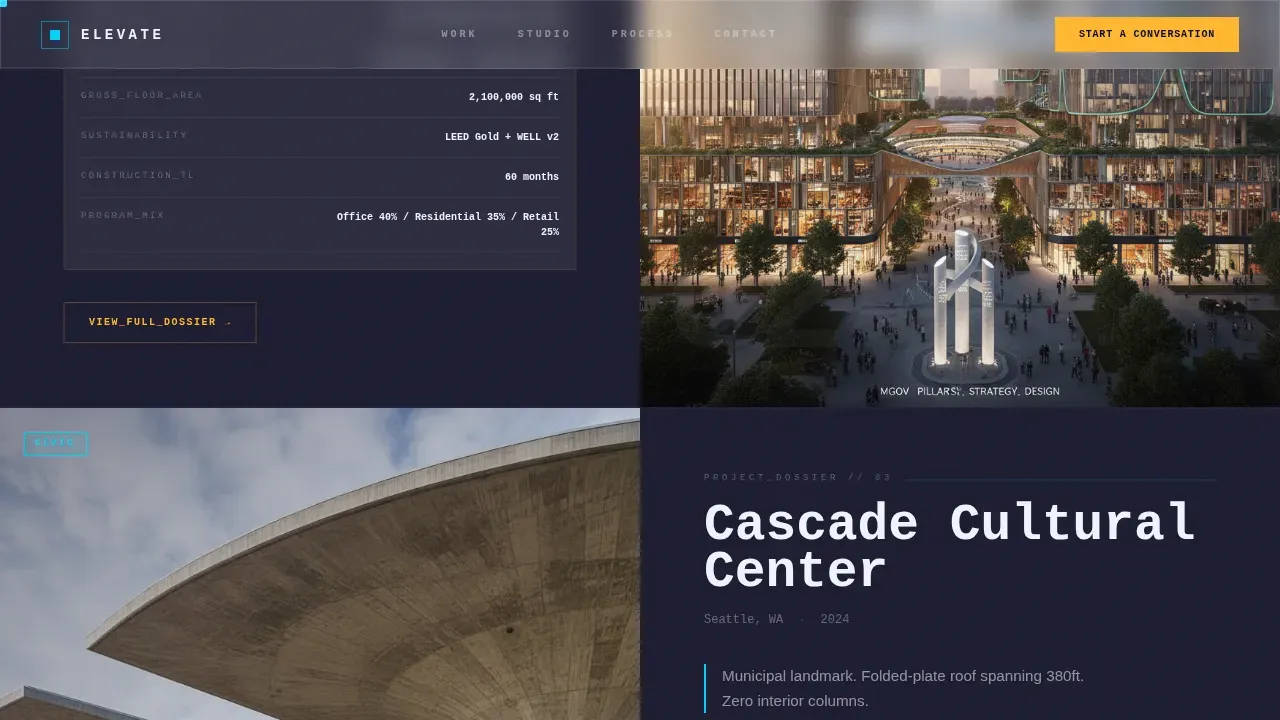
- Horizontal spec-sheet project dossiers covering residential, mixed-use, civic, and supertall building types, with terminal-style line-by-line animation
- A progressive three-step lead capture form plus a gated PDF portfolio download for visitors still evaluating their options
Feature list
This template includes a focused set of features designed to demonstrate professional depth and convert the right clients.
Split-Screen Glassmorphic Hero
The hero divides into two equal halves. The left holds a frosted glass card displaying a high-resolution 3D modeling screenshot with visible layer panels and coordinate data. The right delivers the headline in oversized monospaced type alongside three animated micro-stat counters for projects delivered, square footage shaped, and awards earned.
Horizontal Spec-Sheet Project Dossiers
Each project section functions as a technical dossier. The left panel displays the hero render; the right panel lists structural system, envelope material, gross floor area, sustainability rating, and construction timeline in animated tabular rows. Projects escalate in scale, building a case for the firm's full range of abilities.
Progressive Lead Capture Form
The contact form collects only essential information across three steps: project type, estimated square footage via a slider, and an email address. Asking for minimal detail reduces friction and encourages more inquiries from qualified clients.
Gated PDF Portfolio Download
A secondary call to action offers a downloadable PDF project folio. This path serves visitors still in the research phase, giving them a format they can review privately and share with decision-makers inside their companies.
GSAP Scroll-Triggered Animation System
The template uses GSAP ScrollTrigger for stagger reveals, counter animations, magnetic buttons, and parallax effects. Interactive elements respond to scroll position, making the design process feel live and purposeful rather than static.
Pinned Frosted Glass call to action Bar
After the third project dossier reveal, a frosted glass bar pins into view with the primary "Start a Conversation" call to action. The bar uses amber hover states to draw attention at the exact moment the visitor's confidence is highest.
Page sections overview
| Section | Purpose |
|---|---|
| Split-Screen Hero | Establish firm caliber and display live stats above the fold |
| Spec-Sheet Projects | Present technical project dossiers with scroll-driven animation |
| Pinned call to action Bar | Capture leads after proven portfolio depth is established |
| Progressive Lead Form | Collect project type, square footage, and email in three steps |
| PDF Folio Download | Serve evaluation-stage visitors with a gated downloadable portfolio |
| Minimal Footer | Provide straightforward contact and navigation references |
Design & branding system
The design theme channels Startup Velocity through a glassmorphic color system. Typography reinforces professionalism and precision throughout every section of the architecture portfolio layout.
- Color palette: deep architectural charcoal (#1A1A2E) base, translucent frost white (#FFFFFFB3) panels, electric cyan (#00D2FF) interactive edges, and warm amber (#FFB830) for hover states and active calls to action
- Typography: JetBrains Mono for headlines, stats, and technical labels; DM Sans for body copy, keeping the page both modern and highly readable
- Visual detail: frosted glass cards with 12px backdrop blur, minimal white space, high color contrast, and hover-triggered technical stat reveals maintain the construction-document aesthetic
Mobile & speed optimization
The template is built desktop-first to honor the construction-document design philosophy, but it adapts cleanly for smaller screens. The architecture portfolio layout remains functional and thumb-friendly across every device.
- Responsive layout scales from widescreen desktop to mobile without losing the frosted glass aesthetic or the spec-sheet format
- Server Components handle static content while Client Components manage animations, keeping interactive sections from slowing down the overall page
- Compressed high-quality imagery and lightweight component structure support fast load times so visitors on any device experience the portfolio without delay
How this template helps you convert
The page is structured to prove value before it asks for anything. That sequencing is what separates this template from generic architecture portfolio examples that lead with a form and lose visitors before building trust.
- The split-screen hero establishes the firm's caliber immediately, with live-counting stats and a high-definition screenshot that communicates expertise in the first three seconds
- Horizontal project dossiers stack evidence floor by floor, showcasing design process details, sustainability credentials, and building specifications that demonstrate the firm's technical depth to clients and companies evaluating design-build partners
- The pinned call to action bar and progressive form appear only after three full project reveals, so the firm has already earned the click by highlighting its creative vision, professionalism, and range before requesting contact information
Other information about this template
This template is part of a broader collection of professional architecture portfolio resources available for firms at different stages of growth. The following context may be helpful when evaluating your options.
- The elevate engineering landmark architecture firm portfolio landing page template is designed specifically for firms pursuing landmark-scale commissions, not academic or freelance work
- Firms that have collaborated with municipal bodies or leading developers will find the credential-forward structure particularly effective at highlighting those contributions
- Architecture portfolio examples built on platforms such as Behance or Issuu serve individual architects well, but this template is built for practice-level business development
- Tools like Archifolio help interior designers and architects create flexible digital portfolios that work across every device; this template follows similar principles but focuses on lead generation rather than general showcasing
- Archtix is another responsive template crafted for architecture firms and interior designers; Elevate differs by prioritizing the spec-sheet creative direction and progressive form over a traditional multi-page website format
- For large-scale firms, the project dossier structure can be customized to filter by industry sector such as Infrastructure, Cultural, or Commercial, helping visitors navigate to the project types most relevant to them
- The PDF folio download format is particularly useful for protecting the firm's work during the evaluation phase, giving decision-makers access to a curated presentation they can review and share internally
- Regularly updating the project dossiers and stats counters will ensure the portfolio remains relevant and reflects the firm's current scale and services
Theme
Startup Velocity
Creative direction
Spec Sheet
Color system
Glassmorphic
Direction
Lead Generation
Page Sections
Split-screen Glassmorphic Hero
Horizontal Spec-sheet Project Dossiers
Progressive Three-step Lead Form
Gated PDF Portfolio Download
GSAP Scroll-triggered Animations
Pinned Amber Call to Action Bar
Related questions
Who is this landing page template best suited for?
Can I customize the project dossiers for different building types?
How does the PDF download support lead generation?
Does this template work for interior designers or smaller studios?
What makes this architecture portfolio layout different from a standard portfolio website?