Advanced Tech & AI Platforms Complete Professional Website Template
Bid is a dashboard-style landing page template built for real-time programmatic advertising platforms. It uses an Acid Digital color system, Stats-First Impact creative direction, and animated data-grid layouts to communicate millisecond bidding speed, supply scale, and ROAS performance before asking a visitor for anything. Ideal for ad tech companies targeting growth-stage brands and performance agencies.
by Rocket studio
Quick summary
Bid is a single-page, lead generation landing page template designed for programmatic advertising platforms. It opens with a live-styled dashboard hero, moves through animated proof-point sections, and closes with a progressive lead capture form. The visual identity channels a terminal-screen aesthetic in void black, electric chartreuse, and synthetic violet. Every section earns trust through data before it asks for a click.
Who this template is for
This template is purpose-built for ad tech companies, demand side platforms, and supply side platform providers that need to communicate speed, scale, and efficiency at a glance. If your product runs real-time bidding infrastructure and your buyers are performance marketers, this template speaks their language fluently.
The target visitors this template is designed to convert include:
- Growth-stage direct-to-consumer brands spending five to seven figures per month on paid media, who need to see proof that programmatic ad buying actually works before committing
- Performance agencies juggling multiple client dashboards who evaluate new programmatic advertising platforms on efficiency metrics, not marketing promises
- Ad operations managers and media buyers who think in cost-per-mille (CPM) and return on ad spend (ROAS), and who respond to data before they respond to copy
What problem this template solves
Most ad tech landing pages lead with feature lists and ask for a demo before they have earned trust. Buyers who run real-time bidding campaigns all day are immune to vague claims. They want to see numbers first. They want the platform to feel like it is already working.
This template solves that credibility gap by leading with the data:
- Animated counters, self-drawing graphs, and live-styled dashboard tiles replace lifestyle photography with actual proof, showing metrics like ad impressions served, effective CPM, and ROAS in flight before any headline asks for attention
- The Stats-First Impact creative direction trains visitors to trust the platform by repeating a clear rhythm: massive metric first, context paragraph second, making programmatic advertising work feel visible and real
- The progressive lead form minimizes friction by collecting monthly ad spend bracket, primary channel mix, and work email only, keeping field count low so drop-off happens from lack of interest rather than form fatigue
What you get with this template
You get a fully structured, single-page lead generation layout ready to represent any programmatic advertising platform that runs real-time bidding across display, video, and connected TV (CTV) formats.
Key deliverables included in this template:
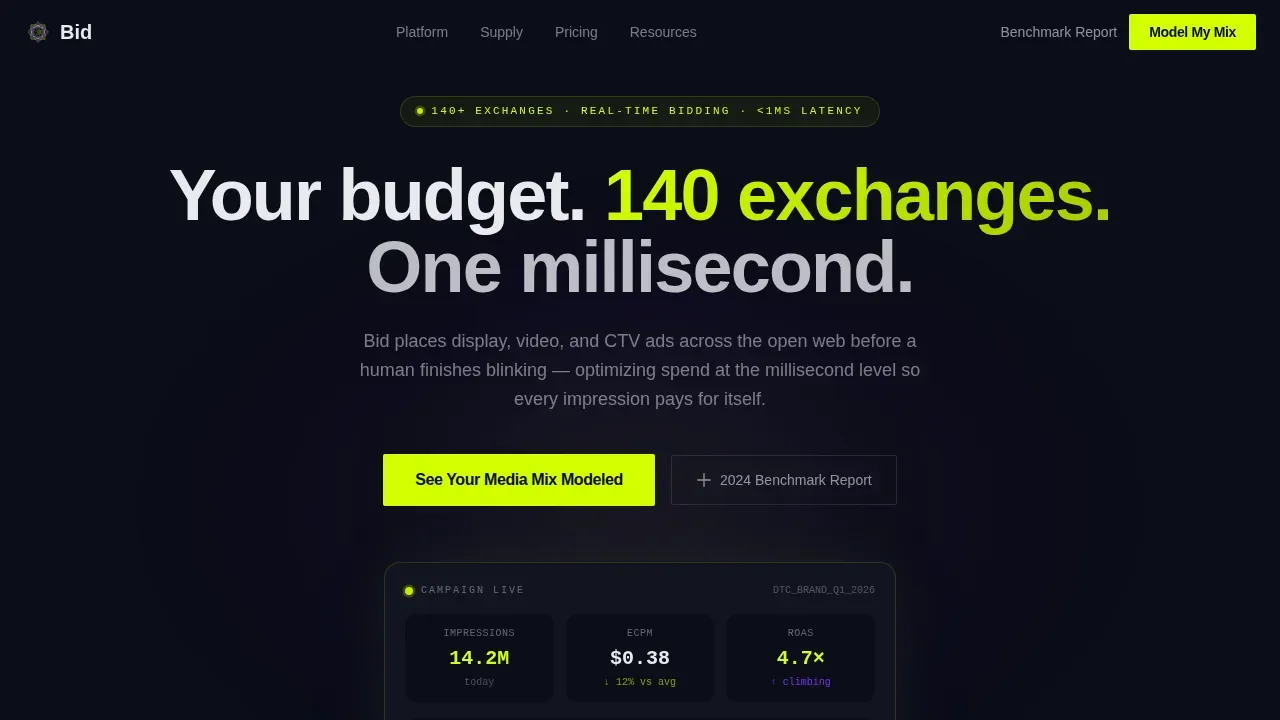
- A full-bleed dark hero section with a radial chartreuse glow, a live-styled dashboard tile showing campaign metrics in flight, and an animated headline: "Your budget. 140 exchanges. One millisecond."
- Five distinct content sections covering supply footprint, optimization engine, revenue and ROAS proof points, and a dual-path lead generation call to action, each built as self-contained data-grid cards with micro-visualizations
- A sticky top bar that activates after first scroll and carries the primary call to action "See Your Media Mix Modeled," plus a secondary gated download path for the benchmark report
Feature list
This template is built around six core capabilities, each grounded in the brief and the Stats-First Impact creative framework.
Animated Metric Hero with Live Dashboard Tile
The hero section opens on a void black full-bleed background with a radial chartreuse glow emanating from center. Inside the glow sits a live-styled campaign tile showing 14.2 million ad impressions served, a $0.38 effective CPM, ROAS at 4.7x, and a bid-density heatmap of the continental United States. A headline fades in above the tile in phosphor white. The product is the visual. No stock imagery interrupts the signal.
Stats-First Scroll Architecture
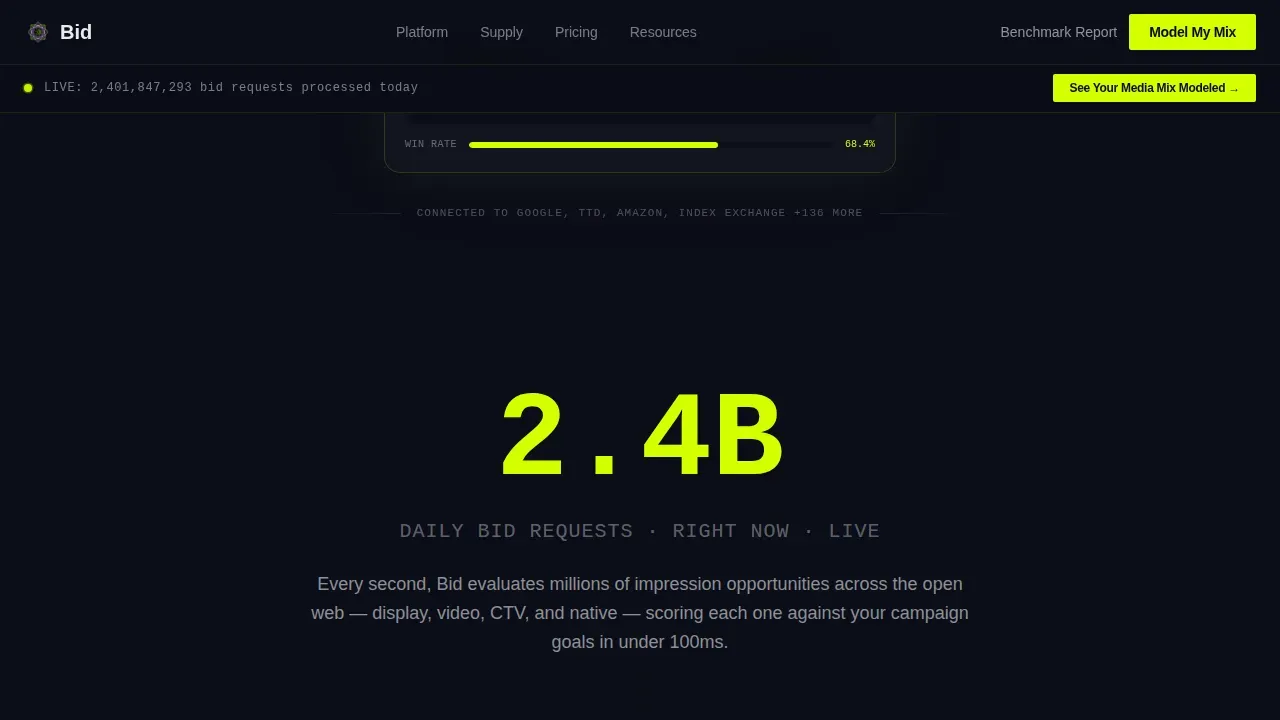
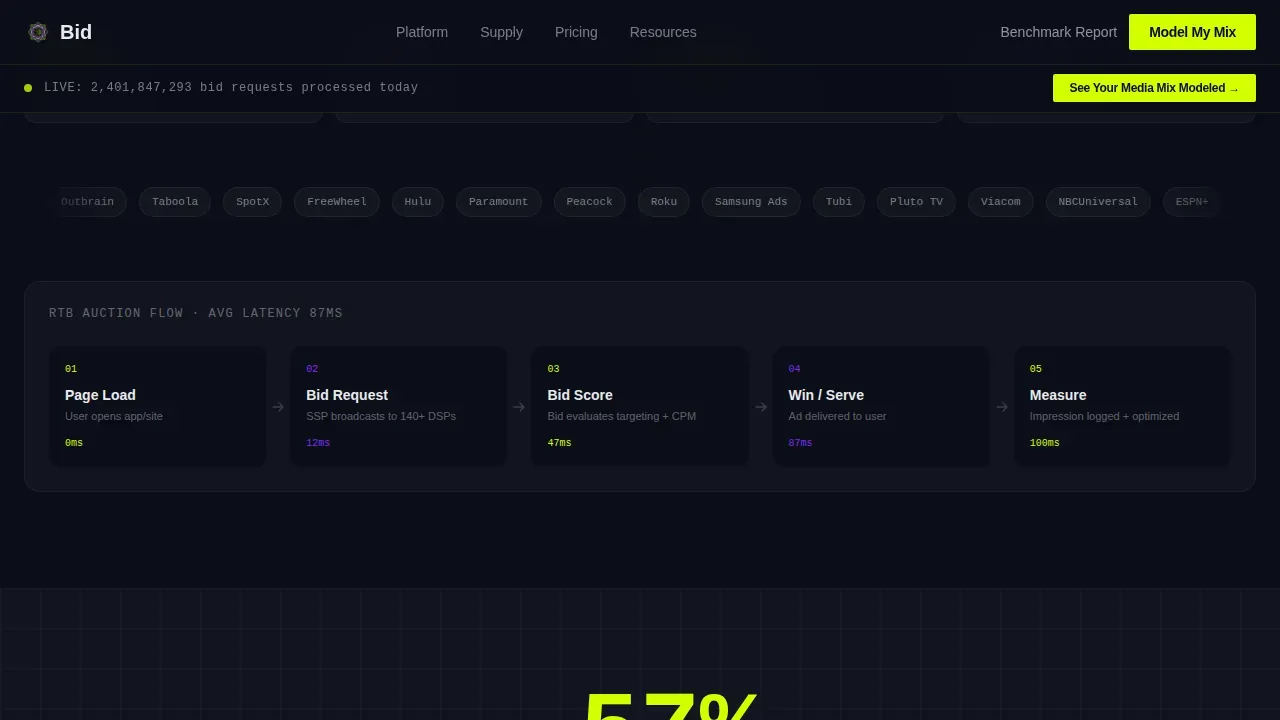
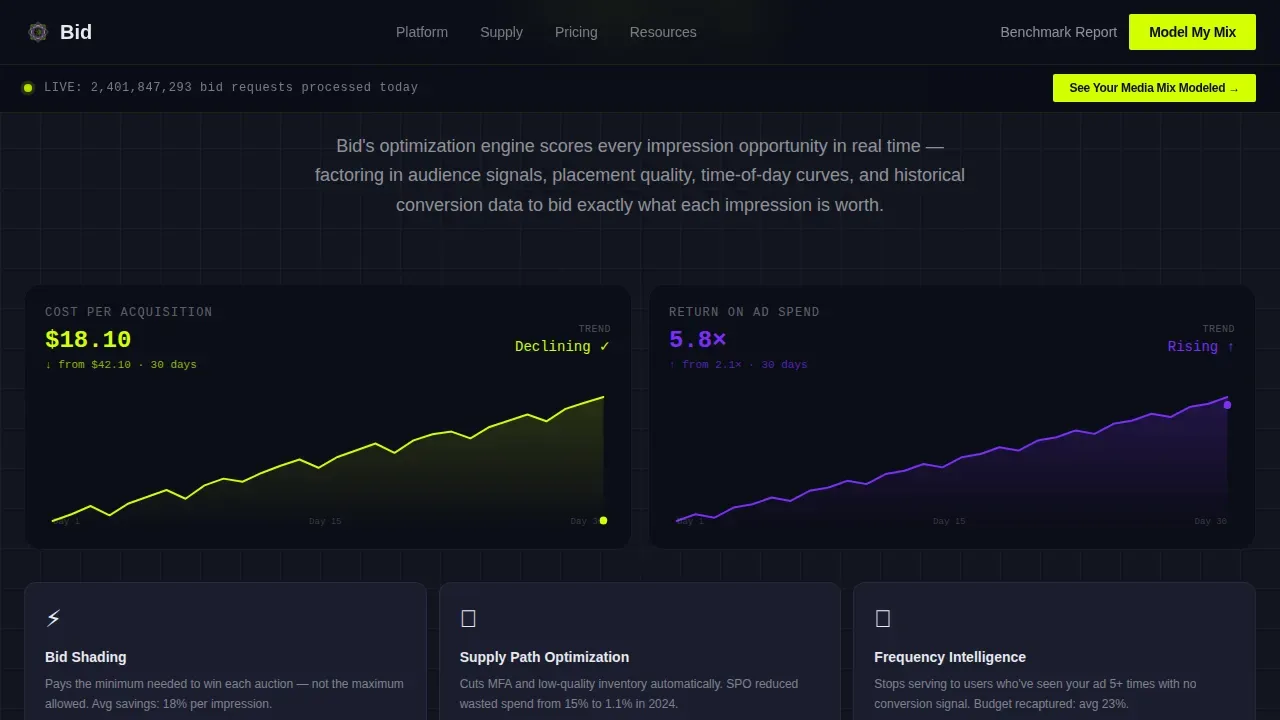
Each content section opens with a massive animated metric before a single word of explanation appears. Visitors see "2.4B daily bid requests" scale up in chartreuse before they read about supply coverage. A real-time graph draws itself showing cost-per-acquisition dropping over 30 days before the optimization algorithm is described. This rhythm, number first then context, conditions visitors to trust the data inside every programmatic ad campaign proof point they encounter as they scroll.
Data-Grid Proof-Point Cards
Content sections are composed of bento-style data-grid cards laid out two and three across. Each card is a self-contained proof point with its own micro-visualization. The narrative escalates in stakes: reach, then efficiency, then revenue recovered, then competitor benchmarks. By the bottom of the page, visitors have absorbed the equivalent of a full platform demo through cards alone. This is how successful programmatic advertising examples are communicated without requiring a sales call.
Progressive Lead Generation Form
The primary lead capture form uses a three-step progressive structure. The first field is monthly ad spend, offered as a dropdown with brackets from $25K to $1M plus. The second field presents checkboxes for primary channel mix across display, video, CTV, and native. The third field collects work email only. No phone field is included. This approach keeps friction low and respects the time of digital marketers who evaluate multiple programmatic advertising platforms in a single afternoon.
Dual Conversion Path with Gated Report
Visitors who are not yet ready to talk can take a secondary path to download the 2024 Programmatic Benchmark Report. This gated PDF captures email and company name only. The dual-path design acknowledges two real buyer states: those ready to see their media mix modeled now, and those still building their programmatic advertising strategy who need more data before committing. Both paths capture qualified leads without forcing a binary choice.
Sticky Navigation Bar with Persistent Call to Action
After the visitor completes their first scroll, a sticky top bar activates and holds the primary call to action in view throughout the rest of the page. The bar uses the chartreuse interactive layer and stays visible across all subsequent sections. This ensures the conversion moment is always one click away, regardless of how deep into the supply footprint or optimization engine sections the visitor has scrolled.
Page sections overview
| Section | Purpose |
|---|---|
| Hero Dashboard Tile | Establishes platform credibility instantly with animated campaign metrics and a radial glow visual |
| Supply Footprint Counter | Communicates scale with a 2.4B daily bid requests animated counter and supply coverage visualization |
| Optimization Engine Graph | Shows CPA trend declining over 30 days via a self-drawing graph before explaining the algorithm |
| Revenue and ROAS Grid | Bento-grid proof-point cards with micro-visualizations escalating from reach to revenue recovered |
| Lead Gen Form | Progressive three-field form plus gated benchmark report download as a secondary conversion path |
| Sticky Top Bar | Persistent call-to-action bar activating after first scroll to keep conversion moment always visible |
| Linear Footer | Single-row footer pattern anchoring the page with minimal distraction |
Design & branding system
The visual identity is built around the Acid Digital color system, designed to feel like a terminal screen running a live auction floor at full intensity. Every color assignment has a functional role, not a decorative one.
The palette and typography choices reinforce the data-dense, electric precision of the platform:
- Void black (#0B0D17) dominates as the background across all sections, making every metric and graph element appear to glow against it; chartreuse (#D4FF00) owns all interactive elements including buttons, hover states, and toggled filters, while synthetic violet (#7B2FFF) traces graph lines, trend rings, and secondary accents; phosphor white (#E8EAED) carries all body text and axis labels
- JetBrains Mono is used for all data displays and numerical readouts, reinforcing the terminal and live-auction aesthetic; DM Sans handles all body copy and descriptive text for legibility and contrast
- Animation levels are set to high throughout: counter animations, self-drawing SVG graphs, pulse glow effects, and scroll-triggered section reveals all contribute to the sense that the platform is live and in motion at all times
Mobile & speed optimization
This template is built desktop-first, matching the primary workflow of ad operations managers and media buyers who monitor campaigns on large monitors. A mobile-responsive fallback ensures the layout holds for visitors arriving from other devices.
Performance and responsiveness choices include:
- CSS animations and Intersection Observer are used for scroll-triggered reveals, keeping the animation pipeline efficient without blocking initial page load
- The mobile layout collapses the multi-column data-grid cards into a single-column stack, preserving readability of metrics and micro-visualizations on smaller screens; call-to-action buttons are sized for thumb-friendly interaction
- The progressive lead form is designed with a minimal field set of three fields, which reduces form completion time regardless of device and supports fast interaction on mobile apps and smaller viewports
How this template helps you convert
The conversion architecture of this template is built on one principle: show results before asking for anything. By the time a visitor reaches the lead form, they have already seen seven proof points that make inaction feel expensive.
The template drives conversions through three deliberate steps:
- The Stats-First Impact scroll trains visitors to trust quantifiable data over marketing language, so when the call to action "See Your Media Mix Modeled" appears, it feels like a natural extension of what they have already been reviewing rather than an interruption
- The dual-path lead capture acknowledges that not every visitor is at the same stage of their programmatic advertising strategy, giving both ready buyers and research-phase visitors a frictionless next step that keeps them in the pipeline
- The sticky top bar and the anchored bottom call-to-action card mirror each other visually, using the same dark glow aesthetic as the hero, so the conversion moment always feels like part of the platform experience rather than a bolted-on form
Other information about this template
This template sits at the intersection of programmatic digital advertising infrastructure and high-intent B2B lead generation design. It is relevant for teams building or marketing real-time bidding RTB engines, demand side platforms, and supply side platform products where the buyer arrives already fluent in ad tech vocabulary.
Several broader programmatic advertising facts are worth understanding when customizing this template for your platform:
- Programmatic advertising is projected to account for nearly 90% of all digital display ad spending by 2026, and the programmatic advertising market is expected to grow significantly in the years ahead, making a conversion-optimized landing page a high-priority asset for any ad tech company
- Real-time bidding RTB is the process by which advertisers bid on publishers' inventory on a single impression basis; the highest bid wins and the ad appears on the user's screen within milliseconds; this automated process does not require direct communication between marketers and publishers
- Demand side platforms allow advertisers to manage programmatic ad buying across multiple ad exchange sources simultaneously; pairing a strong demand side platform with a well-structured supply side platform creates the infrastructure that makes successful programmatic advertising campaigns possible
- Programmatic advertising enables precise targeting by assessing user behavior, demographics, and first-party customer data in real time; this audience segmentation approach means ads reach specific audience segments most likely to convert, reducing wasted impressions and wasted ad spend
- Smart bidding strategies powered by machine learning models evaluate thousands of signals per auction in 40 to 120 milliseconds to determine optimal bids; automated bids placed through these systems allow advertisers to optimize bids at the impression level without manual intervention, and automated bids remain a core efficiency driver for any programmatic campaign
- Ad fraud remains a real concern in programmatic advertising, as bots can falsify ad impressions and clicks to produce wasted ad spend; brand safety is equally important, since an ad appears next to inappropriate content can damage brand perception; this template is designed to give platforms a space to highlight their anti-fraud tools and brand safety commitments as trust signals
- Successful programmatic advertising examples from well-known brands demonstrate the measurable impact of real-time bidding at scale: Lacoste's programmatic advertising campaign generated nearly 20 million ad impressions and 2,290 sales from detailed audience profiles; Audi's programmatic campaign for the Q2 SUV achieved a 400% increase in conversion rates through personalized ad creatives; The Economist's programmatic advertising campaign produced 650,000 new prospects and a 10 to 1 return on investment; a campaign run by Surviveware on Amazon achieved a 10.4x ROAS from a modest initial ad spend; IHG Hotels used programmatic display ads to redirect user visits from third-party booking sites to direct channels; Yettel's campaign on Connected TV reached a 94% view-through rate; and a campaign by Minute Media connected programmatic exchanges to increase competition for ad inventory and raise ad prices, driving more targeted leads
- Dynamic creative optimization lets advertisers tailor ad creatives and creative messaging to different audience segments automatically, reducing creative fatigue and improving campaign performance across banner ads, video ads, audio ads, native ads, and programmatic video ads
- Programmatic guaranteed deals allow advertisers to reserve ad inventory directly with publishers at a fixed price, giving programmatic buying teams a way to lock in premium ad placements without open auction uncertainty
- Key performance indicators for programmatic campaigns typically include CPM, cost-per-acquisition (CPA), ROAS, click-through rate, and view-through rate; real-time tracking of these metrics allows teams to assess whether a programmatic ad campaign is performing and adjust bidding strategies before budget is lost
- This template references Google Ads as a familiar benchmark for buyers evaluating programmatic advertising platforms; Google Ads operates its own real-time bidding ecosystem and is frequently cited when comparing programmatic advertising platforms; a 2014 programmatic advertising campaign using Google's first- and third-party data achieved a 50% increase in brand awareness and a 30% reduction in CPM, illustrating how programmatic buying at scale can improve efficiency across digital ad campaigns; Google Ads remains a useful reference point when positioning a specialized programmatic platform against broader online advertising options available to digital marketers
Theme
Startup Velocity
Creative direction
Stats-First Impact
Color system
Acid Digital
Style
Dashboard/Data Grid
Direction
Lead Generation
Page Sections
Animated Metric Hero with Live Dashboard Tile
Stats-first Animated Scroll Architecture
Bento Data-grid Proof-point Cards
Progressive Three-field Lead Capture Form
Dual Conversion Path with Gated Report Download
Sticky Persistent Call-to-action Bar
Related questions
Who is this landing page template designed for?
Can I use this template to showcase multiple ad formats?
How does the dual-path conversion approach work?
Does this template support brand safety and anti-fraud messaging?
Is this template suitable for a desktop-heavy ad ops audience?