IT Services & Consulting Cost Calculator Website Template
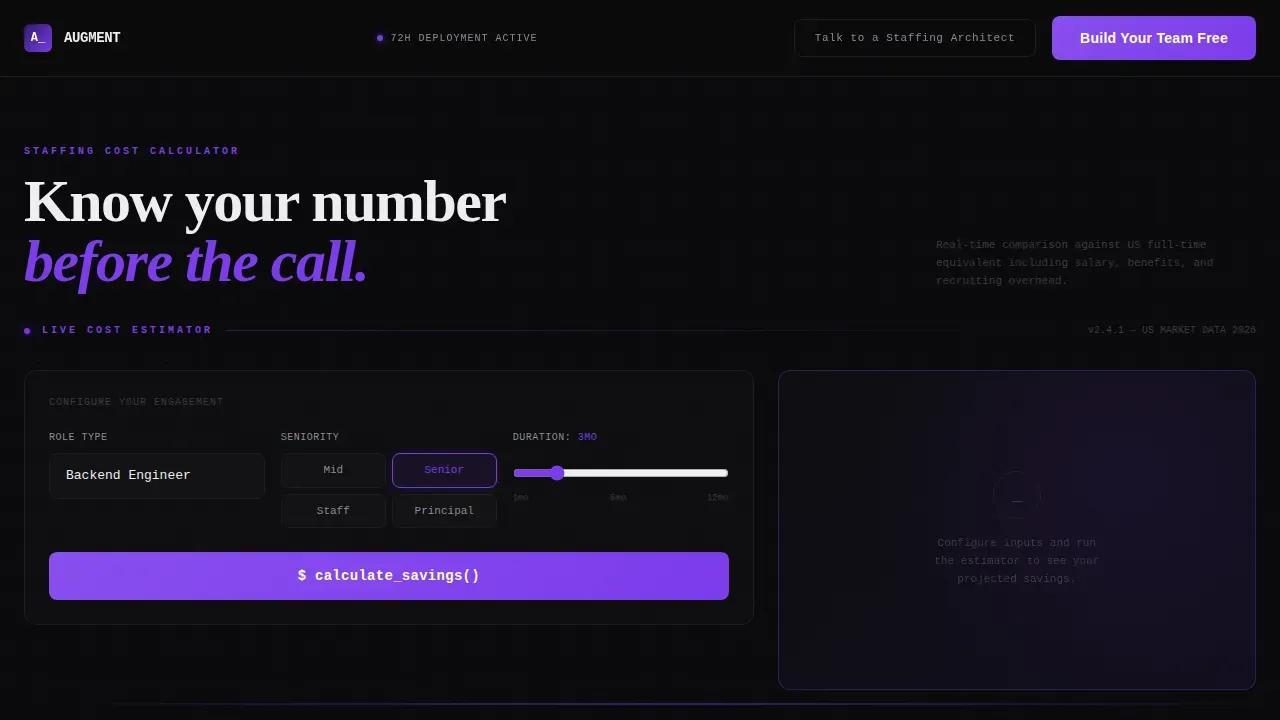
The Augment Instant Engineer Deployment Landing Page Template is a hub-and-spoke, single-page layout built for IT staffing and talent augmentation firms. It leads with a full-width staffing cost calculator, a searchable talent directory grid, an interactive stack taxonomy, case study modules, and SLA trust sections. The Void and Violet color system gives the entire page a production-dashboard aesthetic that speaks directly to technical buyers.
by Rocket studio
Quick Summary
This template is specifically designed for IT staffing and talent augmentation businesses that need to convert visitors fast. It opens with a real-time cost calculator that does the selling before a single paragraph is read. Below the calculator, a sticky anchor navigation guides visitors through six self-contained spoke modules. The result is a focused, high-intent landing page that captures leads and drives sign-ups with minimal friction.
Who This Template Is For
This template serves businesses that deploy senior technical talent on short notice. It is built for multiple audiences across the engineering staffing space, each with a distinct pain point and a short decision window.
- Series B startup CTOs burning runway on a delayed product launch who need a backend or DevOps engineer embedded within seventy-two hours.
- Enterprise engineering managers backfilling a departed tech lead mid-sprint who cannot afford a two-month recruiting cycle.
- Agency founders who just closed a contract larger than their current team can deliver and need full stack or QA specialists immediately.
What Problem This Template Solves
Finding and deploying senior engineering talent is slow, expensive, and filled with process friction. Every week a role stays open costs the business in delayed releases, missed milestones, and recruiting fees that erode margins. Standard landing pages in this niche fail because they lead with paragraphs instead of proof.
- Cost opacity is a core pain point. Buyers cannot quickly compare the cost of augmentation against a full-time hire plus benefits plus recruiting fees. This template puts that math on screen before the visitor scrolls.
- Trust is hard to establish quickly. Technical buyers dismiss vague promises. Social proof in the form of case study metrics and SLA commitments gives visitors concrete evidence before they engage.
- Friction kills sign-ups. Four-field forms, a freemium trial model, and a clear primary call to action button reduce the barriers that cause leads to abandon the page.
What You Get With This Template
You get a complete, production-ready single page with six content spokes anchored from a sticky navigation rail. Every section is modular, making it easy to update talent availability or swap in new skill sets without rebuilding the entire page structure.
- A full-width interactive cost estimator with role type, seniority level, and engagement duration inputs. The output panel displays estimated monthly cost, a US full-time salary comparison, and the savings delta in real time.
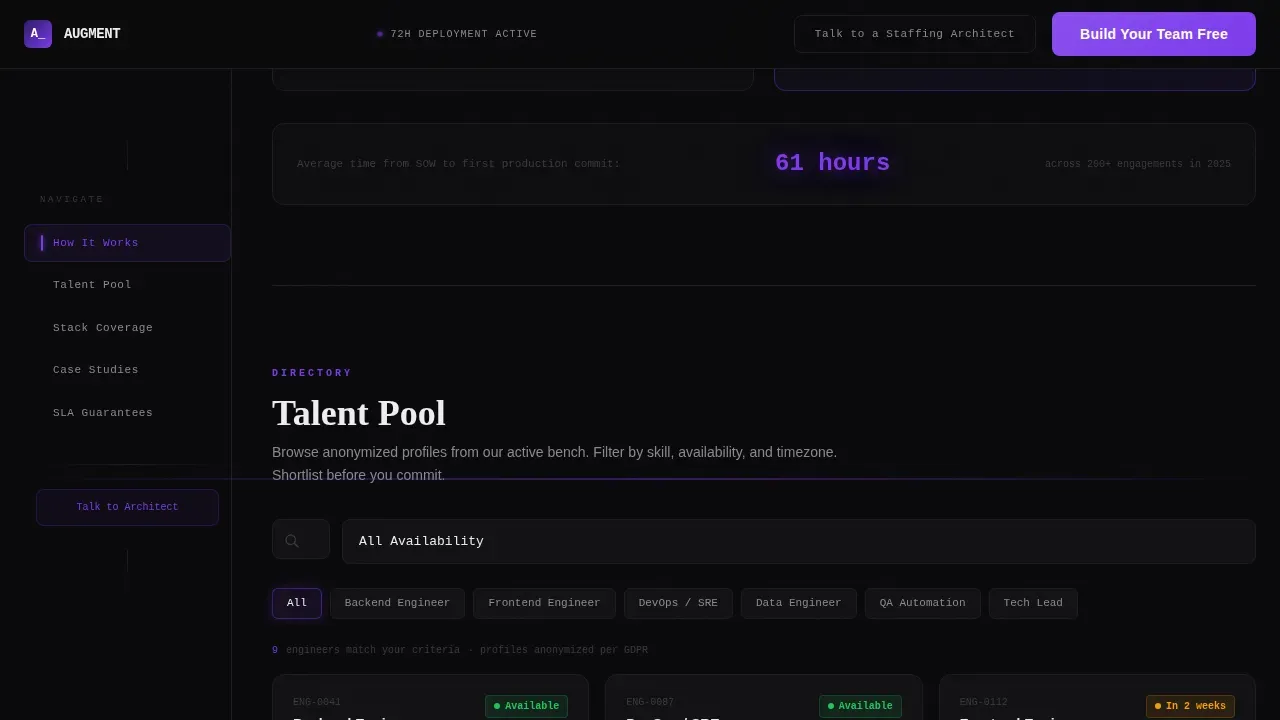
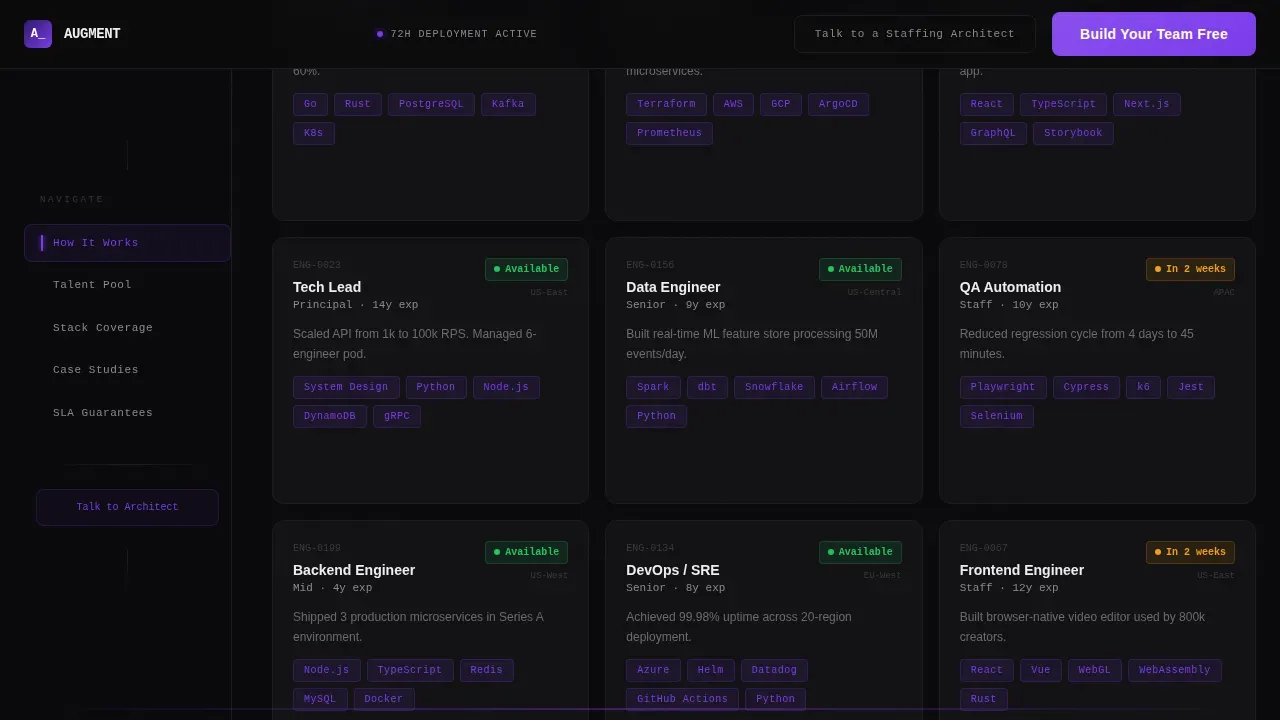
- A searchable talent directory grid showing anonymized engineer profiles with skill tags, availability badges, and years of experience. Visitors can browse and shortlist candidates before committing.
- An interactive stack taxonomy mapping languages, frameworks, and cloud platforms so visitors can immediately confirm coverage for their specific tech environment.
Feature List
This template packs several built-in components that are specifically designed to serve technical buyers and drive measurable lead generation outcomes.
Real-Time Staffing Cost Calculator
The header is a full-width ROI calculator with three visible inputs: role type (Backend Engineer, Frontend Engineer, DevOps, Data Engineer, QA Automation, Tech Lead), seniority level (Mid, Senior, Staff, Principal), and engagement duration in months. As each field is selected, the output panel animates the estimated monthly cost, compares it to a US full-time equivalent including benefits and recruiting fees, and displays the savings delta in electric violet numerals. The tool functions as the primary value proposition before any body copy is read. Using specific numbers in this output panel significantly improves trust and conversion effectiveness with technical buyers who want data, not prose.
Hub-and-Spoke Anchor Navigation
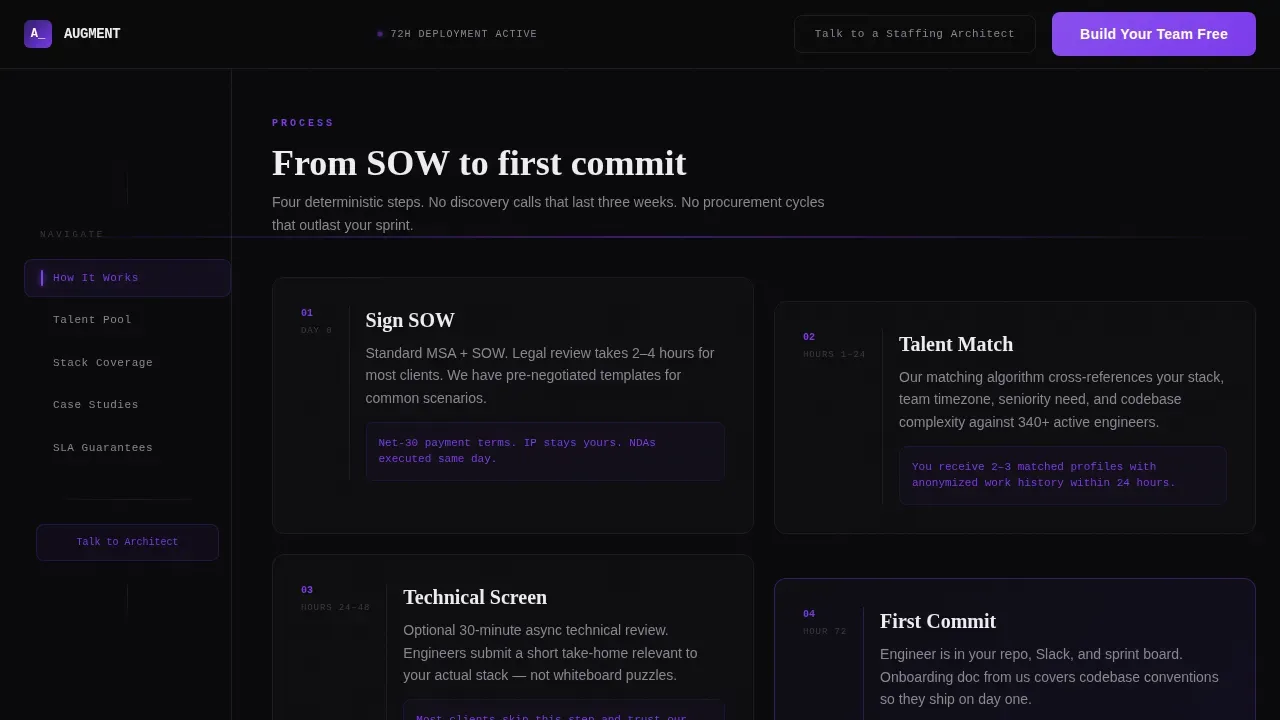
A sticky left-rail navigation links to six spoke modules: How It Works, Talent Pool, Stack Coverage, Case Studies, SLA Guarantees, and a secondary call to action for enterprise buyers. This page layout lets visitors forage nonlinearly, jumping directly to the section most relevant to their pain point. The anchor nav keeps context visible at all times so leads never lose their place on the page.
Searchable Talent Directory Grid
The Talent Pool spoke renders as a searchable directory grid. Each card shows an anonymized engineer profile with skill tags, an availability badge, and years of experience. Visitors can filter by stack and shortlist candidates during their free fourteen-day trial. This feature reinforces the Directory and Discovery theme and gives prospects a specific outcome to anticipate before they sign up.
Interactive Stack Taxonomy
The Stack Coverage spoke maps languages, frameworks, and cloud platforms as an interactive taxonomy. Visitors click into categories to see depth of coverage. This is one of the strongest developer tools in the template because it removes the "do you cover my stack?" pain point before a sales call is needed, saving time for both buyer and provider.
Case Study Metrics Module
The Case Studies spoke presents concrete outcomes with real metrics. Social proof delivered through case study excerpts eliminates risk perception and builds trust with prospects who are evaluating multiple vendors. The benefit stack focuses on specific outcomes rather than features, which is the most effective approach for high converting landing pages in the staffing and implementation services space.
SLA Guarantees Trust Section
The SLA Guarantees spoke is a dedicated trust and credibility module. It commits to deployment timelines and engagement conditions in plain language. Trust badges and clear service-level commitments address hidden objections that technical buyers carry into every evaluation, helping to improve conversion rates by reducing hesitation at the moment of decision.
Page Sections Overview
| Section | Purpose |
|---|---|
| Cost Calculator Header | Delivers real-time ROI data above the fold and houses the primary call to action button |
| How It Works | Explains the 72-hour deployment process in a non-linear, asymmetric layout |
| Talent Pool Grid | Searchable directory of anonymized engineer profiles with filters and availability badges |
| Stack Coverage Map | Interactive taxonomy of languages, frameworks, and cloud platforms |
| Case Studies Module | Presents concrete, metric-backed outcomes to build social proof |
| SLA Guarantees | Trust and credibility section with deployment commitments and service terms |
| Footer | Developer-minimal footer with navigation links and secondary sign-up form |
Design & Branding System
The visual identity follows a Void and Violet color system built to feel like a production monitoring dashboard at 2 AM. Everything non-essential is removed so the data and the calls to action glow. The palette is disciplined: void black dominates backgrounds, and electric violet earns its presence only where attention is required.
- Color palette: Absolute void black (#09090B) for all backgrounds, deep orbital purple (#2D1B69) for structural depth, electric violet (#7C3AED) on interactive states, hover pulses, and calculator outputs, and phosphor white (#EEEEF0) for all text and data.
- Typography system: JetBrains Mono for data, numbers, and code-adjacent labels; DM Sans for body copy and user interface elements; Fraunces for display headings that need editorial weight.
- Animation and interactivity: High-motion GSAP scroll reveals, counter animations on the calculator output, real-time input response, and violet hover pulses on interactive elements to signal live process states.
Mobile & Speed Optimization
The template is built desktop-first, which matches the primary audience of CTOs and engineering managers reviewing options at a desk. The layout, however, is structured to remain readable and functional on smaller screens. Fast load times are critical for retaining technical audiences, and the template's architecture separates static and dynamic components to support that goal.
- Component separation: Static sections use server-rendered components for fast initial load. Interactive components such as the calculator and searchable talent grid are client-side, keeping the initial page weight low.
- Mobile optimization: The anchor navigation and calculator inputs reflow for smaller viewports. The talent directory grid collapses to a single-column layout on mobile so visitors can still browse profiles and capture leads from any device.
How This Template Helps You Convert
High converting landing pages do not rely on a single moment to close a visitor. This template builds conversion pressure across the entire page, starting the moment a visitor lands and continuing through every spoke they visit.
- The calculator converts before copy does. The headline of a landing page is responsible for roughly 40 percent of the conversion rate, and here the calculator acts as that headline. A strong opening earns the next few seconds of attention; a weak one loses visitors permanently. By surfacing cost savings data immediately, the template gives visitors a specific number to react to before they read a word of body copy. The primary call to action button, "Build Your Team Free," appears directly beneath the savings delta while it is still registering.
- Social proof and SLA commitments close the gap. Testimonials, case study metrics, and explicit service-level agreements layer in trust at the points where visitors are most likely to hesitate. Effective landing pages eliminate risk perception at each decision point, not just at the bottom of the page. The secondary call to action, "Talk to a Staffing Architect," floats in the anchor nav for enterprise buyers who need a human touchpoint before committing.
- Minimal form friction drives sign-ups. The lead capture form collects only four fields: work email, company name, primary role needed, and expected start date. Landing pages that convert effectively minimize form fields to reduce friction, especially for technical buyers who are resistant to sales-call pressure. Reducing form fields at this stage can significantly increase conversion rates for business-to-business staffing services.
Other Information About This Template
This section covers additional context about how this template fits into a broader marketing and lead generation strategy, and how it works within common landing page builder environments.
- Platform compatibility: This template is built for use with a landing page builder that supports dynamic content, custom code blocks, and component-level interactivity. No-code landing page builders allow users to design and publish landing pages without writing code, and this template is structured to work inside those environments where a drag and drop or drop editor interface is available.
- AI-assisted customization: Many ai powered landing page builders can generate and refine copy based on natural language prompts. This template's modular structure works well alongside ai tools and ai agents that handle repetitive tasks like copy variation or layout testing, freeing teams to focus on higher-value decisions. An ai powered agent workflow can also be used to personalize dynamic content across different audience segments, saving time on manual updates.
- Lead capture and CRM integration: Landing page builders typically include form builders, lead capture tools, and CRM integrations. This template's four-field sign-up form is designed to plug into those workflows so leads flow directly into automation sequences. Capturing leads who do not convert on their first visit through an email nurture sequence is an important part of any complete sales funnels strategy.
- Pricing and conversion context: The calculator output doubles as the pricing pages experience for this service. Transparent pricing improves user trust and reduces friction. The template supports pricing tables and pricing tiers comparisons within the calculator output panel, framing cost against a US full-time equivalent to make the value immediately clear. Every high converting AI service landing page should include a clear pricing section so the purchase decision feels safe.
- Pop-ups and exit-intent: The template structure can support pop ups for exit-intent offers to capture leads who are about to leave the page without converting. High converting landing pages often include this layer to recover visitors who engaged with the calculator but did not click the primary call to action button.
- Broader use cases: While this template is specifically designed for IT staffing firms serving enterprise and Series B clients, the underlying structure is adaptable. Local businesses and small businesses offering specialized implementation services or technical consulting can use the same hub-and-spoke page layout to reach a focused audience. The modular design means each spoke can be rewritten to address a different service line without changing the overall page architecture.
- Conversion effectiveness at scale: Many landing page builders provide built-in testing capabilities to compare variants and measure clicks, conversions, and user behavior. This template's action oriented structure makes it well suited for split testing individual sections. Teams can test call to action button wording, calculator default values, or social proof placement to improve overall conversion effectiveness across campaigns.
- The augment instant engineer deployment landing page template is specifically built to let staffing firms deploy professional, lead-generating pages in minutes rather than weeks, without waiting on designers or developers to build from scratch.
Theme
Directory & Discovery
Creative direction
Calculator/Tool First
Color system
Void & Violet
Direction
Freemium/Trial
Page Sections
Real-time Staffing Cost Calculator
Hub-and-spoke Anchor Navigation
Searchable Talent Directory Grid
Interactive Stack Taxonomy
Case Study and Social Proof Modules
SLA Guarantees Trust Section
Related questions
What three types of landing pages should I know about?
What makes a landing page convert visitors at a higher rate?
How do you make a landing page template that works for a technical audience?
What is a good conversion rate for a landing page in B2B staffing?
Can this template be customized without writing custom code?