AI-Powered RPA Workflow Automation Landing Page Template
The Automate landing page template is built for AI-powered robotic process automation platforms targeting VP-level operations leaders. It combines a data-dense, analyst-grade layout with animated dashboard visuals, brutalist typography, and a three-step progressive lead capture form. The design converts skeptical buyers into audit leads through proof-first sequencing, bold benchmark data, and a cockpit-grade iridescent aesthetic.
by Rocket studio
Quick summary
The Automate template is a single-page, dashboard-style layout designed for AI workflow automation and robotic process automation platforms. It leads with a live-data hero visualization, escalates through sourced benchmark stats and case study strips, then closes with a progressive three-step audit form. The goal is clear: turn ops leaders who have failed RPA projects into qualified leads.
Who this template is for
This template was built for a specific kind of buyer and a specific kind of product. If your platform automates enterprise business processes using artificial intelligence, this layout speaks your audience's language before a single word of body copy loads.
- VP Operations leaders at mid-market insurance carriers, logistics firms, and healthcare revenue cycle teams
- Directors of IT and Finance who have been burned by at least two failed robotic process automation vendors
- Founders and marketers at B2B SaaS companies selling intelligent automation, process automation, or ai workflow automation solutions to enterprise ops teams
What problem this template solves
Operations teams at mid-market companies are still doing the work that machines should own. Analysts stitch together spreadsheets at 2 a.m. Claims intake clerks copy data between legacy systems. Finance teams rekey the same invoice processing fields across three platforms. The problem is not a lack of tools. It is a lack of trust in those tools, built up through failed deployments and vague vendor promises.
A landing page that leads with ROI data, shows the automation mechanism step by step, and earns the form click through evidence rather than promises solves a real conversion problem for robotic process automation platforms.
- Buyers arrive skeptical of vendor claims after past failed deployments, so proof must come before any ask
- Generic SaaS templates do not communicate the data density and analytical credibility that VP-level ops buyers expect
- Most templates bury the call to action or lead with features instead of measurable outcomes
What you get with this template
This is a fully structured, single-page layout built for ai workflow automation and process automation lead generation. Every section has a defined job, and the visual system reinforces that machine-grade precision from the first pixel.
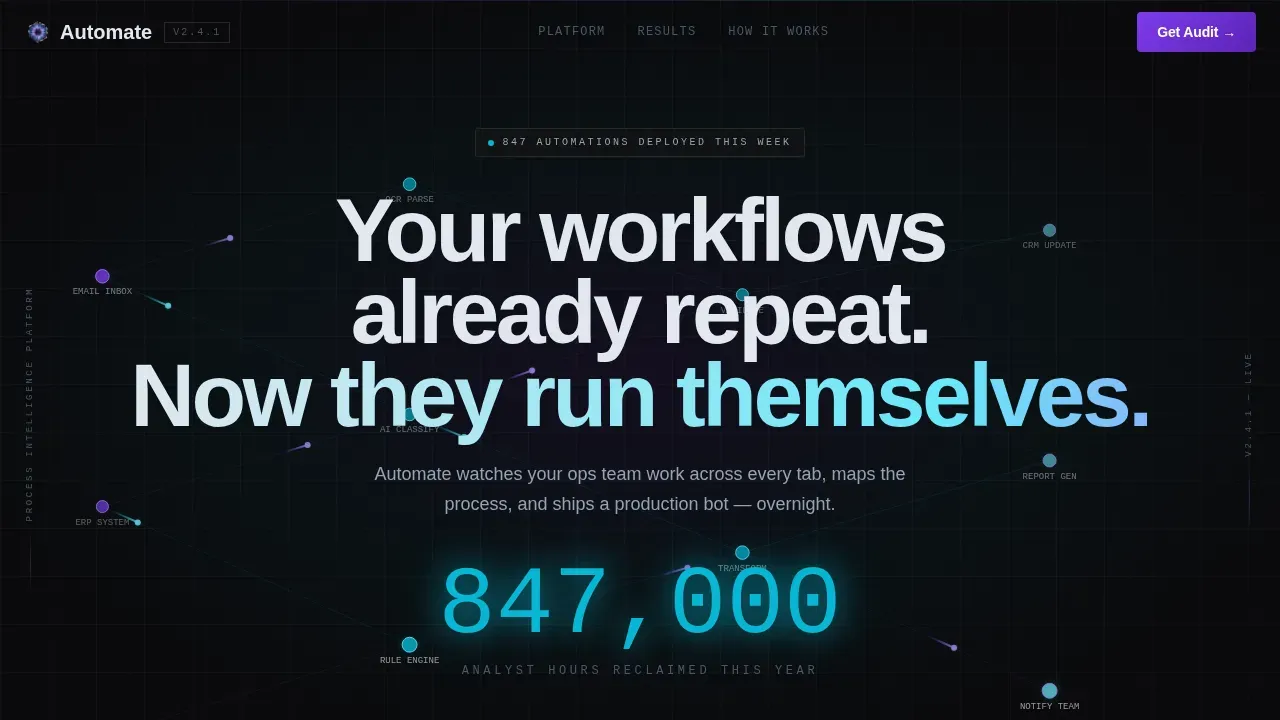
- A full-bleed animated hero section with a process-node network visualization, a counting statistic in cyan monospace, and a 96-point headline
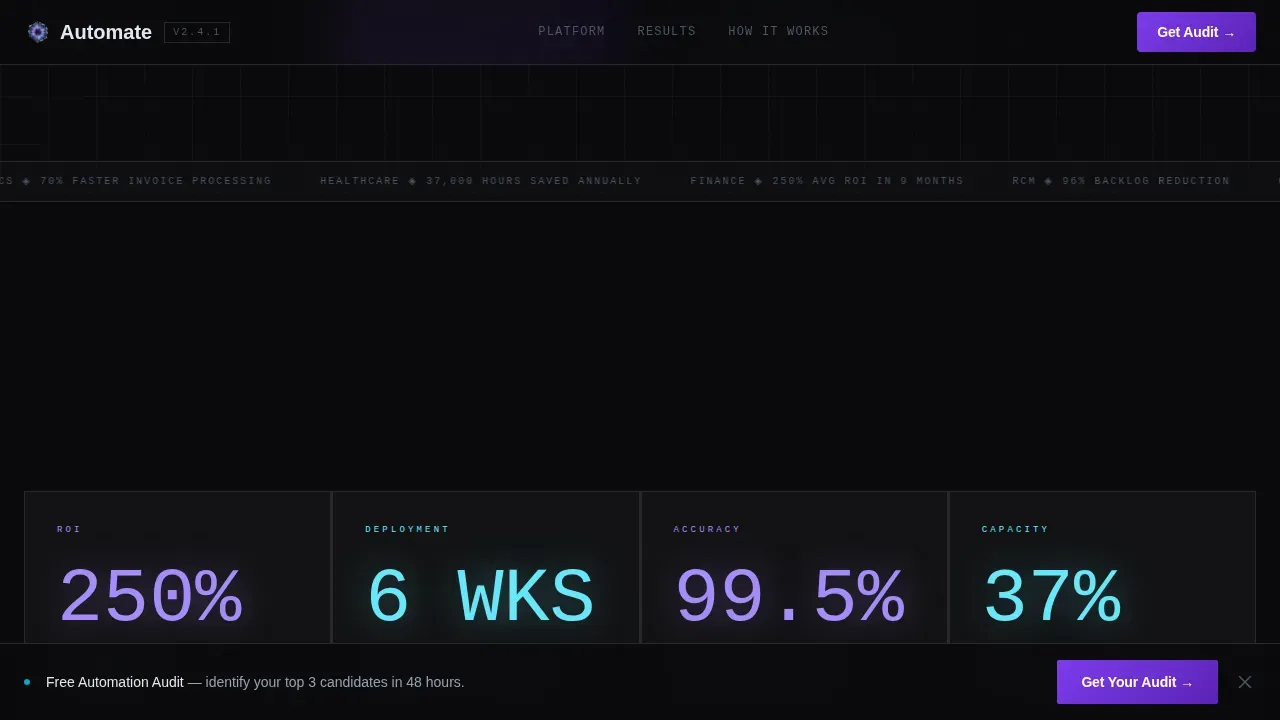
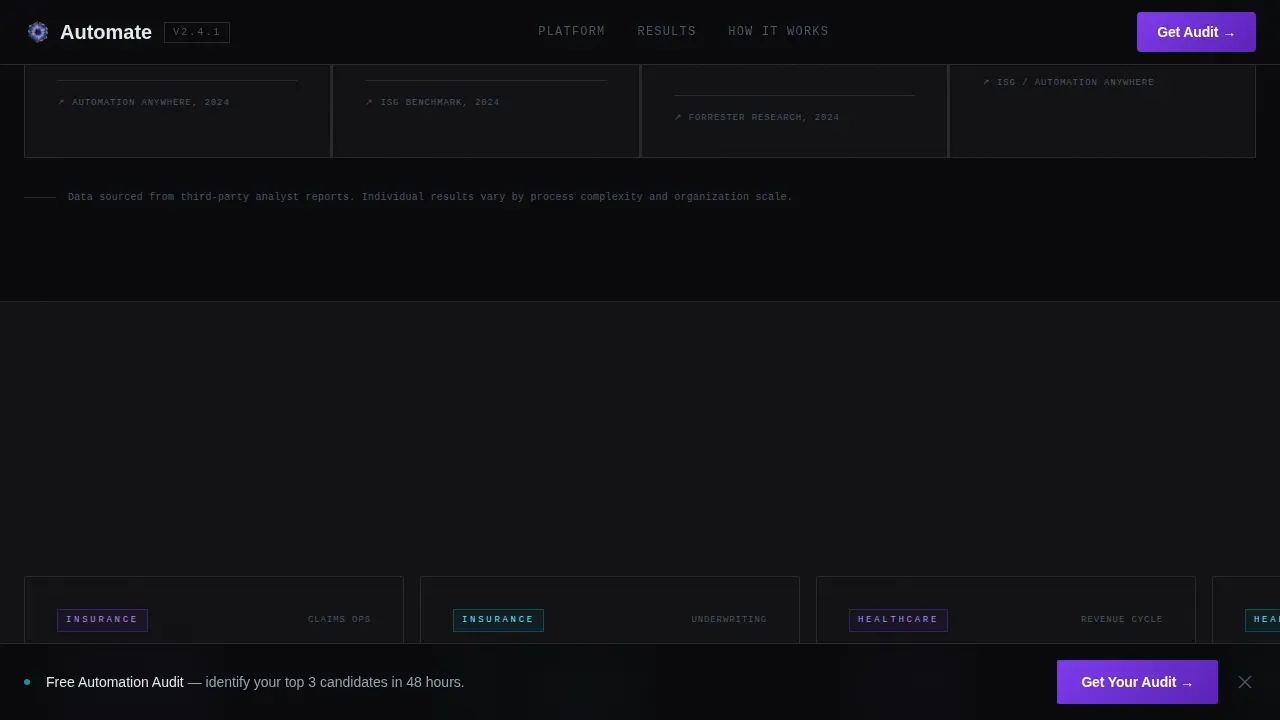
- Four brutalist stat cards showing automation ROI benchmarks, deployment timelines, error reduction rates, and hours recovered, each formatted in analyst-deck style
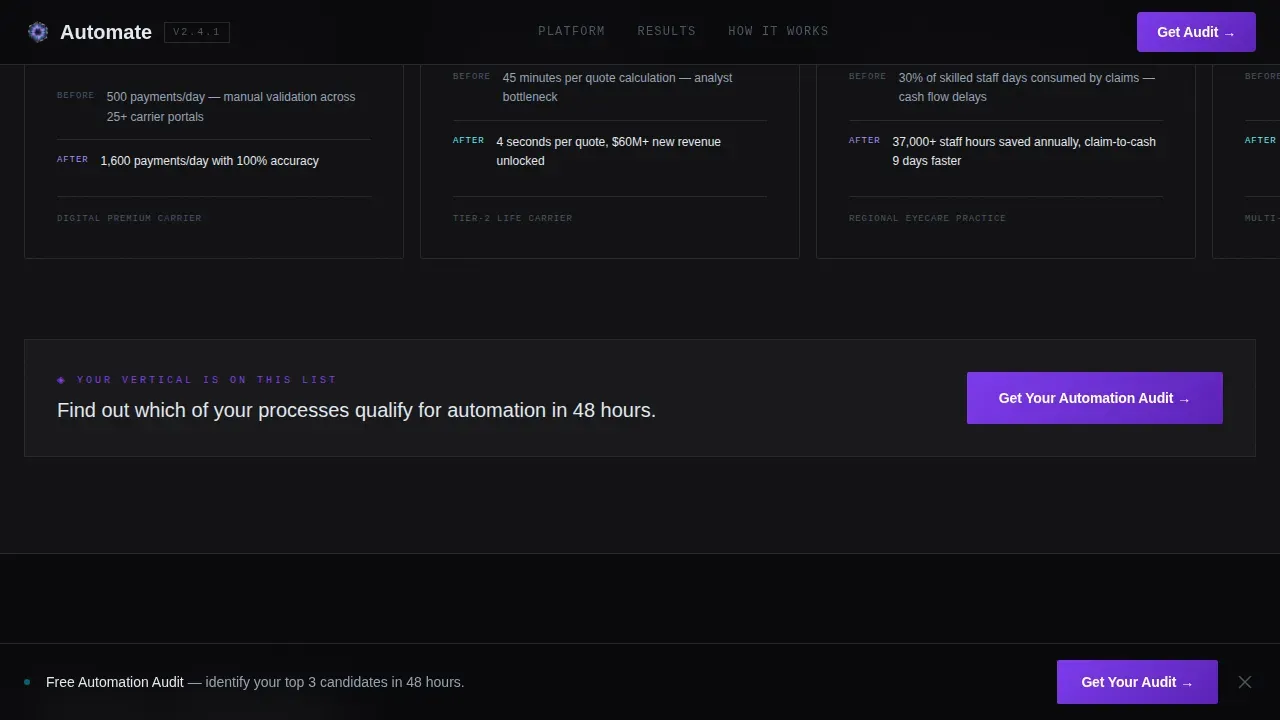
- A horizontal scrolling case study strip with before-and-after metrics by industry vertical, a three-phase animated process discovery flowchart, and a three-step progressive disclosure lead capture form with a secondary gated report download
Feature list
This template delivers six core capabilities that are directly reflected in the layout, interaction design, and conversion structure described in the brief.
Animated Process-Node Hero Dashboard
The full-bleed header renders an animated network visualization where process nodes pulse with iridescent light and data streams arc between them in real time. A 96-point white headline anchors the center. A live-counting cyan monospace number builds urgency by showing hours reclaimed from automated processes. This hero communicates that the platform is a machine already in motion, not a concept.
Brutalist Benchmark Stat Card Grid
Four data cards present sourced automation metrics in a grid layout that reads like an analyst briefing. Each card highlights a key performance result: average ROI from ai workflow automation, rapid deployment timelines, error reduction from intelligent automation, and full-time-equivalent hours recovered. The bold brutalist design uses oversized type, void black backgrounds, and single-pixel silver borders to make every number feel like evidence.
Horizontal Case Study Strip
A horizontally scrolling strip presents industry-specific case studies, each showing the company vertical, the process automated, and the before-and-after metric in oversized type. Finance teams, insurance carriers, and logistics operations each get their own card. This section demonstrates concrete outcomes from robotic process automation rpa deployments across high volume tasks and complex workflows, making the ROI claim tangible rather than theoretical.
Three-Phase Process Discovery Flowchart
An animated flowchart reveals the platform's three-phase method: Observe, Map, and Build. Each phase is disclosed as the visitor scrolls into it. The visualization shows how the ai workflow engine watches how operations teams interact across browser tabs, maps those patterns using machine learning, and then deploys a production bot. The scroll-triggered reveal keeps buyers engaged through the mechanism explanation.
Three-Step Progressive Lead Capture Form
The primary conversion element is a three-step progressive disclosure form. Step one captures company size and industry vertical. Step two presents multi-select chips for processes to automate, covering invoice processing, claims intake, order management, data migration, and a custom option. Step three collects name and work email. A sticky bottom bar keeps the call to action visible throughout the scroll. A secondary path offers a gated benchmark report download for visitors not yet ready to speak with sales.
Iridescent Brutalist Design System
The visual identity uses void black (#09090B) as the dominant background, holographic violet (#7C3AED) for primary accents and glow states, electric cyan (#06B6D4) for secondary data highlights, and near-white silver (#E2E8F0) for body text and grid lines. Hover states bloom with violet-to-cyan gradients. Typography pairs JetBrains Mono for metrics with Manrope for headlines, set massive and tight-tracked.
Page sections overview
| Section | Purpose |
|---|---|
| Full-Bleed Hero | Animated node visualization, counting statistic, 96-point headline |
| Benchmark Stat Cards | Four sourced ROI and efficiency metrics in analyst-deck grid |
| Case Study Strip | Horizontal scroll, vertical-specific before-and-after metrics |
| Process Discovery Flow | Scroll-triggered three-phase Observe, Map, Build animation |
| Audit Lead Form | Three-step progressive disclosure with sticky call-to-action bar |
| Report Download call to action | Gated secondary conversion for benchmark report email capture |
| Footer Row | Linear single-row footer with navigation and compliance signals |
Design & branding system
The design language is Bold Brutalist with an AI Iridescent color system. Every visual decision is purposeful. Nothing is decorative. The palette feels like a GPU render farm at midnight, where every color is earned by data and every surface is matte black.
- Color system: void black (#09090B) dominant background, holographic violet (#7C3AED) for primary glow and accent states, electric cyan (#06B6D4) for data highlights and the counting metric, near-white silver (#E2E8F0) for body text and single-pixel grid borders
- Typography: JetBrains Mono for all metrics, counts, and data readouts; Manrope for headlines set at massive scale with tight tracking and brutally direct phrasing
- Interaction states: hover effects bloom from violet to cyan in a gradient that simulates light refracting through a prism; no decorative elements appear outside of data-driven context
Mobile & speed optimization
The template is built desktop-first, reflecting the reality that VP-level operations buyers review vendor pages on workstations during business hours. The layout prioritizes dense data readability on large screens, with the animation system optimized for those contexts.
- Desktop-first layout with full-bleed sections, horizontal scroll strips, and oversized typography designed for widescreen workstation displays
- Responsive structure ensures the single-column fallback remains readable on smaller screens, with touch-friendly tap targets and simplified animation states for mobile visitors
- Server Components handle all static sections while Client Components manage the animated node graph, counting numbers, scroll-triggered phase reveals, and the multi-step form to keep render performance balanced
How this template helps you convert
This template is structured as a proof-to-mechanism-to-inevitability sequence. The visitor never feels sold to. They feel informed, then compelled. Lead generation for ai workflow automation and intelligent automation platforms requires trust before action, and this layout earns that trust section by section.
- The hero and stat card sections lead with third-party benchmark data and measurable outcomes before asking for anything, establishing credibility with buyers who are already skeptical of robotic process automation vendor claims
- The case study strip and process discovery flowchart show the mechanism in action, transforming abstract claims about process automation and artificial intelligence into concrete before-and-after results that VP-level buyers can take to a budget conversation
- The three-step progressive form and sticky call-to-action bar minimize friction by breaking data entry into logical steps, while the secondary gated report path captures visitors who are researching rather than buying, supporting lead management across the full funnel
Other information about this template
This template sits at the intersection of enterprise B2B lead generation and the rapidly growing market for intelligent automation solutions. The global workflow automation market is projected to reach $23.77 billion by the end of 2025, making this a high-demand category where strong landing page design translates directly into competitive advantage.
The layout is compatible with broader ai workflow automation ecosystems. For teams building on or alongside microsoft power automate, the template's case study and stat card sections can be tailored to highlight integrations with microsoft tools such as Office 365, Teams, and SharePoint. Microsoft power automate offers over 1,400 prebuilt connectors and integrates with Azure AI services, making it a relevant reference point for buyers evaluating enterprise-grade workflow tools. Microsoft power platforms are widely used in mid-market enterprise environments, and this template's design language communicates fluency with those ecosystems.
The template's conversion structure reflects best practices for ai automation lead generation. Minimizing form fields to three to five essential inputs reduces friction and improves completion rates. Compliance trust signals, such as GDPR and ISO certification badges, can be added to the footer row to reassure enterprise clients evaluating ai solutions. Case studies with specific ROI metrics and security badges build social proof that meets enterprise procurement standards.
- The template supports process mining visualizations through its three-phase animated flowchart, which illustrates how the platform moves from observing unstructured data patterns to deploying automated processes
- The design system accommodates desktop flows and cloud flows documentation within the case study cards, letting buyers see exactly how an ai workflow handles both browser-based and server-side automation
- Non technical users, including operations leaders without coding backgrounds, can understand the platform's value immediately because the template communicates through metrics and outcomes rather than technical architecture
- The layout supports structured data presentation in the stat card grid, while the case study strip handles unstructured data narratives from real deployments
- For teams exploring low code or drag and drop interface builders alongside this template, the design system is clean enough to adapt as a companion sales page for those product tiers
- Platforms offering a free plan or tiered pricing, where paid plans start at a defined entry point, can integrate pricing context into the audit form step one or the footer row
- The secondary call to action can also support ai credits or usage-based offer framing for platforms that bill on consumption models
- Generative ai capabilities, including natural language query interfaces and ai assistants embedded in the platform, can be highlighted in the stat card or process flowchart sections without requiring design changes
- The template's structure also supports digital process automation narratives that extend beyond traditional robotic process automation rpa use cases into intelligent document processing, sentiment analysis, and intelligent routing scenarios
Theme
Bold Brutalist
Creative direction
Industry Report
Color system
AI Iridescent
Style
Dashboard/Data Grid
Direction
Lead Generation
Page Sections
Animated Process-node Hero Dashboard
Brutalist Benchmark Stat Card Grid
Horizontal Case Study Strip
Three-phase Scroll-triggered Flowchart
Three-step Progressive Lead Capture Form
Iridescent Brutalist Visual System
Related questions
What types of automation platforms is this template designed for?
Can this template support a secondary conversion path alongside the primary form?
How does the three-step form reduce friction for enterprise buyers?
Is the animated hero section compatible with real platform data?
What design customizations are straightforward to make?