Intelligent Campaign Automation SaaS Landing Page Template
Automate is a scroll reveal SaaS landing page template built for marketing automation platforms. It opens with a live-feeling code snippet hero, reveals data findings section by section, and guides visitors toward a freemium trial through a progressively disclosed sign-up form. The terminal-dark design speaks directly to growth leads, agency operators, and solo founders who need campaigns that run without constant oversight.
by Rocket studio
Quick summary
Automate is a single-page, scroll reveal landing page template designed for SaaS marketing automation products. It pairs a syntax-highlighted code snippet hero section with self-drawing animated charts, side-by-side benchmark panels, and a progressive freemium sign-up flow. The entire page is built around a terminal-dark Midnight Blue palette that signals precision and control to a technical, growth-minded audience.
Who this template is for
This landing page template was designed with three distinct buyer personas in mind. Growth leads at Series A saas startups who are drowning in manual spreadsheet segments will recognize themselves in every line. Agency operators managing more clients from one dashboard will see their workflow reflected in the benchmark panels. Solo founders who built the saas product but never built the funnel will find the sign-up path low-friction enough to act immediately.
- Growth leads at Series A saas startups managing complex segmentation manually
- Agency operators running multiple client accounts who need one tool that handles the heavy lifting
- Solo founders in saas companies who need lead generation running while they focus on the product
What problem this template solves
Most saas landing pages bury the value proposition under generic headlines and stock photography. Visitors leave before they understand what the saas product actually does. Saas startups in competitive niches cannot afford a bad strategy at the top of the funnel. This landing page template solves that by treating every scroll reveal as a data finding, not a sales pitch. The visitor feels like they discovered the insight rather than being sold to.
- Marketing teams lose trust signals when their landing page leads with vague promises instead of specific numbers
- Saas startups waste ad spend driving traffic to a landing page that does not convert visitors because the value proposition is unclear
- Solo founders and smaller teams lack the time and resources to build compelling copy from scratch, so the template provides a ready-made narrative structure
What you get with this template
This landing page template delivers a complete, section-led conversion flow designed to explain features through data storytelling rather than bullet points. Every element has a defined role. The entire page is structured so that each scroll reveal earns the next, building trust at every stage before asking for an email address.
- A syntax-highlighted, animated code snippet hero section that replaces the conventional hero image with live-feeling automation logic
- Five core content sections including open-rate lift charts, segmentation benchmark panels, a workflow complexity index, a progressive sign-up form, and a footer
- A sticky bottom call-to-action bar that re-appears after the second scroll reveal, keeping the primary action visible without interrupting the data narrative
Feature list
This landing page template ships with purpose-built components that match the demands of saas startups in marketing automation. Each feature below is part of the template as described in the source brief.
Animated Code Snippet Hero Section
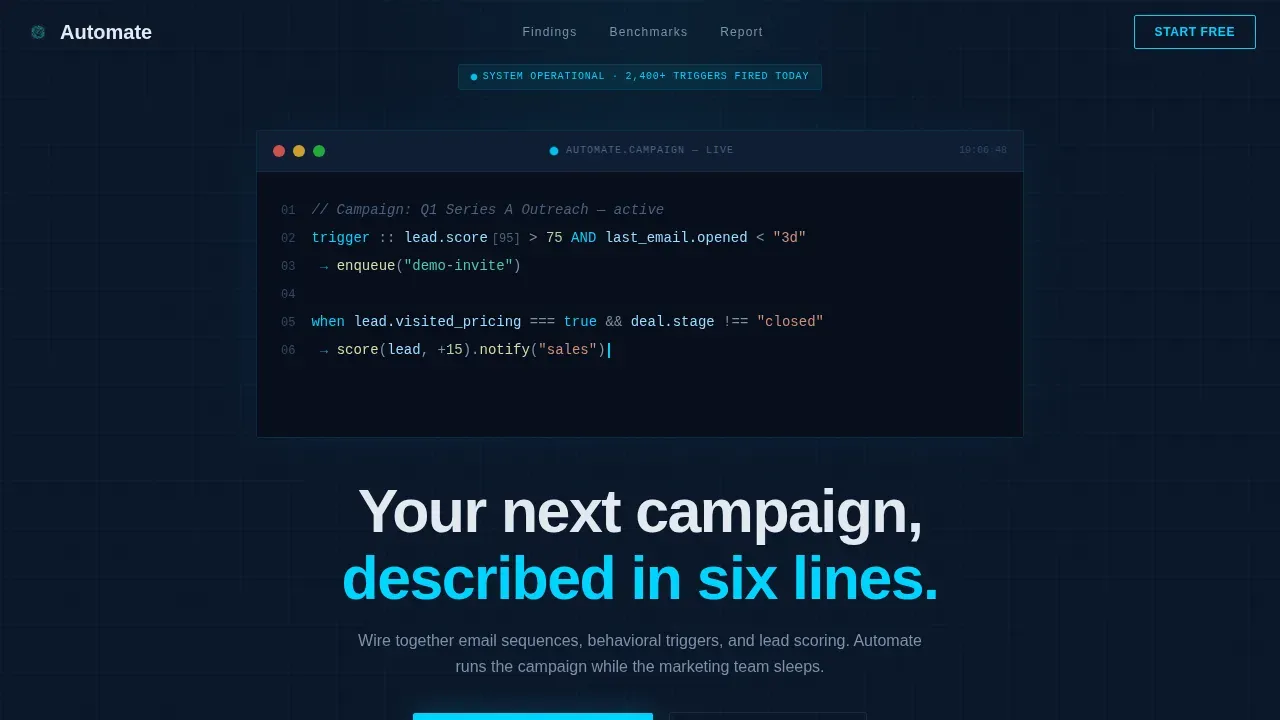
The hero section opens with a syntax-highlighted code block centered on a deep navy background. The snippet reads like a real automation workflow and animates live, with variables populating and return values resolving in view. There is no hero image, no illustration, and no stock photography. The effect communicates that this is a platform for people who think in systems, not in slides. This hero section immediately sets the value proposition without a single word of marketing copy.
Scroll Reveal Data Sections
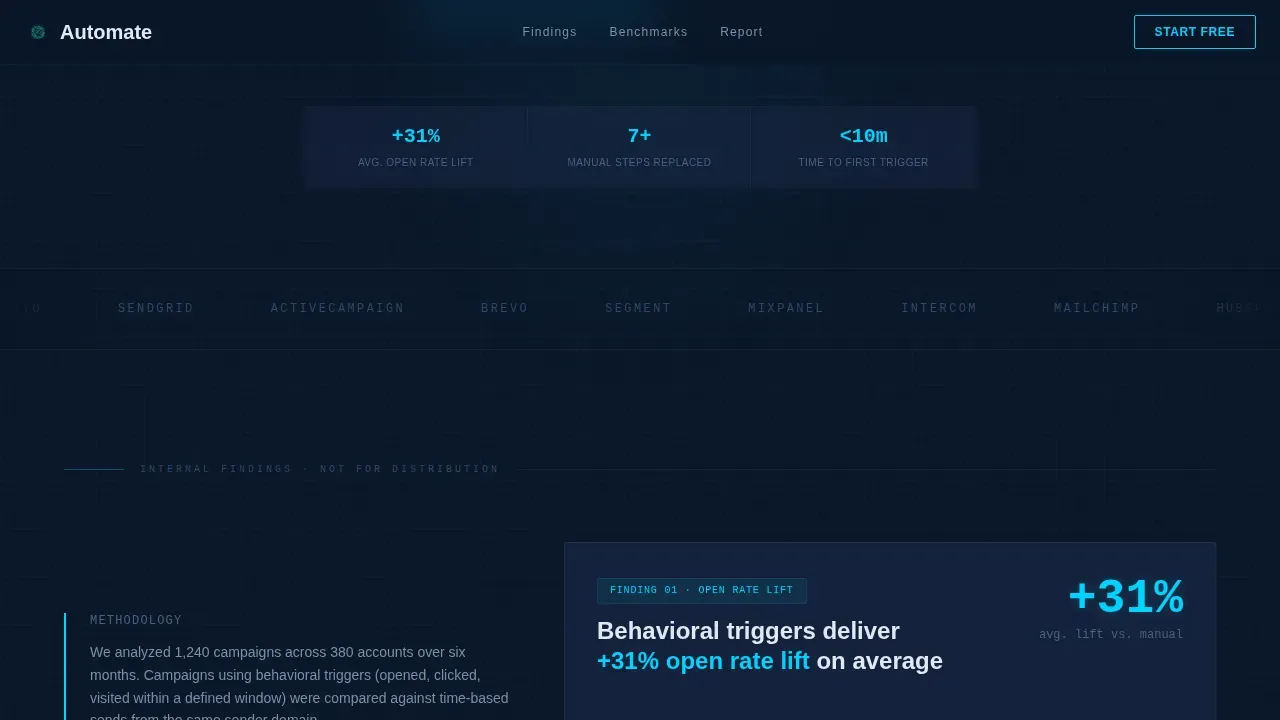
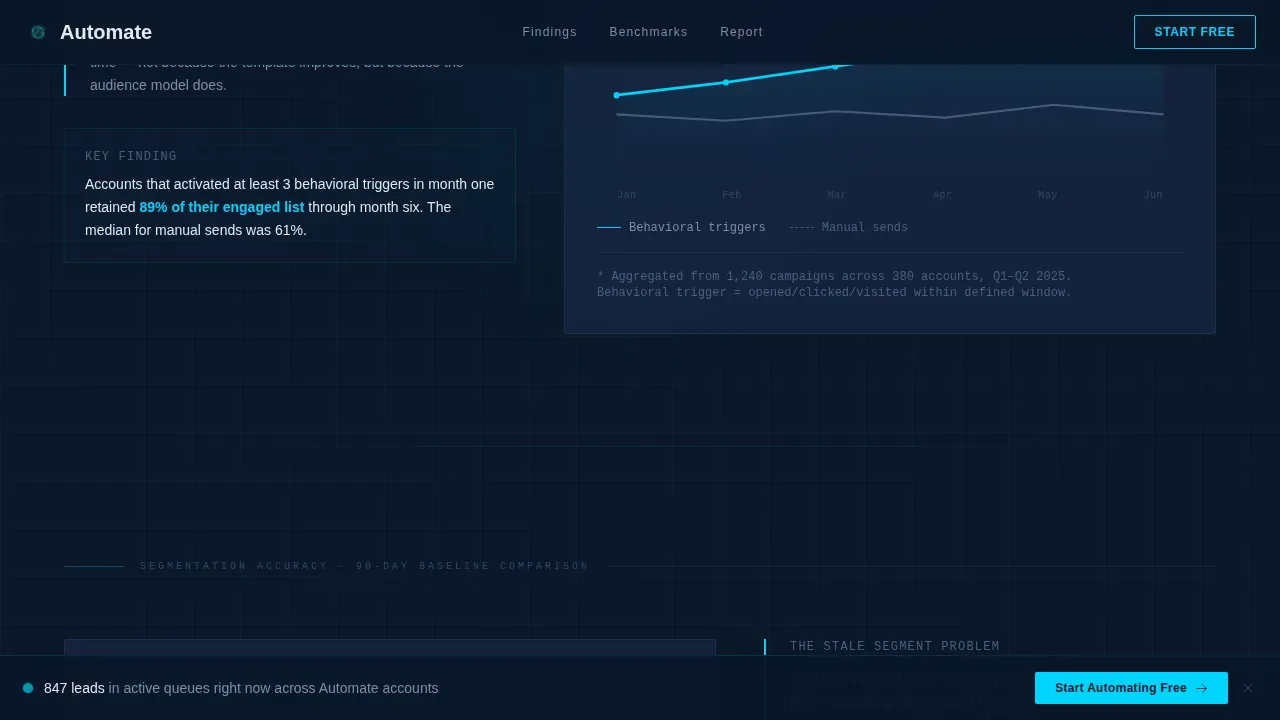
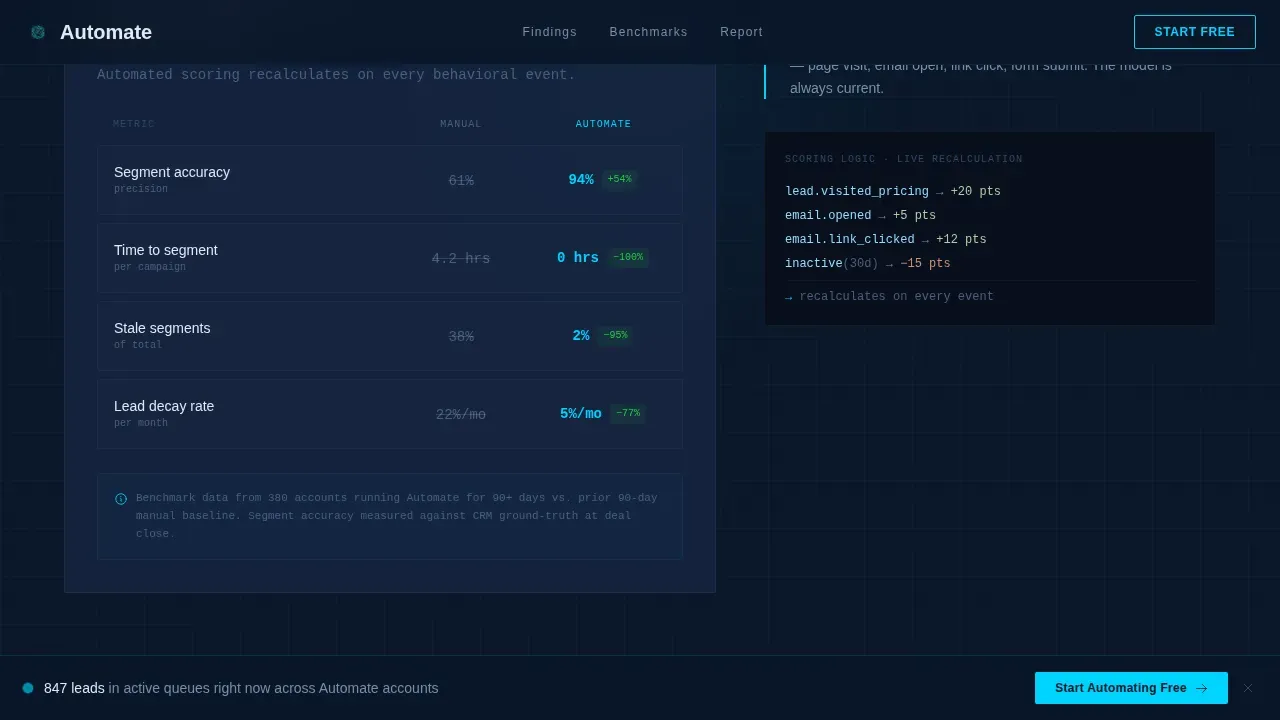
Each of the three core content sections surfaces as a research finding, not a feature pitch. Section one animates an open-rate lift chart that draws itself into view. Section two presents a side-by-side metric panel comparing manual tagging versus automated scoring. Section three renders a workflow complexity index showing how many steps the platform replaces. This Industry Report creative direction makes tactical execution feel like evidence, not persuasion. The approach is well-suited to saas pages that need to earn trust before asking for a sign-up.
Progressive Freemium Sign-Up Form
The sign-up form is disclosed in three stages. The first interaction asks for an email address only, keeping form fields minimal and reducing friction. The second step reveals a single dropdown for team size. The third step offers an optional field to connect an existing stack via an email service provider. No credit card is required. This structure reflects the principle that reducing form fields on saas landing pages can significantly increase conversion rates, because visitors commit in small steps rather than one large ask.
Sticky Conversion Bar
After the second scroll reveal, a sticky bottom bar appears and persists for the remainder of the session. It repeats the primary call to action in electric cyan against the navy void. The bar does not obscure content, but it ensures the action to start free trial is never more than a glance away. This supports a seamless user experience without interrupting the data narrative that drives scroll engagement.
Dual Conversion Paths
The landing page supports two parallel conversion goals. The primary path targets visitors ready to sign up for the free plan. The secondary path offers a gated PDF report download, requiring only a work email address, capturing leads who are still in the consideration stage. This dual-path structure means the landing page serves different audiences in one flow without confusion or visual clutter.
Social Proof Integration Blocks
The template includes designated blocks for social proof. These blocks are formatted as specific metric claims from three named user personas: a growth lead, an agency operator, and a solo founder. Company logos appear as text marks, not image files. Only 54% of saas landing pages feature any form of social proof, so this template makes trust signals a structural priority rather than an afterthought. Specific numbers in social proof claims are more effective than vague promises on saas landing pages, and the template reflects that principle directly.
Page sections overview
| Section | Purpose |
|---|---|
| Hero Code Snippet | Opens with animated automation logic and the primary call to action |
| Open Rate Lift | Animated chart reveals behavioral trigger performance data |
| Manual versus Automated | Side-by-side benchmark panel compares segmentation accuracy |
| Workflow Complexity Index | Steps-replaced visualization with social proof metric blocks |
| Progressive Signup Form | Three-stage freemium form with optional ESP connection field |
| Linear Footer | Single-row footer with navigation and secondary trust signals |
Design & branding system
The design language follows a Midnight Blue color system that feels like a monitoring dashboard viewed in a dark room. The palette is restrained by design: everything recedes except the signals that matter. Typography combines JetBrains Mono for code blocks with DM Sans for headings and body text, creating a clear hierarchy between system output and human narrative.
- Primary background is deep terminal navy (#0A1628), card surfaces use muted steel (#1B2A4A), and body text renders in cool interface white (#E2E8F0)
- Electric cyan (#00D4FF) is reserved exclusively for interactive elements, hover states, live data pulses, and call-to-action labels, giving the entire page a single, unmistakable signal color
- Animation is driven by GSAP ScrollTrigger, with self-drawing SVG charts and a code typewriter effect in the hero section, so the landing page communicates motion and precision without video
Mobile & speed optimization
The template is built desktop-first to match the terminal aesthetic and the primary audience of growth leads working in browser-based dashboards. A mobile responsive fallback ensures the landing page remains functional and readable on smaller screens. Mobile-first design principles inform tap target sizing so that the sticky call-to-action bar and progressive sign-up form remain usable without pinching or horizontal scrolling on any device. Mobile-first response design ensures the template uses accessible tap targets to prevent abandonment before automation kicks in.
- Server Components handle static content sections for performance optimization, while Client Components manage animations and interactive elements
- The progressive form disclosure reduces cognitive load on smaller screens by showing only one step at a time, which also supports seamless user experience on mobile
- The sticky conversion bar is sized and positioned to remain visible without covering key content on portrait-orientation mobile views
How this template helps you convert
A landing page acts as the conversion machine at the end of automated campaigns. This template is engineered around that role. Every design and copy decision supports the freemium trial sign-up as the primary outcome, with the secondary PDF download path capturing visitors who need more time. The conversion optimized layout is not accidental: it follows a clear logic of trust-building before action.
- The hero section earns attention immediately with a live-feeling code snippet that proves the platform understands automation logic, establishing credibility before a single marketing claim is made
- Each scroll reveal delivers a data finding that builds the case for the platform through evidence rather than persuasion, so by the time the sign-up form appears, the visitor has already made the decision
- The progressive form structure and the sticky call-to-action bar work together to keep the path to the free plan visible and low-friction at every stage of the page
Other information about this template
This template was built specifically for the saas marketing automation niche, but its section structure and data-storytelling approach translate well across saas pages in adjacent growth tool categories. The following points cover additional context that buyers commonly ask about before choosing a landing page template for a saas product.
- The template supports audience targeting for campaigns running across ad platforms including google ads, linkedin ads, and facebook campaigns, with dynamic headline areas that can be updated to match traffic source messaging
- AI powered features and ai tools are increasingly expected by saas startups: this template is structured to accommodate ai agents and ai assistant positioning copy in the hero section and benchmark panels without redesigning the layout
- Budget optimization and budget allocation decisions are easier when the landing page is already converting efficiently, and this template supports that by minimizing wasted ad spend on traffic that bounces before seeing the value proposition
- The template is compatible with marketing tools in the existing stack, including native integration with common email service providers via the optional ESP connection field in the progressive form
- Social media management platforms and major marketing platforms that drive inbound traffic benefit from a landing page that loads with clear trust signals and a single focused call to action, reducing drop-off from paid campaigns
- For saas companies exploring pricing tiers, the template layout supports a pricing section addition without restructuring the entire page; the modular component-based system allows for quick A/B testing of pricing panels
- Swipe pages and horizontal scrolling are not part of this template's navigation model; the entire experience is vertical scroll reveal, which matches the Industry Report creative direction and the terminal dashboard aesthetic
- The template's key elements are designed to serve smaller teams and saas startups that cannot afford to invest in custom development: it provides enterprise features in layout quality without enterprise-level build time
- Rocket.new is an ai powered vibe-coding platform that builds full, production-ready apps from natural-language prompts; its subscription-based model includes a free trial and paid plans starting at $25 per month, and it targets product managers, solopreneurs, front-end developers, and small to medium businesses, making it a relevant context platform for teams evaluating saas landing page templates on a free ai builder
- Machine learning and ai productivity gains are real drivers for teams choosing automation tools; this template positions those benefits clearly through the benchmark and complexity-index sections
- Free ai tools and completely free plan options are common decision factors for saas startups; the template's freemium flow, with its free plan entry point and optional paid plan upgrade path, is already structured to communicate those tiers without extra copy
- Content creation for the landing page is simplified because the template ships with a defined narrative arc: the visitor moves from code snippet to data evidence to sign-up without the marketing team needing to invent a new structure
- Team collaboration on the template is straightforward because each section is a self-contained component, and support teams or agency operators can swap content blocks without touching the animation layer
- The faq section at the bottom of this overview addresses the most common pre-purchase questions about the template's scope, customization, and compatibility
- Advanced features such as event-triggered re-engagement flows, abandoned trial recovery sequences, and ai assistant chat overlays can be added to the landing page after launch without breaking the core layout
- Customer engagement metrics improve when the landing page leads with specific outcomes and displays trust badges prominently; this template makes both structural defaults, not optional add-ons
- Demo requests are supported through the secondary conversion path; visitors who download the PDF gated report can be re-targeted with a demo invite sequence, which mirrors the automation logic shown in the hero section itself
- Lead generation performance improves when sign ups are low-friction; this template is designed around that principle from the first form field to the sticky bar
Theme
Directory & Discovery
Creative direction
Industry Report
Color system
Midnight Blue
Style
Scroll Reveal (Progressive)
Direction
Freemium/Trial
Page Sections
Animated Code Snippet Hero
Scroll Reveal Data Storytelling
Progressive Three-step Sign-up Form
Sticky Freemium Call-to-action Bar
Dual-path Lead Capture
Metric-driven Social Proof Blocks
Related questions
Does this template require coding knowledge to customize?
Can the progressive sign-up form connect to an existing email service provider?
Is there a free plan option for launching this landing page?
How does the dual conversion path work for different audiences?
Can this template be adapted for google ads or linkedin ads campaigns?