Port & Terminal Vertical SaaS Booking Website Template
Berth is a glassmorphic, card-grid landing page template built for port and terminal booking systems. It opens with a live metrics dashboard, walks visitors through a Problem-to-Solution arc, and closes with a frictionless three-field signup. Every section is designed to prove competence before asking for commitment, making it ideal for vertical SaaS products in port and terminal operations.
by Rocket studio
Quick summary
Berth is a single-page, card-grid landing page template for port and terminal management software. It leads with a real-time stats dashboard, moves through an animated Problem-to-Solution arc, and ends with a low-friction free-trial signup. The glassmorphic visual system and Dynamic Motion theme give it the feel of a professional maritime control environment.
Who this template is for
This template is built for software teams and product marketers selling port and terminal management tools to operational buyers. It speaks the language of people who run live berth schedules, not general business audiences.
- Terminal operations managers coordinating multiple vessel arrivals and berth assignments daily
- Port authority coordinators who currently rely on printed weekly berth plans and manual phone confirmations
- Logistics dispatchers at freight forwarders who lose hours chasing shifting estimated times of arrival
What problem this template solves
Port and terminal operations teams face a specific trust gap when evaluating new software. A generic SaaS landing page does not reassure an operations manager who needs to know a tool can handle crane queues, tidal windows, and live vessel status in one view.
- Chaotic communication across messaging apps and printed spreadsheets makes it hard to show buyers the contrast between old methods and a modern scheduling grid
- Most SaaS templates fail to convey operational scale, leaving terminal buyers unconvinced before they ever reach a signup form
- Static pages with no live data or interactive demos waste the attention of time-pressed port professionals
What you get with this template
This template gives you a fully structured, conversion-focused landing page built around the operational realities of port and terminal management software. Every section is designed to match the mental model of an operations buyer.
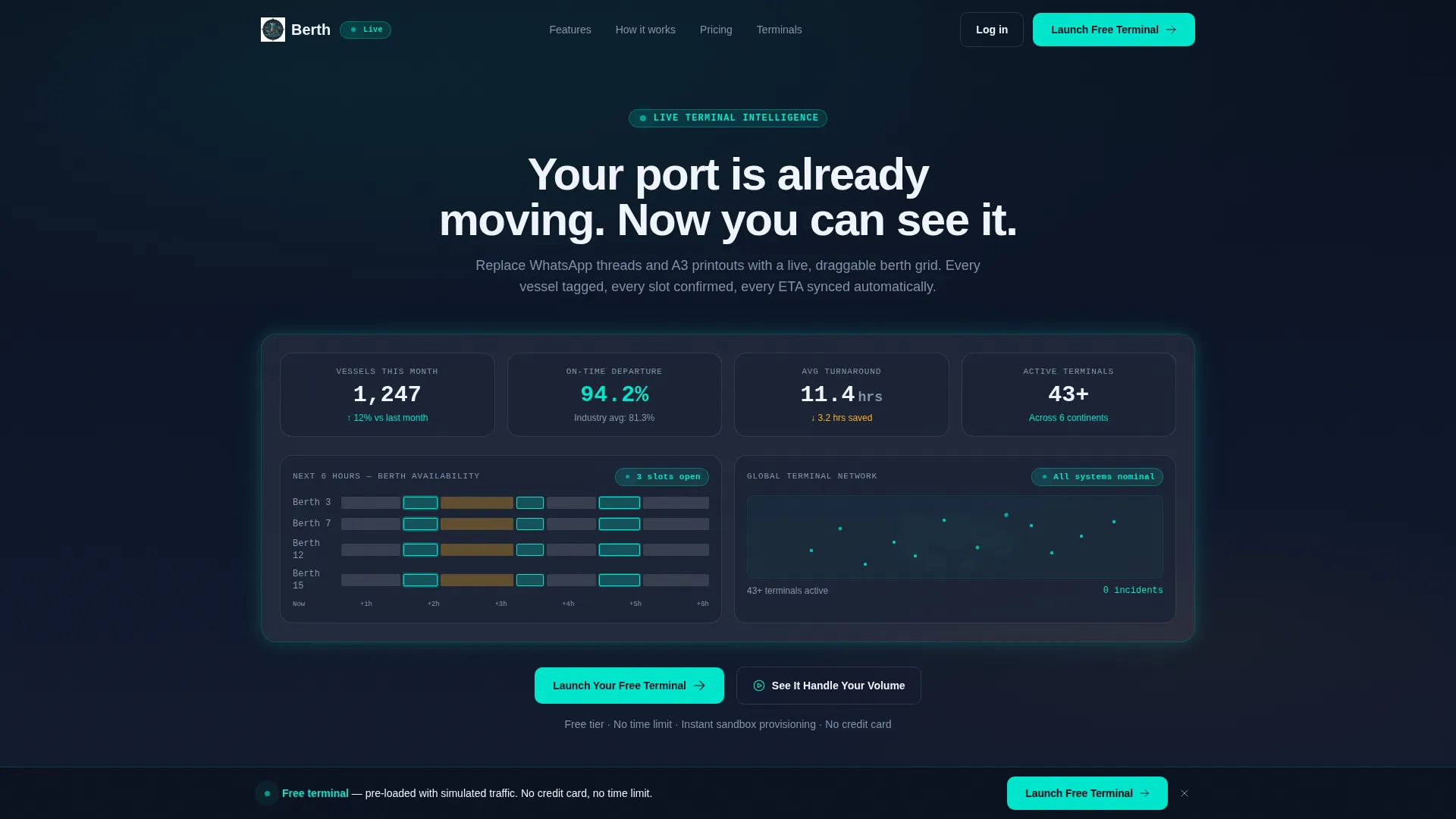
- A viewport-wide glassmorphic header dashboard displaying seven animated metrics, including vessels berthed, on-time departure rate, turnaround time, and a miniature global port map
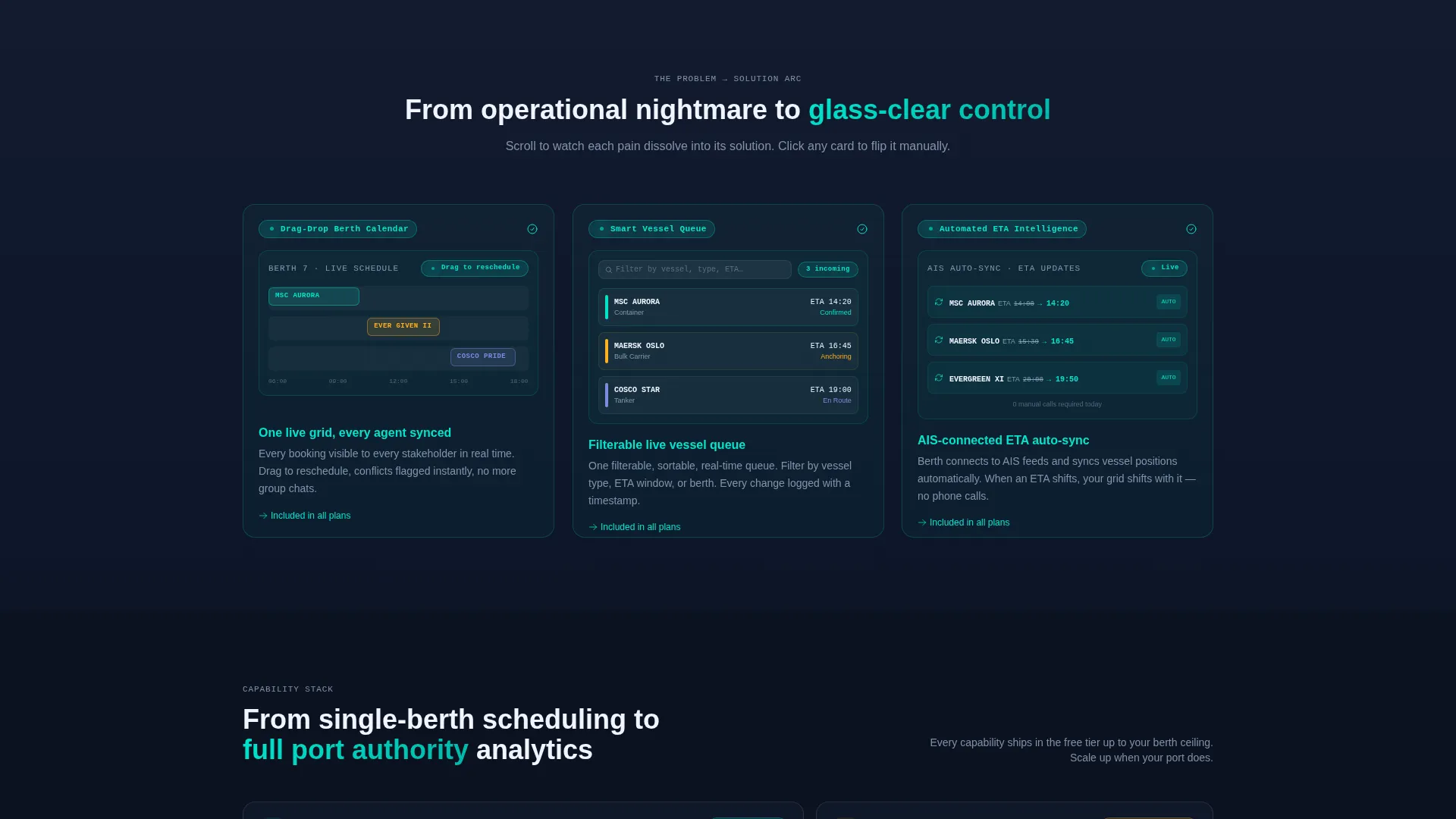
- A Problem-to-Solution card arc with three flipping pain-point cards that each dissolve into an interactive solution micro-demo
- A sticky bottom conversion bar, an inline 90-second video demo modal, and a three-field sequential signup form that provisions a sandbox terminal on submission
Feature list
This template includes a focused set of purpose-built components. Each one serves the page's core goal: earning the trust of operational buyers before asking them to sign up.
Animated Metrics Dashboard Header
The header is a full-width glassmorphic panel that animates seven real operational metrics on load. Counters tick upward, status dots pulse, and a miniature global port map shows faint dot-pulse animations at over 40 terminals. The headline types in over the live data display.
Problem-to-Solution Card Arc
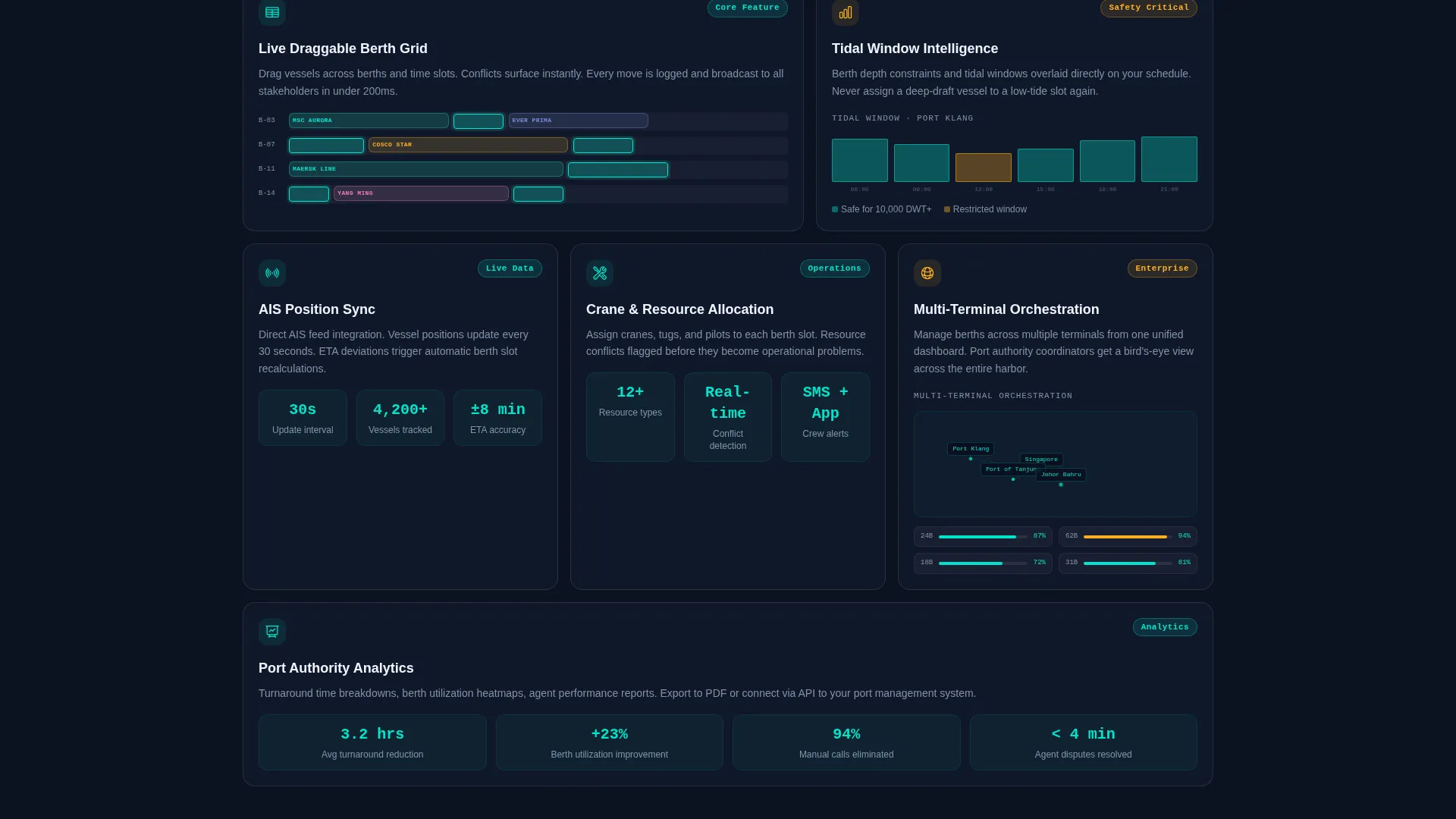
Three pain-point cards animate in with a subtle shake effect on scroll entry. Each card depicts a real operational problem, then flips or dissolves into a corresponding solution card. The arc moves from single-berth scheduling through multi-terminal coordination to full port-authority analytics.
Interactive Micro-Demo Cards
Each solution card in the arc functions as a lightweight interactive preview. Visitors can engage with a drag-and-drop berth calendar view, a filterable vessel queue, and an automated estimated time of arrival sync feed directly on the page.
Inline Video Demo Modal
A secondary conversion path labeled "See It Handle Your Volume" triggers a 90-second video demo. The video plays inside a glassmorphic modal overlay and ends with the same three-field signup form so the conversion path stays consistent.
Sequential Three-Field Signup Form
The signup form collects port or terminal name, number of berths managed via a dropdown, and a work email address. Submitting the form provisions a pre-loaded sandbox terminal with simulated vessel traffic so users enter a working product immediately.
Sticky Conversion Bar
After the visitor scrolls past the third content section, a sticky bottom bar appears with the primary call to action. It stays visible throughout the rest of the page scroll, reinforcing the free-trial offer without interrupting reading flow.
Page sections overview
| Section | Purpose |
|---|---|
| Header Dashboard | Display live animated metrics and primary call to action |
| Pain Point Cards | Surface three real operational problems with motion cues |
| Solution Flip Cards | Resolve each pain point with an interactive demo card |
| Multi-Terminal Row | Escalate the narrative to fleet-scale orchestration |
| Port Analytics Row | Introduce full port-authority reporting capabilities |
| Video Demo Modal | Deliver a 90-second inline product walkthrough |
| Signup Form Block | Capture leads with a three-field sequential form |
| Sticky Conversion Bar | Persist the free-trial call to action on scroll |
Design & branding system
The visual identity uses a Dynamic Motion theme built on a Glassmorphic color system. Every card reads as a separate instrument panel floating on layered translucent surfaces, evoking a rain-streaked control room window at night.
- Color palette: deep harbor ink (#0B1120) as the base, frosted glass panel white at 60% opacity (#FFFFFF99) for card surfaces, tidal cyan (#00E5CC) for live-state indicators and interactive highlights, and signal amber (#FFB020) for alerts and urgent-state badges
- Background gradient runs from near-black at the header down to deep slate (#131B2E) in lower sections, with glass cards carrying a 1-pixel frost-line border and subtle backdrop blur on each panel
Mobile & speed optimization
The card-grid layout is modular by design, which makes it adaptable to narrower viewports without restructuring the core narrative flow. Motion elements are designed to be controlled and purposeful rather than decorative.
- Glass cards restack vertically on smaller screens, keeping each instrument-panel card readable as a standalone unit
- Counter animations and pulse effects are triggered on scroll entry, so motion only runs when the relevant section is in view
How this template helps you convert
This template is built around a freemium and free-trial conversion model. Every design and copy decision is made to reduce hesitation and build confidence before the form appears.
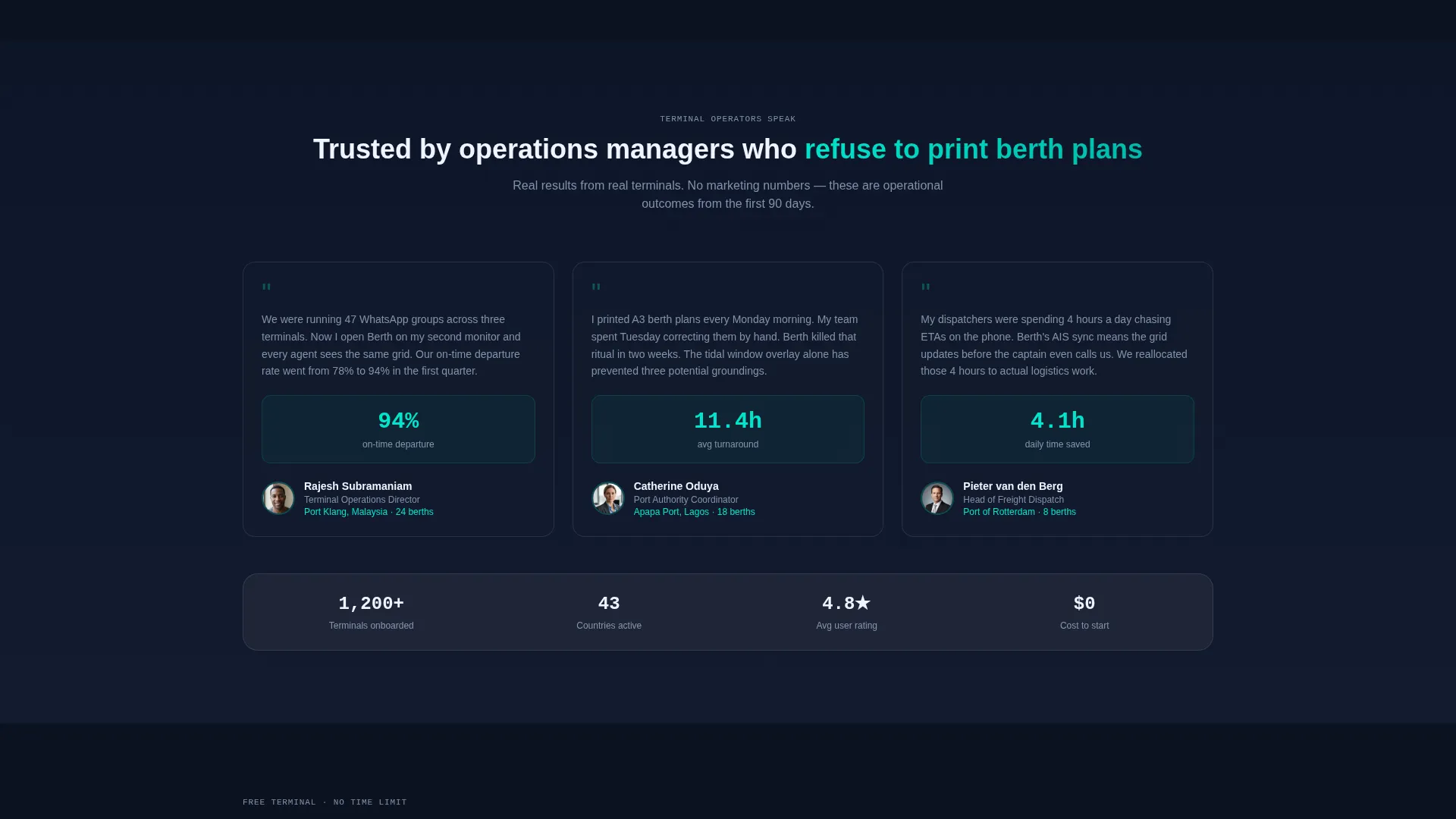
- The header dashboard leads with real operational metrics, establishing credibility before any marketing claim is made, so buyers arrive at the call to action already trusting the product
- The Problem-to-Solution arc makes the value exchange explicit: visitors see their exact daily pain points reflected on screen, then watch them resolve in real time, which shortens the mental distance between "interesting" and "I need this"
- The no-time-limit free tier, communicated clearly on the page, removes the urgency objection entirely and replaces it with a berth-count growth model that makes upgrading feel natural rather than forced
Other information about this template
This template is part of a focused set of vertical SaaS landing page templates designed for operational and logistics software categories. It is well-suited for teams positioning a port and terminal booking system against legacy workflows.
- The template style is a Card Grid with modular sections, making individual rows easy to reorder or remove without breaking the visual hierarchy
- The freemium and free-trial conversion direction is baked into the page structure from the header call to action through to the sticky bar, so no extra conversion layer needs to be added
- Motion behavior follows a Dynamic Motion theme where animations reinforce meaning: shaking pain cards, flipping solution cards, and ticking counters all carry narrative weight, not just visual interest
- The template works as a standalone launch asset for a new port management product or as a redesign foundation for an existing tool moving upmarket
Theme
Dynamic Motion
Creative direction
Problem→Solution Arc
Color system
Glassmorphic
Style
Card Grid (Modular)
Direction
Freemium/Trial
Page Sections
Animated Metrics Dashboard Header
Problem-to-solution Card Arc
Interactive Micro-demo Cards
Inline Video Demo Modal
Sequential Three-field Signup Form
Sticky Bottom Conversion Bar
Related questions
Who is this landing page template designed for?
Can I customize the metrics shown in the header dashboard?
Does the free-trial signup form connect to a backend system?
What makes this template different from a generic SaaS landing page?
Is the inline video demo included in the template?