Secure Crypto Landing Page Template
Ledger is a Bold Brutalist landing page template built for a blockchain-based content management system. It opens with a live vulnerability calculator, moves through a documented problem-to-solution arc, and closes with a node deployment call to action. Built for investigative newsrooms, human rights organizations, and Web3 publishers who need proof that content cannot be silently changed.
by Rocket studio
Quick summary
Ledger is a single-page, comparison-table landing page template for a blockchain-based content management system. The page opens with a brutalist estimator that calculates editorial vulnerability, then walks visitors through a documented problem arc before presenting Ledger's architectural answers in side-by-side comparison tables. Every visual and structural decision reinforces one idea: immutable truth.
Who this template is for
This template is built for high-stakes publishers and mission-critical technology teams who cannot afford silent content tampering. It speaks directly to audiences where editorial integrity is a matter of safety, not just preference.
- Investigative newsrooms operating under hostile or authoritarian regimes
- Human rights organizations and NGOs capturing time-sensitive evidence
- Web3-native publishers and decentralized media teams who reject centralized database control
What problem this template solves
Traditional content management systems give hosting providers, platform owners, and internal bad actors the ability to alter, delete, or backdate published content without any visible trace. For investigative journalism and human rights documentation, that vulnerability is not a theoretical risk. It is a documented pattern.
- No native audit trail means silent edits leave no verifiable evidence
- Centralized infrastructure creates single points of censorship and control
- Rollback and version history on traditional platforms can itself be manipulated
What you get with this template
You get a complete, ready-to-customize landing page built around a single persuasive arc: from calculable vulnerability to a deployable solution. Every section is designed to move a skeptical, technically literate audience from awareness to action.
- A live header calculator that animates vulnerability numbers in real time
- A documented problem timeline followed by direct architectural comparison tables
- A sticky minimized estimator bar and a multi-platform node deployment call to action
Feature list
This template includes a focused set of purpose-built components, each serving the core message of provable content integrity.
Live Vulnerability Estimator Header
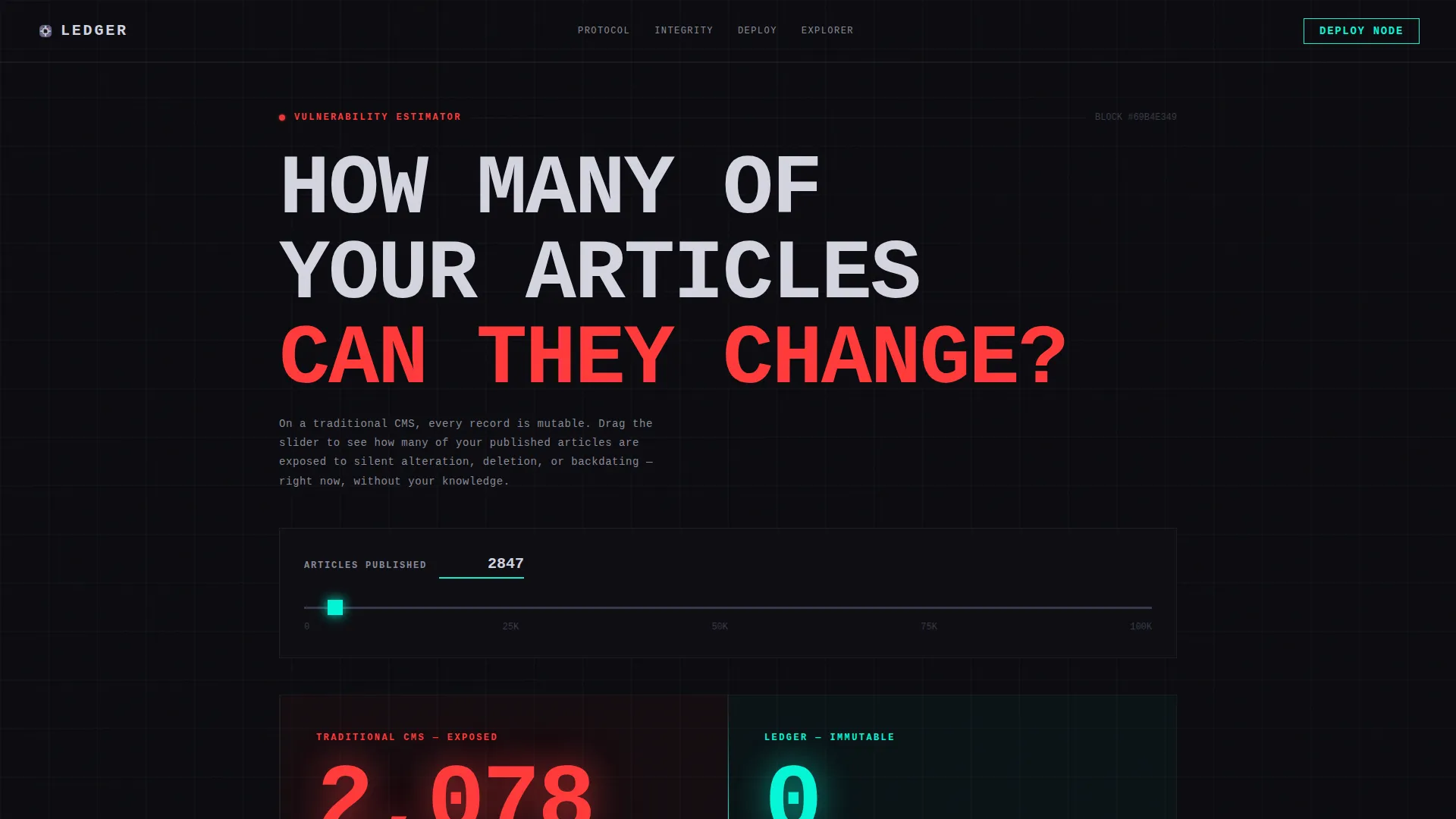
The header presents a brutalist input form with a slider and numeric field. Visitors enter their newsroom's article count, and the page instantly calculates how many articles could have been silently altered on a traditional system versus zero on Ledger. The resulting numbers animate in oversized monospaced type, red on the vulnerability side and iridescent cyan on the Ledger side.
Sticky Minimized Estimator Bar
After the visitor scrolls past the header, their calculated vulnerability number follows them as a compact sticky bar. The red figure stays visible in the corner, creating a persistent, personal cost-of-inaction prompt that remains active until the visitor converts.
Documented Problem Timeline
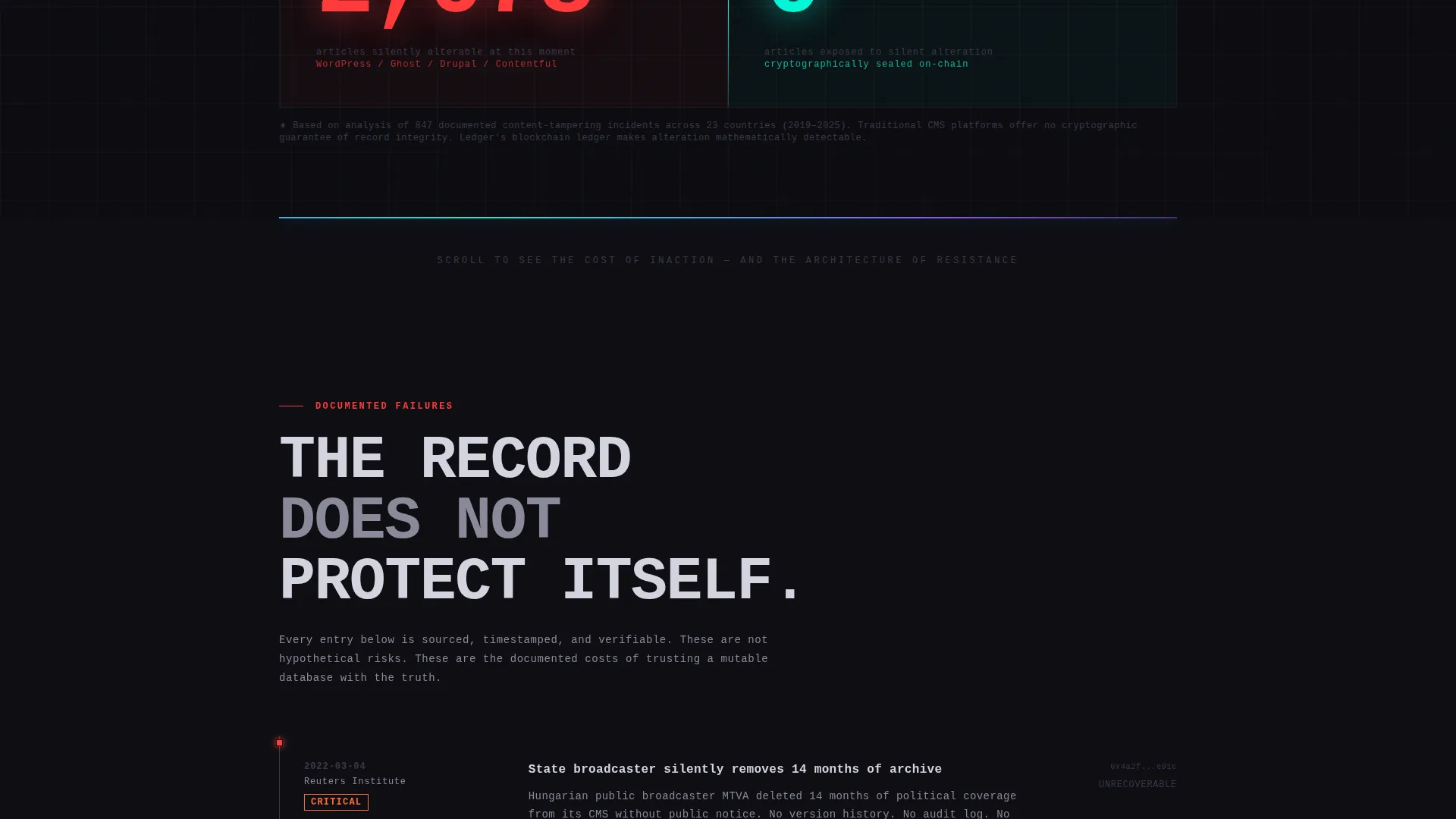
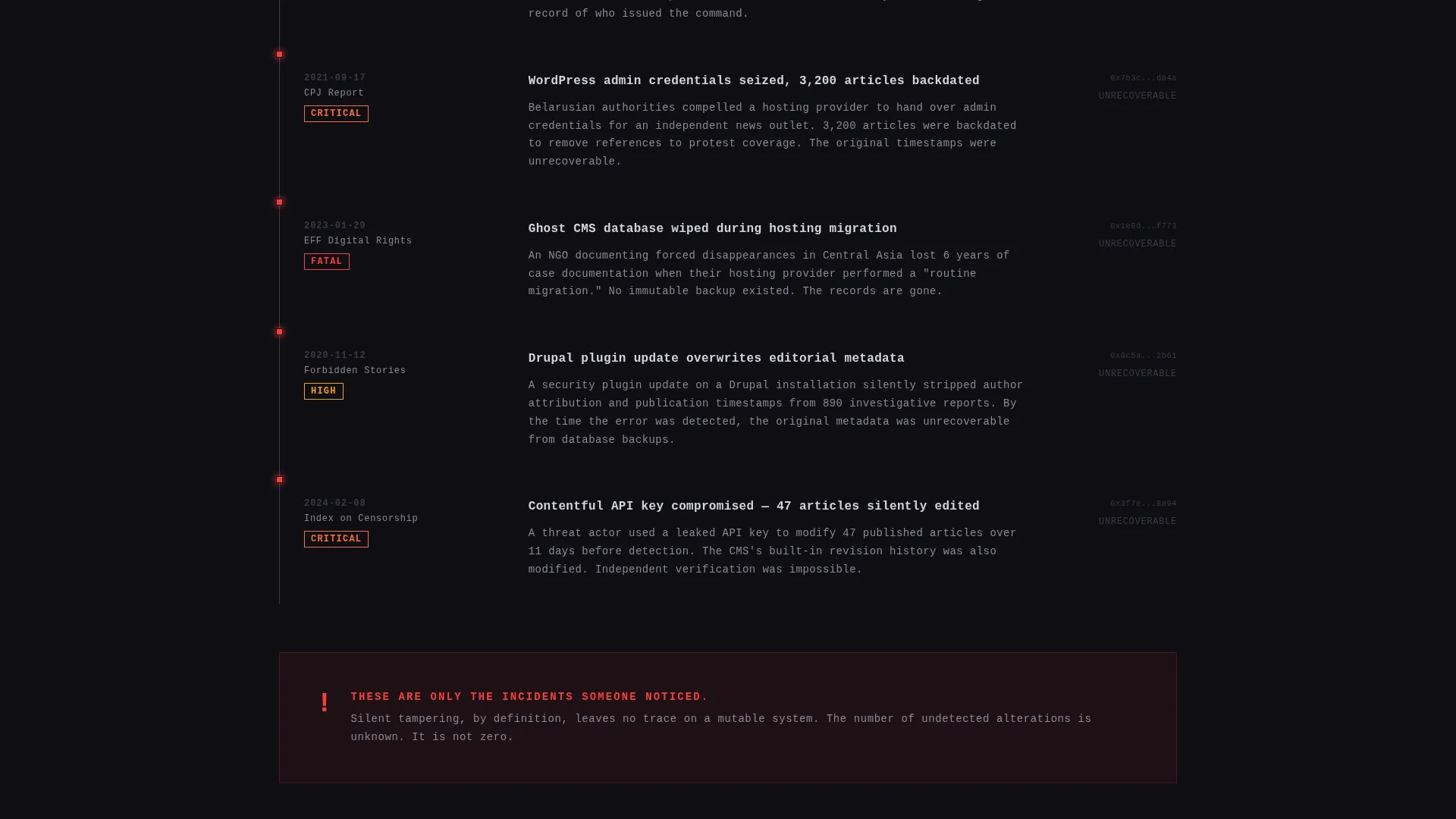
Section one presents a chronological timeline of real, sourced incidents of content management system tampering, censorship, and silent deletion. Each entry carries a timestamp, making the problem concrete and verifiable rather than abstract.
Brutalist Comparison Tables
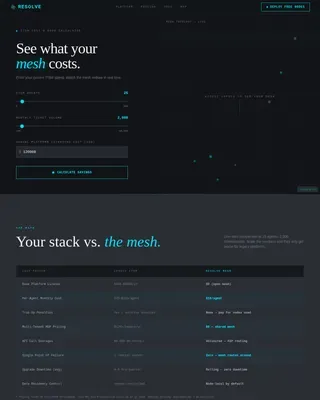
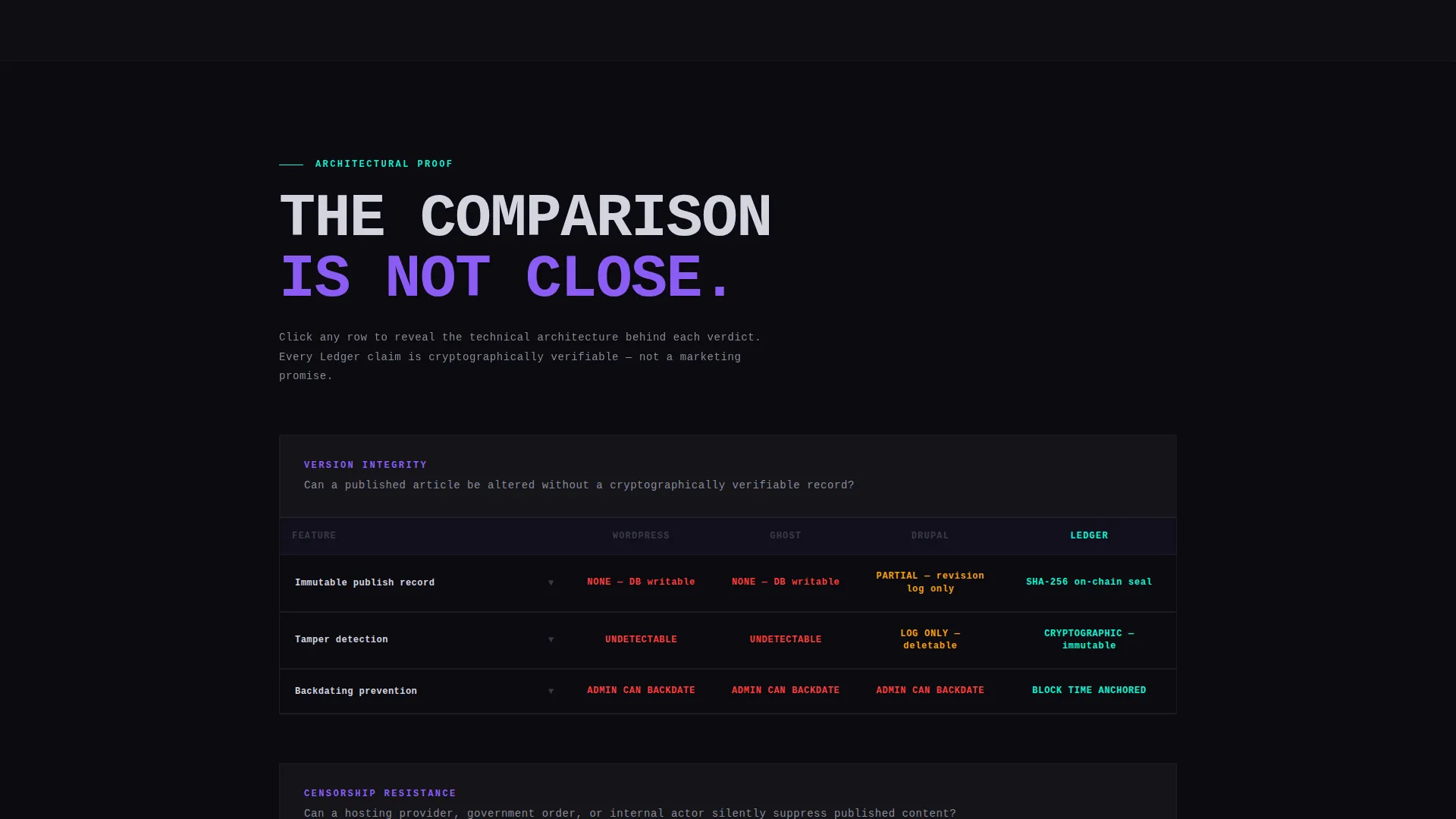
Multiple comparison tables pit traditional content management platforms against Ledger across five dimensions: version integrity, censorship resistance, audit transparency, contributor authentication, and deployment sovereignty. Each table row uses toggle cells that flash violet on hover to reveal deeper technical detail.
Multi-Platform Node Deployment call to action
The primary call to action is "Deploy Your Ledger Node" with platform toggle buttons covering Linux, Docker, and managed cloud environments. A secondary call to action links to a public block explorer so visitors can audit a live block before committing to a download.
Problem-to-Solution Scroll Arc
The page is structured as a deliberate narrative arc. The upper half builds dread through documented failures. A single horizontal rule in iridescent cyan marks the pivot. Every section below then mirrors a problem with Ledger's specific architectural answer, transforming the reading experience from exposure to agency.
Page sections overview
| Section | Purpose |
|---|---|
| Header Estimator | Calculate editorial vulnerability in real time |
| Problem Timeline | Document real CMS tampering incidents with sources |
| Cyan Divider Rule | Mark the pivot from problem to solution |
| Version Integrity Table | Compare version control across platforms |
| Censorship Resistance Table | Show decentralization advantage over hosted CMS |
| Audit Transparency Table | Contrast on-chain audit trails with traditional logs |
| Contributor Auth Table | Compare identity verification and signing models |
| Deployment Sovereignty Table | Contrast self-hosted node versus. centralized hosting |
| Node Deployment call to action | Drive Linux, Docker, or cloud node download |
| Block Explorer call to action | Offer live on-chain verification before download |
| Sticky Estimator Bar | Persist vulnerability number across full scroll |
Design & branding system
The visual identity follows a Bold Brutalist aesthetic built on an AI Iridescent color system. The palette is industrial and dark by default, then prismatic and electric wherever interaction or data emphasis occurs.
- Core palette: void black (#0B0B0F) for backgrounds, liquid chrome (#D4D4E0) for body text, shifting violet (#8B5CF6) for borders and hover states, and iridescent cyan (#06F5D6) reserved for interactive states and data highlights
- Typography is monospaced and oversized, set edge-to-edge with no padding buffer, reinforcing the cold, archival aesthetic of a sealed record system
- Hover states on comparison table cells flash violet, and animated number tallies use iridescent cyan to visually separate Ledger's zero-vulnerability claim from the red vulnerability count on traditional systems
Mobile & speed optimization
The template is built with a responsive layout so the brutalist grid and comparison tables reflow cleanly on smaller screens. The heavy typographic choices and dark backgrounds are handled in a way that preserves legibility across device sizes.
- Oversized monospaced type scales down without losing the edge-to-edge brutalist character
- Comparison tables adapt to horizontal scroll or stacked layouts on mobile viewports
- The sticky estimator bar remains functional and visible on mobile screens throughout the scroll
How this template helps you convert
The page is engineered to make the cost of inaction feel personal and measurable before asking for any commitment. Conversion pressure builds from the first interaction and stays consistent to the final call to action.
- The header estimator makes vulnerability calculable immediately, turning an abstract risk into the visitor's own specific number before they read a single line of copy.
- The problem-to-solution arc uses documented evidence to build credibility, so by the time the visitor reaches the comparison tables and the deployment call to action, the case for Ledger is already proven rather than just stated.
Other information about this template
This template is categorized under Blockchain-Based Enterprise Software and sits within the broader Technology category. It is purpose-built for the blockchain-based content management system niche, where trust, auditability, and decentralization are primary purchase drivers rather than design aesthetics.
- The template style is a Comparison Table layout, making it suited for audiences who evaluate tools by specification rather than by marketing language
- The creative direction follows a Problem-to-Solution Arc, a proven structure for technically literate buyers who need to see evidence before they act
- The header concept is a Calculator or Estimator, which is particularly effective in enterprise and mission-critical software contexts because it converts risk into a measurable, personal figure
- The primary landing page direction is App Download, with the node deployment call to action serving as the conversion endpoint
- The Bold Brutalist theme and AI Iridescent color system position this template as visually distinct from conventional software marketing pages, which reinforces the product's core claim of being different by design
Theme
Bold Brutalist
Creative direction
Problem→Solution Arc
Color system
AI Iridescent
Style
Comparison Table
Direction
App Download
Page Sections
Live Vulnerability Estimator
Documented Problem Timeline
Brutalist Comparison Tables
Sticky Personal Risk Bar
Multi-platform Deployment Call to Action
Problem-to-solution Scroll Arc
Related questions
Who is this landing page template designed for?
What does the header estimator do?
What dimensions do the comparison tables cover?
What platforms does the deployment call to action support?
Does the sticky estimator bar stay active throughout the scroll?