Freight & Cargo Specialist Professional Website Template
Chassis is a modular card-grid landing page built for drayage carriers targeting freight forwarders, import managers, and logistics coordinators at major US port gateways. The Engineering Blueprint design uses an industrial dark-mode palette, an animated port map header, and a bento-style capability spec grid to communicate operational reach and reliability before a single scroll.
by Rocket studio
Quick summary
Chassis is a lead-generation landing page for drayage service providers. It opens with a dark-mode animated port map, moves into a modular capability spec grid, and closes with a three-step progressive quote form. Every section is built to convert freight forwarders and logistics coordinators who need proof of reliability, not persuasion.
Who this template is for
This template is designed for B2B drayage carriers who need to turn qualified logistics buyers into inbound quote requests. It speaks directly to operations-focused decision makers who evaluate carriers on data, not design.
- Freight forwarders and import managers managing vessel arrivals at ports like LA/Long Beach, Savannah, and New York/New Jersey
- Third-party logistics (3PL) coordinators handling chassis shortages and intermodal handoffs at rail yards
- Drayage service providers who want a professional, high-credibility web presence without building from scratch
What problem this template solves
Freight coordinators distrust carrier websites that use vague language and stock imagery. They have been burned by carriers who claimed coverage they could not deliver. This template replaces soft promises with a spec-sheet format that leads with metrics and proof points.
- Missed appointment windows, demurrage charges, and chassis shortages are buyer pain points the layout addresses directly through visible compliance stats and per-diem mitigation data
- The progressive quote form and zip-code coverage checker reduce friction for cautious buyers who want to verify service reach before committing
- The industrial visual design signals operational seriousness to an audience that lives in dispatch dashboards, not marketing brochures
What you get with this template
You get a fully structured drayage landing page with five purpose-built sections, two conversion paths, and a high-density capability grid. Everything is scoped for desktop-first use with a solid mobile fallback.
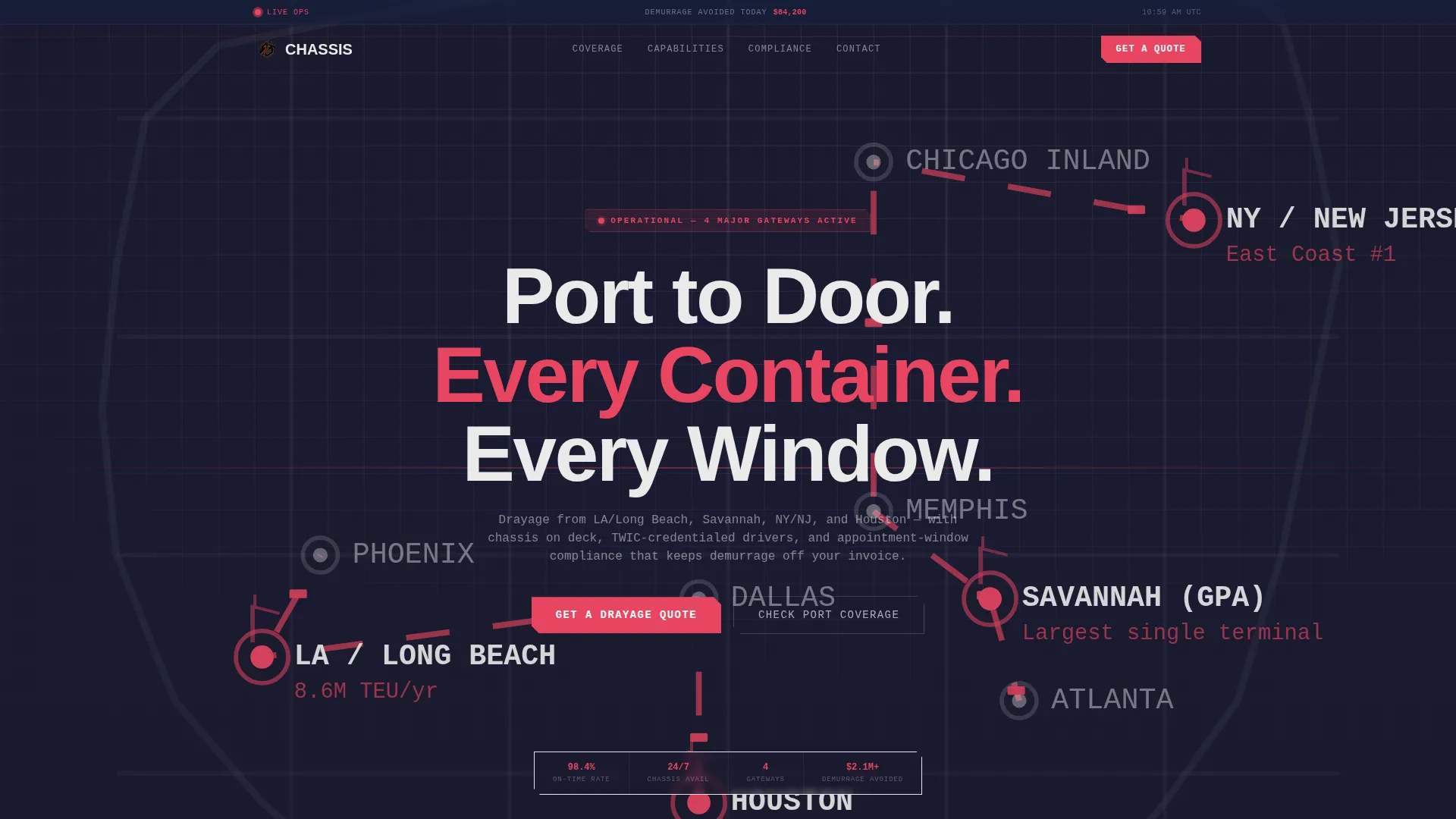
- A dark-mode animated hero with port map, pulsing route lines, and container count tickers
- A bento-style modular card grid covering chassis availability, port coverage zones, container size handling, certifications, and compliance rates
- A three-step progressive quote form plus a secondary "Check Port Coverage" zip-code path
Feature list
This template packs a specific set of interactive and visual capabilities drawn directly from its brief. Each one serves the goal of converting logistics buyers through demonstrated competence.
Animated Port Map Hero
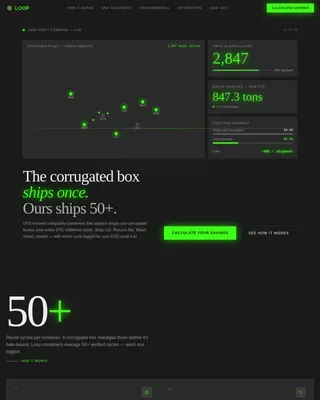
The header renders a dark-mode cartographic view of a major port complex. Crane icons mark berths, terminal gates are plotted, and animated SVG route lines pulse orange from port to inland destinations. Container count tickers run along the top edge. The headline "Port to Door. Every Container. Every Window." fades in over the map.
Modular Capability Spec Grid
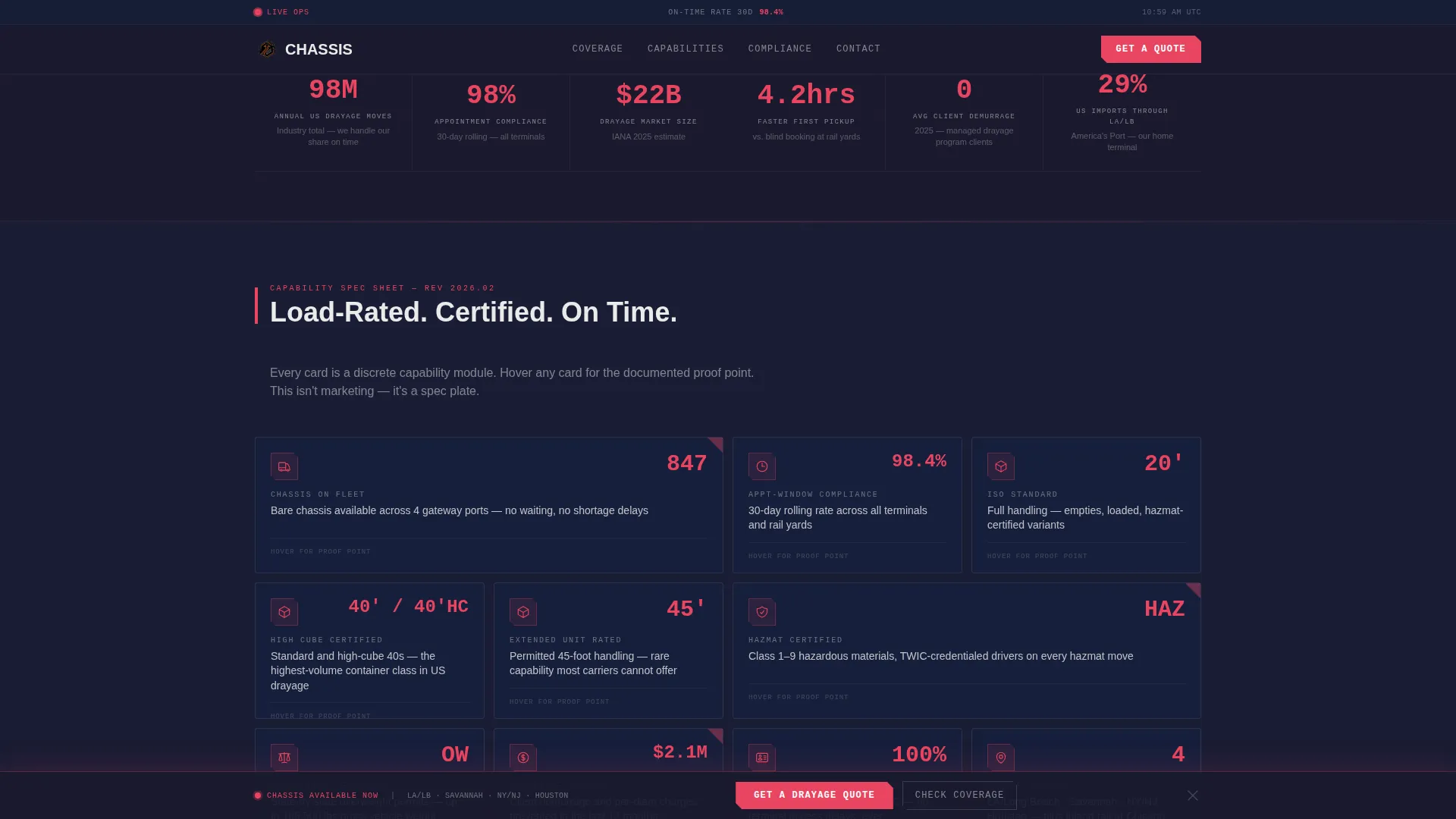
The core section uses a bento-style card grid where each card is a discrete capability module. Cards display an icon, a metric, a short descriptor, and a hover-flip state that reveals a one-sentence proof point. Rows escalate logically from container types handled to compliance rates and certifications.
Three-Step Progressive Quote Form
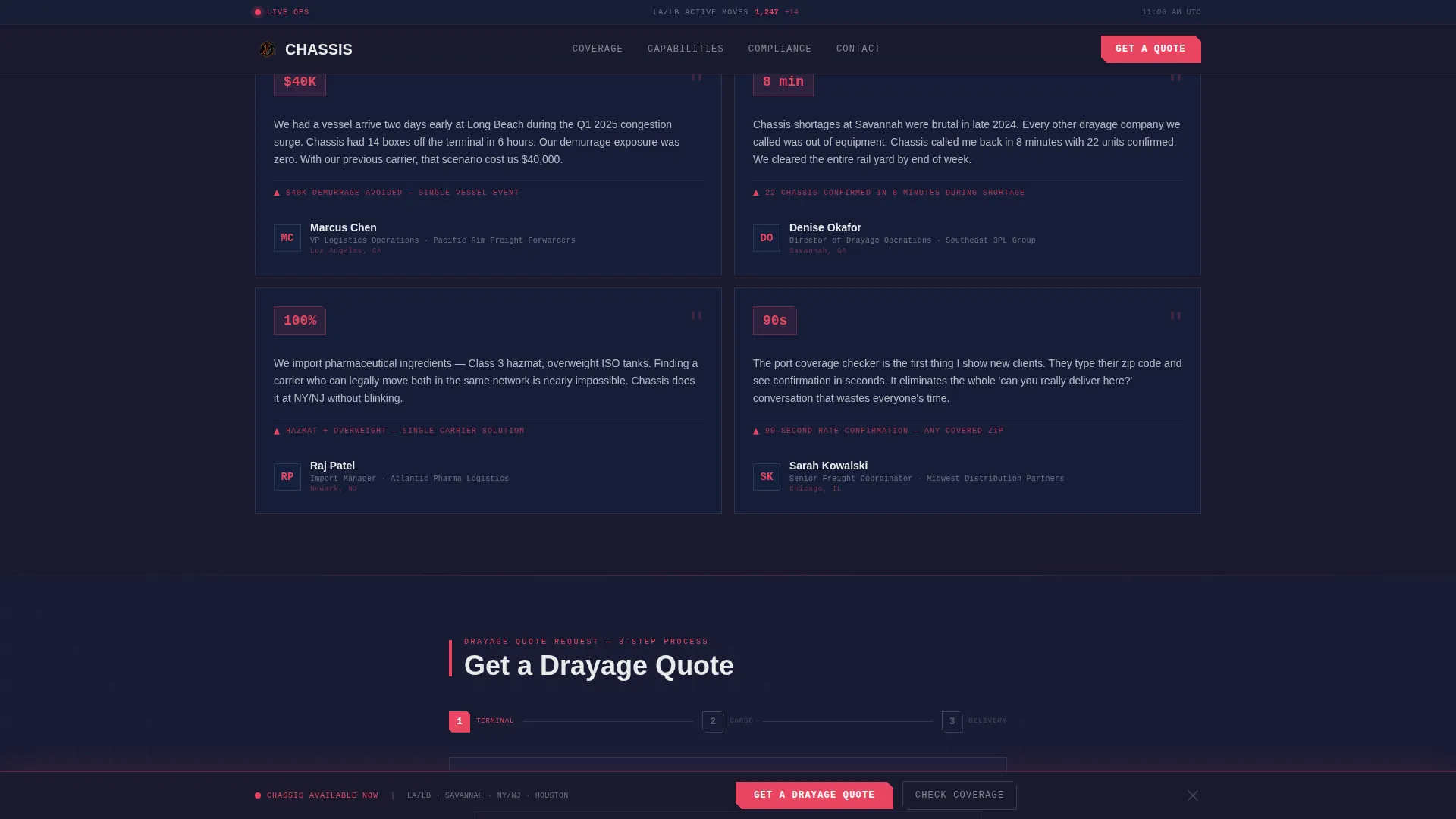
The lead capture form uses progressive disclosure across three steps: port or rail terminal selection via dropdown, container size and weekly volume, then delivery zip code and contact details. This staged approach reduces abandonment by asking only what is needed at each step.
Zip Code Coverage Checker
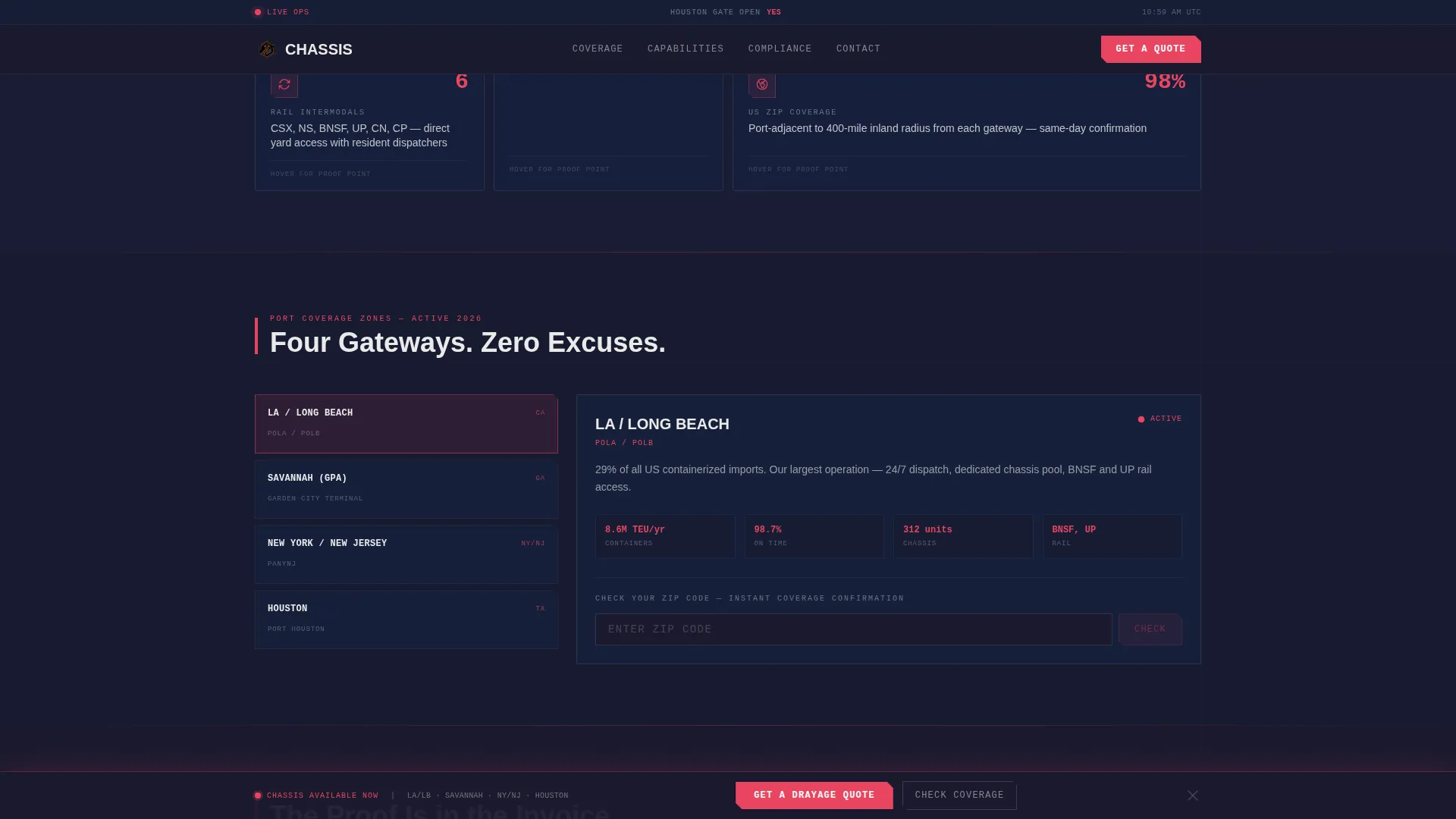
A secondary conversion path lets visitors enter a zip code to instantly verify service area coverage. This lowers friction for freight coordinators who need confirmation before filling out the full quote form.
Sticky Quote Bar
A sticky bottom bar with a "Get a Drayage Quote" call to action activates after the visitor scrolls past the second card row. It stays visible throughout the rest of the page without disrupting reading flow.
Social Proof with Specific Metrics
A dedicated proof section displays client testimonials from freight forwarders with specific demurrage savings figures and compliance rate data. Metrics like 98.4% appointment-window compliance and per-diem mitigation stats appear as live-data-feel display elements.
Page sections overview
| Section | Purpose |
|---|---|
| Animated Hero Map | Communicate port coverage and operational reach immediately |
| Capability Spec Grid | Show container handling, chassis availability, and certifications |
| Port Coverage Metrics | Display TEU volume, on-time rate, and gateway stats |
| Social Proof Block | Reinforce reliability with demurrage savings and testimonials |
| Progressive Quote Form | Capture leads through a low-friction three-step disclosure |
| Linear Footer | Provide contact and navigation in a single-row format |
Design & branding system
The visual identity follows an Engineering Blueprint theme. The palette references a chassis spec plate on cold-rolled steel: functional, load-rated, and free of decoration. Typography is set in DM Sans for body and interface labels, and JetBrains Mono for all metrics, ticker values, and data points.
- Deep structural black (#1A1A2E) and technical graphite (#16213E) alternate as background layers; high-vis orange (#E94560) marks every interactive element and live data point; schematic white (#EAEAEA) draws grid lines and type
- Card borders mimic weld seams on a flatbed frame, with uniform card structure across the spec grid for a parts-catalog feel
- Zero ornamentation: no gradients, no decorative illustration, no softening visual elements
Mobile & speed optimization
The template is built desktop-first to match how freight coordinators actually work, on large dispatch-dashboard screens. The mobile layout is a solid fallback that preserves the card grid structure and form usability at smaller sizes.
- Animated components such as the SVG route lines, container ticker, and card hover states are handled as Client Components to isolate interactivity from static content
- Static sections use Server Components to keep non-interactive areas lean
- The sticky quote bar and three-step form are fully functional on mobile, maintaining the progressive disclosure flow at any screen size
How this template helps you convert
The page is structured to move a skeptical logistics buyer from "just browsing" to "requesting a quote" through a sequence of trust signals that build on each other.
- The animated port map in the hero establishes operational reach before the visitor reads a word, reducing immediate bounce from buyers who question whether you actually serve their gateway
- The spec grid communicates competence through density: real metrics, container specs, and certifications displayed as a parts catalog rather than marketing copy, which resonates with buyers who distrust vague claims
- Two conversion paths, a full three-step quote form and a lighter zip-code checker, let cautious buyers engage at their own comfort level, increasing the total number of leads captured
Other information about this template
This template is categorized under Logistics and Supply Chain, specifically the Freight and Cargo subcategory with a focus on the drayage service niche. It is localized for the United States market with US port terminals, US zip codes, and 12-hour time format throughout.
- Animation intensity is set to high: scroll-reveal stagger, card flip on hover, pulsing SVG route lines, and ticker activation are all included in the template structure
- The footer follows a linear single-row pattern, keeping the bottom of the page clean and functional
- Container size handling in the spec grid covers 20-foot, 40-foot, 40-foot high-cube, and 45-foot units, along with hazmat and overweight certifications as discrete capability cards
Theme
Engineering Blueprint
Creative direction
Spec Sheet
Color system
Carbon Fiber
Style
Card Grid (Modular)
Direction
Lead Generation
Page Sections
Animated Dark-mode Port Map Header
Bento-style Capability Spec Grid
Three-step Progressive Quote Form
Zip Code Coverage Checker
Sticky Bottom Quote Bar
Metrics-driven Social Proof Section
Related questions
Who is this landing page template built for?
Can I customize the port locations and service area data in the template?
What makes the quote form different from a standard contact form?
Is this template suitable for carriers that serve rail intermodal yards as well as ocean ports?
What container sizes and certifications does the spec grid cover?