Atelier Studio Memoir Blog Landing Page Template
Chronicle is a cinematic dark, asymmetric landing page template built for memoir writers and literary bloggers. It uses a 60/40 grid, gallery-walk scroll structure, and an emotionally sequenced excerpt layout to draw readers in and convert them into email subscribers. The design feels like stepping into a working studio where every visual and typographic choice serves the story.
by Rocket studio
Quick summary
Chronicle is a single-page memoir blog landing page template designed for writers publishing long-form personal essays. It is built around an asymmetric 60/40 grid, a Cinematic Dark color system, and a Gallery Walk creative direction. The page presents memoir excerpts as gallery installations, guiding readers through an emotionally escalating scroll that ends with a clear email capture call to action.
Who this template is for
Chronicle is a perfect fit for writers, independent literary publishers, and personal essay artists who want their work to land with the same gravity it took to write it. This template gives voice to anyone who has survived a defining chapter and wants to present that story with the visual weight it deserves.
- Memoir writers publishing long-form personal essays directly to readers
- Independent literary bloggers who want to create a studio-quality reading experience
- Writers navigating post-rupture life, including divorce, grief, or career loss, who are building an audience around honest, craft-led prose
What problem this template solves
Most blog templates are built for news feeds and content velocity. They are not built for the slow, deliberate world of literary memoir. A memoir writer trying to build an audience faces real challenges: how do you present a piece of writing so that a stranger feels it within seconds? How do you carry a reader from curiosity to genuine emotional investment before asking for their email address?
Chronicle solves these challenges by treating each excerpt as a standalone visual and narrative installation. The template removes the friction between the visitor and the writing.
- Generic blog layouts flatten every story into the same card-grid format, stripping away the weight that memoir writing earns through craft and revision
- Standard landing page templates prioritize product features or service offers, leaving writers without a structure that can carry literary emotion and convert it into subscriber growth
- Writers lose potential readers who land on a plain page, find nothing to feel, and leave before they ever begin reading
What you get with this template
Chronicle delivers a complete, ready-to-customize landing page built from clearly defined sections. Each section has a specific role in guiding the visitor through an emotionally sequenced reading experience. The template is built for desktop-first presentation with a mobile-responsive layout, so the story reads well on any screen.
- A full asymmetric 60/40 grid layout with six distinct page sections, including a hero manifesto, three gallery excerpt installations, a floating email bar, a full-width email call to action, and a footer
- A Cinematic Dark visual system using deep charcoal, warm parchment, muted rose, and tarnished gold, applied with typographic precision across Fraunces display type and DM Sans body text
- Scroll-triggered animations including staggered text reveals, gallery zigzag transitions, and a floating email bar entrance, all built as client-side components
Feature list
This section walks through the core built-in capabilities that make Chronicle work as both a visual presentation and a lead generation tool.
Asymmetric 60/40 Gallery Grid
The layout divides every excerpt section into a 60-column prose side and a 40-column photography side. The two sides alternate left and right as the visitor scrolls, creating a zigzag rhythm that mirrors moving through gallery rooms. This visual rhythm gives each story installment its own breathing room and keeps the reading experience feeling curated rather than crowded. The grid is one of the most compelling aspects of the template's design, giving each piece of writing the space to present itself with authority.
Cinematic Dark Color System
Chronicle uses a four-tone palette applied with strict hierarchy. Deep charcoal (#1A1A1D) covers every background surface. Warm parchment (#E8DCC8) carries all body text, making prose readable against the dark floor without harshness. Muted rose (#9B6B6B) appears only in memoir category tags and thin divider lines. Tarnished gold (#B8973A) is reserved exclusively for pull quotes and hover states, arriving selectively the way light arrives in a Caravaggio painting. This restraint makes every gold element feel like a reward.
Gallery Walk Excerpt Installations
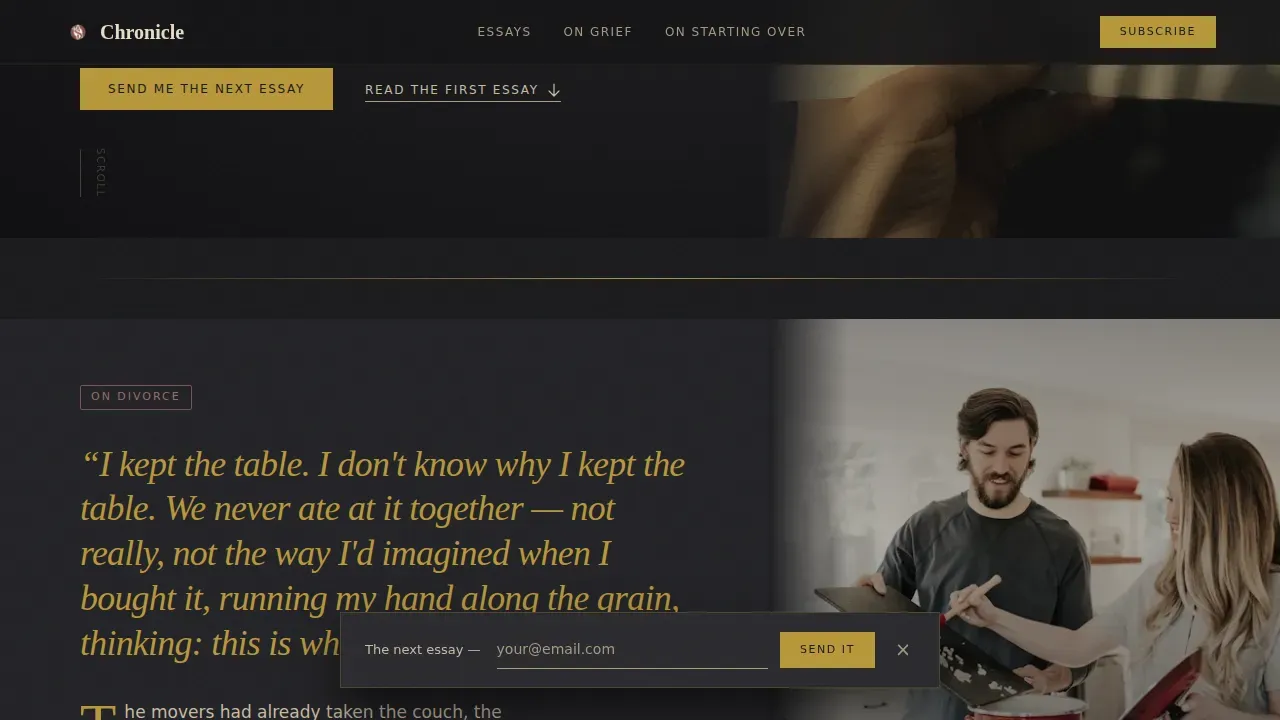
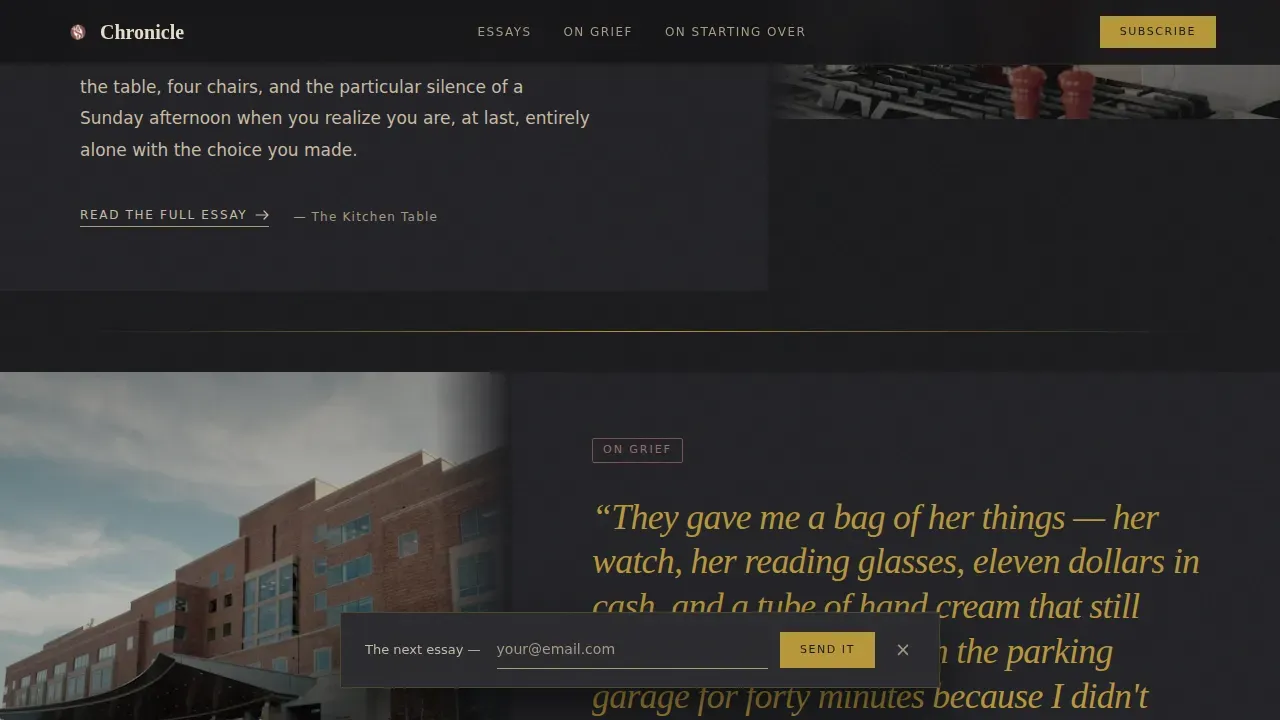
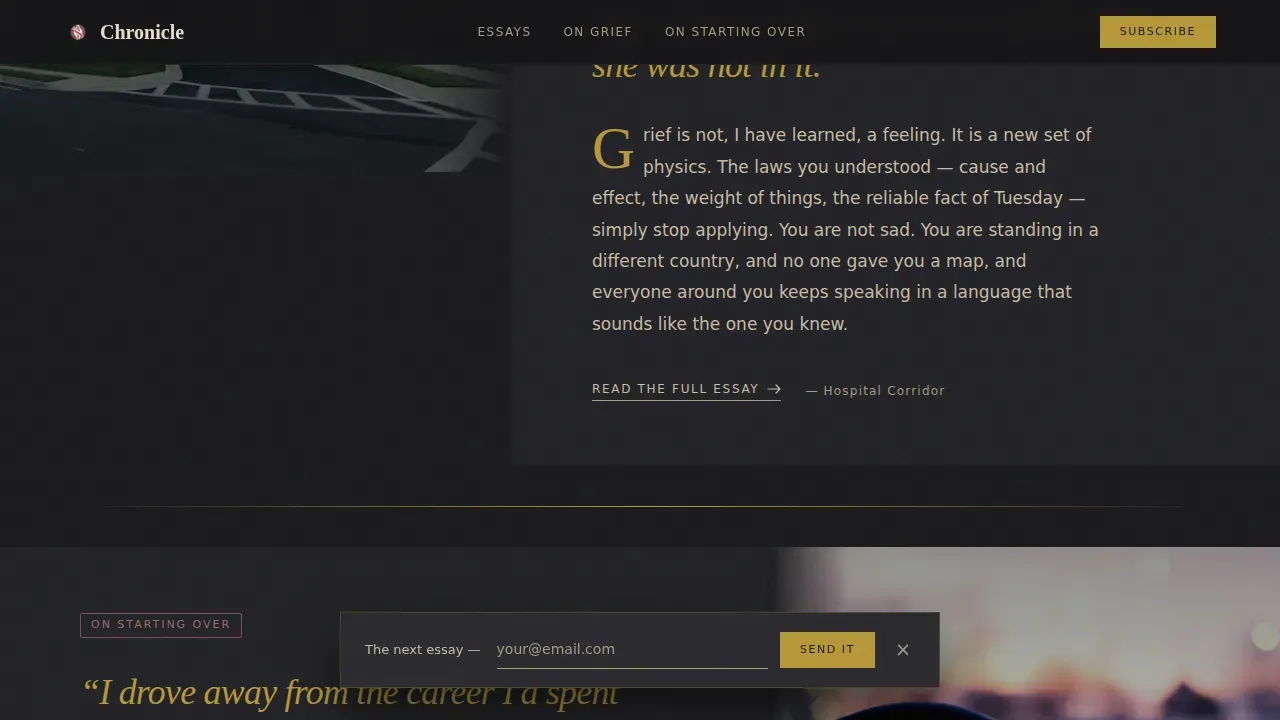
Each of the three built-in excerpt sections functions as a standalone installation. The 60-column side carries a large italic pull quote in Fraunces serif display type. The 40-column side holds a contextual photography image: a kitchen table, a hospital corridor, a rearview mirror. Between each installation, thin gold horizontal rules act as visual pauses. The emotional arc escalates deliberately: the first excerpt is observational and wry, the second hits grief and fracture, and the third arrives at hard-won clarity.
Scroll-Triggered Animation System
Chronicle is built with high-animation intent. Staggered text reveals bring the manifesto hero quote onto the screen with weight and timing. Scroll-triggered transitions carry the visitor from one gallery installation to the next with a sense of controlled momentum. The floating email bar makes its entrance after the third excerpt, animated rather than static, so it feels like an invitation rather than an interruption. All animation components are built as client-side components to keep static sections stable.
Lead Generation Email Capture
The primary conversion mechanism is a single-field email signup with the call to action "Send Me the Next Essay." This appears first as a floating bar after the second memoir excerpt, then again as a full-width section before the final piece. A secondary conversion, "Read the Full Memoir," appears on each excerpt card and gates the full text behind the same email capture. The page earns the click by giving away the most powerful sentences for free. By the time the form appears, the visitor has already felt something.
Manifesto Hero Header
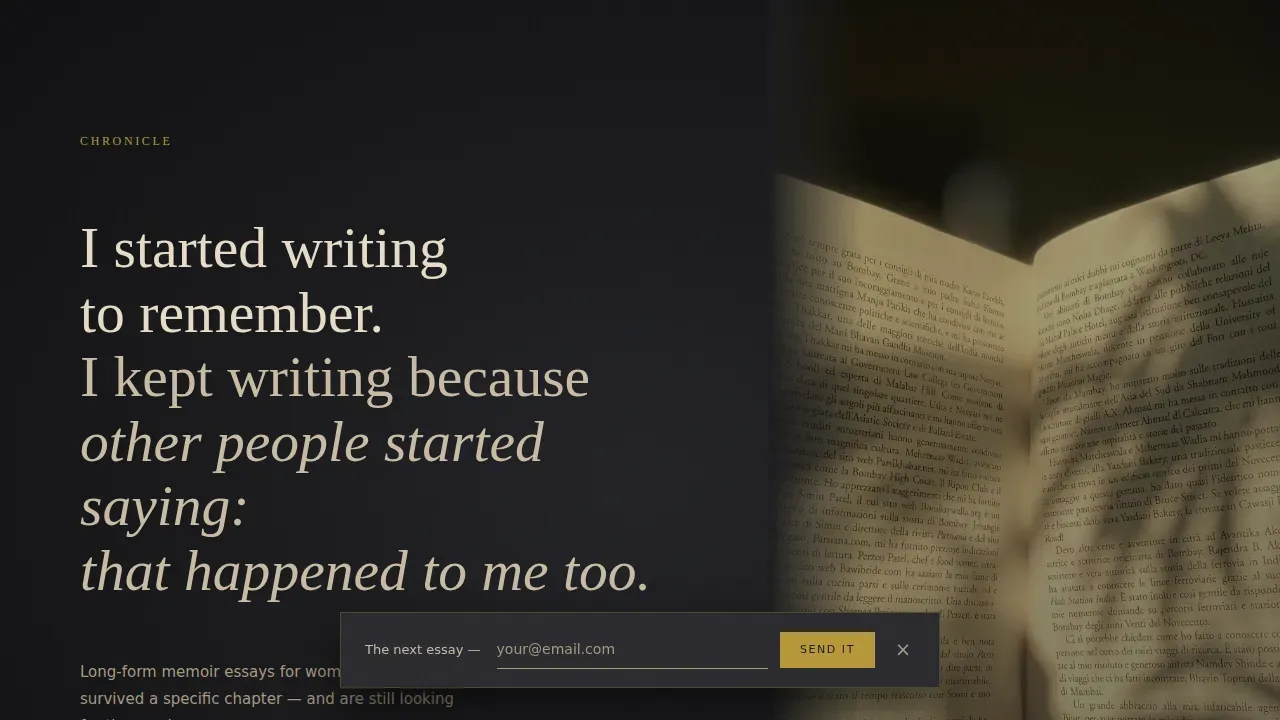
The hero section opens with an oversized serif manifesto quote set left-aligned against an unbroken charcoal field. The quote occupies the 60-column side. The 40-column side holds a single vertical photograph: a hand holding an open notebook, shot from above, shallow depth of field, warm tungsten light catching the pen's shadow across the page. Navigation is hidden until the visitor begins to scroll, keeping the first impression entirely focused on the writing and the image.
Page sections overview
| Section | Purpose |
|---|---|
| Hero Manifesto Header | Opens with an oversized serif quote and vertical notebook photograph to establish emotional tone immediately |
| Excerpt I: Kitchen Table | First gallery installation presenting an observational, wry memoir excerpt with contextual photography on the right side |
| Excerpt II: Hospital Corridor | Second gallery installation presenting a grief and fracture excerpt with photography alternated to the left side |
| Floating Email Bar | Appears after the second excerpt as an animated single-field signup inviting visitors to receive the next essay |
| Excerpt III: Rearview Mirror | Third gallery installation presenting a clarity-focused excerpt, completing the emotional arc of the scroll |
| Full-Width Email Call to Action | Full-width email signup section placed before the final piece, reinforcing the primary conversion goal |
| Footer Pattern | Horizontal footer providing closing context and navigation, built to the Vercel Horizontal pattern |
Design & branding system
Chronicle's visual identity is built around an Atelier Studio aesthetic that draws on the same principles a printmaker uses when pulling successive proofs: every layer serves the final image, and nothing appears without a reason. The palette and typographic choices work together to create a brand presence that feels like a lit studio space rather than a digital product page. Great design can tell a story by reflecting personal narratives through every visual decision, and this template applies that principle to every pixel.
- Typography uses Fraunces for all display and pull-quote elements, a serif face with ink-on-paper warmth, paired with DM Sans for body text and user interface elements, creating a clear visual hierarchy between the literary voice and the functional chrome
- Color is applied with strict hierarchy: charcoal as the dominant background, parchment for body text, rose reserved for memoir category tags and thin divider lines, and gold appearing only for pull quotes and hover states
- Thin gold horizontal rules sit between each gallery installation as visual breaths, and the muted rose dividers carry a restraint that lets the prose and photography remain the focus of every section
Mobile & speed optimization
Chronicle is designed desktop-first, with the 60/40 asymmetric grid built for wide-screen reading. The layout is also mobile-responsive, meaning the column structure adapts gracefully to narrower screens without losing the visual hierarchy that makes the template work. The animation system uses client-side components only, keeping static sections lightweight and rendering efficiently.
- The staggered text reveals and scroll-triggered gallery transitions are scoped to client components, so the static page structure loads without waiting on animation scripts
- The floating email bar and full-width call to action sections are structured to display correctly on mobile screens, preserving the single-field email capture functionality and the call to action copy across all device widths
How this template helps you convert
Chronicle is built around the principle that a reader who has already felt something is far more likely to give you their email address. The conversion strategy is sequenced across the entire scroll, not concentrated at the bottom of the page where attention is already fading.
- The hero manifesto quote opens with a single, powerful sentence that makes the right visitor feel instantly recognized. This is not a welcome message or a feature list. It is a declaration that filters for the exact reader this template is designed to serve, and it sets the emotional context for every excerpt that follows.
- The three gallery installations present the most powerful sentences from each memoir excerpt for free, escalating in emotional intensity from wry observation through grief to clarity. By the time the floating email bar appears after the second excerpt, the visitor is already invested in the story and wants to know what comes next.
- The full-width email call to action section appears before the final piece, creating a moment of genuine anticipation. The visitor is watching the arc complete itself and the form offers them access to the ending. The secondary "Read the Full Memoir" conversion on each excerpt reinforces the same offer at every stage of the scroll.
Other information about this template
Chronicle is a versatile landing page template that carries ideas from the world of gallery installation art, literary publishing, and editorial photography into a single, cohesive digital structure. Whether you are a writer who has recently completed a memoir project, or someone who has long ago begun collecting personal essays and is now ready to build an audience, this template gives you a high level of visual and narrative control from day one.
The template is well-suited to anyone inspired by the tradition of literary memoir as practiced by writers and artists from New York to San Francisco, from York to any city where serious personal writing finds its readers late at night. The design takes inspiration from the editorial photography world, where the camera is used not just to document but to interpret, and where images carry the same emotional weight as words on a page. Photography plays a significant role in documenting personal and cultural narratives, and Chronicle is built to honor that relationship between image and text.
The collection of page sections is thoughtfully structured so that a designer or an independent writer can begin customizing immediately. Each section presents its own context clearly, making it straightforward to introduce your own photography, pull quotes, and memoir category tags without needing to rebuild the visual hierarchy from scratch. Unique website templates like this one help writers create personalized memoir blogs that stand out from standard options, and the ability to tailor every color, font, and image within an established system means you can focus on the writing rather than the layout.
The template's presentation approach draws on the same ideas that make museum exhibitions compelling: each piece is given floor space, context, and breathing room. Visitors are not rushed. They are guided. The scroll itself becomes the narrative, and the visual evidence of craft, from the ink-wet quality of the color palette to the shallow depth-of-field photography, creates a world that feels considered and real. This approach reflects how great designers often draw inspiration from their travels, cultural experiences, and the spaces where art lives, from gallery floors in San Francisco to modern museum rooms in New York.
The template is designed to introduce writers to new readers across every industry where personal storytelling has value. Writers in San Francisco's literary community, artists building audiences in northern California, and essayists publishing from anywhere in the world will find the template's structure a natural fit for their project. Whether your work is inspired by the streets of San Francisco, the quieter landscapes of the American Midwest, or the cultural narratives of a community you carry with you, Chronicle gives you the visual tools to present it with the seriousness it deserves.
The template's design system is also informed by broader ideas about how visual presentation shapes emotional reception. Just as interior design can serve as a medium for storytelling, allowing individuals to express their identities and histories through their spaces, Chronicle treats every page section as a room in a studio. The progression from hero to excerpt to call to action is a narrative journey, where each decision contributes to the overall story being told. Effective storytelling in design involves a balance of narrative and visual elements, and this template applies that balance deliberately.
For writers who are recently returning to their craft after a period away, or who are newest member of a literary community and want to make a strong first impression, Chronicle offers a ready-to-use structure that feels like it was built for this exact moment. It is an exciting template to work with precisely because it does not treat writing as content. It treats writing as art.
Additional information for buyers: Chronicle templates are fully customizable, including color values, typography sizing, section order, and photography placement. The template does not require a specific content management system to function. Writers can use the page structure to present any memoir project, from a single long-form essay to a growing collection of personal writing. Using unique website templates saves time and effort in the design process, allowing writers to focus entirely on the work that matters.
- The template's Cinematic Dark color system and Atelier Studio theme make it a distinctive choice in a market where most blog templates default to light, minimal aesthetics
- Writers who are fan of literary memoir as an art form will find the gallery walk scroll structure a natural and fun way to present their work to new readers
- The template can support a range of memoir subjects: from the deeply personal challenges of grief and divorce to the quieter progress of a career reinvented, and every story sits within the same visual system without feeling generic
- The page is built to function as a dream reading experience for the visitor who arrives at two in the morning searching for someone who has already written the sentence they cannot yet say aloud
- For additional context on customization scope and section structure, buyers are encouraged to review the full template preview and the section-by-section breakdown provided in the marketplace listing
Theme
Atelier Studio
Creative direction
Gallery Walk
Color system
Cinematic Dark
Style
Asymmetric Grid (60/40)
Direction
Lead Generation
Page Sections
Asymmetric 60/40 Gallery Grid
Cinematic Dark Color System
Gallery Walk Excerpt Installations
Scroll-triggered Animation System
Sequenced Lead Generation Capture
Manifesto Hero Header
Related questions
Can I use Chronicle if I am not a professional writer?
How does the email capture work within the template?
Can I replace the photography in each gallery section?
Is Chronicle suitable for a growing essay collection?
Can the Cinematic Dark color palette be customized?