Comprehensive Government Study Guide Landing Page Template
Polity is a sidebar companion landing page designed for political science study platforms. It combines an animated data-storytelling header, narrative case study sections, and a 12-question diagnostic quiz to help students identify knowledge gaps. Built on a warm Community Hearth aesthetic with a Teal Catalyst color system, it turns complex constitutional theory into an engaging, conversion-focused study experience.
by Rocket studio
Quick summary
Polity is a sidebar companion landing page template built for political science education platforms. It guides visitors through an animated world map header, three narrative case study sections, a diagnostic quiz flow, and a study methodology bento grid. The template is designed to convert students into registered users through quiz completion and email capture, all wrapped in a warm, lamp-lit academic aesthetic.
Who this template is for
This template is designed for EdTech founders, political science educators, and independent course creators who want to provide an engaging study platform for students of government and public policy. It works equally well for organized academic programs and self-directed learners who browse independently. Any organization building a political science study site will find this structure purposeful and ready to use.
- Second-year undergrads who need focused support cramming federalism, comparative politics, and political theory before midterms
- Graduate applicants drilling international relations (IR) theory for GRE subject tests who want scenario-based practice over rote definitions
- Self-taught civic learners and researchers who want to understand why some political systems survive crises that break others
What problem this template solves
Most political science study resources present definitions, not decisions. Students read about constitutional theory in isolation, disconnected from the historical moments that tested it. The result is surface-level knowledge that does not hold up under exam pressure or real analytical effort. This template solves that gap by organizing research and theory around real political crises, then using a diagnostic quiz to help each user determine exactly where their understanding breaks down.
- Students cannot easily determine which of the four core pillars (comparative politics, political theory, international relations, public policy) they actually need to focus on before an exam
- Existing study pages provide static content with no mechanism to surface knowledge gaps or guide the user toward a next step
- Educators lack a visually compelling political landing page that balances academic credibility with clear calls-to-action designed to sign visitors up and retain them
What you get with this template
You get a fully structured, single-page sidebar companion template with rich interactive sections, a defined visual system, and a clear conversion architecture. Every section serves a purpose, from the opening data visualization to the final email-capture gate. The template provides a complete political landing page structure that educators can adapt to their own program, content library, or policy research platform.
- An animated SVG world map hero section, three narrative case study cards, a quiz conversion section, a four-pillar study methodology bento, student testimonials, and a linear footer
- A persistent teal sidebar companion that tracks scroll progress, surfaces related notes, and offers micro-prompts to keep visitors engaged throughout the page
- A gated PDF download path for the Weimar case study, giving visitors who do not take the quiz a secondary way to access the platform and sign up
Feature list
This template packs a focused set of creative, high-interactivity features that work together to provide academic depth and persuasive clarity. Each feature is designed to serve a specific purpose in the learning and conversion journey.
Animated Data-Storytelling Hero
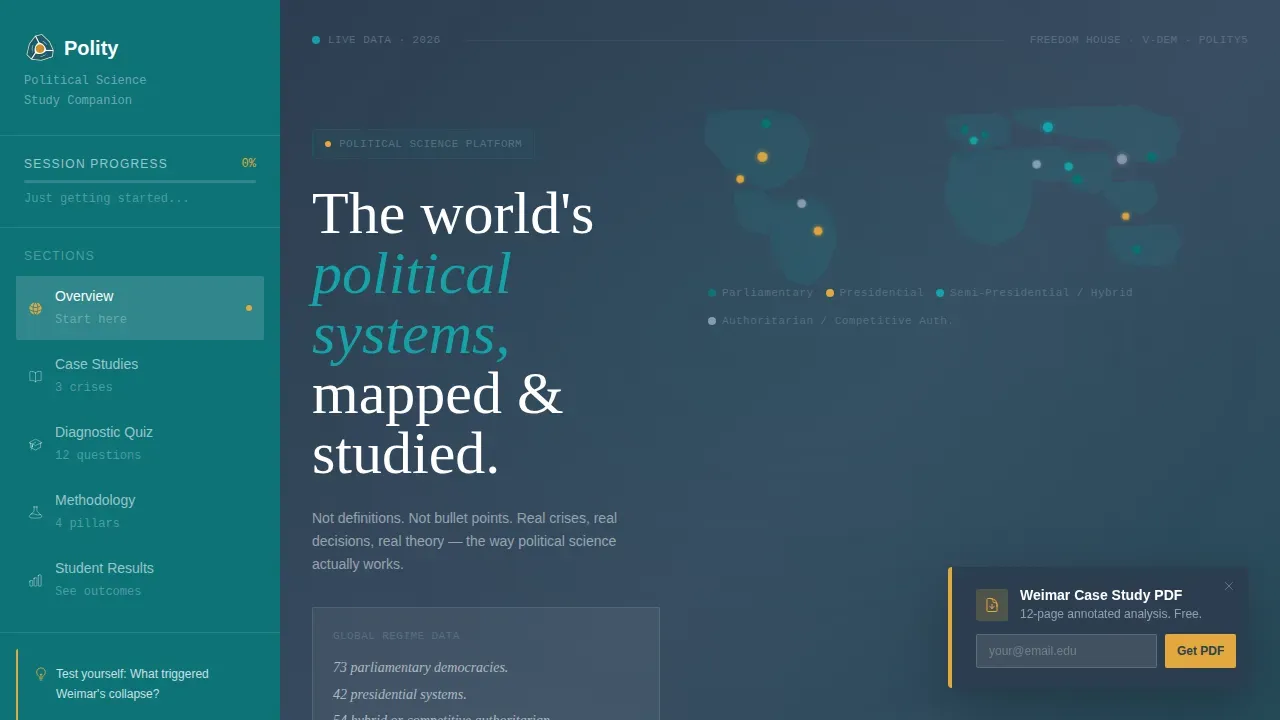
The header opens with a hand-drawn-style animated SVG world map. Parliamentary democracies pulse in teal, presidential systems glow amber, and hybrid regimes flicker between both. A typewriter-animated statistic scrolls across the center, and hovering over any region reveals a one-line case study teaser. The data itself functions as the visual, with no stock photography involved. This approach draws visitors in immediately and frames the site as a research-grade study tool from the first second.
Narrative Case Study Cards
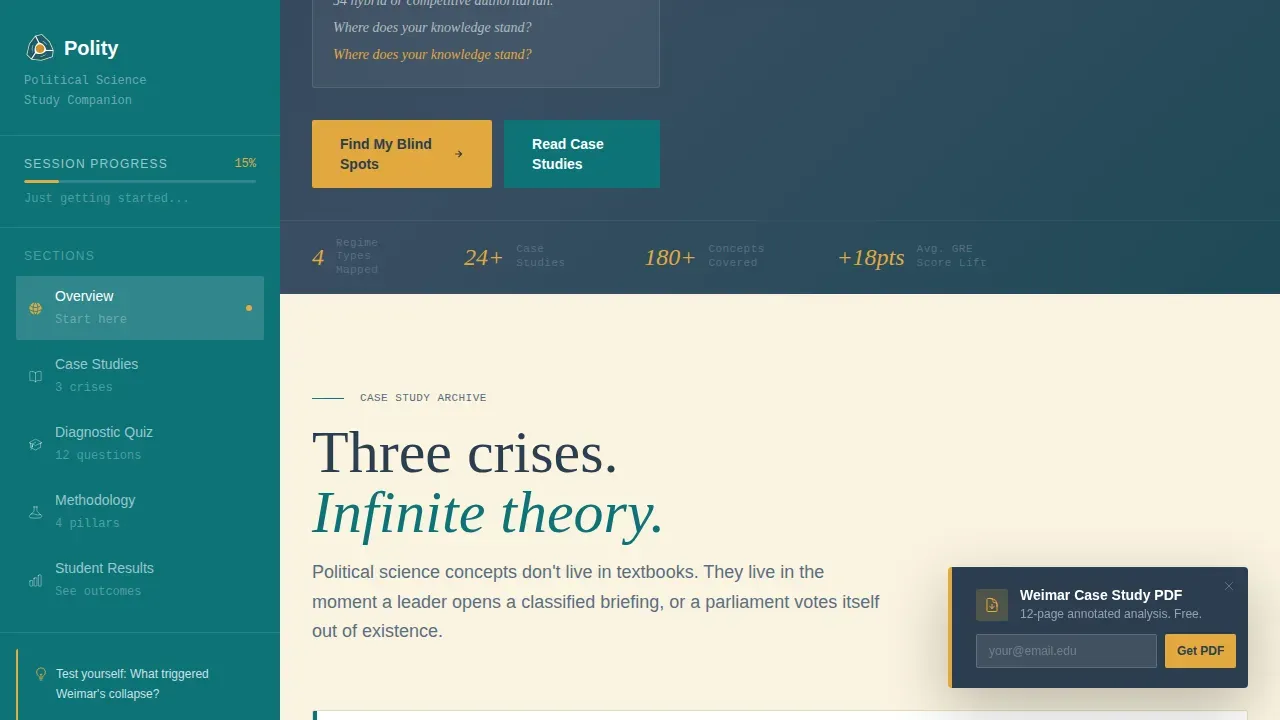
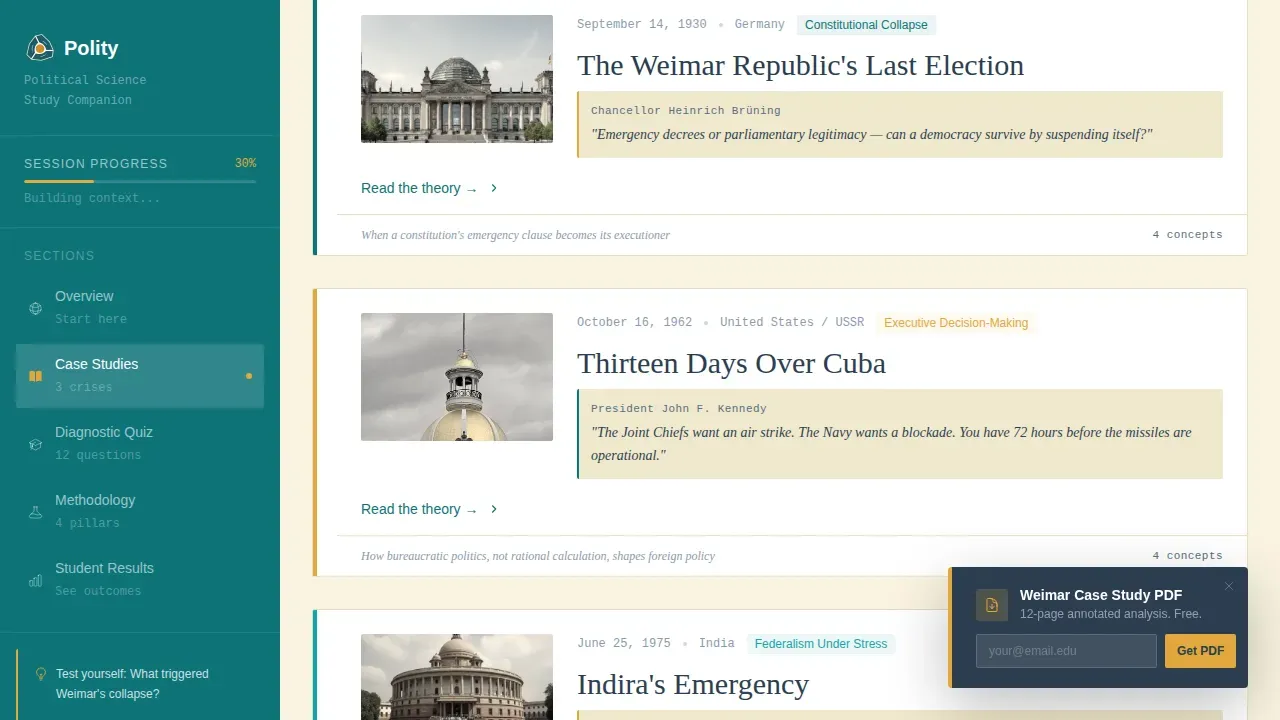
Three political crisis cards structure the core content section. Each card opens with a tension: a date, a decision, a leader's dilemma. The Weimar Republic's constitutional collapse introduces comparative government concepts. The Cuban Missile Crisis unpacks executive decision-making theory. India's Emergency of 1975 teaches federalism under stress. Each case study peels back layers of theory embedded inside a historical narrative, so the research and policy context arrive through story rather than definition. This approach reflects the principle that effective study guides for polity diagnostics use a visual scaffolding approach to simplify complex subjects.
Persistent Sidebar Companion
The deep-teal sidebar sits fixed on the page as a persistent study companion. It tracks scroll progress, surfaces notes related to the current section, and delivers "Test yourself on this concept" micro-prompts at key moments. This keeps the user aware of their own knowledge gaps while they move deeper into the content. The sidebar functions as a live table of contents and an accountability tool in one, giving the page a study-desk quality that static pages cannot provide.
12-Question Diagnostic Quiz Flow
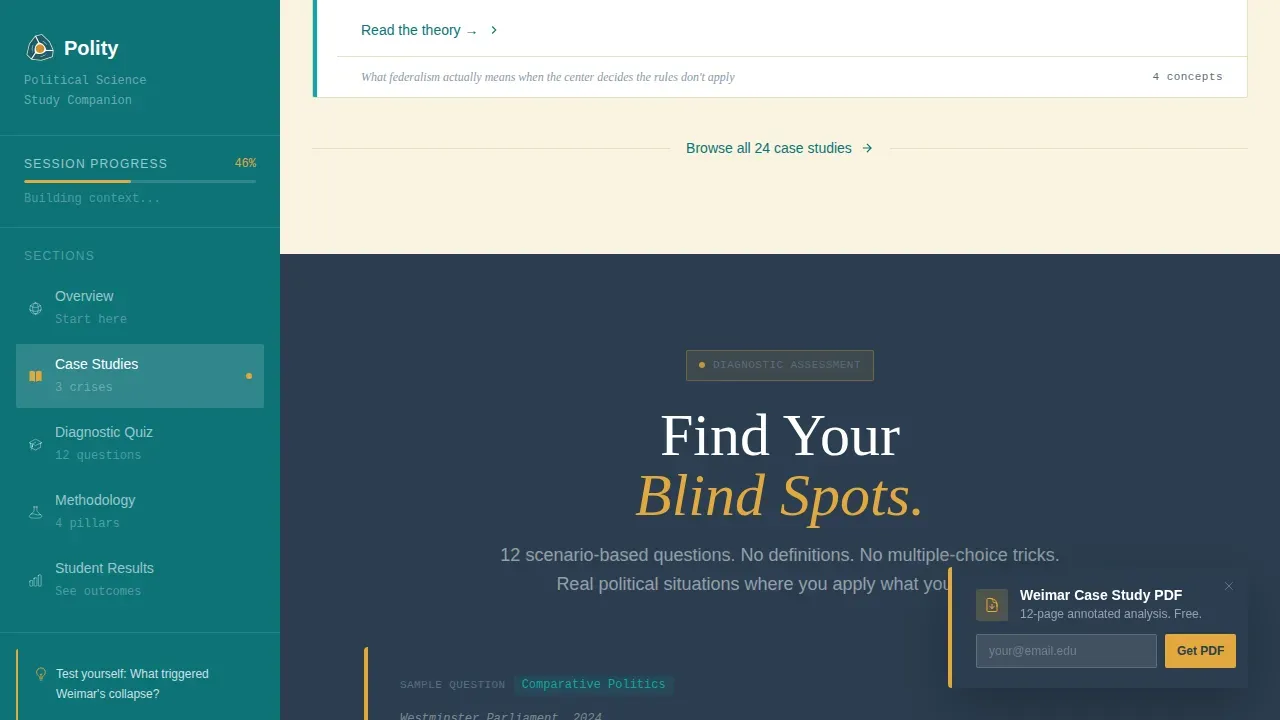
The primary conversion mechanism is a scenario-based diagnostic quiz covering all four study pillars. Questions are situational, not definitional. For example: "A coalition government loses a confidence vote. What happens next in a Westminster system?" After completing the quiz, results reveal a personalized study map that visualizes the user's strongest and weakest areas across the teal-amber spectrum. This structure gives every visitor a reason to sign up and a clear sense of what they will gain by doing so.
Email-Gated Results and PDF Download
Two conversion paths give visitors meaningful choices. The primary path places email capture between quiz completion and the full results page. The prompt reads: "Enter your university email to unlock your complete Political Science Readiness Profile." The secondary path offers a gated PDF download of the Weimar case study for visitors who scroll deep but do not take the quiz. Both paths respect user preferences while creating a natural moment to sign up and access the full platform.
Four-Pillar Study Methodology Bento
An asymmetric bento grid presents the four study pillars: comparative politics, political theory, international relations, and public policy. Each pillar functions as a dedicated section within the grid, showing scope and depth without overwhelming the page. This section helps visitors understand the breadth of the program before committing to the quiz, making it a key trust-building element in the conversion structure.
Page sections overview
| Section | Purpose |
|---|---|
| Animated World Map Hero | Introduces the platform with data-driven visual storytelling and a typewriter statistic |
| Narrative Case Study Cards | Delivers political theory through three historical crisis narratives |
| Quiz Conversion Section | Presents the "Find Your Blind Spots" call-to-action and launches the diagnostic |
| Study Methodology Bento | Displays the four pillars of the program in an asymmetric bento grid layout |
| Student Testimonials | Provides social proof with specific exam outcomes and study context |
| Linear Single-Row Footer | Closes the page with a clean, minimal footer structure |
Design & branding system
The visual identity follows a Community Hearth theme built on the Teal Catalyst color system. The palette feels like a well-loved textbook: teal sticky tabs marking key passages, amber highlighter bleeding through cream pages, and confident dark marginalia in the margins. Fraunces (a serif display font) handles headings, while DM Sans carries all body text with a clean, readable weight. The creative direction treats research data and historical narrative as the primary visual material, not decorative imagery.
- Deep seminar-room teal (#0D7377) anchors the sidebar and primary interface elements; warm parchment (#FAF3E0) fills content backgrounds; charcoal ink (#2C3E50) handles body text; and catalyst amber (#E2A83E) activates buttons, progress indicators, and highlighted annotations
- High animation fidelity throughout: GSAP-driven scroll reveals, SVG map pulses, typewriter effects on the hero statistic, and hover interactions on regional map clusters all bring the page to life
- The sidebar sits in deep teal as a persistent companion, while the main content area breathes in parchment warmth, creating a clear visual hierarchy between navigation and study content
Mobile & speed optimization
This template is designed desktop-first to match the study platform's primary use case, where users typically sit at a desk with a larger screen, multiple browser tabs open, and research materials spread around them. However, the layout is built to respond cleanly across device sizes so that students who browse or review material on a phone or tablet can still access the full experience. The sidebar companion adapts for smaller screens without losing its core functionality.
- The animated SVG world map and GSAP interactions are built for desktop priority, with responsive versions that scale gracefully to smaller device viewports
- Static sections such as the case study cards, bento grid, and testimonials use server components to keep the page light, while interactive elements like the quiz flow and map use client components
- The PDF download and email-capture paths are accessible regardless of device size, so no conversion opportunity is lost when visitors browse on mobile
How this template helps you convert
A political landing page only works when it earns trust, delivers value, and makes the next step obvious. This template is designed to do all three in sequence, moving each visitor from curious to committed through a structured progression of content, interaction, and incentive.
- The animated hero map and typewriter statistic create immediate curiosity and academic credibility, encouraging visitors to scroll deeper into the case study narrative sections and engage with the research before they reach any sign-up prompt
- The 12-question diagnostic quiz delivers a personalized study map that gives each user a concrete, data-informed reason to provide their email and access the full Political Science Readiness Profile, turning the quiz result into the primary conversion incentive
- The gated Weimar PDF download provides a lower-commitment secondary path for visitors who prefer to access a research paper or case study sample before committing to the quiz flow, ensuring a broader share of visitors convert on their own terms
Other information about this template
This template is suited to a wide range of political science education contexts. Whether you are creating a platform for undergraduates in a policy program or developing a research companion for graduate-level study, the structure scales to your purpose. The following notes provide additional context for teams evaluating this template for their organization or institute.
- The template is designed around the study of government systems and regime types, drawing on methodologies similar to the Polity5 dataset and Political Economy Analysis (PEA) tools, which researchers and professionals use to assess political system health, functionality, and institutional integrity
- A polity diagnostic study guide systematically evaluates the institutional, structural, and procedural characteristics of a political system, including the distribution of power, the nature of authority, and the level of democratic consolidation; this template's case study structure reflects that analytical approach
- The authority spectrum concept, which classifies political systems along a spectrum from autocracy to democracy, is a natural fit for the world map hero section, where regime types are visualized as distinct clusters across countries and regional groupings
- Assessment of regime type in polity diagnostics includes evaluating civil liberties, political rights, and the rule of law; the template's four-pillar bento and quiz questions are designed to address these dimensions in scenario-based form
- Contextual analysis in polity diagnostics includes historical background, social and economic drivers, and structural and institutional frameworks; each narrative case study card in this template is structured to provide that layered context
- Political actors and power dynamics, including identification of formal and informal actors, their interests, resources, and influence, can be addressed through the annotated case study format this template supports
- A political science research paper typically includes a literature review, a theoretical framework section that provides an overview of possible explanations for the core question, case studies, and a conclusion that summarizes the core argument and discusses broader implications; this template's sections naturally mirror that research paper structure for teaching purposes
- The introduction of a research paper should state the core question and provide an overview of the rest of the paper; the hero statistic and world map in this template serve a parallel purpose, framing the platform's core question immediately
- A research paper's conclusion should summarize the core argument and findings while discussing broader implications; the personalized study map delivered after quiz completion functions as a personalized conclusion for each user's diagnostic session
- The American Political Science Association (APSA) uses a variation of the Chicago Manual of Style for citation, and platforms built on this template can reference that standard in their study guide content and downloadable PDF materials
- A policy paper should include clear and measurable criteria for assessing the success of a policy choice; quiz questions covering the public policy pillar can incorporate these criteria directly
- A one pager helps effectively deliver your message and facilitates a productive conversation on the issues of importance to you and your organization; when creating a one pager for advocacy or outreach purposes, present the information clearly and use concise bullet points; a one pager should include key facts and concise information relevant to the issues being discussed
- Meeting with a legislator or staff person in the district office or on Capitol Hill is a great way to share your story and information about your organization; platforms built on this template can support that kind of civic advocacy work by providing downloadable, shareable research summaries in PDF form
- Key elements of an effective political landing page include a compelling headline, a clear value proposition, and social proof such as testimonials; this template includes all three by design
- Calls-to-action on landing pages should be clear and prompt; the two primary calls-to-action here are "Find Your Blind Spots" for the quiz path and "Download the Weimar Case Study" for the PDF path
- The design of a high-converting political landing page requires balancing educational outcomes with persuasive elements; this template addresses that balance through its sequenced content architecture
- Mixed methods are used in polity diagnostics to combine quantitative and qualitative data; the quiz's scenario-based questions and the case study narratives together reflect that mixed-method philosophy
- Political landing page templates often include features for easy customization and user-friendly design; this template follows that standard with clearly defined color tokens, typography choices, and modular section layouts
- Responsive design ensures compatibility across devices; the template's desktop-first approach still accounts for visitors who browse on smaller screens
- Political landing pages should contain eye-catching themes, action buttons, and contact forms to engage visitors; the amber-accented buttons and email-capture form in this template fulfill that role
- Using animations and unique design elements can make political landing pages more appealing to users; the GSAP-driven SVG map and typewriter statistic are the primary examples of that approach here
- This template is well-suited for use by academic institutes, civic education organizations, and independent educators, including those based in markets like southern california, where large university populations and civic engagement programs create strong demand for quality political science study tools
- The polity diagnostic political science study guide landing page template is a ready-to-deploy structure for any educator or platform creator who wants to turn political science research into an interactive, conversion-oriented study experience
Theme
Community Hearth
Creative direction
Case Study Narrative
Color system
Teal Catalyst
Style
Sidebar Companion
Direction
Quiz/Assessment
Page Sections
Animated Data-storytelling Hero Map
Narrative Crisis Case Study Cards
Persistent Sidebar Companion
Question Diagnostic Quiz with Personalized Results
Dual Conversion Path Architecture
Four-pillar Study Methodology Bento Grid
Related questions
Who is this template designed for?
What sections does this template include?
How does the diagnostic quiz conversion flow work?
Does the template include a gated PDF download path?
Is this a single-page or multi-page template?