Logistics Software Comparison Website Template
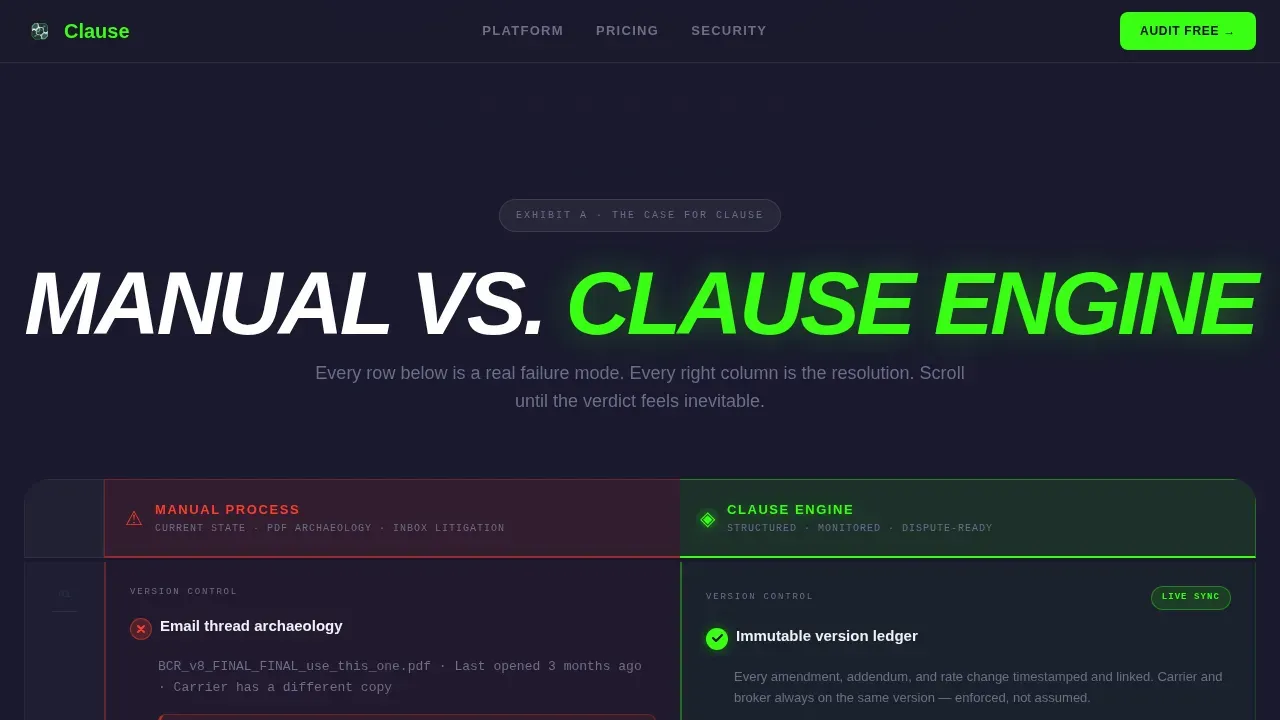
The Clause freight contract clarity landing page template is a Bold Brutalist, Glassmorphic comparison landing page built for logistics contract management platforms. It opens with a syntax-highlighted code snippet exposing broken freight language, then walks visitors through a seven-row Manual Process versus Clause Engine table that builds an undeniable case for smarter, legally binding contract intelligence.
by Rocket studio
Quick summary
This is the clause freight contract clarity landing page template: a single-page, high-drama comparison layout designed for B2B logistics software companies that turn messy freight agreements into structured, enforceable digital contracts. It pairs a Bold Brutalist visual weight with a Glassmorphic surface treatment, guiding logistics coordinators, operations directors, and legal professionals from problem recognition to a free audit signup in one focused scroll.
Who this template is for
This template is purpose-built for logistics and legal tech companies whose buyers live inside the freight industry every day. It speaks directly to people who have inherited broken processes, not beginners shopping for basic contract tools.
- Logistics coordinators at third-party logistics firms who manage stacks of PDF amendments and need a smarter way to handle transportation services agreements
- Operations directors at mid-market shippers who carry years of inherited handshake deals and urgently need legally binding, structured transportation agreements
- Legal counsel at freight brokerages who review the same indemnification language repeatedly and want a platform that flags gaps before legal proceedings become necessary
What problem this template solves
Freight contracts are a legal minefield. Carrier addendums pile up. Rate confirmations contradict each other. Terms around payment terms, delivery schedules, and limitation of liability get buried in ambiguous language that no one catches until a dispute costs six figures. The manual process of reviewing every legal document by hand is slow, error-prone, and expensive in legal fees alone.
- Ambiguous language in transportation services contracts goes undetected until it becomes a liability clause violation or a formal dispute
- Logistics teams juggling dozens of service providers have no clear system to track signed agreements, renewal dates, or version changes
- Legal professionals waste hours reviewing identical indemnification language across hundreds of transportation agreements with no automation to surface the real risk
What you get with this template
You get a complete, conversion-focused single-page layout built around a Problem to Solution arc. Every section is designed to do persuasive work, so by the time a visitor reaches the call-to-action form, the case has already been made. The template delivers a structured visual story, not a generic product page.
- A full code-snippet hero section with brutalist typography and frosted glass panels that make any logistics professional stop scrolling
- A seven-row comparison table contrasting the manual process against the platform, with a sticky secondary call-to-action that appears after row three and a primary call-to-action anchored at the table's verdict
- A stats and credibility section, a three-field signup form asking for company name, contract volume, and work email, and a footer built on a horizontal flow pattern
Feature list
This template includes the following purpose-built sections and interaction patterns, each extracted directly from the product brief.
Syntax-Highlighted Code Snippet Hero
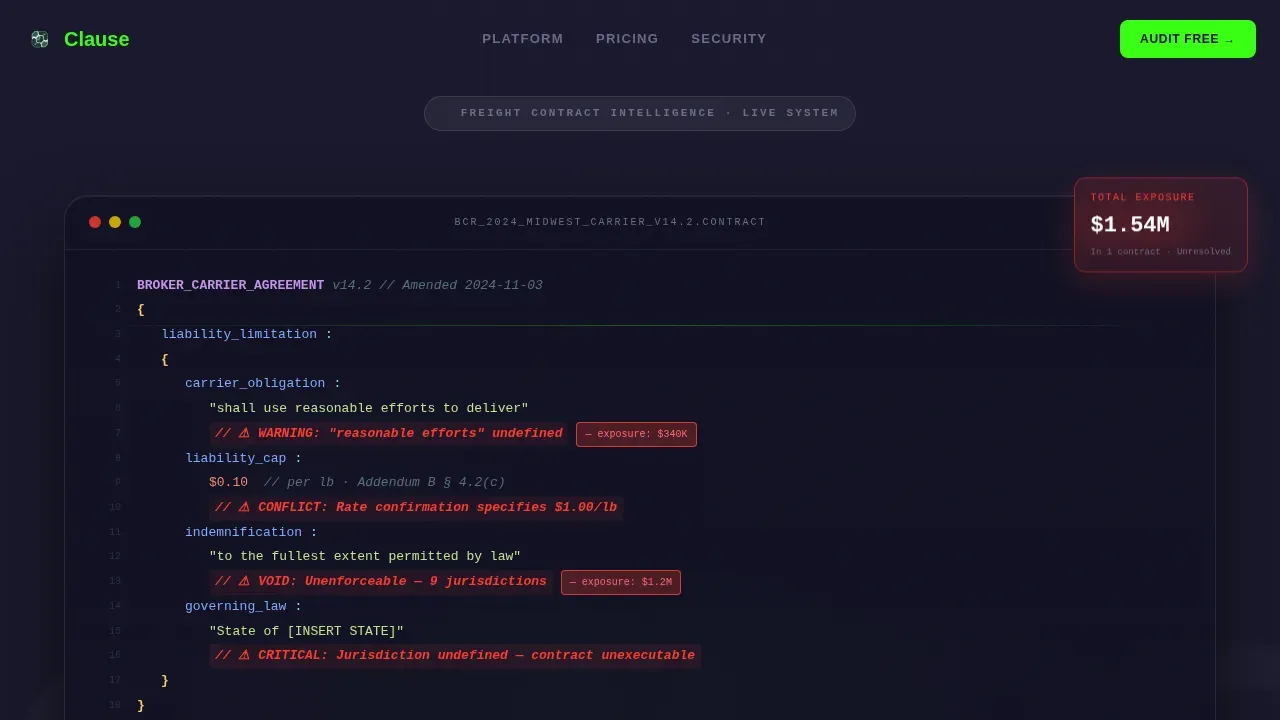
The header opens with a monospaced block of real freight contract language rendered as syntax-highlighted code. Red error annotations call out ambiguous terms with inline liability warnings such as exposure estimates in USD. The panel sits on frosted glass over a brutalist concrete texture. No stock photography is used. The visual immediately establishes credibility with legal professionals and logistics coordinators who recognize the language on sight.
Seven-Row Escalating Comparison Table
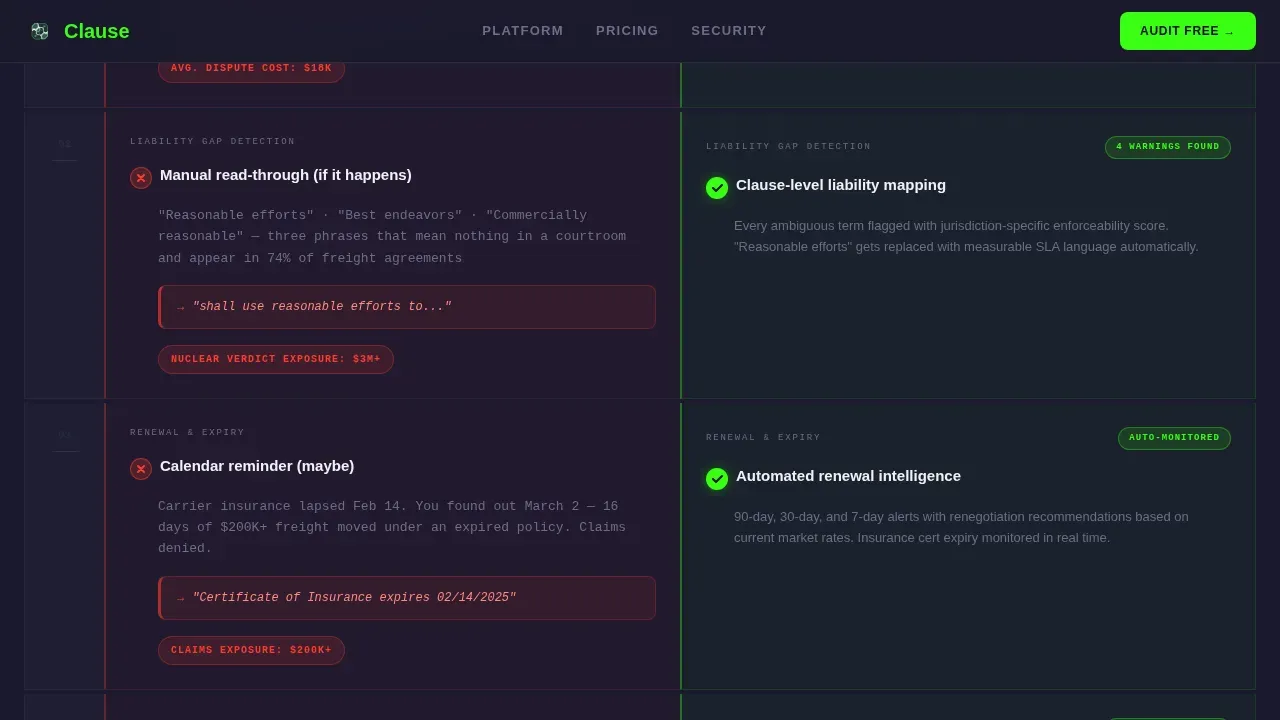
The core of the landing page is a side-by-side table contrasting the manual contract process against the platform. Each row raises the stakes, moving from version tracking and payment terms clarity through liability detection and renewal automation. The left column renders the manual side in harsh, red-lined contract fragments. The right column shows clean, glowing glass cards. The design is structured so that every scroll deeper reveals a more expensive failure on the left and a more elegant resolution on the right. This row-by-row case-building approach mirrors how legal professionals structure arguments: evidence first, verdict last.
Sticky Secondary Call-to-Action Trigger
After the third comparison row, a sticky secondary call-to-action appears reading "See Your Risk Score." This element is triggered by scroll position and remains visible as the visitor continues through the remaining rows. It captures users who are convinced early without interrupting the persuasive flow for those who need the full table to reach a decision. The primary call-to-action, "Audit Your Contracts Free," is anchored at the bottom of the table where the platform column decisively wins.
Three-Field Conversion Form
The signup form is deliberately minimal. It asks for company name first, then number of active carrier contracts via a dropdown with three ranges, then a work email address. The light friction is intentional. By the time a visitor reaches the form, the comparison table has already done the persuading. Adding more fields at this stage would contradict the simplicity promise the platform spent ten sections building.
Stats and Credibility Section
Between the comparison table and the signup form, a credibility section surfaces industry liability statistics, nuclear verdict data, and logistics industry scale numbers. This section uses a grid layout to present quantitative contract data clearly. It gives legal professionals and procurement teams the third-party validation they need before committing to a free audit.
Bold Brutalist Glassmorphic Design System
The entire template is built on a design language that combines industrial weight with unexpected transparency. Deep charcoal forms the primary background. Frosted translucent glass cards carry content. Electric dispatch green marks active states, winning-column highlights, and call-to-action elements. Cargo gray handles secondary text and divider lines. JetBrains Mono renders all code and data. Plus Jakarta Sans carries all interface copy. The result feels like a loading dock at midnight lit by a single fluorescent strip.
Page sections overview
| Section | Purpose |
|---|---|
| Code Snippet Hero | Opens with annotated freight contract code to trigger immediate professional recognition |
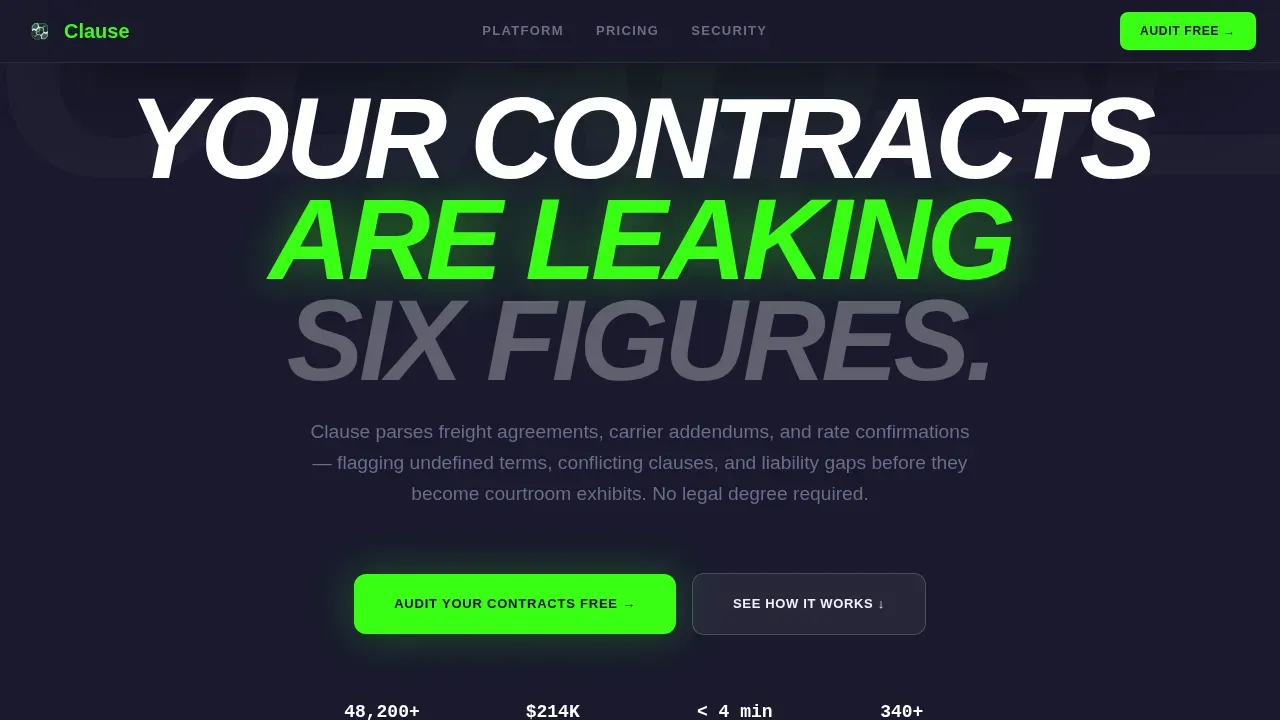
| Brutalist Headline Block | Anchors the core value proposition in large, high-contrast typography |
| Comparison Table Header | Labels the two columns and sets the framing before the evidence begins |
| Row 1: Version Tracking | Contrasts chaotic PDF management against structured version control |
| Row 2: Payment Terms | Shows the risk of undefined payment terms versus clear, automated fee tracking |
| Row 3: Delivery Schedules | Exposes the cost of missed delivery schedules versus automated monitoring |
| Sticky call to action Trigger | Secondary call-to-action appears after row three for early-convert visitors |
| Row 4: Liability Detection | Escalates stakes with undetected liability clause gaps versus automated flagging |
| Row 5: Renewal Automation | Compares manual renewal tracking against automated contract expiry alerts |
| Row 6: Dispute Readiness | Contrasts scrambled documentation against an organized dispute resolution record |
| Row 7: Verdict Row | Final row delivers the decisive platform win and anchors the primary call to action |
| Stats and Credibility | Grid of industry liability numbers and social proof data |
| Audit Signup Form | Three-field form capturing company, contract volume, and work email |
| Footer Flow | Horizontal pattern footer with contact details and navigation |
Design & branding system
The visual identity is built around industrial tension. The goal is to make freight contract risk feel as visible and tangible as the solution being offered. Every design decision reinforces that contrast.
- Color palette: deep slab charcoal (#1A1A2E) as the primary background, frosted translucent white at 12% opacity for glass card surfaces, electric dispatch green (#39FF14) for active-state accents and winning-column highlights, and muted cargo gray (#6C6C8A) for secondary text and divider lines
- Typography: JetBrains Mono for all code blocks and data display, Plus Jakarta Sans for all interface and body copy; generous line spacing and sufficient white space around text prevent walls of text that discourage reading
- No stock photography or faces anywhere in the template; the hero visual is raw contract language dissected like source code, giving the page an authority that staged imagery cannot match
Mobile & speed optimization
The template is designed desktop-first. Logistics coordinators and legal professionals typically review contracts at a desk, and the comparison table requires horizontal space to deliver its full persuasive impact. However, the layout is built to remain functional and readable on smaller screens.
- The comparison table stacks into a single-column accordion layout on mobile devices, preserving the row-by-row escalation without requiring horizontal scrolling
- Static server-rendered components handle all non-interactive content, with minimal client-side code reserved only for the sticky call-to-action trigger, scroll-reveal animations, and form validation
How this template helps you convert
This template is structured as a courtroom exhibit. Every element exists to build the case for the platform, row by row, until the verdict is inevitable and the signup form feels like the obvious next step.
- The code-snippet hero triggers instant recognition in logistics and legal professionals. They see broken freight contract language they have lived with for years, annotated with the exact liability exposure they fear. That recognition creates urgency before a single marketing claim is made.
- The seven-row comparison table escalates the stakes progressively. Each row reveals a more expensive manual failure beside a more elegant platform resolution. By row seven, the cumulative weight of the evidence makes the "Audit Your Contracts Free" call-to-action feel less like a pitch and more like a professional obligation.
Other information about this template
This section covers practical context that buyers often need before choosing a logistics contract management template.
- Transportation services agreements are contracts that outline the terms and conditions of transporting goods or people. A comprehensive transportation services agreement template must include detailed components tailored specifically to the nature of those transportation services, including routes, delivery schedules, special handling requirements, and clearly defined payment terms with penalties for late payments.
- Transportation services agreements outline the responsibilities and liabilities of both parties, reducing the risk of disputes. They ensure that all activities comply with applicable laws and relevant laws governing freight operations, protecting both parties involved from legal issues arising from ambiguity.
- A terms and conditions agreement is a legally binding document that outlines the rules and expectations users must follow when accessing a platform. A well-crafted terms and conditions agreement can help protect a business from abusive users, limit liability in the event of disputes, and inform users of their rights and obligations clearly. Terms and conditions agreements are not legally required, but they are highly recommended for any company offering transportation services or logistics software.
- A terms and conditions template can simplify the process of creating a legally sound agreement. Using a professional terms and conditions generator can help logistics technology companies create legally compliant documents faster. Sample terms and free terms resources exist, but customizing a conditions template to your specific service model is essential because generic language leaves gaps.
- Terms and conditions examples in the logistics sector typically include a liability clause, a termination clause, a governing law section, and a dispute resolution clause. These terms and conditions examples inform users about payment method expectations, applicable fees, and confidentiality obligations related to confidential information shared during the engagement.
- The limitation of liability section in any legally binding agreement should define the maximum extent permitted by law under which the platform accepts responsibility, including whether it covers incidental or consequential damages or only direct losses. The extent permitted by law and the fullest extent permitted language matter significantly in freight disputes where personal injury or cargo damage is claimed.
- A signed agreement becomes enforceable when both parties involved have provided mutual consent and a person authorized to bind each organization has executed it. Prior agreements are superseded when an entire agreement clause is present, which is standard practice in modern transportation agreements.
- The governing law section determines which jurisdiction's laws govern any dispute. Specifying governing law and the dispute resolution process in advance avoids costly ambiguity. A clear dispute resolution clause, including whether disputes go to arbitration or litigation, protects both the service provider and the client from extended legal proceedings.
- Intellectual property rights and the intellectual property clause matter in logistics software contracts because platform data, algorithms, and outputs may constitute exclusive property. The intellectual property clause should specify what remains the provider's own property and what rights the client receives. Intellectual property protections also cover copyright laws applicable to the platform's code and content.
- An end user license agreement, often called a EULA, governs how users access and use the software. It differs from a terms and conditions agreement in scope but shares common elements including a user account creation process, restrictions on restricted parties, and rules about users access to the platform's features.
- The Digital Millennium Copyright Act, commonly known as the DMCA, establishes copyright laws that apply to digital platforms operating in the United States. Any platform offering logistics contract management software should include specific legal disclosures addressing the DMCA and intellectual property rights to remain compliant with applicable laws.
- Service providers offering transportation services must maintain service quality standards that accurately reflect the agreed delivery schedules and performance benchmarks. When a service provider fails to meet those benchmarks, the terms and conditions agreement should specify whether the client has grounds for legal contract remedies or immediate termination of the engagement.
- Confidentiality obligations are standard in B2B logistics contracts. Both parties must protect confidential information shared during the engagement, and the terms should define what happens to that information after termination. Breach of confidentiality obligations can trigger legal fees and legal proceedings if not handled properly.
- Transportation agreements should define what happens when events outside a party's reasonable control, such as natural disasters or carrier network failures, affect business interruption or service delivery. Naming these scenarios in the contract prevents disputes about whether a delay falls within normal business operations or constitutes a breach.
- Transportation services agreements are typically managed by legal, procurement, and logistics teams within an organization. Storing all transportation agreements in a secure, centralized contract repository provides clear insight into contract performance and risks. Enhanced tracking ensures all parties adhere to agreed schedules and service levels, maintaining smooth transportation operations.
- Juro's AI-native platform automates repetitive tasks involved in creating and managing transportation services agreements. Juro fosters seamless collaboration across teams within a single browser-native workspace, reducing the risk of miscommunication or lost documents. These capabilities are offered as a reference point for how modern contract intelligence platforms approach the problem this template is designed to market.
- Best practices for freight contract landing pages focus on clarity, transparency, and explicit consent to ensure terms are legally binding. Require affirmative, active consent through a clickwrap checkbox before users can proceed with a quote or booking. Block access to final booking or services until the user has checked the agree box. A conditions agreement enforceable in court depends on proving that a person authorized to accept the terms did so knowingly.
- Include a library of pre-approved clauses for liability, payment, and dispute resolution that are regularly reviewed for compliance with relevant laws and current business practices. Inform users about their own risk when using transportation services without a fully executed legal document in place. Use specific legal disclosures and a clear governing law section to ensure the conditions agreement is enforceable across applicable laws.
- From a design and usability standpoint, design the landing page to help users navigate visually with icons next to key sections. Use hover-over tooltips to define industry-specific jargon or complex legal terms without cluttering the main page. Eliminate top navigation bars or external links to keep the user focused on the contract. Use a table of contents with anchor links to allow users to jump to specific sections in longer legal documents. Clearly display when the terms were last updated to maintain transparency. Present complex information such as rate tables and detention fee schedules in bullet points, numbered lists, or tables rather than in dense paragraphs. Use a large, clean sans-serif font and generous line spacing to prevent walls of text that discourage reading. Layer each major clause with a plain-language summary to help non-legal readers understand their obligations.
- Contact details for the logistics software company should appear in the footer of the landing page, including a business email and, where applicable, a physical address. Displaying contact details builds trust with legal professionals evaluating the platform.
- Abusive users and accounts used by restricted parties, including any terrorist supporting entities, should be addressed in the platform's terms and conditions to protect the company legally. The terms should give the platform the right to immediate termination of a user account if these conditions are violated. The platform remains solely responsible for enforcing these rules consistently. The terms should also note that revised terms will be communicated to users and that continued use constitutes acceptance. Remaining provisions unaffected by a change should be stated explicitly to show that the entire agreement does not collapse if one clause is amended. The terms should address prior written consent requirements for any transfer of rights and clarify what own accounts users may operate on the platform.
- The template's desktop-first build reflects how business operates in the freight industry: contract review happens at a desk, in a browser, often with a second monitor open. The design ensures both you and your buyers have a professional-grade experience from the first page load.
Theme
Bold Brutalist
Creative direction
Problem→Solution Arc
Color system
Glassmorphic
Style
Comparison Table
Direction
Comparison/Versus
Page Sections
Code Snippet Hero with Liability Annotations
Seven-row Escalating Comparison Table
Scroll-triggered Sticky Call-to-action
Three-field Minimal Signup Form
Stats and Credibility Grid
Bold Brutalist Glassmorphic Visual System
Related questions
What types of logistics companies is this template built for?
Does this template include the comparison table interaction and sticky call-to-action behavior?
Can I customize the freight contract clauses and copy shown in the hero code snippet?
What fields does the signup form include?
Is this template appropriate for displaying a terms and conditions agreement or end user license agreement?