Clearance - Authoritative Customs Landing Page Template
Clearance is a single-column landing page template built for fine art and antiquities customs brokers operating at the highest level of the market. It leads with a dashboard-style tracking interface, organizes each compliance capability into a distinct spec-sheet block, and drives B2B conversions through a compliance review request form and a gated PDF download.
by Rocket studio
Quick summary
Clearance is a data-forward landing page template designed for artwork and antiques customs brokers. It opens with a live-status shipment dashboard, then walks prospects through export licensing, tariff classification, carnet documentation, and cultural patrimony compliance. Every section reads like a technical dossier. Two conversion paths capture both ready buyers and researchers.
Who this template is for
This template is built for customs brokerage firms that specialize in fine art, antiques, and high-value cultural property. It speaks directly to the professionals responsible for cross-border shipment decisions.
- Auction houses managing post-sale international shipping across multiple jurisdictions
- Museum registrars coordinating incoming loans with fixed exhibition opening dates
- Private dealers, gallery shipping managers, and family office administrators moving collections between residences or art fairs
What problem this template solves
Moving Old Masters, Ming dynasty ceramics, and contemporary installations across borders involves a dense web of export licenses, tariff codes, carnet documents, and cultural property laws. A generic services page cannot communicate that level of jurisdictional fluency. Prospects need to see evidence of expertise before they trust a firm with irreplaceable objects.
- Auction houses and museum registrars rarely respond to vague compliance claims. They need data: timelines, tariff codes, and documented protocols.
- A single misclassified tariff code or missing export license can trigger seizure, financial penalties, and reputational damage. The template addresses each risk explicitly.
What you get with this template
You get a fully structured single-column landing page that organizes customs brokerage capabilities into discrete, scannable blocks. Each block presents one regulatory challenge alongside a systematic answer, building cumulative credibility as the visitor scrolls.
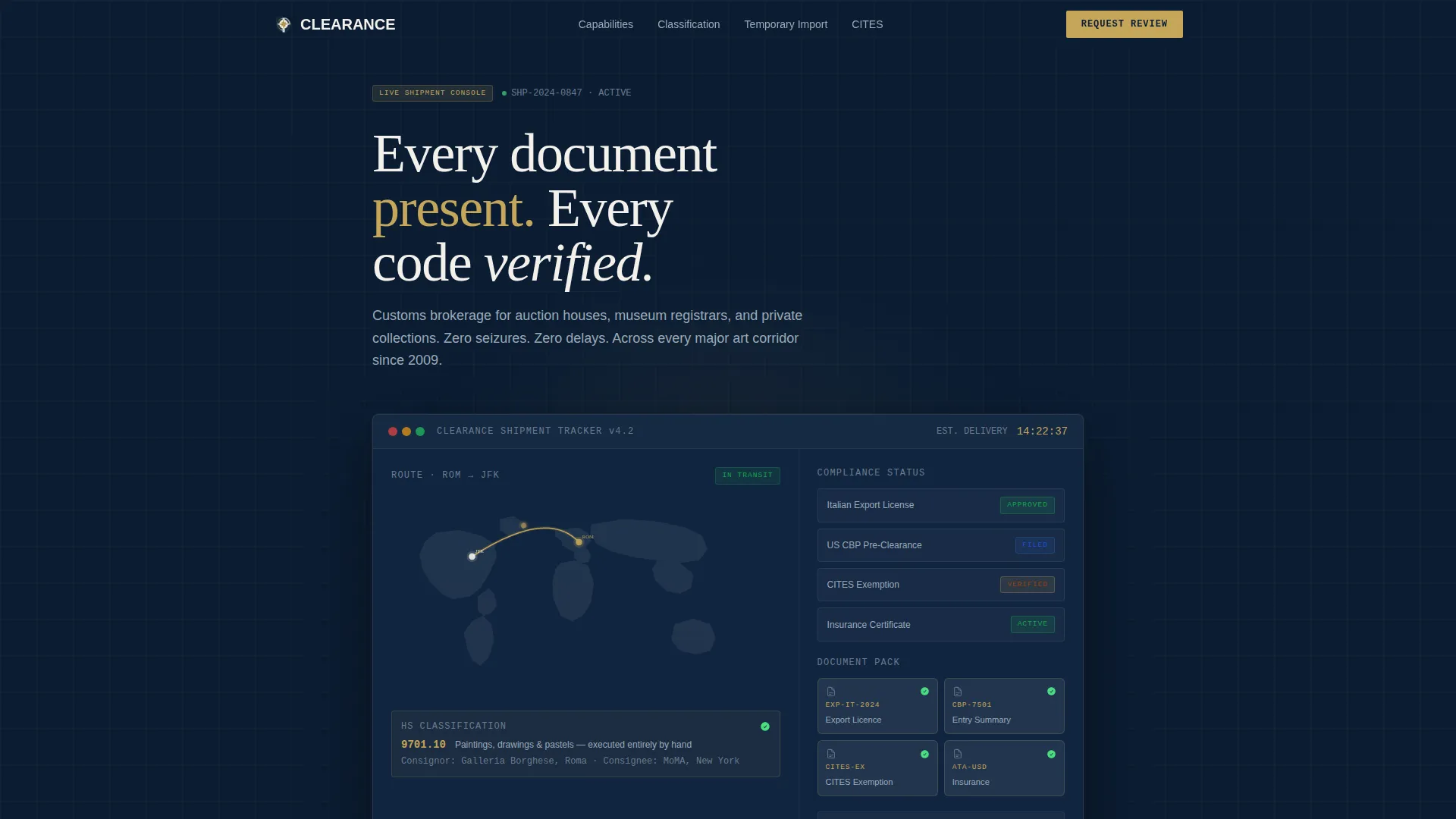
- A hero section featuring a stylized shipment tracking dashboard with live status chips, a world map route arc, document thumbnails, and a tariff classification field
- A two-path conversion system: a compliance review request form with role dropdowns and corridor multi-selects, plus a gated PDF download for researchers not yet ready to engage
- Five capability blocks covering export license navigation, tariff classification accuracy, temporary import carnets, and CITES and cultural patrimony compliance
Feature list
This template delivers purpose-built components for the artwork and antiques customs brokerage market. Every element is grounded in the specific regulatory and operational context these clients navigate daily.
Live-Status Shipment Dashboard
The header presents a stylized tracking interface showing an active shipment mid-transit. Status chips display approval states for export licenses, US Customs and Border Protection pre-clearance, and CITES exemption verification. A glowing route arc on a world map and green-checked document thumbnails communicate process mastery before a single line of copy is read.
Country-by-Country Export License Table
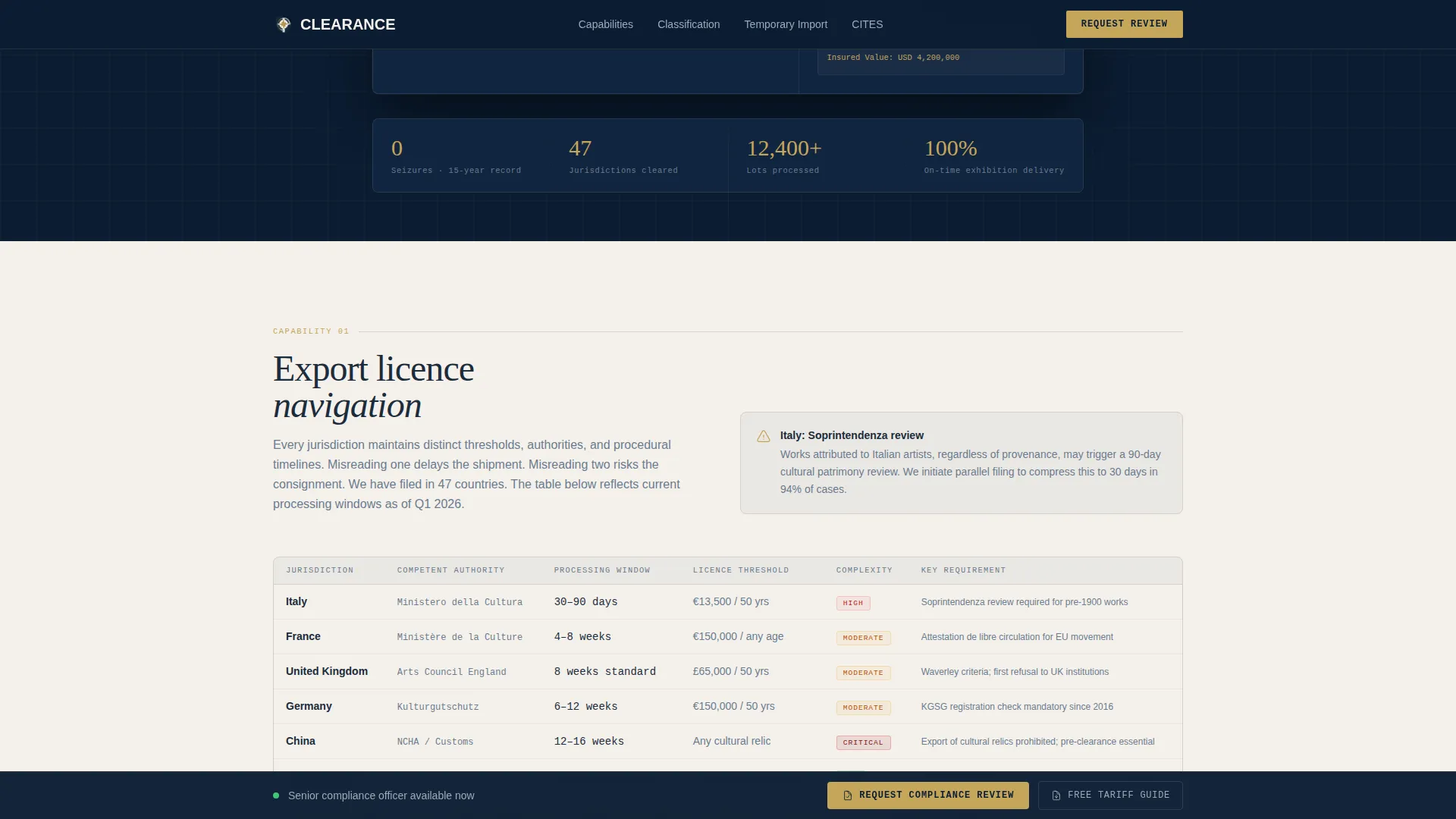
The first capability block includes a mini-table of clearance timelines by jurisdiction. Visitors can immediately assess whether the broker understands the specific corridors relevant to their work. The table format reinforces the spec-sheet tone and demonstrates data fluency.
Tariff Classification Accuracy Block
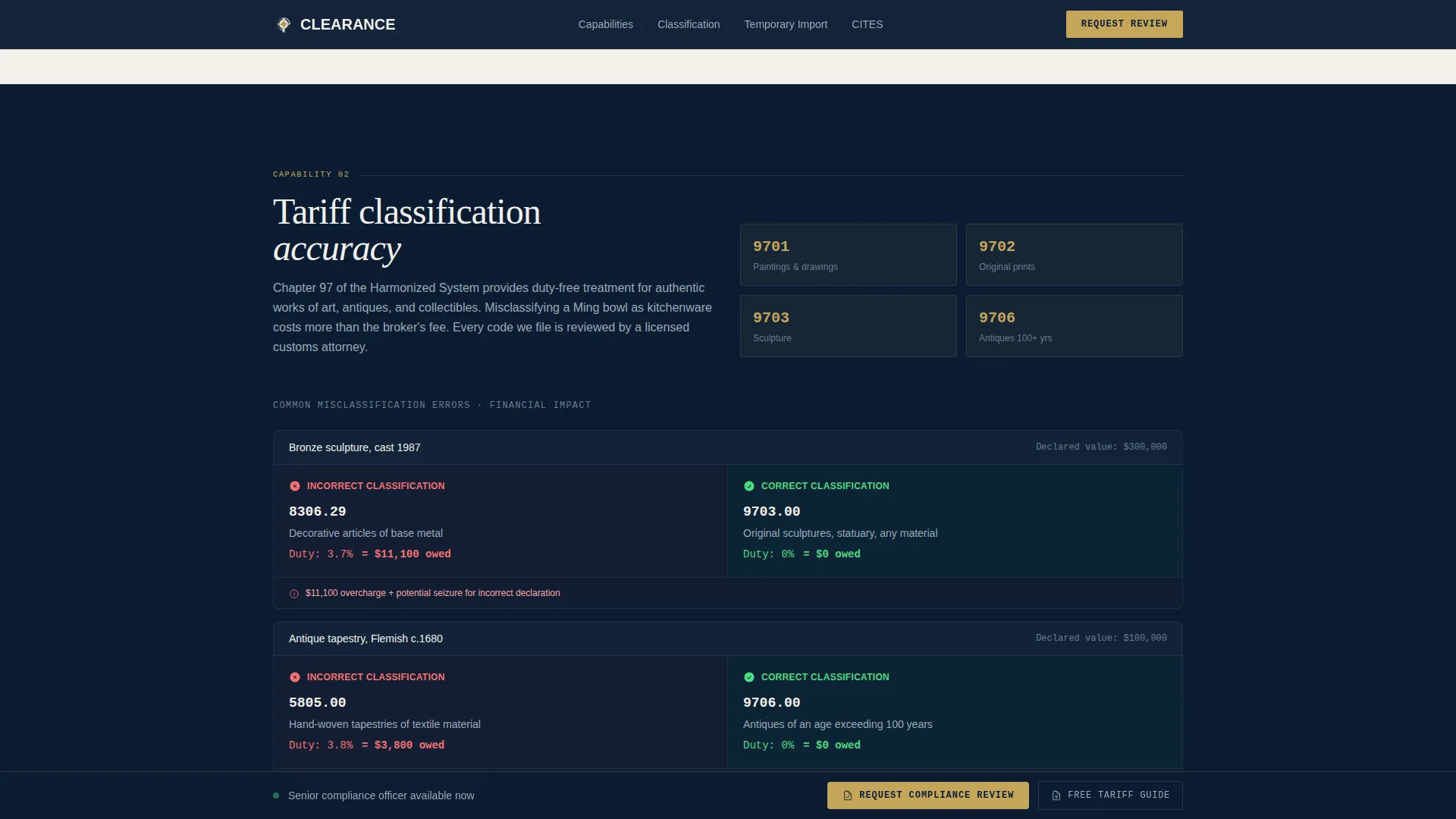
A side-by-side comparison shows common misclassification errors paired with their corresponding financial penalties. This block directly addresses the cost of getting it wrong, using the Harmonized System code format (for example, 9701.10 for hand-executed paintings and drawings) to signal professional-grade accuracy.
Temporary Import and Carnet Documentation Section
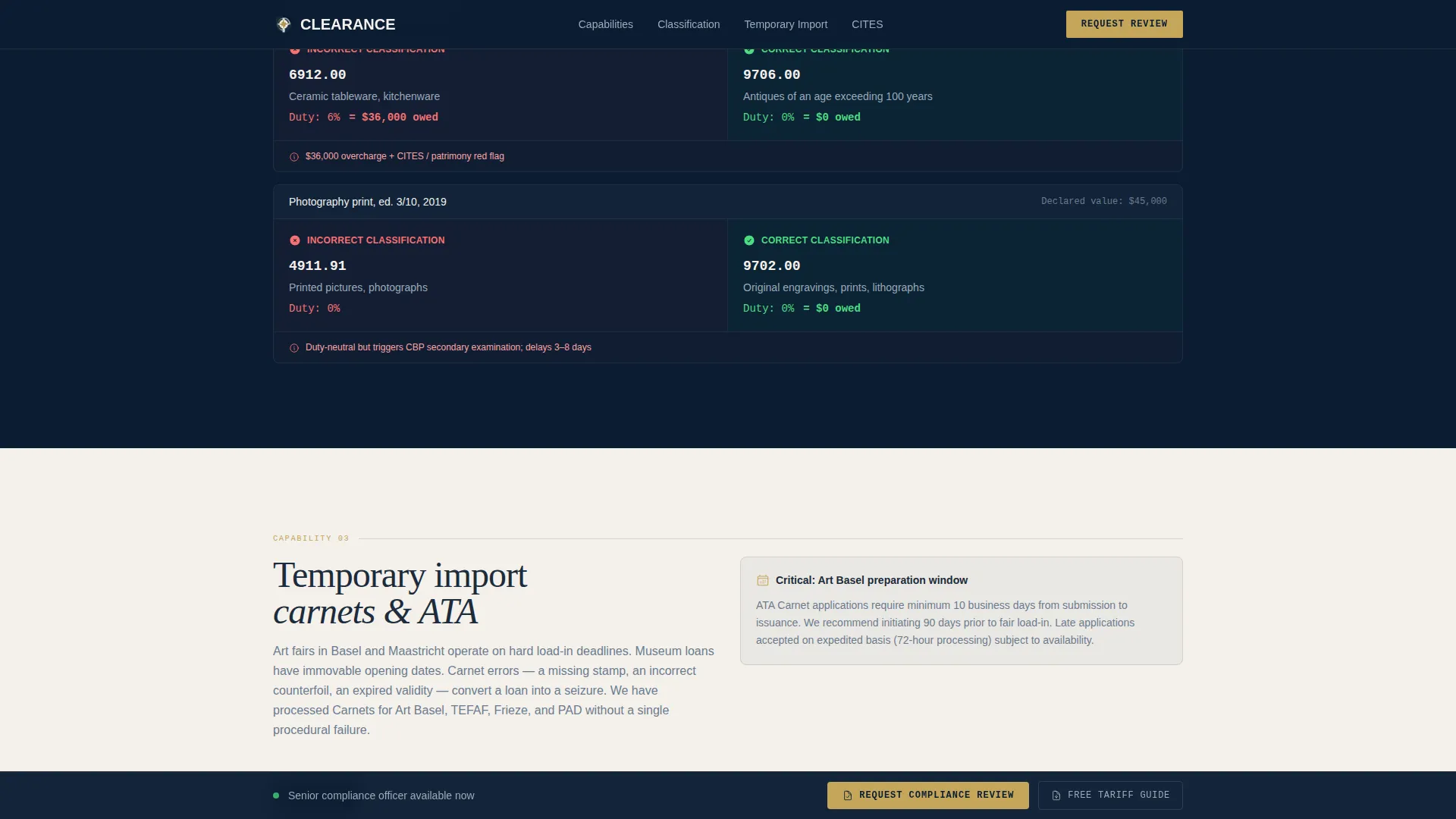
This block covers ATA (Admission Temporaire/Temporary Admission) carnets and temporary import documentation for loan exhibitions. It gives museum registrars and gallery managers a clear picture of the paperwork protocols used for pieces traveling to fixed-date events.
Dual Conversion Path System
The primary call to action is a compliance review request form that captures company name, role, typical shipment corridors, and annual volume range. A secondary path offers a downloadable PDF guide gated behind email and company name only. A sticky bottom bar activates on scroll and repeats the primary call to action throughout the page.
CITES and Cultural Patrimony Compliance Block
A dedicated section covers Convention on International Trade in Endangered Species (CITES) compliance and cultural patrimony regulations for antiquities. This block builds trust with clients handling pre-Columbian objects, ancient ceramics, or any item subject to provenance documentation requirements.
Page sections overview
| Section | Purpose |
|---|---|
| Hero Dashboard | Live-status shipment tracking interface with world map arc, status chips, and tariff classification field |
| Export License Navigation | Country-by-country clearance timeline table showing jurisdiction-specific processing windows |
| Tariff Classification Accuracy | Misclassification error comparison with financial penalty data |
| Primary Call to Action | Compliance review request form with role dropdown and corridor multi-select |
| Temporary Import Carnets | ATA documentation overview for loan exhibitions and temporary import scenarios |
| CITES Patrimony Compliance | Regulatory framework block for antiquities, endangered materials, and cultural property |
| Gated PDF Download | Secondary conversion path offering a downloadable art import tariff classification guide |
| Footer | Linear single-row footer with contact and navigation links |
Design & branding system
The visual identity follows a Service Utility theme built around a Navy Authority color system. The palette deliberately evokes the interior of a bonded warehouse vault: serious, orderly, and built to last.
- Deep admiralty navy (#0B1D33) dominates the header and footer; pressed-linen white (#F4F1EC) carries the mid-page content panels; institutional brass (#C5A55A) appears sparingly on status indicators, hover states, and active shipment badges; regulation gray (#6B7B8D) keeps dense informational text legible
- Typography combines DM Sans for headings, IBM Plex Mono for data fields and tariff codes, and Fraunces as an editorial serif accent, reinforcing the dossier-precise tone throughout
Mobile & speed optimization
This template is built with a desktop-first priority, reflecting how B2B procurement decisions are made. Museum registrars, auction house logistics coordinators, and gallery shipping managers typically work from workstations where a full dashboard interface and data-rich comparison tables are most effective.
- The single-column flow stacks cleanly on smaller screens, keeping the dashboard, capability blocks, and conversion forms accessible across devices
- Static content is handled with server components, while dashboard animations, the sticky call to action bar, and interactive form elements use client components to keep page weight manageable
How this template helps you convert
Every design and copy decision in this template is built to reduce hesitation and move qualified prospects toward a compliance review conversation.
- The dashboard header earns credibility before any copy is read. Status chips, verified document icons, and a precise tariff code signal that this firm has already handled the exact paperwork a prospect is worried about.
- The compliance review form captures actionable prospect data. Role, shipment corridors, and annual volume range give the broker enough context to respond with genuinely specific intelligence rather than a generic follow-up.
- The gated PDF download creates a second conversion lane for prospects in research mode. Registrars and logistics coordinators who are not yet ready to request a review will exchange an email address for a document that demonstrates expertise and keeps the firm top of mind.
Other information about this template
This template is part of a broader Logistics and Supply Chain category, nested within the Artwork and Antiques Logistics subcategory and built specifically for the Artwork and Antiques Customs Broker niche. It carries one of the highest intersection match scores in that niche.
- The Spec Sheet creative direction and Dashboard Preview header concept are paired intentionally: the dashboard earns emotional trust, and the spec-sheet blocks build rational confidence, working together to move the visitor through a high-consideration B2B decision
- Animation is set to medium intensity. Scroll reveals, a status chip pulse effect, and a route arc draw animation add motion without distracting from the data-forward content
- The template supports English-language copy with USD and EUR currency references and covers international shipment corridors including the United States, the European Union, the United Kingdom, and Asia
- The linear single-row footer pattern keeps the bottom of the page clean and appropriately minimal for an institutional brand
Theme
Service Utility
Creative direction
Spec Sheet
Color system
Navy Authority
Style
Single Column Flow
Direction
Partnership/B2B
Page Sections
Live-status Shipment Dashboard Header
Country-by-country Clearance Timeline Table
Tariff Misclassification Penalty Comparison
ATA Carnet and Temporary Import Block
Dual Conversion Path System
CITES and Cultural Patrimony Section
Related questions
Who is the primary audience for this landing page template?
Can the shipment dashboard in the header be customized?
What does the compliance review request form collect?
What is the gated PDF download designed to do?
Does this template cover both contemporary art and antiquities compliance?