Advanced Government Software Cost Estimator Website Template
Clearance is a split-screen landing page template built for government payment processing platforms. It contrasts legacy disbursement systems with modern instant settlement using a live metrics header, a Problem-to-Solution scroll arc, and a conversion-focused calculator prompt. The Tech Glass visual identity pairs deep civic navy with electric indigo for a control-room aesthetic that signals credibility and speed.
by Rocket studio
Quick summary
Clearance is a single-page template designed for government payment infrastructure platforms. It uses a 50/50 split-screen layout to place the old world directly beside the new one, batch queues versus zero-queue processing, 22-day cycles versus sub-second settlements. Every section builds the case for change, and every call to action makes that case personal.
Who this template is for
This template speaks directly to decision-makers inside government finance and operations. It is built for people who understand the weight of delayed disbursements and need to justify modernization to leadership.
- State treasury officers managing high-volume batch payment files
- County clerks reconciling returned ACH (Automated Clearing House) payments manually
- Federal program directors overseeing emergency relief and social welfare disbursements
What problem this template solves
Government payment platforms face a credibility gap. Potential agency clients are skeptical of vendor promises, burdened by legacy processes, and accountable to strict compliance requirements. A generic product page does not address the human cost of slow disbursements or the operational pain of outdated workflows.
- Legacy batch processing creates weeks-long delays for citizens waiting on checks and refunds
- Manual reconciliation and 47-field approval forms waste staff hours and introduce errors
- Emergency and welfare payment programs suffer most when funds sit in holding queues
What you get with this template
This template delivers a complete, conversion-ready landing page layout for a government payment platform. Every section is purpose-built to move a skeptical agency buyer from awareness to action.
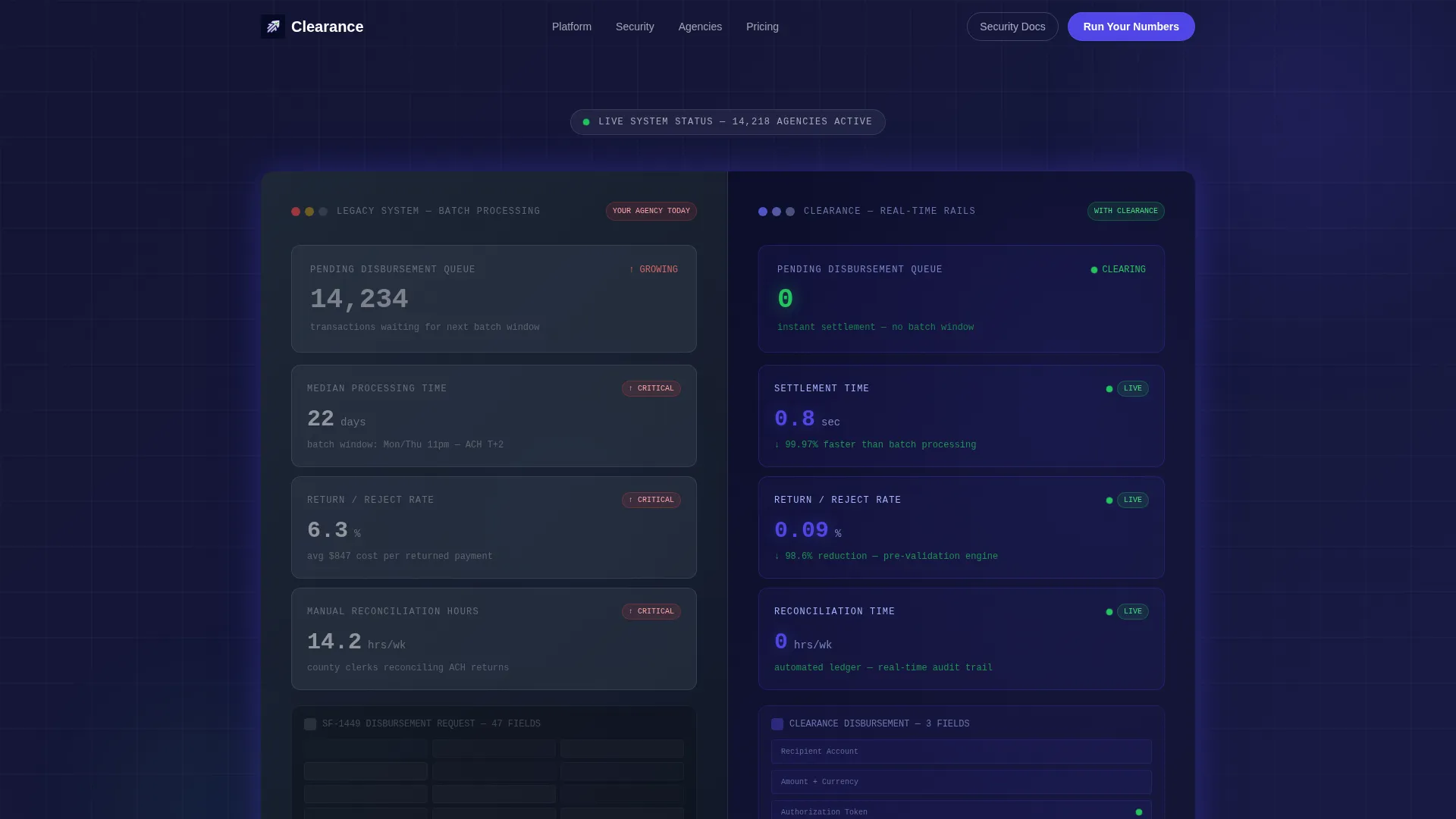
- A live-style Stats and Metrics header that compares old-system numbers against new-system results side by side
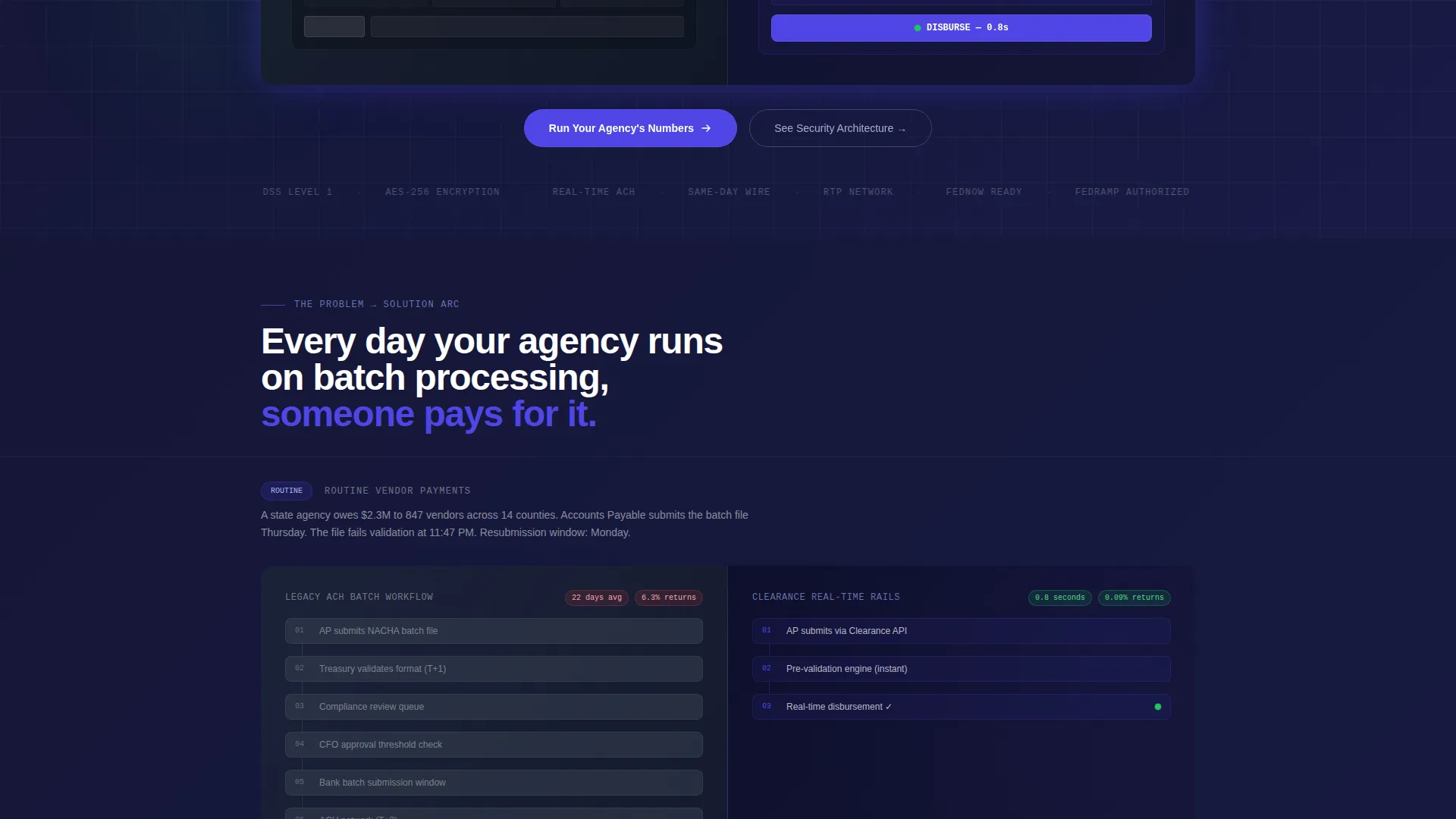
- A scrolling Problem-to-Solution arc with escalating stakes, from routine vendor payments to disaster relief and child welfare
- Two primary conversion paths: a personalized cost-of-delay calculator and a security architecture overview for compliance-focused buyers
Feature list
This template includes a focused set of layout components designed to build trust and drive action with government procurement audiences.
Split-Screen Comparison Layout
The entire page is structured as a 50/50 split. Every section places the legacy workflow on the left and the rebuilt workflow on the right. This side-by-side format lets the difference argue for itself before a single word of copy is read.
Live Metrics Dashboard Header
The opening header presents two panels of operational data frozen mid-operation. The left shows a batch queue past 14,000 transactions, a 22-day median processing time, and a 6.3 percent return rate. The right mirrors those exact metrics under the new system: zero queue, 0.8-second processing, and a 0.09 percent return rate.
Escalating Problem-to-Solution Arc
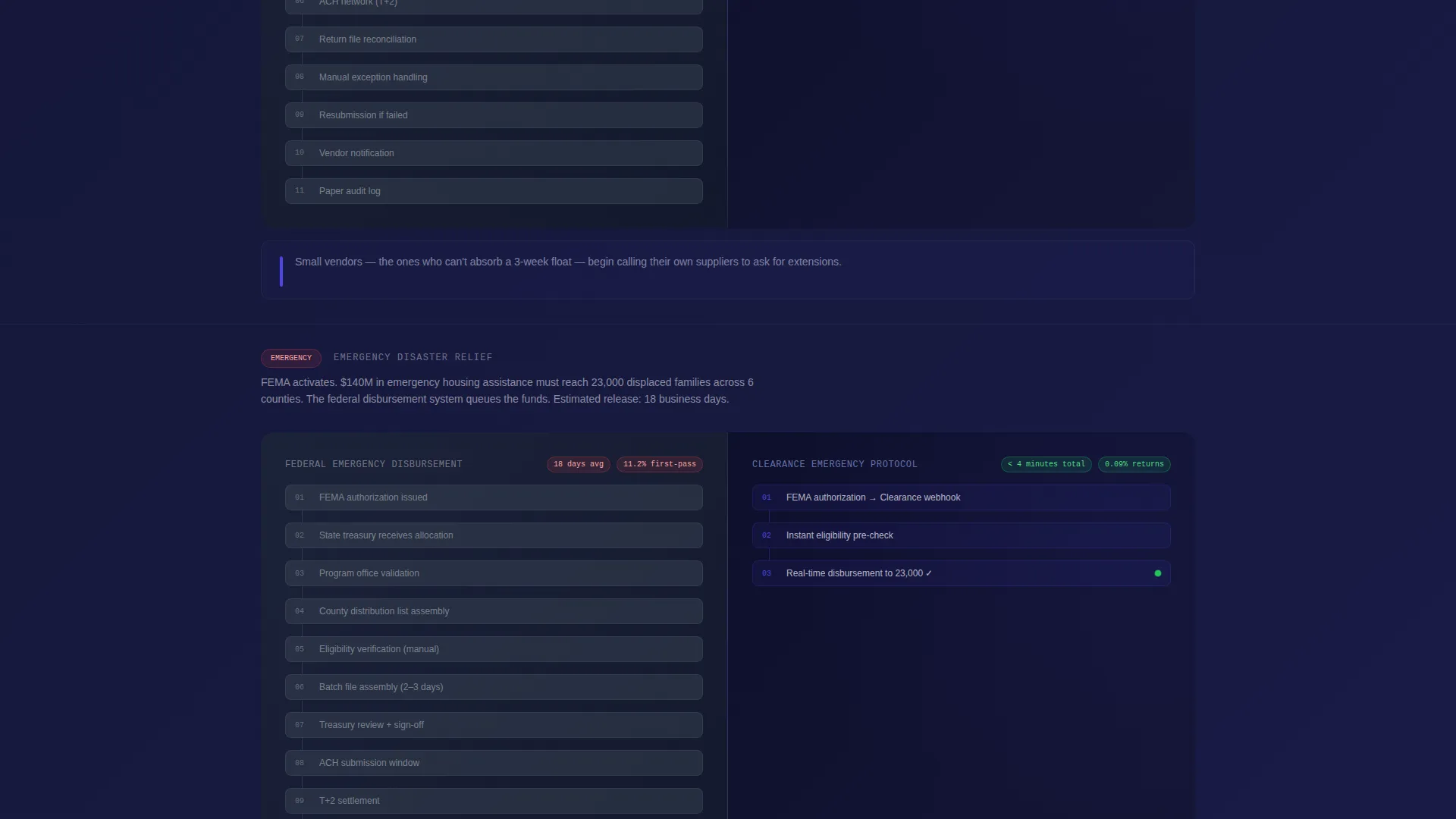
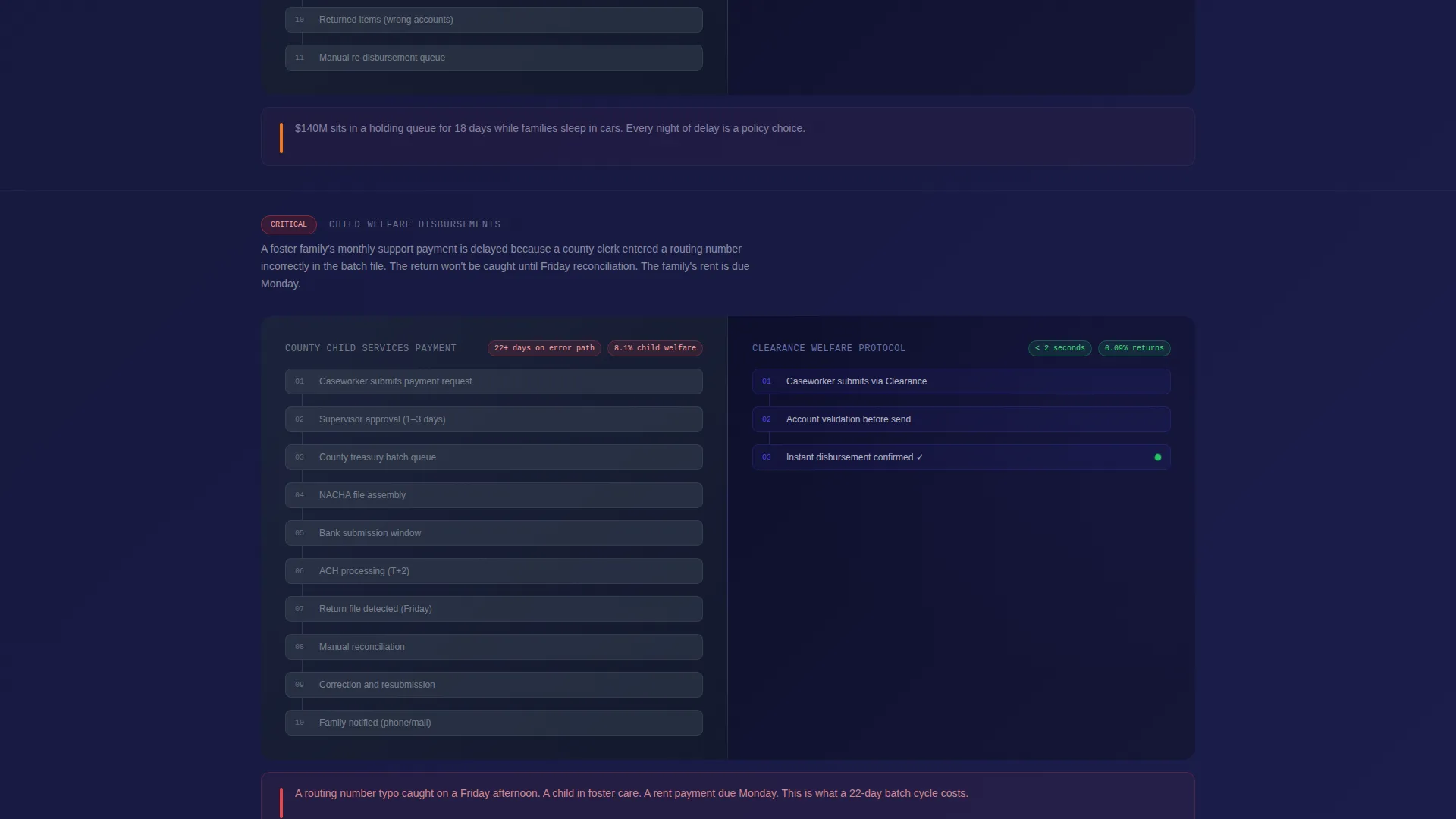
Each scroll section raises the stakes. The arc moves from routine vendor payments through emergency disaster relief and into child welfare disbursements. Legacy artifacts such as 47-field forms, 11-node approval flowcharts, and redacted audit findings anchor the left side, while the right side shows the simplified, real-time alternative.
Personalized Cost-of-Delay Calculator
The primary call to action opens an interactive calculator. Visitors select their agency type, monthly transaction volume, and current average processing days. The tool generates a personalized cost-of-delay report, making the platform's value concrete and specific to each agency's situation.
Dual Conversion Path Design
The template supports two distinct buyer journeys in parallel. Operations and finance leads follow the primary calculator path. Technology and compliance officers follow a secondary path labeled "See the Security Architecture," which addresses concerns around compliance frameworks before any sales conversation begins.
Tech Glass Visual System
The layout uses frosted glass card surfaces, glowing indigo data highlights, and signal green reserved exclusively for confirmed successful states. The palette creates a control-room atmosphere that communicates precision and institutional reliability without feeling cold or corporate.
Page sections overview
| Section | Purpose |
|---|---|
| Metrics Dashboard Header | Compare old versus. new system KPIs side by side |
| Vendor Payment Section | Introduce routine disbursement inefficiency and solution |
| Disaster Relief Section | Escalate stakes with emergency fund delay scenario |
| Child Welfare Section | Peak human-cost moment in the scroll arc |
| Calculator call to action Block | Prompt visitors to generate their agency cost report |
| Security Architecture call to action | Give compliance buyers a dedicated conversion path |
Design & branding system
The visual identity is built around the Tech Glass theme using an Electric Indigo color system. The palette is designed to feel like a government control room operating at full capacity, precise, serious, and alive with real-time data.
- Deep civic navy (#0D0F2B) forms the primary background, grounding the page in institutional weight
- Electric indigo (#4F46E5) powers buttons, data highlights, and active interface states across both panels
- Frosted panel white (#E8EAFF) renders glass-card surfaces, and signal green (#22C55E) appears only on success states and completed transaction confirmations
Mobile & speed optimization
The split-screen layout is structured to adapt clearly across device sizes without losing the comparison logic that drives the page's argument.
- The 50/50 panels are designed to stack cleanly on smaller screens, preserving the before/after narrative in a vertical scroll
- Frosted glass card components and the metrics dashboard are optimized for legibility at reduced viewport widths
How this template helps you convert
The template is built as a Comparison/Versus conversion engine. Every design and copy decision is aimed at reducing doubt and accelerating the decision to engage.
- The metrics header converts skepticism immediately by leading with numbers rather than claims, letting the performance gap make the first argument before any headline appears.
- The escalating scroll arc raises the human cost of inaction section by section, so by the time a visitor reaches the call to action, the emotional and operational case for change is already established.
- The dual conversion paths serve two distinct buyer types in one page, ensuring that both operations leads and compliance officers find a relevant next step without leaving to search elsewhere.
Other information about this template
This template is part of a broader library of government software and civic technology layouts designed for complex B2B (business-to-business) procurement audiences.
- The template is built for teams pitching to public-sector buyers where trust, compliance language, and operational specificity matter more than visual novelty
- The calculator interaction and security architecture path make this layout suitable for platforms that need to satisfy both program directors and chief technology officers in a single visit
- The layout style and visual language are well-suited for government payment processing platforms positioning against incumbent legacy vendors
Theme
Tech Glass
Creative direction
Problem→Solution Arc
Color system
Electric Indigo
Style
Split Screen (50/50)
Direction
Comparison/Versus
Page Sections
Split-screen Comparison Layout
Live Metrics Dashboard Header
Escalating Problem-to-solution Arc
Personalized Cost-of-delay Calculator
Dual Conversion Path Design
Tech Glass Visual Identity
Related questions
Who is this landing page template designed for?
Can I adapt the calculator section for my platform's specific metrics?
Does the template include both conversion paths out of the box?
Is the split-screen layout suitable for mobile viewing?
What makes this template different from a standard software landing page?