Customs & Trade Privacy Policy Website Template
Clearance is a dark, data-command landing page template built for customs brokerages that need to earn enterprise trust fast. It pairs a spec-sheet creative direction with a Carbon Fiber color system, surfacing clearance performance grids, compliance accuracy data, integration specs, and a qualification-first lead capture form, all on one high-impact, desktop-first page.
by Rocket studio
Quick summary
Clearance is a single-page, dashboard-style template for customs brokerages operating at enterprise scale. It leads with a massive performance headline, then walks visitors through port-level clearance data, compliance accuracy methodology, integration specs, and a qualification-first lead form. The tone is precise, confident, and data-forward, every section persuades through specificity rather than adjectives.
Who this template is for
This template is built for customs brokerages that process high entry volumes and want to convert serious B2B buyers rather than tire-kickers. It speaks the operational language of logistics professionals who evaluate brokers on numbers, not marketing copy.
- Freight forwarders managing 200 or more entries per month who need reliable multi-port coverage
- Import compliance managers at regulated goods companies who have been burned by Harmonized Tariff Schedule (HTS) classification errors or agency holds
- Third-party logistics (3PL) operations directors who need one broker capable of clearing across every district without fumbling the handoff
What problem this template solves
Most customs brokerage websites look like every other professional services site. They make claims without proof, list ports without data, and offer contact forms with no qualification. Logistics buyers with real volume need more than that before they pick up the phone.
- Brokers lose credible leads because their sites cannot demonstrate operational scale in a way that a logistics VP finds convincing
- Prospects burned by past classification errors need methodology and accuracy data, not promises, before they commit to a new broker
- High-volume freight forwarders waste time in early conversations because no pre-qualification happens before a human touches the lead
What you get with this template
You get a fully structured, single-page layout designed to do the qualifying work before your sales team gets involved. Every section is built around the data points that enterprise logistics buyers actually care about.
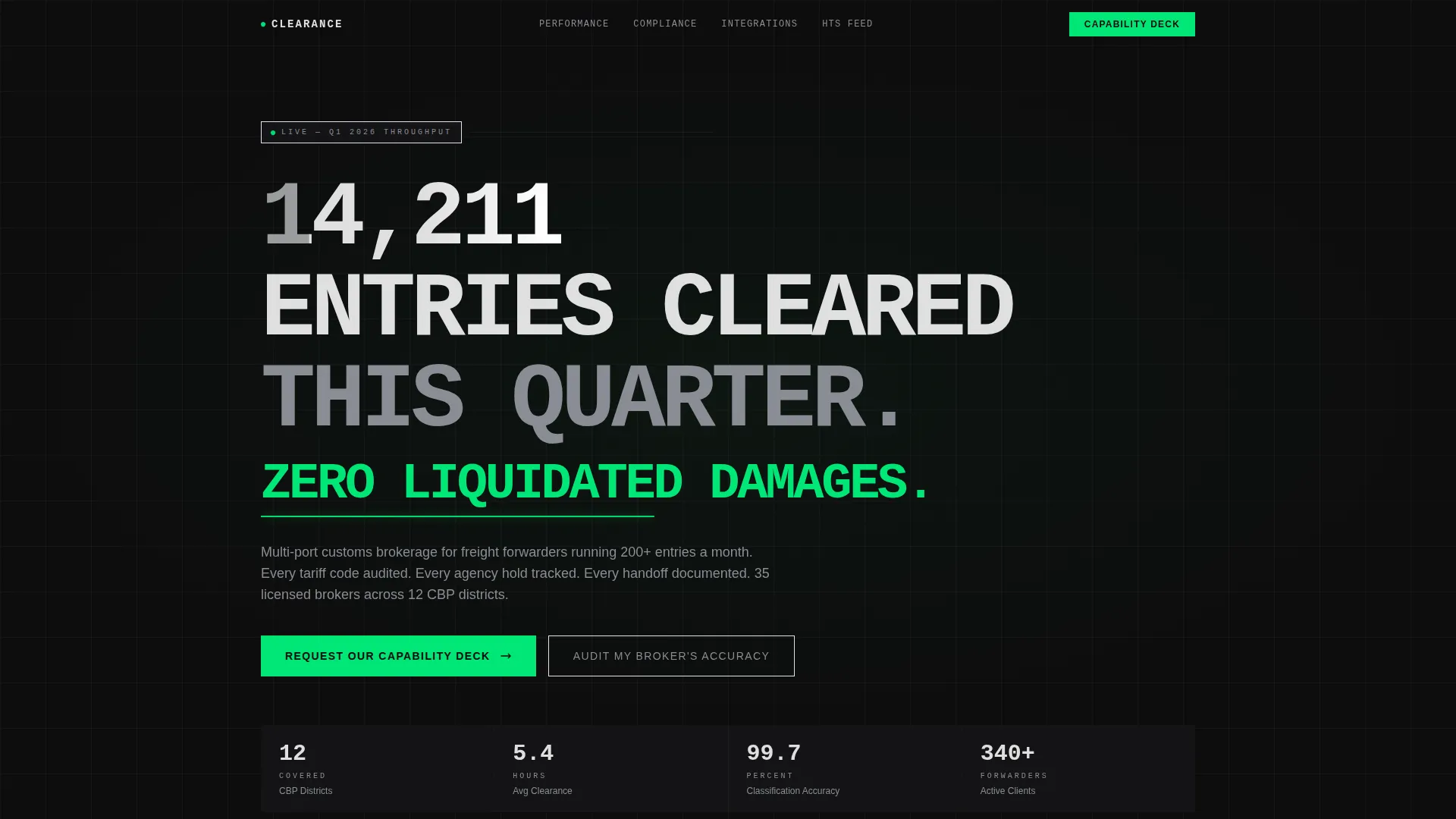
- A hero section with a large-format, data-driven headline and a live-pulsing status indicator that signals operational confidence immediately
- A multi-section spec-sheet layout covering port-level clearance performance, compliance accuracy with methodology, integration specifications, and an HTS classification volume feed
- A dual-path lead capture system with a qualifying capability deck request form and a lower-commitment free compliance audit offer
Feature list
This template includes a focused set of purpose-built components. Each one is designed to do a specific job inside the sales funnel of an enterprise customs brokerage.
Large-Format Data Hero
The hero opens with an enormous, engineered-sans headline displaying a real clearance volume number and a zero-liquidated-damages record. A thin status-green underline pulses beneath the number like a live heartbeat monitor, signaling active operations rather than static branding.
Clearance Performance Data Grid
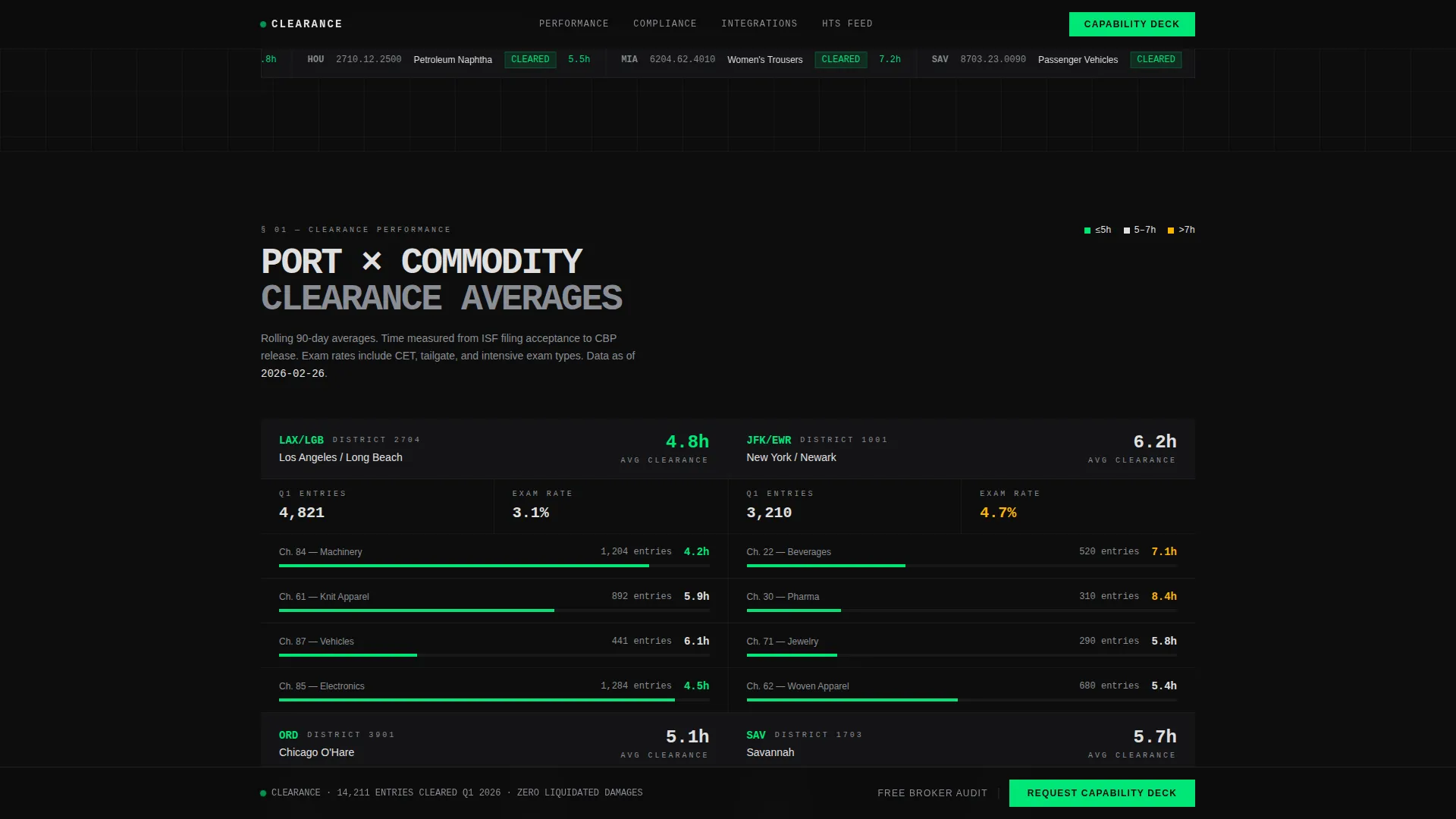
A port-by-commodity clearance time grid breaks down average entry processing times across major United States ports including Los Angeles, New York/JFK, Chicago/O'Hare, Seattle, Houston, Miami, and Savannah. The grid rewards close readers with the operational granularity that only a broker running real volume would dare publish.
Compliance Accuracy Bento Block
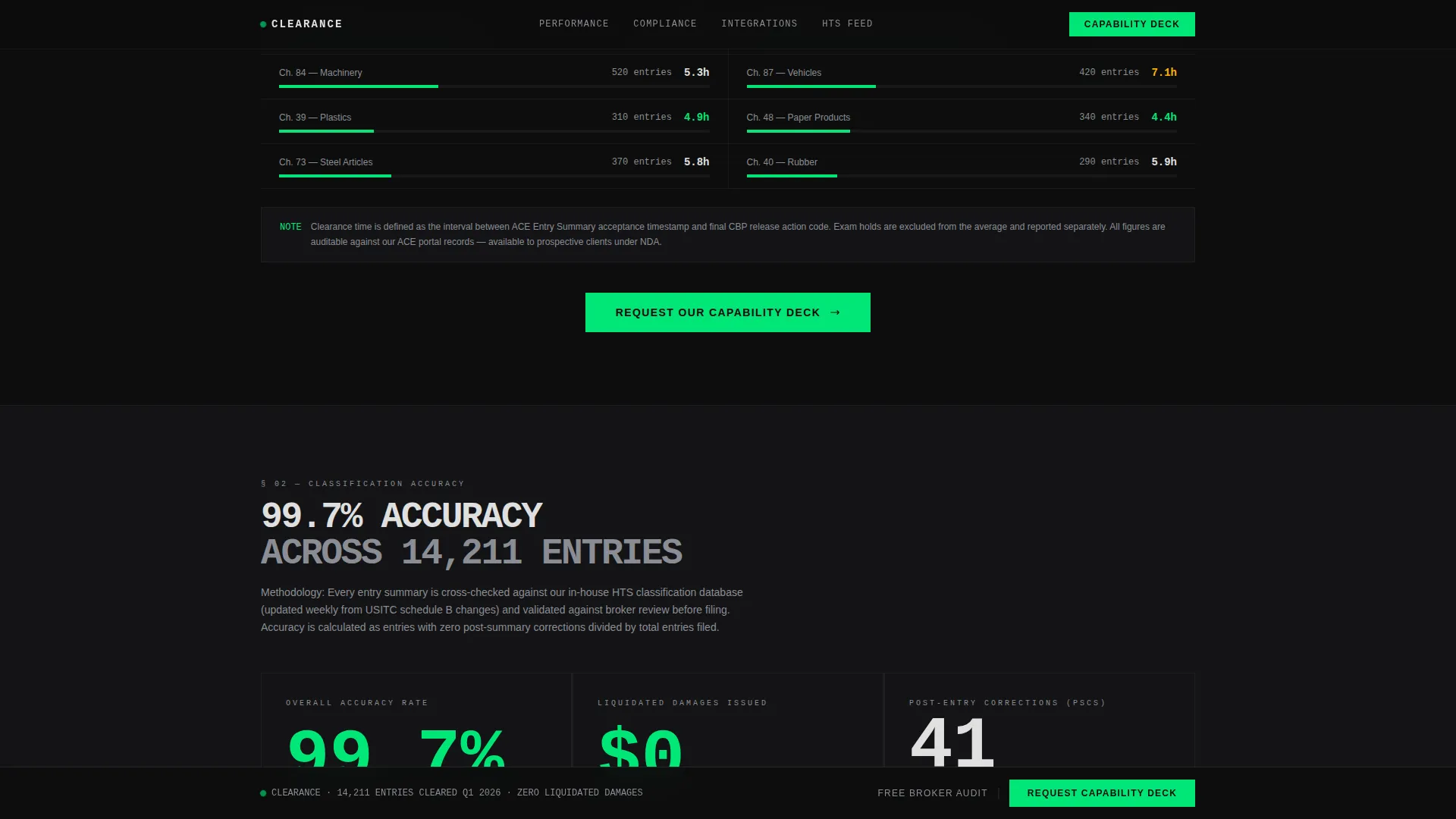
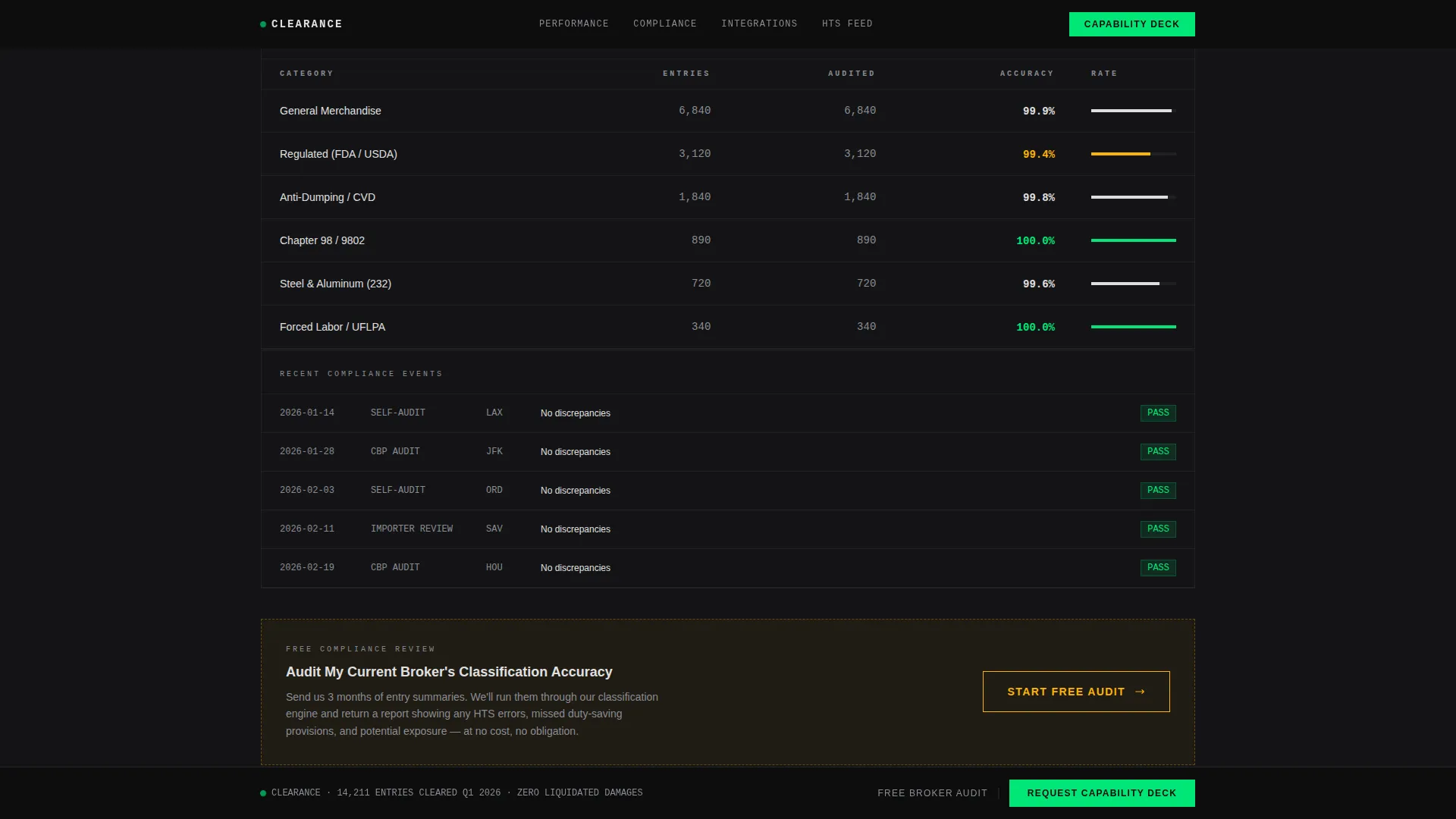
A dedicated bento-style section displays a compliance accuracy percentage alongside a clear breakdown of the methodology used to calculate it. This gives import compliance managers the evidence they need to justify switching brokers internally.
Integration Specifications Panel
A structured data grid presents integration compatibility details for the logistics software platforms and government filing systems relevant to enterprise freight operations. Specifications are displayed in monospaced type to reinforce the technical, spec-sheet aesthetic.
Qualification-First Lead Form
The capability deck request form collects company name, monthly entry volume via a tiered dropdown (under 50, 50 to 200, 200 to 500, and 500 or more), primary port of entry, and work email. Volume qualification happens before any human involvement, keeping the sales pipeline focused on high-fit prospects.
Persistent Call-to-Action Bar
A sticky bottom bar keeps the primary call to action visible throughout the entire scroll journey. A secondary offer for a free broker classification accuracy audit gives hesitant prospects a low-commitment entry point that still surfaces operational pain.
Page sections overview
| Section | Purpose |
|---|---|
| Hero Headline Strip | Opens with a bold clearance volume stat and pulsing live indicator to establish scale immediately |
| Clearance Performance Grid | Shows port-by-commodity average clearance times to demonstrate multi-port operational depth |
| Compliance Accuracy Block | Presents accuracy percentage with methodology to build credibility with compliance-focused buyers |
| Integration Specs Grid | Details software and filing system compatibility in a technical data-grid format |
| HTS Classification Feed | Displays a live-style volume feed of Harmonized Tariff Schedule chapter activity to reinforce active processing |
| Lead Capture Form | Qualifies prospects by monthly entry volume before routing them to the sales team |
| Sticky call to action Bar | Keeps the primary and secondary conversion paths visible at all times during scroll |
| Footer Row | Delivers a clean single-row footer with essential links and contact information |
Design & branding system
The visual identity follows a Data Command theme built on a Carbon Fiber color system. The palette is deliberately functional, every color communicates a specific status rather than decorating the page. The overall feel is a long-haul cockpit instrument panel at cruising altitude: dark, matte, and zero glare.
- Deep carbon black (#0D0D0D) as the primary background, brushed graphite (#2A2D34) for panel surfaces, and cool titanium white (#E0E0E0) for body type
- Status-green (#00E676) reserved exclusively for cleared shipment indicators and live status signals, keeping its meaning unambiguous across all data grids
- Alert amber (#FFB300) used only for action-required states, so the color carries functional weight every time it appears on screen
Mobile & speed optimization
The template is built desktop-first, reflecting the reality that logistics vice presidents and operations directors typically work from large-screen workstations when evaluating broker partners. The layout is fully responsive for mobile use cases as well.
- Server Components power the static sections, keeping the page lightweight for initial load, while Client Components handle animations and interactive data grid states
- Scroll-triggered data reveals, pulsing status indicators, beam animations, and a marquee element add motion without compromising the performance of the static content layer
- Data grid hover states and inline form validation give desktop users an interactive, command-console experience that reinforces the Data Command visual identity
How this template helps you convert
The page is engineered around a Partnership and Business-to-Business (B2B) conversion model. It moves a skeptical enterprise buyer from curiosity to qualified lead through a deliberate sequence of trust signals and commitment steps.
- The data-dense hero and scrolling performance grids establish operational credibility before any call to action appears, so prospects are pre-sold on capability by the time they reach the form
- The volume-tiered dropdown in the lead form qualifies prospects by scale automatically, ensuring the sales team only speaks with freight forwarders and importers who match the brokerage's target entry volume
- The free broker classification accuracy audit offers a low-stakes second path for hesitant buyers, surfacing their current broker's classification pain and creating a natural opening for a consultative sales conversation
Other information about this template
This template is part of the Clearance collection and is categorized under Logistics and Supply Chain, specifically in the Customs and Trade subcategory. It is designed for the customs brokerage niche and carries an intersection match score of 13, indicating a high degree of alignment between the template style and the target industry.
- The template uses DM Sans for user interface text and data labels, and JetBrains Mono for numerical values and tariff codes, creating a clear visual hierarchy between narrative copy and operational data
- Animations include scroll-triggered data reveals, pulsing indicators, beam animations, and a marquee element; interactivity includes data grid hover states, form validation, and a sticky call-to-action bar
- The footer follows a linear single-row pattern, keeping the page clean and focused on conversion rather than secondary navigation
Theme
Data Command
Creative direction
Spec Sheet
Color system
Carbon Fiber
Style
Dashboard/Data Grid
Direction
Partnership/B2B
Page Sections
Large-format Data Hero
Port-by-commodity Performance Grid
Compliance Accuracy Bento Block
Integration Specifications Panel
Qualification-first Lead Form
Persistent Sticky Call to Action Bar
Related questions
Who is the primary audience for this landing page template?
Can I update the performance numbers and port data shown in the grids?
What does the lead form collect and why?
What is the secondary conversion path in this template?
Is this template suitable for a brokerage that covers only a few ports?