Clearance — Reliable Trade-Compliance Landing Page Template
Clearance is a single-column landing page template built for wine and spirits customs brokers. It leads with hard compliance data, walks visitors through a self-filing versus broker comparison, and closes with a focused lead-capture form. The charcoal and amber design system communicates authority and precision from the first scroll.
by Rocket studio
Quick summary
Clearance is a conversion-focused landing page template designed for wine and spirits customs brokers. It opens with an isometric import pipeline illustration, anchors every section in compliance statistics, and drives visitors toward a rate comparison request. The layout is a single-column flow built around a Stats-First approach and a Comparison/Versus conversion path.
Who this template is for
This template is built for businesses that move alcohol shipments through customs and need to prove their value before a prospect ever picks up the phone. It speaks directly to the brokerage side of the wine and spirits import industry.
- Customs brokers specializing in wine, spirits, or both
- Boutique import firms handling multi-country allocations
- Logistics providers serving restaurant groups or direct-to-consumer wine programs
What problem this template solves
Most importers do not realize how much self-filing costs them until a pallet sits on a dock for three weeks. This template makes that cost visible and positions the brokerage as the faster, cheaper alternative.
- Demurrage fees, compliance holds, and permit delays are hard to quantify without a direct comparison
- Importers juggling TTB permits, Certificate of Label Approval filings, and FDA prior notice often underestimate the complexity
- Boutique buyers and restaurant groups need proof, not promises, before switching from self-filing
What you get with this template
The template delivers a complete single-page layout structured around data-led persuasion. Every section earns the next scroll with a statistic before a sentence.
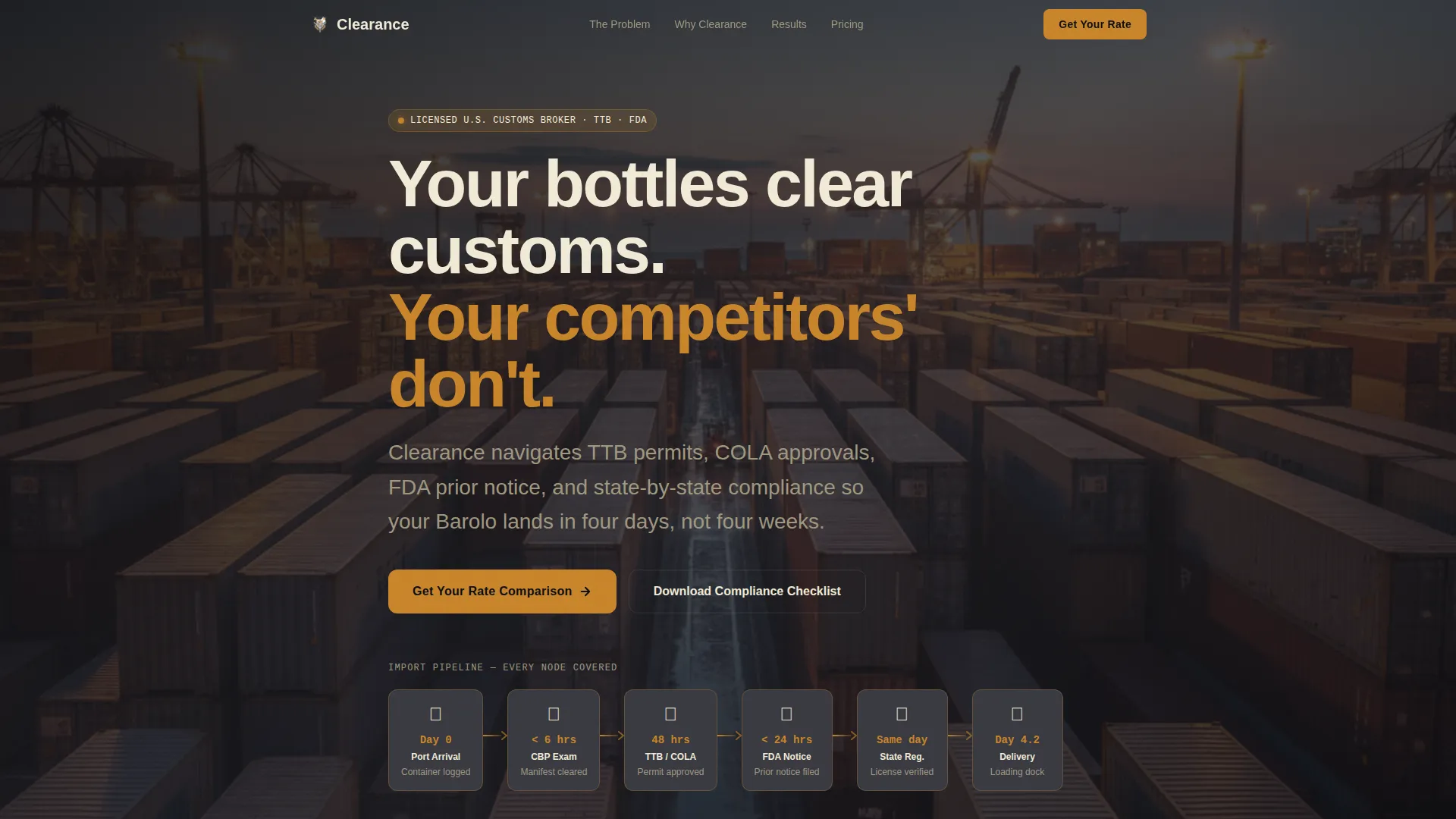
- A full isometric header illustration showing the customs pipeline from cargo ship to restaurant loading dock
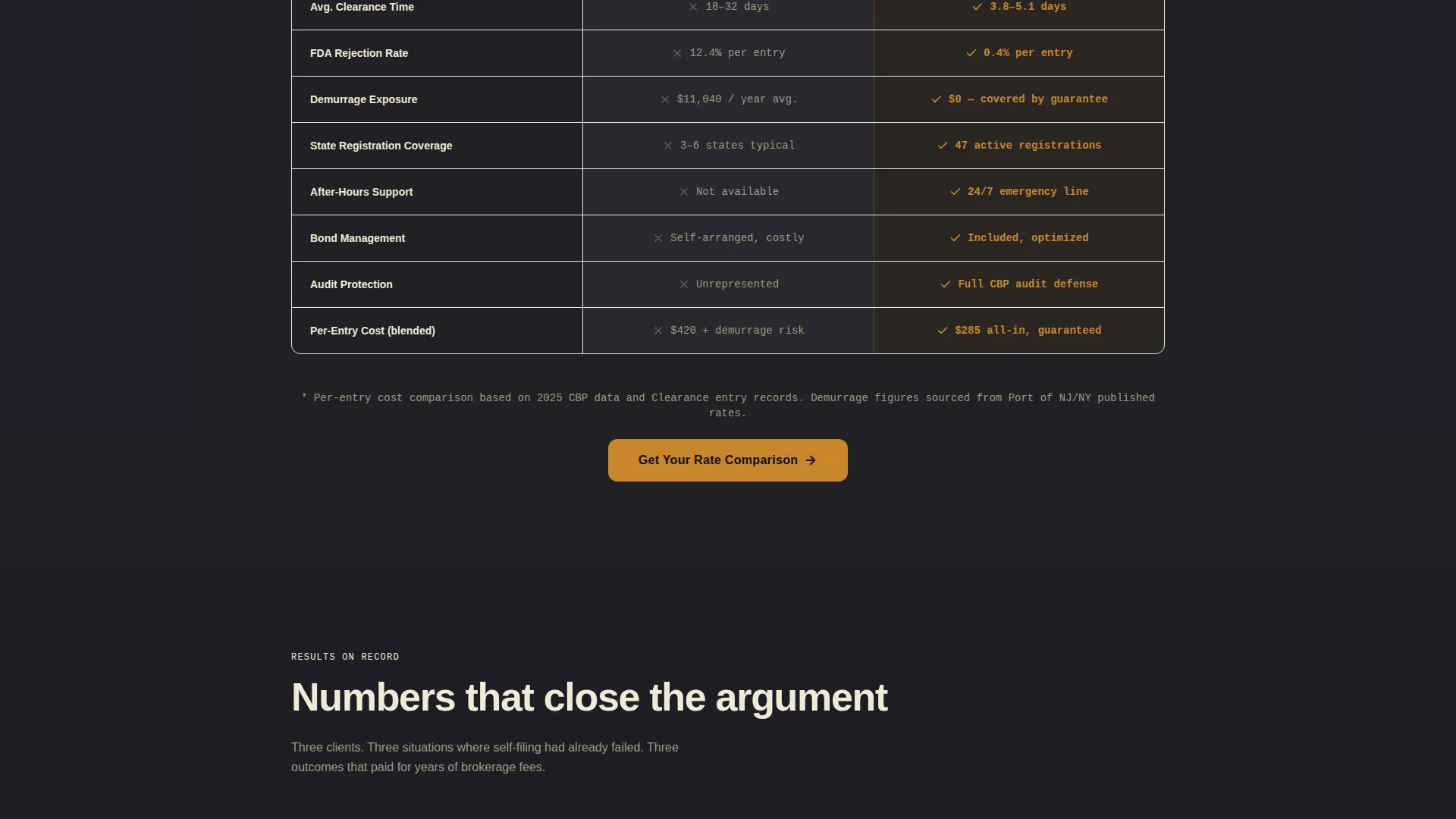
- A side-by-side versus table comparing self-filing against brokerage across eight measurable dimensions
- Three single-stat case study cards and a dual-path lead capture form with both a consultation request and a gated checklist download
Feature list
The Clearance template includes a set of purpose-built sections and components drawn directly from the brief.
Isometric Pipeline Header
The header renders the entire import process as a connected schematic. A cargo ship, a document approval node, a state compliance checkpoint, and a delivery truck are illustrated in a bird's-eye cutaway. Each node carries a live-feeling statistic: average clearance time, first-pass approval rate, and total Certificate of Label Approval filings.
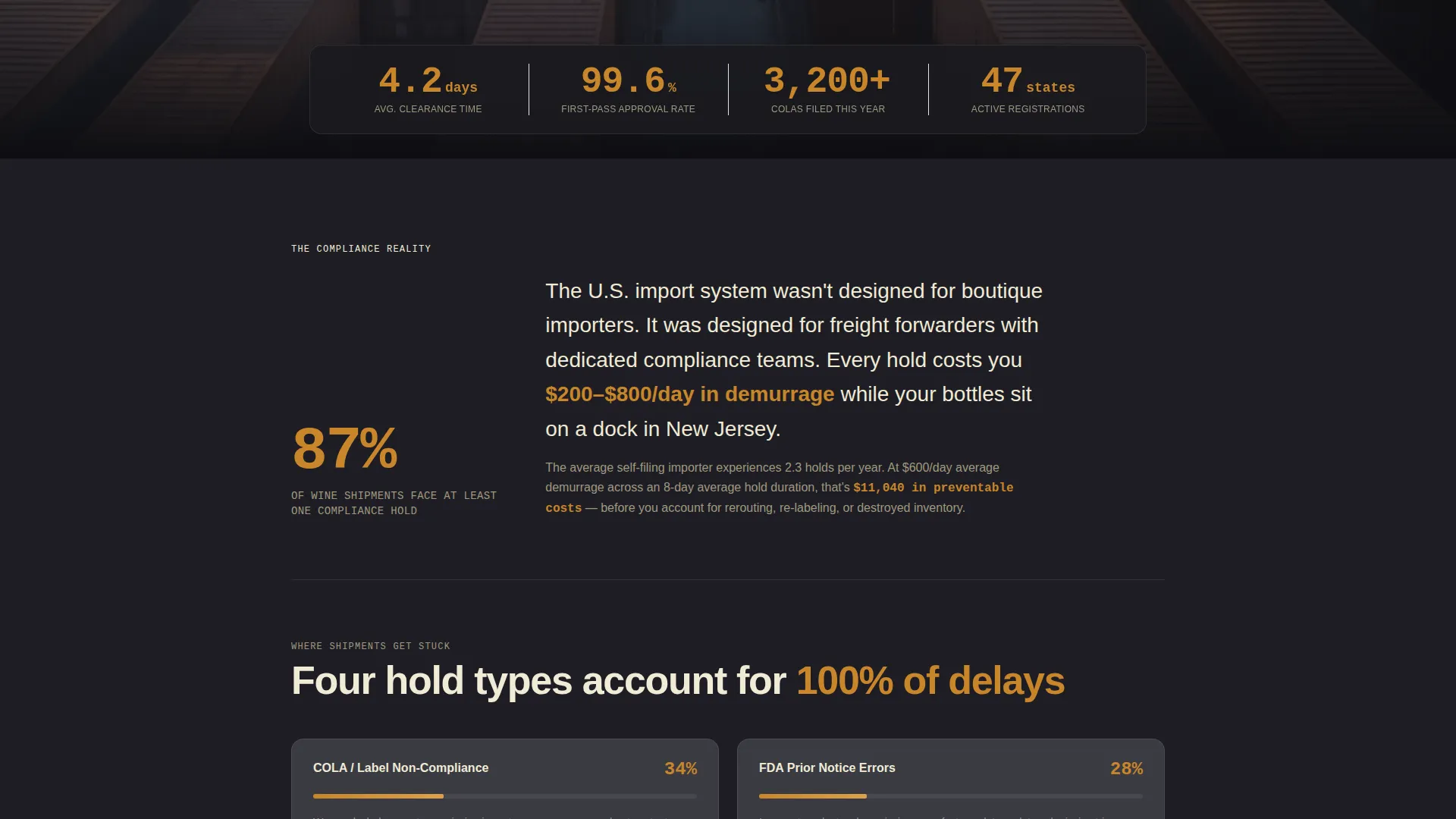
Stats-First Section Architecture
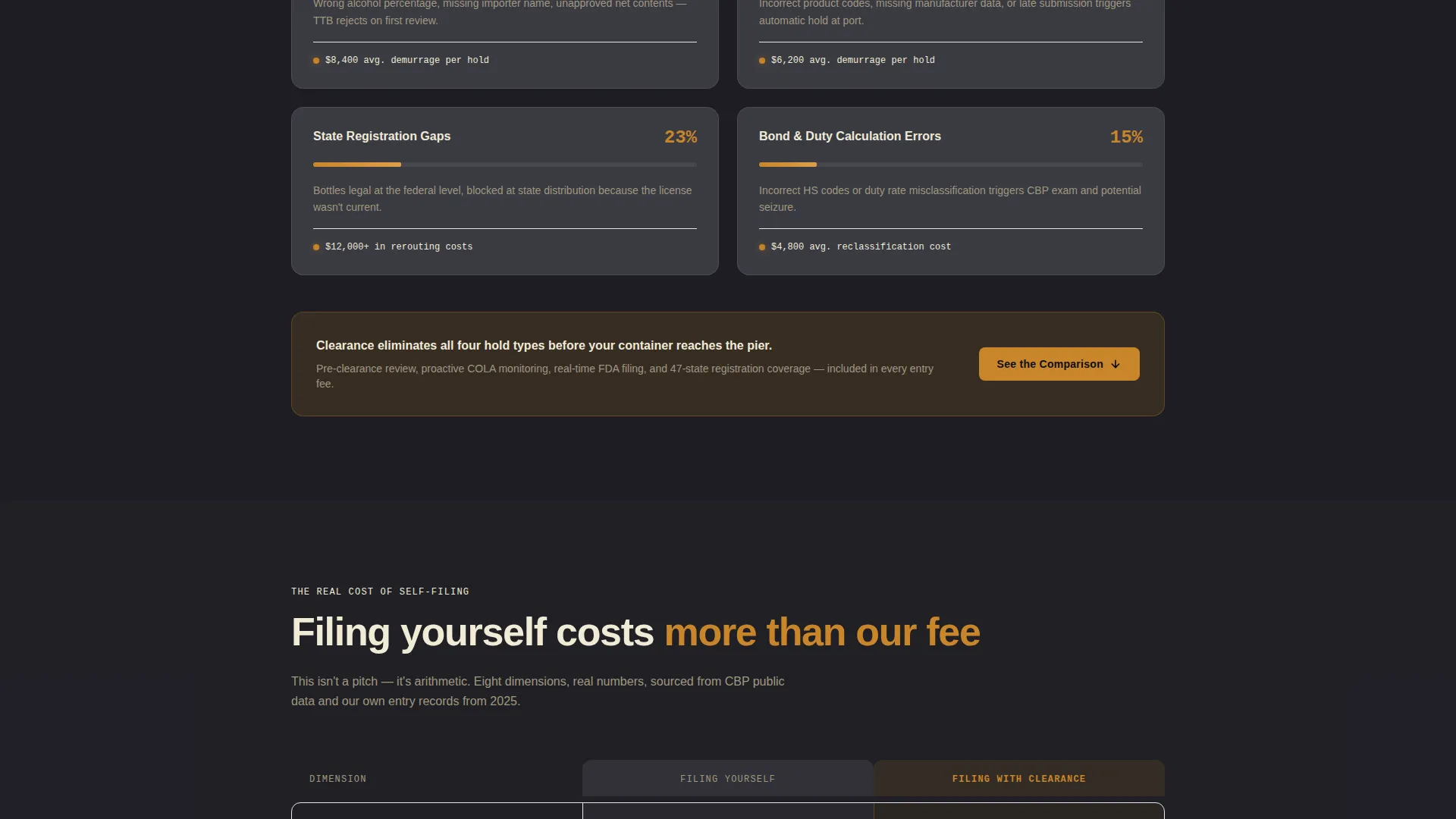
Every scroll begins with a number before a narrative. The first section below the fold opens with a bold compliance hold statistic, then unpacks how each hold type is eliminated. This pattern repeats throughout the page so data always precedes explanation.
Comparison Engine Table
A full-width versus table contrasts self-filing against broker-assisted filing across eight dimensions: clearance time, FDA rejection rate, demurrage costs, state registration coverage, after-hours support, bond management, audit protection, and per-entry cost. Amber checkmarks highlight broker advantages; charcoal marks indicate self-filing gaps.
Single-Stat Case Study Cards
Three stacked cards present real-outcome numbers. Each card leads with one dollar figure or operational result, then adds a short prose explanation. The format keeps the proof visible and scannable without requiring the visitor to read long paragraphs.
Dual-Path Lead Capture
The primary form collects three fields in sequence: annual import volume, primary product type, and business email. A secondary path offers a gated Importer's Compliance Checklist download, capturing only email and company name. Both paths are present on the same page, allowing visitors at different buying stages to self-select.
Sticky Mobile Call to Action
On mobile viewports, a fixed bottom bar keeps the primary call to action visible throughout the scroll. The bar carries the "Get Your Rate Comparison" prompt and stays anchored without blocking the content above it.
Page sections overview
| Section | Purpose |
|---|---|
| Isometric pipeline header | Establishes the import workflow and anchors key performance stats visually |
| Compliance hold opener | Opens below the fold with a problem statistic to earn continued reading |
| Self-filing versus brokerage | Compares eight dimensions side by side to make the cost of self-filing concrete |
| Case study cards | Stacks three outcome-focused stat cards to validate brokerage performance |
| Primary rate comparison form | Captures three-field lead data from visitors ready to speak with the brokerage |
| Checklist download path | Offers a gated PDF download for visitors not yet ready to request a quote |
| Sticky mobile bar | Keeps the primary call to action accessible on smaller screens throughout scroll |
Design & branding system
The visual identity follows a Service Utility theme built around a Charcoal and Amber color system. The palette evokes the interior of a customs bonded warehouse at early morning: industrial, precise, and no-nonsense.
- Background uses deep dock charcoal (#1E1E24); card surfaces use bonded-warehouse gray (#3A3A42); body text renders in parchment (#F0EAD6)
- Aged-barrel amber (#C8852A) is applied exclusively to statistics, interactive elements, call-to-action buttons, and status indicators
- Color is earned, not decorative: amber appears only where the visitor's eye needs to land
Mobile & speed optimization
The template is structured to maintain clarity and hierarchy on smaller screens without sacrificing the data-dense layout.
- The versus table is designed to remain legible on mobile viewports with horizontal scroll or stacked row behavior
- The sticky bottom bar replaces the inline call-to-action placement on mobile, keeping the conversion path one tap away at all times
How this template helps you convert
The page is built around a Comparison/Versus conversion strategy. Every design and copy decision moves the visitor from problem awareness to rate request.
- The stats-first structure leads with compliance hold data, making the cost of inaction concrete before asking for anything
- The versus table answers the most common objection ("I can file myself") with eight measurable comparisons, eliminating doubt before the form appears
- The dual-path form captures both high-intent visitors ready to request a rate and lower-intent visitors who want the compliance checklist first
Other information about this template
This template sits within the Logistics and Supply Chain category, specifically the Wine and Spirits Logistics subcategory. It is designed for the Wine and Spirits Customs Broker niche and carries an intersection match score of 13, indicating a tight alignment between the template style, creative direction, and the specific market it serves.
- The template style is Single Column Flow, which keeps the persuasion path linear and reduces decision fatigue
- The creative direction is Stats-First Impact, meaning every section opens with a data point rather than a headline claim
- The header concept is Isometric, providing a schematic and mechanical visual rather than a lifestyle or aspirational illustration
- The landing page direction is Comparison/Versus, built to convert visitors who arrive with an existing self-filing habit
Theme
Service Utility
Creative direction
Stats-First Impact
Color system
Charcoal & Amber
Style
Single Column Flow
Direction
Comparison/Versus
Page Sections
Isometric Pipeline Header Illustration
Stats-first Section Architecture
Eight-dimension Comparison Table
Single-stat Case Study Cards
Dual-path Lead Capture Form
Sticky Mobile Call-to-action Bar
Related questions
Who is this landing page template designed for?
Can I customize the statistics in the header and case study cards?
What does the dual-path lead capture form include?
Does the comparison table work on mobile devices?
Is this template suitable for a spirits-only or wine-only brokerage?