Sociology Flashcard App Landing Page Template
Cohort is a sociology flashcard and review landing page template built for students who need to memorize theory fast. It pairs spaced repetition flashcards with adaptive quizzes, a curriculum comparison table, and an honest feature grid. The design feels like a well-annotated study guide, calm, organized, and built to earn trust before every click.
by Rocket studio
Quick summary
Cohort is a single-page template for a sociology flashcard and review app. It combines a live flashcard header, a curriculum comparison table, and an FAQ-driven scroll flow that mirrors real student anxiety. The design uses a warm, low-contrast palette to feel reassuring at 2 a.m. Every section moves a visitor closer to signing up or downloading a free resource.
Who this template is for
This template is built for sociology education products that need to earn student trust quickly. It speaks directly to learners who are under exam pressure and want evidence before they commit to a new study tool.
- Second-year sociology undergrads preparing for midterms and finals
- Mature students returning to education after a long break from academic writing
- A-level pupils working through topics like functionalism and conflict theory before January mocks
What problem this template solves
Students searching for sociology revision tools are skeptical. They have tried generic flashcard apps before and found them too shallow for exam-board-specific content. This template addresses that distrust directly by showing curriculum coverage, honest feature comparisons, and a low-friction signup path.
- Removes doubt about curriculum fit with a comparison table of supported exam boards
- Replaces vague marketing claims with an honest, checkmark-based feature grid
- Converts hesitant visitors into free-trial users without asking for payment details upfront
What you get with this template
The template delivers a fully structured, single-page layout designed around real student decision points. Each section earns trust before asking for any action. The page ends with a clear, repeated call to action and a secondary lead-capture path for visitors who are not yet ready to sign up.
- A live flashcard header section framed as a free trial invitation
- An FAQ-driven scroll flow with a curriculum comparison table and spaced repetition explainer
- A sticky mobile call-to-action bar and a secondary PDF cheat sheet download path
Feature list
This template is built around prompt-backed components that reflect genuine student behavior and real product clarity.
Live Flashcard Header
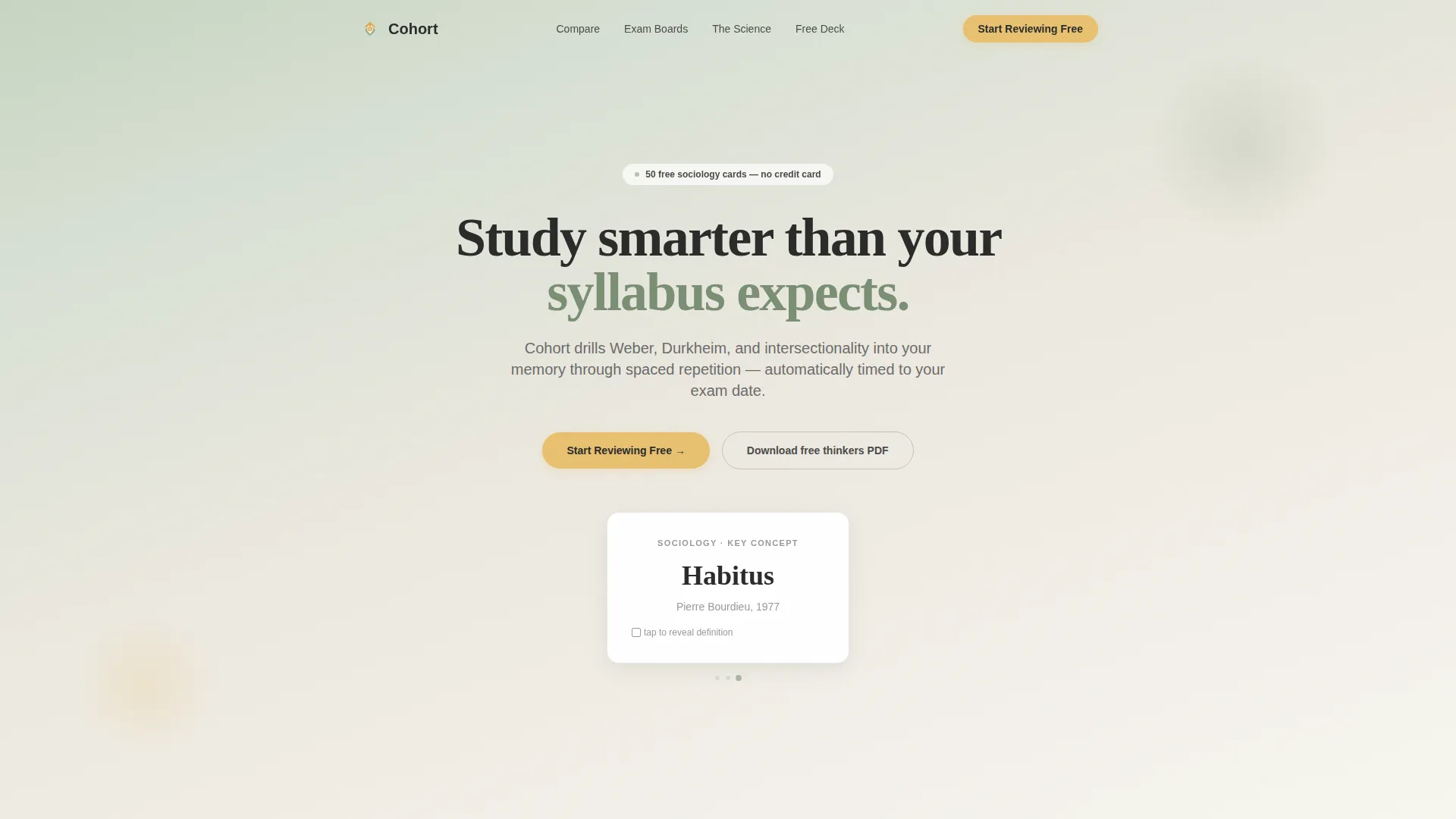
The header presents a sociology term mid-flip, with one side showing the word and the other revealing a concise definition with a source citation. A soft sage-to-white gradient sits behind it, and the headline and amber pill button are immediately visible without scrolling.
Curriculum Comparison Table
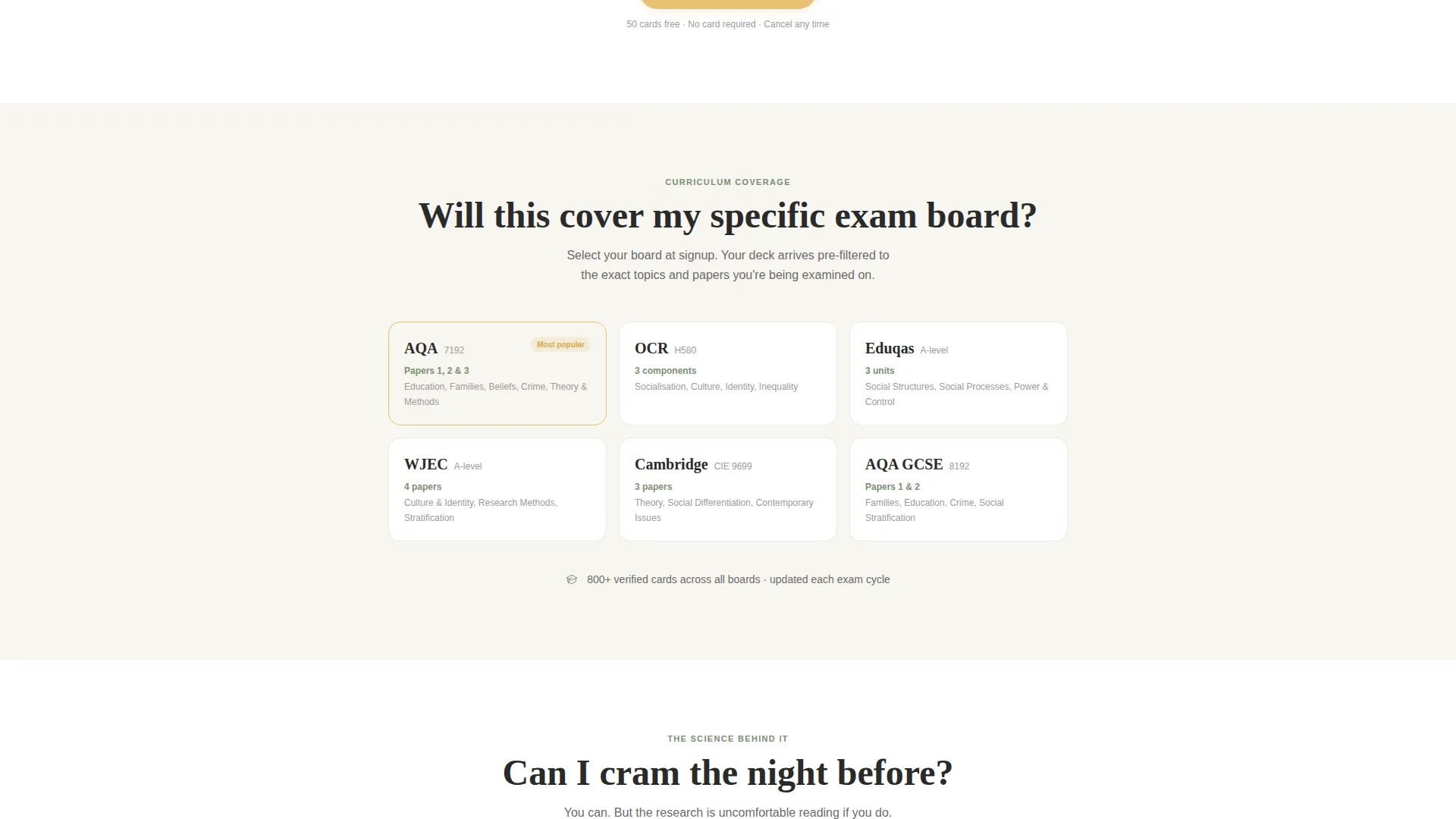
A structured table shows which exam boards and curricula the app supports. It answers the real question students type first and removes the single biggest reason a visitor would leave without converting.
Honest Feature Comparison Grid
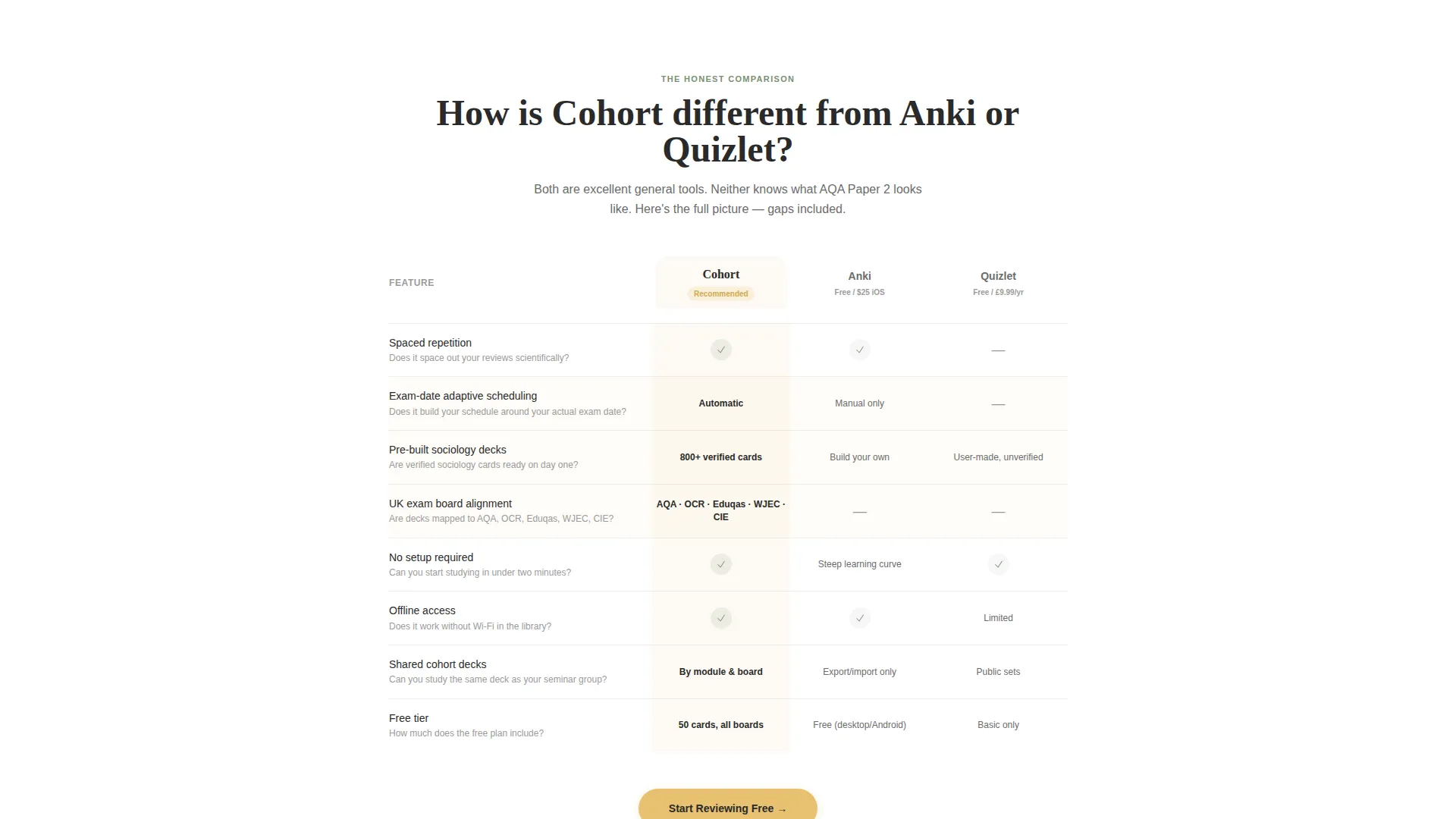
A side-by-side grid compares app features against competing study tools. Checkmarks appear in sage where features exist. Gaps are left honestly blank rather than filled with vague claims.
Spaced Repetition Explainer
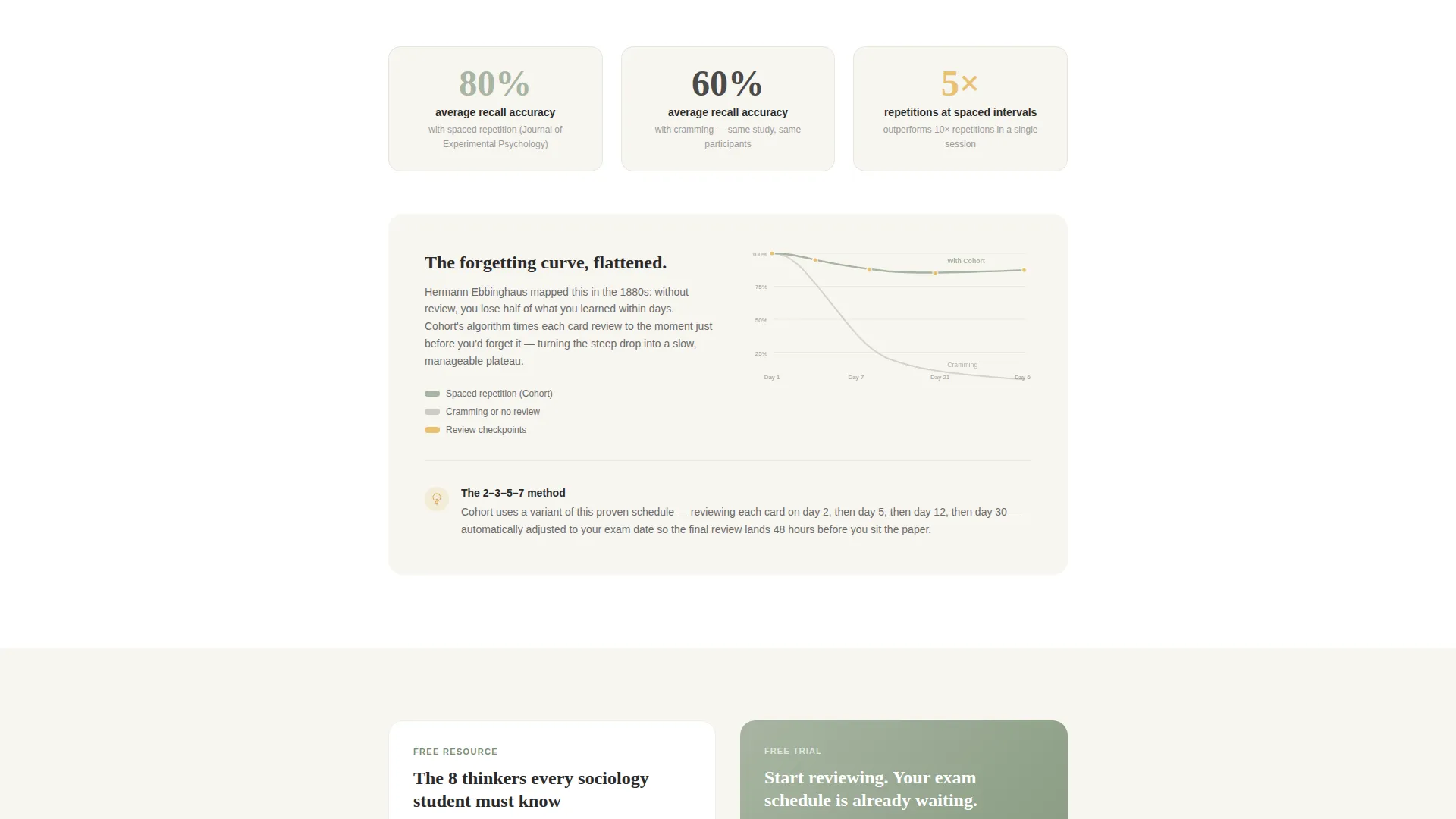
A dedicated section introduces the spaced repetition algorithm using a simple retention-curve timeline graphic. It answers the cram question directly and explains why the method works better than last-minute reading.
Zero-Friction Signup Form
The primary call-to-action opens a signup form that asks only for an email address, exam date, and exam board selected from a dropdown. No payment details are required to start.
PDF Cheat Sheet Download Path
A secondary conversion path offers a free PDF summary of key sociological thinkers in exchange for an email address. Visitors who are not ready to commit still leave with something useful and a reason to return.
Page sections overview
| Section | Purpose |
|---|---|
| Live Flashcard Header | Opens with a free trial invitation framed as a term mid-flip |
| Primary Headline Block | States the value proposition and free deck count |
| Curriculum Comparison Table | Confirms exam board and syllabus coverage |
| Feature Comparison Grid | Shows honest checkmark comparison against competing tools |
| Spaced Repetition Explainer | Explains the retention algorithm with a timeline graphic |
| Primary Call to Action | Places "Start Reviewing Free" after the comparison table |
| PDF Cheat Sheet Offer | Captures emails via a free sociological thinkers download |
| Sticky Mobile Bar | Repeats the primary call to action on mobile scroll |
| FAQ Section | Addresses real late-night student questions in sequence |
Design & branding system
The visual identity follows an Educational Guide theme built around the Soft Mist color system. Every color choice reinforces calm focus rather than urgency or pressure. The product itself is the visual, no stock photography of students appears anywhere on the page.
- Chalk-dust white (#F7F5F0) and seminar-room sage (#A8B5A2) form the page background and text hierarchy
- Pencil-graphite gray (#4A4A4A) handles body text and secondary labels for clean readability
- Muted highlighter amber (#E8C170) is reserved for interactive elements, active table cells, and the primary call-to-action button
Mobile & speed optimization
The template is structured for a smooth experience on small screens, where most late-night revision sessions happen. The sticky bottom bar keeps the primary call to action reachable without scrolling back to the top.
- Sticky mobile call-to-action bar repeats "Start Reviewing Free" throughout the scroll journey
- The signup form is minimal by design, asking only three fields to reduce drop-off on mobile keyboards
- The comparison table and feature grid are laid out to remain scannable on narrow viewports
How this template helps you convert
Every design and copy decision in this template is built around reducing the specific fears that stop sociology students from signing up for a new study tool.
- The curriculum comparison table answers the first trust question before the visitor even thinks to ask it, removing the most common reason for leaving without acting.
- The honest feature grid builds credibility by leaving gaps blank, which makes the checkmarks that do appear far more believable and persuasive.
- The two-path conversion structure means visitors who are not ready to subscribe still leave with a free PDF and an email relationship, keeping the door open for a return visit.
Other information about this template
This template is part of the Cohort adaptive learning template collection, designed for education products in the sociology and social sciences space. It is well-suited for course creators, edtech startups, and independent tutors building a sociology flashcard or review app landing page.
- The template style is a Comparison Table layout, making it directly useful for products that need to differentiate from well-known flashcard tools
- The FAQ-driven creative direction mirrors the question patterns students use when searching for revision tools at exam time
- The header concept is built around a Free Trial invitation, which aligns with the content and resource destination intent of the page
- This template is a strong fit for products competing in the sociology education niche, where curriculum specificity and honest claims carry more weight than polished visuals
Theme
Educational Guide
Creative direction
FAQ-Driven
Color system
Soft Mist
Style
Comparison Table
Direction
Content/Resource
Page Sections
Live Flashcard Header Section
Curriculum Comparison Table
Honest Feature Comparison Grid
Spaced Repetition Explainer
Zero-friction Free Trial Signup
PDF Cheat Sheet Lead Capture
Related questions
Can I customize the exam boards shown in the comparison table?
Does the template include actual sociology flashcard content?
Is the sticky mobile call-to-action bar included in the template?
What information does the free trial signup form collect?
Can this template work for subjects other than sociology?