Dynamic Hospitality Network Landing Page Template
Switchboard is a real-time hospitality directory listing landing page template built for hotel owners ready to break free from costly online travel agency commissions. It combines a live-filterable listing grid, animated pain metrics, and a direct comparison table into one sleek, dashboard-style landing page. Hotels, boutique stays, and serviced apartments across 200-plus cities get a high-visibility stage for direct bookings.
by Rocket studio
Quick summary
Switchboard is a dashboard-style landing page template for hospitality directory and listing platforms. It connects travelers with vetted hotels, boutique stays, and serviced apartments across 200-plus cities. The design channels a Bloomberg-terminal aesthetic: luminous data on deep navy, Electric Indigo accents, and reactive cyan hover states. Every section drives one action: get hotel owners to list their property free and keep their revenue.
Who this template is for
This template is built for founders and operators who want to create a hospitality directory website that competes with the big online travel agency platforms. It fits teams that need a polished, data-forward landing page without writing custom code from scratch.
- Mid-market hotel owners losing 20 to 25 percent of room revenue to OTA commissions who want direct booking alternatives
- Travel agents and booking agencies assembling group reservations at speed across multiple locations
- Digital nomads and property managers seeking a platform that showcases a hotel's offerings with verified pricing and real availability
What problem this template solves
Hotels and resorts are losing significant money to online travel agency giants every year. Guests rarely realize that booking direct saves them around fifteen percent, and hotel owners rarely have the tools to prove it fast. A generic website or cluttered directory listing page cannot make that case on its own.
- Visitors cannot easily browse, filter, or compare hotels by amenity, price band, or guest rating in one place
- Hotel owners have no fast way to show travelers why direct bookings beat OTA platforms on cost and listing control
- Property managers waste time on manual setups that do not reflect real-time room availability or current pricing
What you get with this template
You get a complete, production-ready landing page structured around a clear problem-to-solution arc. Every section is designed to move visitors from awareness to action. The template provides all the visual and structural elements needed to launch a compelling hospitality directory site.
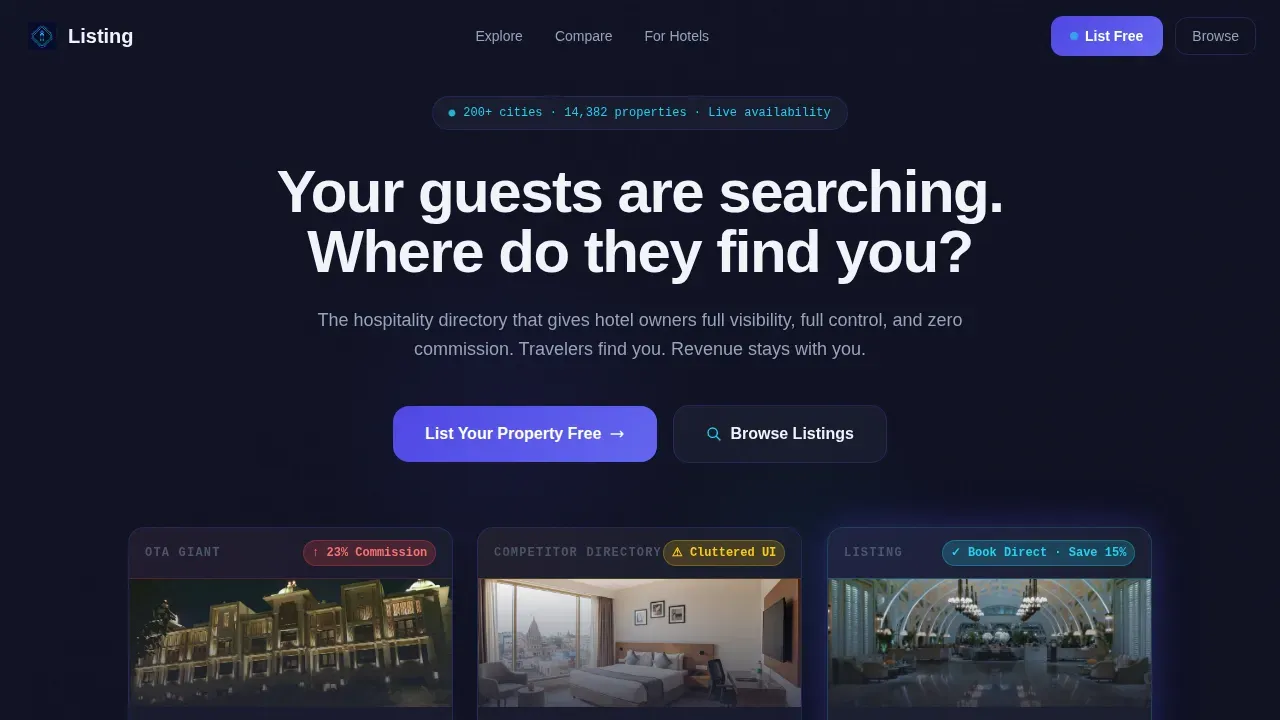
- A hero section with three Dark Glass Panel comparison cards, a typing headline, and scroll-tilt animation
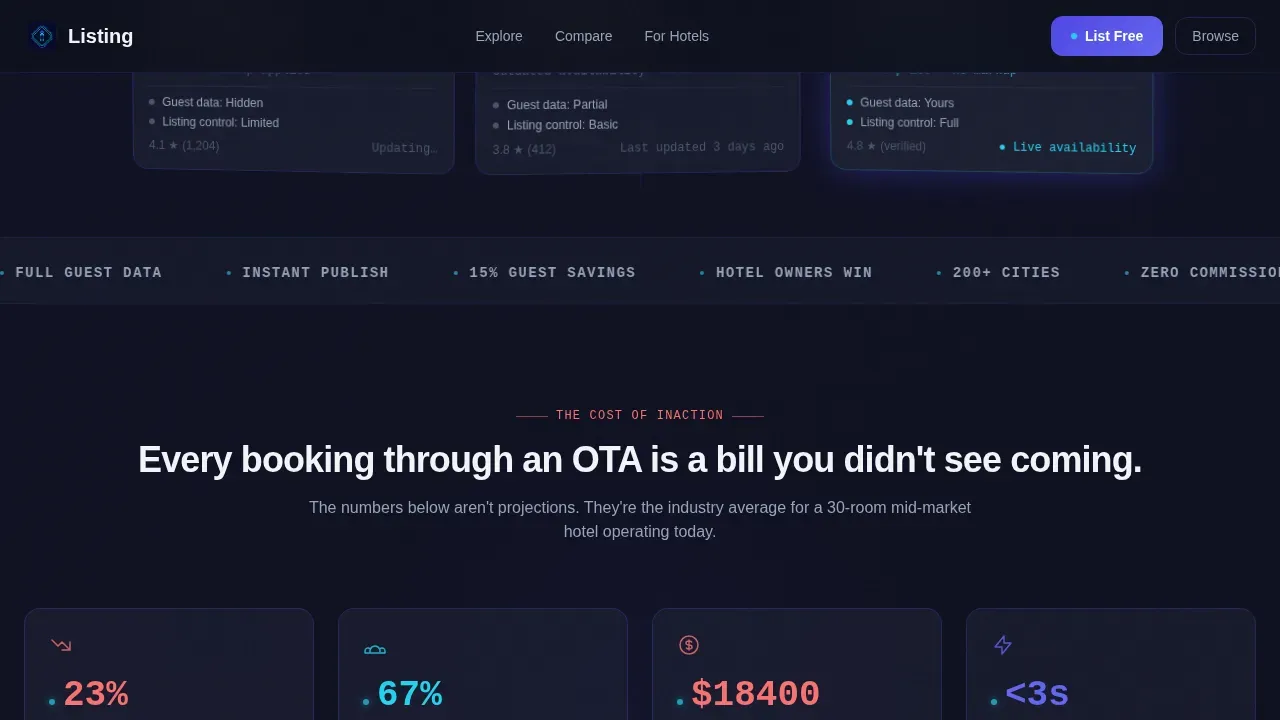
- An animated pain metrics section with counters displaying OTA commission rates and revenue lost per room
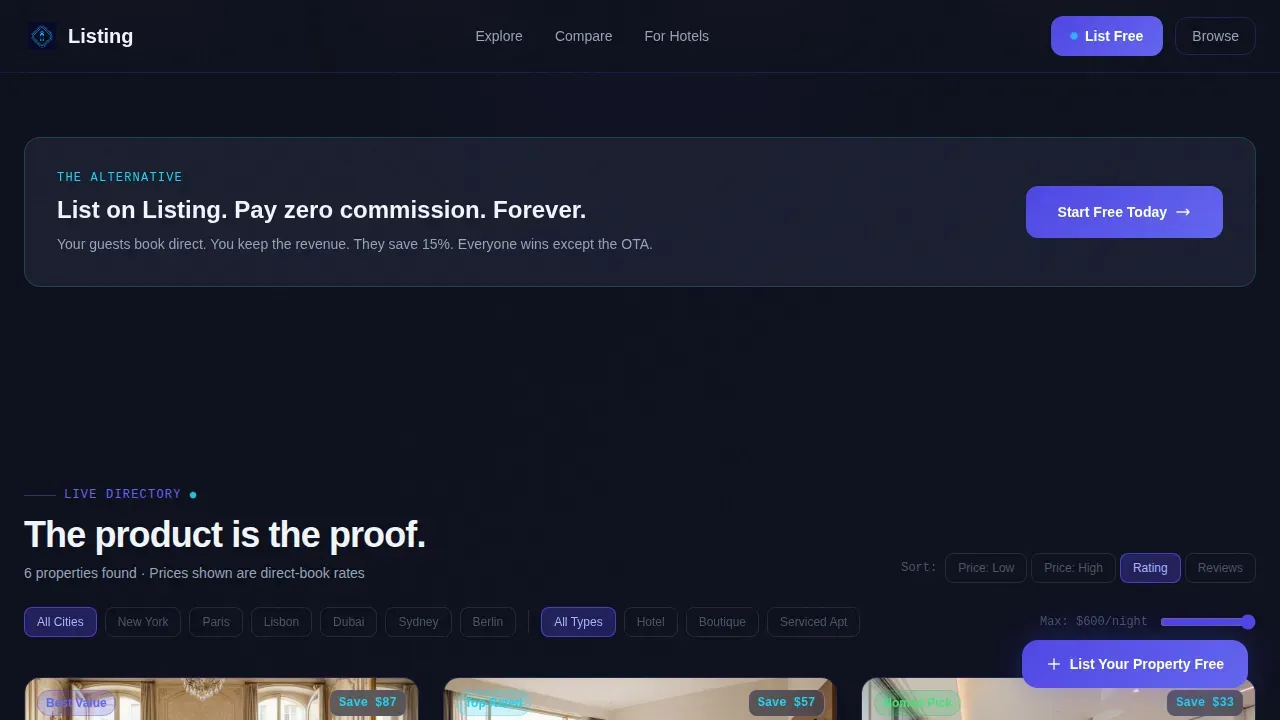
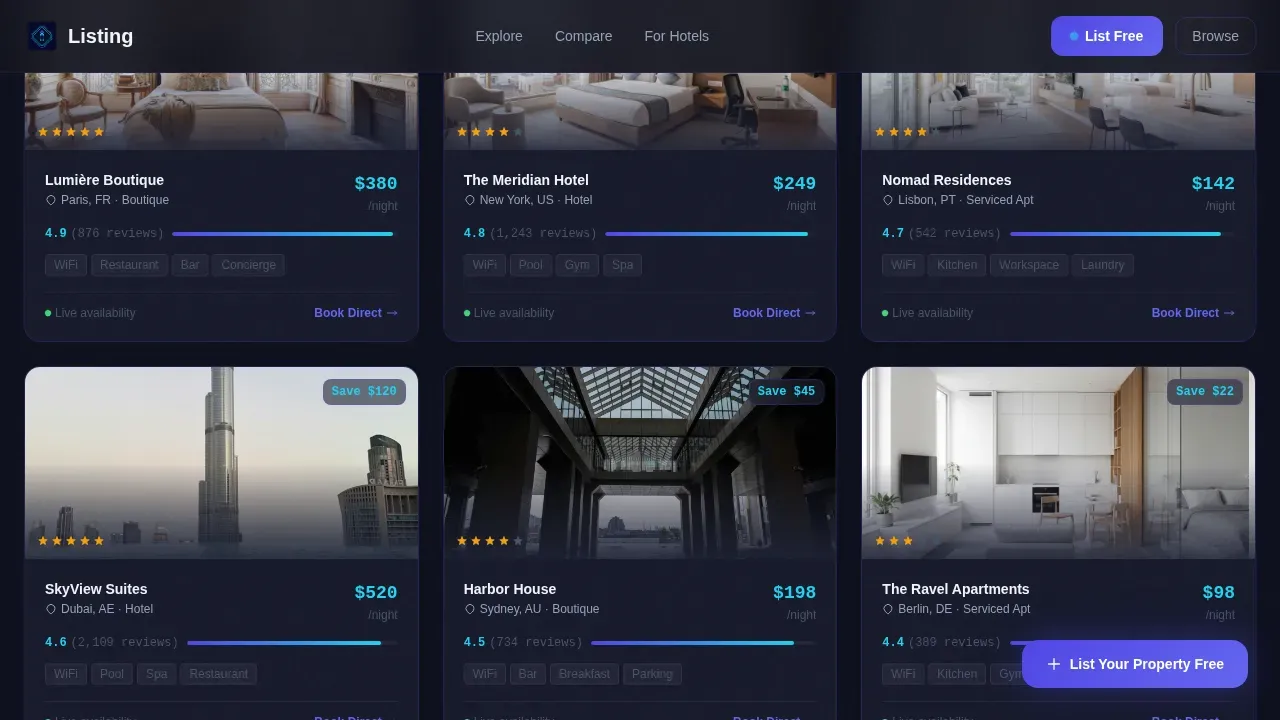
- A live-filterable hotel listing grid, a side-by-side versus table, and a compact call-to-action form at the bottom
Feature list
This template is built around six core capabilities that work together to establish trust, demonstrate value, and drive hotel listing sign-ups.
Dark Glass Panel Hero with Typing Headline
Three frosted, translucent comparison cards hover over a deep navy background. Each card displays a different platform scenario: an OTA listing with its commission markup, a competitor directory with a cluttered design, and this platform's clean direct-book card. A headline types itself in above. Panels tilt on scroll, catching light like screens on a desk.
Animated Pain Metrics Section
Scroll-triggered counters display average OTA commission rates, the percentage of travelers who prefer direct bookings, and estimated revenue lost per room per year. This section quantifies the cost of inaction before asking visitors to do anything. It is the most essential tool for converting skeptical hotel owners into active listing customers.
Live-Filterable Hotel Listing Grid
A dashboard-style grid lets users browse and search sample hotel listings sortable by city, star rating, and nightly rate. Detailed information about each property is displayed in clean listing cards. The grid itself is the proof of concept: it shows the directory's speed and functionality before any sign-up is required.
Versus Table with Animated Rows
A side-by-side comparison table shows this platform against leading OTA platforms. Each row covers commission rates, listing control, guest data ownership, and time to publish. Rows animate in staggered on scroll, with the platform winning each category through data rather than spin. Users can see the benefit of switching at a glance.
Dual Call-to-Action Conversion Flow
The primary call to action, "List Your Property Free," appears as a floating button after the versus table and anchors again inside a compact form. The secondary path, "See How You Compare," invites hotel owners to enter their property URL for an instant visibility audit. Both paths save the lead through different levels of commitment.
Compact Listing Sign-Up Form
The bottom of the page holds a focused form: property name, city, number of rooms, and email. This minimal setup reduces friction and keeps the page focused on a single conversion goal. No lengthy fields, no distraction, just the contact details needed to complete the onboarding handoff.
Page sections overview
| Section | Purpose |
|---|---|
| Hero Comparison Cards | Establish platform advantage visually |
| Pain Metrics Counter | Quantify OTA commission cost |
| Live Listing Grid | Prove directory speed and design |
| Versus Comparison Table | Show direct platform superiority |
| Call-to-Action Form | Capture property listing sign-ups |
| Footer | Linear single-row navigation close |
Design & branding system
The design language is what sets this template apart from every generic directory website. It takes the density of a financial data terminal and rebuilds it with the restraint of a modern product design team. Information steps forward; every surface recedes.
- Color system: deep screen-dark navy (#0D0F1C) as the base, charged indigo (#4F46E5) for primary actions, cool interface gray (#1E2235) for card panels, and reactive cyan (#22D3EE) firing on hover states and live data pulses
- Typography: Plus Jakarta Sans for headings and display text, paired with JetBrains Mono for all data, stats, and pricing figures to reinforce the dashboard aesthetic
- Visual motion: typing effects on the headline, scroll-reveal animations, staggered table row entrances, and subtle tilt on the hero panels all create a sleek, high-energy feel without sacrificing readability
Mobile & speed optimization
The template is designed desktop-first to handle the data grid complexity that hotel owners expect when reviewing listing options on a large screen. At the same time, responsiveness across devices is built into every layout decision.
- The directory design supports one-handed navigation principles, with large tap targets and clear button sizing that work across device types including tablets and smaller screens
- Fast loading is supported through a component architecture that separates static sections from interactive elements like the live filter grid and animated counters, keeping the page responsive under real usage conditions
- Mobile responsiveness ensures that hotel listing cards, the versus table, and the sign-up form remain readable and functional regardless of device screen size
How this template helps you convert
This landing page is engineered around a single conversion goal: getting hotel owners to list their property free. Every section tightens the arc from pain to proof to action.
- The animated metrics section makes the cost of inaction numerically undeniable before any call to action appears, so visitors arrive at the versus table already primed to act
- The dual conversion flow offers two entry points based on intent: the "List Your Property Free" form captures ready buyers, while the visibility audit captures curious leads through personalized experience rather than commitment pressure
- The focused bottom form with minimal fields removes friction at the final step, improving the effectiveness of the page by keeping customers on a single path to completing their reservation or sign-up
Other information about this template
This template is part of the Startup Velocity theme family and uses the Electric Indigo color system. It is categorized under the Hospitality Digital Presence subcategory within the Technology category. The template style is Dashboard and Data Grid, and the creative direction follows a Problem-to-Solution Arc with a Comparison and Versus conversion focus.
- The template is fully customizable, allowing teams to adjust colors, typography, section copy, and listing card data to match a company's brand and city coverage
- Customization options extend to the CMS layer: listing data, pricing fields, and room details can be updated without touching the core design code, making it practical for non-technical operators to maintain and grow their directory
- Additionally, the template supports integration of trust elements such as security badges, verified review counts, and city coverage stats to help build credibility with first-time visitors
- The home page layout follows a linear single-row footer pattern and is designed to create a strong first impression that keeps users on the site, browses multiple listing pages, and returns for future bookings
- Themes, appearance, and layout elements across all listing pages can be adjusted to fit resorts, boutique properties, or serviced apartment platforms equally well
- The template is a pre-designed layout ready for teams to customize and establish their directory website quickly, saving weeks of design and code work
Theme
Startup Velocity
Creative direction
Problem→Solution Arc
Color system
Electric Indigo
Style
Dashboard/Data Grid
Direction
Comparison/Versus
Page Sections
Dark Glass Panel Hero Section
Animated OTA Pain Metrics
Live-filterable Listing Grid
Versus Comparison Table
Dual Conversion Call-to-action Flow
Compact Property Sign-up Form
Related questions
Do I need to write code to set up this template?
Can the hotel listing grid show real availability and pricing?
Is the template suitable for directories listing resorts and serviced apartments, not just hotels?
How does the visibility audit call-to-action path work?
Can I expand the directory with more listing pages over time?