Intelligent Ecommerce Analytics Landing Page Template
Score is a scroll-reveal landing page template built for AI-powered purchase-probability scoring platforms targeting ecommerce directors and growth leads. It uses a Tech Glass visual system with a carbon-fiber palette, animated spec-sheet sections, a live score simulator, and a Comparison/Versus conversion layout to turn anonymous visitor sessions into quantified, actionable revenue decisions.
by Rocket studio
Quick summary
Score is a single-page, scroll-reveal landing page template designed for real-time ecommerce AI lead scoring platforms. It features a live dashboard hero, four progressive spec-sheet reveals, an interactive score simulator, and a side-by-side Comparison section. The Tech Glass aesthetic uses deep cockpit black, frosted-glass cards, and electric green data accents to communicate precision and performance.
Who this template is for
This template was built for founders, product marketers, and growth leads who need a high converting landing page for a B2B artificial intelligence (AI) tool in the ecommerce space. It is a strong fit for teams whose target audience includes ecommerce directors running high-volume stores and performance marketers optimizing return on ad spend (ROAS).
- Ecommerce AI platform teams launching a converting landing page for a scoring or personalization product
- Growth-team leads who need a specific landing page that speaks directly to Shopify Plus and Magento buyers
- Performance marketers building a targeted landing page that connects technical capability to measurable revenue outcomes
What problem this template solves
Most ecommerce businesses struggle to separate high-intent visitors from browsers before they reach checkout. A generic product page cannot do that job. Without a dedicated, personalized landing page built around a clear value proposition, even well-funded ad campaigns lose money on visitors who were never going to convert.
- Visitors feel overwhelmed when a landing page tries to cover every feature at once instead of one signal at a time
- Teams running paid ads need message match between ad promises and the page the visitor lands on
- Ecommerce landing pages that lack social proof, visual data, and live scoring signals fail to create urgency or earn trust
What you get with this template
This template delivers a complete, production-ready ecommerce landing page built around six carefully sequenced sections. Each section fades up from darkness using scroll-triggered glass card animations that mimic a system booting up, revealing one technical layer at a time. The landing page content is structured to convert visitors progressively, not all at once.
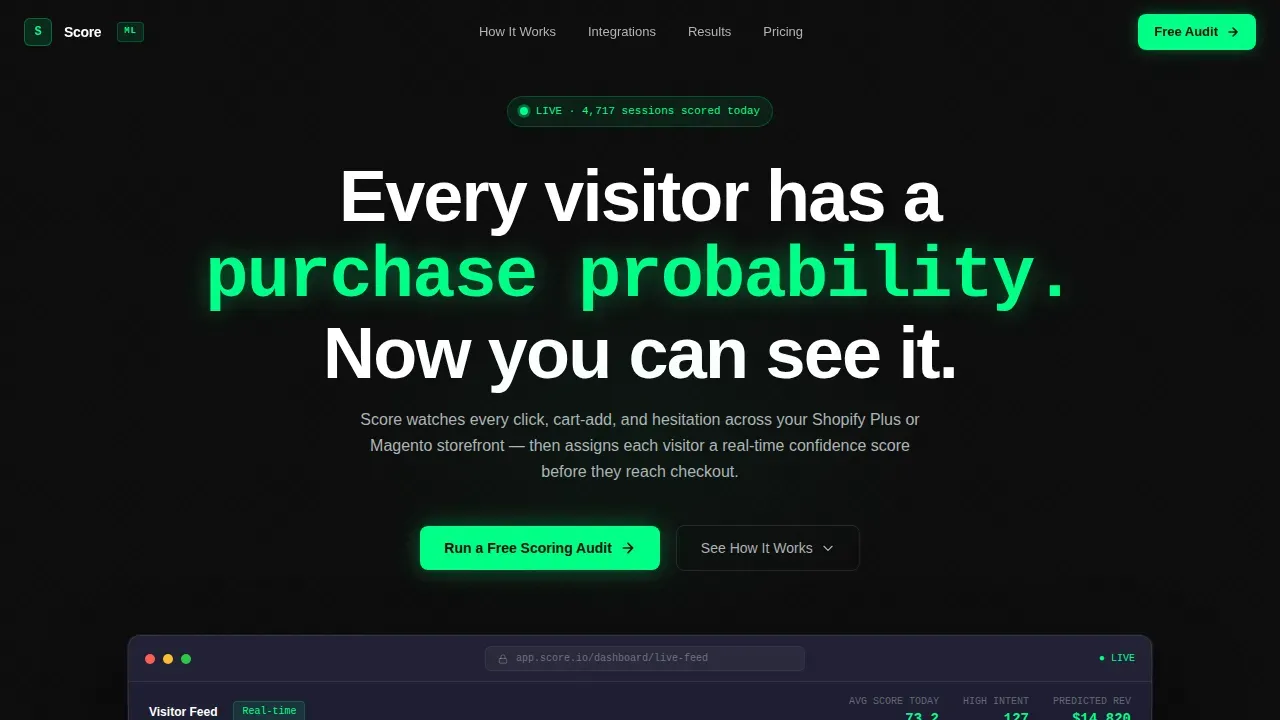
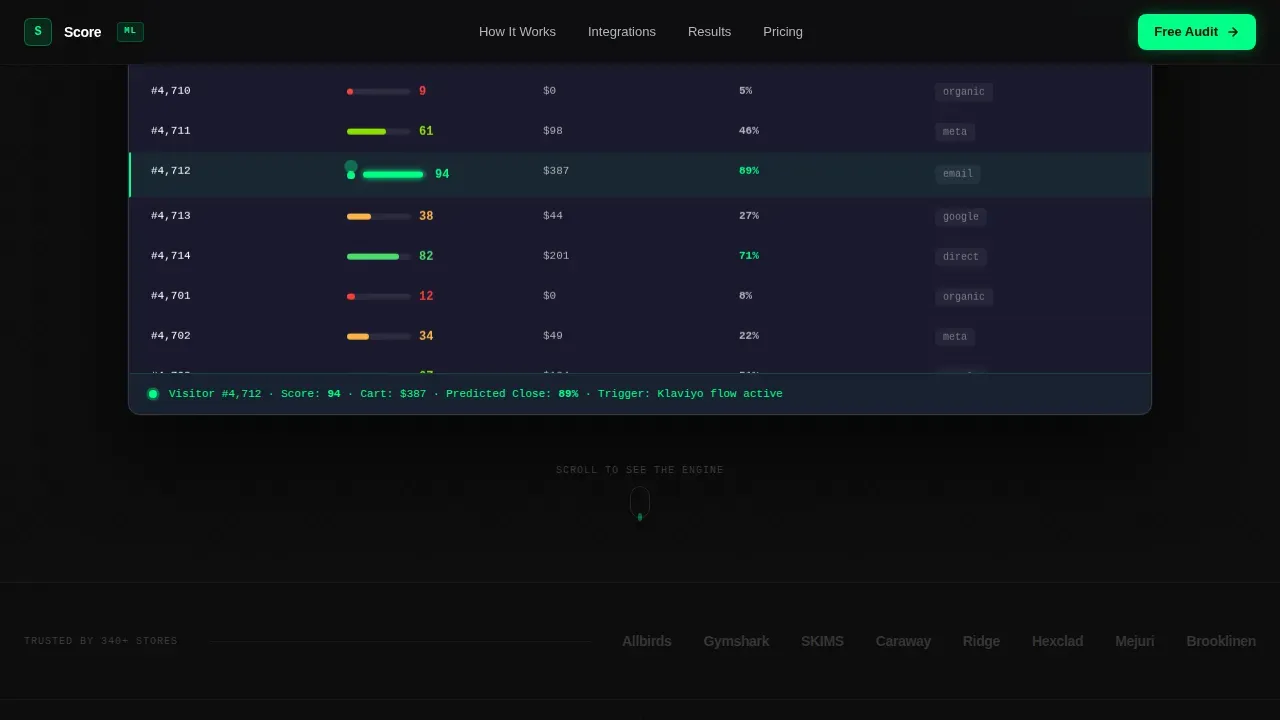
- A browser-chrome-framed hero dashboard with a live visitor feed, animated score rows, and a pulse animation on the highlighted session
- Four progressive spec-sheet reveal sections covering data inputs, model architecture, integration specs, and an interactive live score simulator with draggable sliders
- A persistent Comparison section splitting the screen between baseline conversion rates and score-powered results, plus a three-field audit request form as the primary call to action
Feature list
This landing page template includes the following built-in capabilities.
Live Dashboard Hero with Score Feed
The hero section renders a browser-chrome-framed storefront visitor feed scrolling upward in real time. Each row displays an anonymized session tagged with a lead score from 0 to 100, rendered in a color gradient from dim red through amber to electric green. One highlighted row shows a full data snapshot including cart value and predicted close probability, with a subtle pulse animation radiating from the score. The flat, straight-on screenshot aesthetic keeps the focus on the product working, not decorative styling.
Progressive Spec-Sheet Scroll Reveals
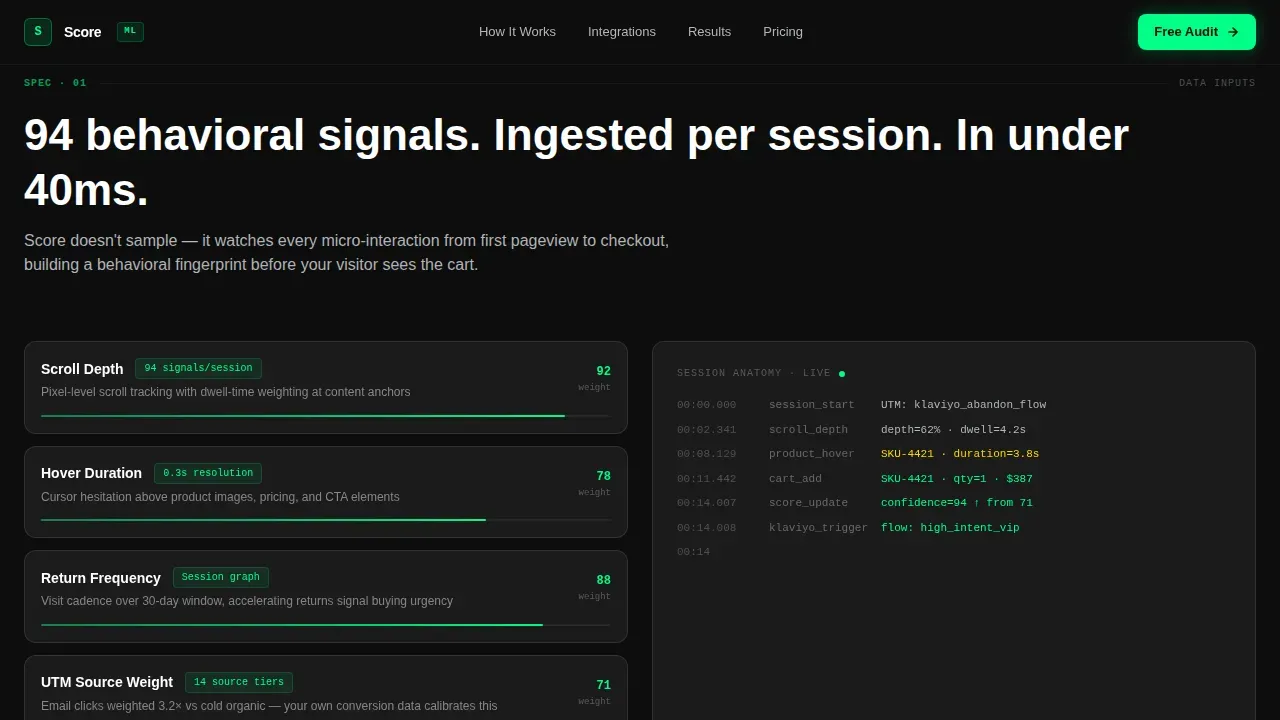
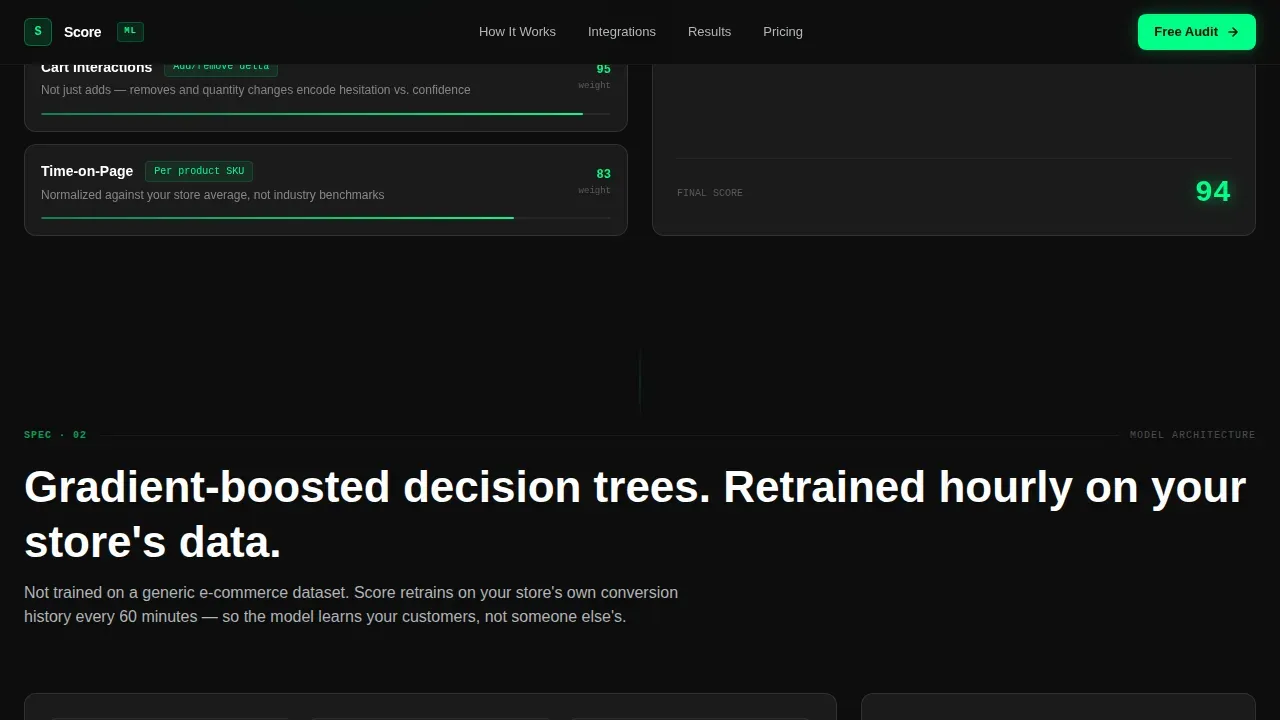
Four full-width sections unfold one technical layer at a time as the visitor scrolls. The first reveal covers behavioral signals ingested per session, including scroll depth, hover duration, return frequency, and UTM source weighting. The second reveal addresses model architecture. The third covers integration details. The fourth presents the live score simulator. Each section fades up from a dark background, glass card first, then data populating left to right, mimicking a system boot sequence. This landing page design respects search intent by answering technical questions in the order a buyer would ask them.
Interactive Live Score Simulator
The fourth spec-sheet section includes a live score simulator that visitors can interact with directly. Draggable sliders for cart value and session count cause the purchase-probability score to recalculate visibly on screen. This is a key element of the Comparison/Versus conversion strategy: it lets users interact with the scoring engine before they submit any contact information. Visual data populates in real time, so users interact with the product concept rather than reading about it.
Comparison/Versus Conversion Section
A persistent sticky section appears after the four spec reveals and splits the screen into two columns. The left column shows baseline ecommerce metrics: manual segmentation, batch sends, and a 2.1% conversion baseline. The right column shows score-powered results: real-time prioritization, triggered flows, and a 4.8% average conversion rate across 340 or more stores. Each stat animates into place. Cited source tooltips accompany every number to support trust and social proof.
Three-Field Audit Request Form
The primary call to action is "Run a Free Scoring Audit." It uses a single email input that auto-detects the platform domain from the company email, followed by a monthly-visitor dropdown and a current conversion rate field. This form is the engine of the campaign's success: it generates a projected lift report before the first sales call, removing the typical friction between ad spend and a booked demo.
Carbon Fiber Tech Glass Design System
Every surface in this landing page uses the full Carbon Fiber color system as the visual hierarchy backbone. Deep cockpit black forms the background. Frosted-glass cards with a 1-pixel luminous border sit on top. Electric green appears only on scores, calls to action, and live data pulses. Silver body text and white headlines complete the palette. The JetBrains Mono typeface renders all data values while DM Sans handles body and headline copy.
Page sections overview
| Section | Purpose |
|---|---|
| Hero Dashboard Preview | Display real-time visitor feed with animated purchase-probability scores |
| Data Inputs Reveal | Disclose behavioral signals ingested per session on scroll |
| Model Architecture Reveal | Explain gradient-boosted decision trees and hourly retraining |
| Integration Spec Reveal | Show one-snippet setup and native app compatibility details |
| Live Score Simulator | Let visitors drag sliders and watch the score recalculate |
| Comparison / Versus | Split-screen stat animation comparing baseline to score-powered results |
| Audit Request Form | Capture email, visitor volume, and current conversion rate |
| Footer | Linear single-row footer with secondary navigation and legal links |
Design & branding system
The visual identity follows a Tech Glass theme built on a Carbon Fiber color system. Every design decision is made to communicate precision. The palette absorbs light on every surface except the edges, which catch it like a scalpel catching a beam. Electric green appears only when something is quantified, training the eye to chase scored data.
- Color system: deep cockpit black (#0D0D0D) background, woven graphite (#1A1A2E) surface, translucent panel gray (rgba 255, 255, 255 at 6% opacity) for glass card surfaces, electric scoring green (#00FF87) for scores and calls to action, cool silver (#B0B3B8) for body text, pure white (#FFFFFF) for headlines
- Typography: JetBrains Mono for all score values and data fields; DM Sans for body copy, landing page headline text, and section paragraphs
- Animation: scroll-triggered glass card fades, left-to-right data population, score pulse radiating from highlighted rows, animated stat counters in the Comparison section, and slider-driven score recalculation in the simulator
Mobile & speed optimization
This template is desktop-first in its primary device priority, reflecting the reality that ecommerce directors and growth leads typically use desktop dashboards. However, the layout is built to remain functional and readable on mobile devices without sacrificing the key visual hierarchy that makes the landing page effective.
- Mobile-first layout rules are applied to ensure mobile users experience a clean, uncluttered reading flow even when slider interactions simplify to tap-based inputs
- Client Components are scoped only to the interactive simulator and animated sections; the hero and static sections use a static render approach to protect page speed and avoid slow loading pages
- Optimize images and static assets are handled through the template's build configuration to reduce the risk of slow page load times that raise bounce rates and lower conversion rates
How this template helps you convert
This landing page is structured around a single conversion goal: getting a qualified ecommerce director or growth lead to submit their domain and current conversion rate. Every design and copy decision serves that goal. The page earns the click by quantifying the gap between inaction and adoption before asking for anything.
- The progressive spec-sheet structure builds credibility section by section, so visitors never feel overwhelmed and the landing page content stays focused; message match between the hero and each downstream reveal keeps user engagement high across the full scroll
- The Comparison section uses animated key metrics and cited social proof to create urgency; showing the gap between a 2.1% baseline and a 4.8% score-powered average makes inaction feel expensive and moves high intent visitors toward the audit form
- The three-field form and secondary path to a competitor teardown page give the visitor two clear next steps; this reduces decision paralysis and keeps conversion rates high without making visitors feel overwhelmed by too many choices
Other information about this template
This section covers additional practical details about how this template can be used and extended for ecommerce landing pages in competitive paid-traffic environments.
- Landing page builder compatibility: this template is designed as a standalone production build and is not dependent on a drag-and-drop landing page builder, making it suitable for development teams that want full code control
- For teams running Google Ads search campaigns, the landing page supports message match by allowing the landing page headline and hero subheadline to be edited to reflect specific ad copy, which improves Quality Score and reduces ad costs
- The Comparison section is structured to support A/B testing; teams can swap the stat values or test headlines without restructuring the layout, enabling data driven decisions based on real campaign performance
- Social proof elements in the Comparison section, including cited tooltips, are designed to work alongside customer testimonials, star ratings, and security badges when teams choose to add them in the form area or below the audit call to action
- The template supports personalized landing experiences by allowing the hero dashboard row highlight and simulator default values to be pre-populated from URL parameters tied to a specific traffic source or ad campaign
- Shipping details, security badges, and early access messaging can be added to the form section or the footer without disrupting the overall visual hierarchy
- For ecommerce landing pages running alongside email campaigns, the form's domain auto-detection logic can be pre-filled via UTM parameters passed from the email link, improving personalized landing relevance for each audience segment
- Teams that build many landing pages across multiple ad campaigns can use this template as a base and swap the spec-sheet content to match different product landing page variants without redesigning from scratch
- The secondary call to action, "See How We Beat [Competitor]," links to a teardown page and can be configured to target any competitor comparison path relevant to the ecommerce business
- Website pages that serve paid ads perform best when they eliminate navigation distractions; this template removes the top navigation bar entirely, keeping the visitor focused on a single call to action and protecting campaign conversion rates
Theme
Tech Glass
Creative direction
Spec Sheet
Color system
Carbon Fiber
Style
Scroll Reveal (Progressive)
Direction
Comparison/Versus
Page Sections
Live Dashboard Hero with Score Feed
Progressive Spec-sheet Scroll Reveals
Interactive Live Score Simulator
Comparison / Versus Conversion Section
Three-field Audit Request Form
Carbon Fiber Tech Glass Design System
Related questions
What type of ecommerce platform is this landing page template built for?
Can the spec-sheet sections be edited to match a different AI product?
Does this template include the interactive score simulator as a working component?
How does the Comparison section support higher conversion rates?
Is this template suitable for use alongside paid ad campaigns?