Legal AI Landing Page Template for SaaS
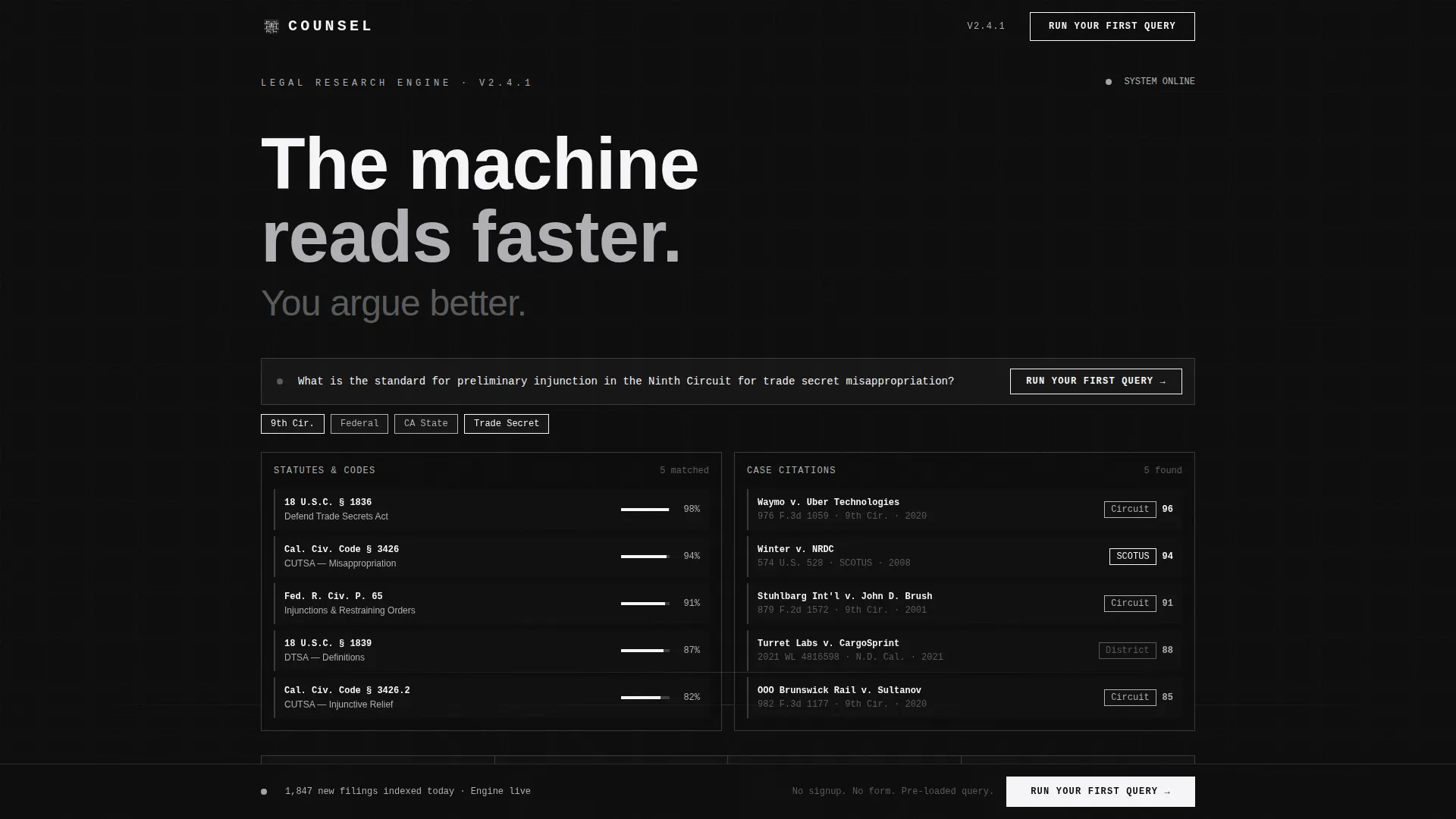
Counsel is a bold brutalist landing page template built for legal AI SaaS products. It opens with a live search demo that parses queries in real time, then walks visitors through a problem-to-solution arc using data grid modules, a citation network map, and three strategically placed calls to action that drive users directly into a free trial workspace.
by Rocket studio
Quick summary
Counsel is a single-page, dashboard-style landing page template designed for AI-powered legal research tools. It combines a live interactive search preview, visceral problem framing, and escalating data modules to convert litigation partners, solo practitioners, and in-house counsel into free trial users before they leave the page.
Who this template is for
This template is built for founders, product teams, and marketers launching legal AI SaaS tools in the litigation and research market. If your product helps legal professionals find case law faster, this template speaks their language from the first pixel.
- Litigation partners at firms drowning in discovery and motion research
- Solo practitioners who need research depth without a dedicated team
- In-house counsel at mid-market companies requiring airtight answers overnight
What problem this template solves
Legal AI products are hard to sell because the value is invisible until someone actually uses the tool. Generic SaaS landing pages fail here. They describe features instead of demonstrating them. Counsel solves this by putting the product experience front and center before any scroll happens.
- Visitors often bounce before understanding what the tool actually does
- Static screenshots fail to show real-time parsing speed and result depth
- Conversion drops when a signup form appears before any product trust is built
What you get with this template
You get a fully structured, single-page landing page built around a problem-to-solution arc. Every section earns the next scroll by adding evidence, demonstration, or stakes. The template is desktop-first with a mobile fallback, built using Next.js Server Components for static sections and Client Components for interactive modules.
- An interactive hero with a real-time legal query parser and live result panels
- Four distinct data grid modules covering the problem wall, precedent grid, citation network, and mid-page call to action
- A scroll-depth-triggered fixed bottom bar that activates at 40 percent scroll and drives clicks into a pre-loaded trial workspace
Feature list
This section covers the core built-in capabilities of the Counsel template as specified in the source brief.
Live Search Demo Header
The header is a functioning search bar on a pitch-black viewport. As the visitor types a legal question in plain English, jurisdiction tags materialize, statute numbers cascade down the left column, and case citations populate a right-hand panel with confidence scores and court levels. The visitor uses the product before scrolling once.
Problem Wall Section
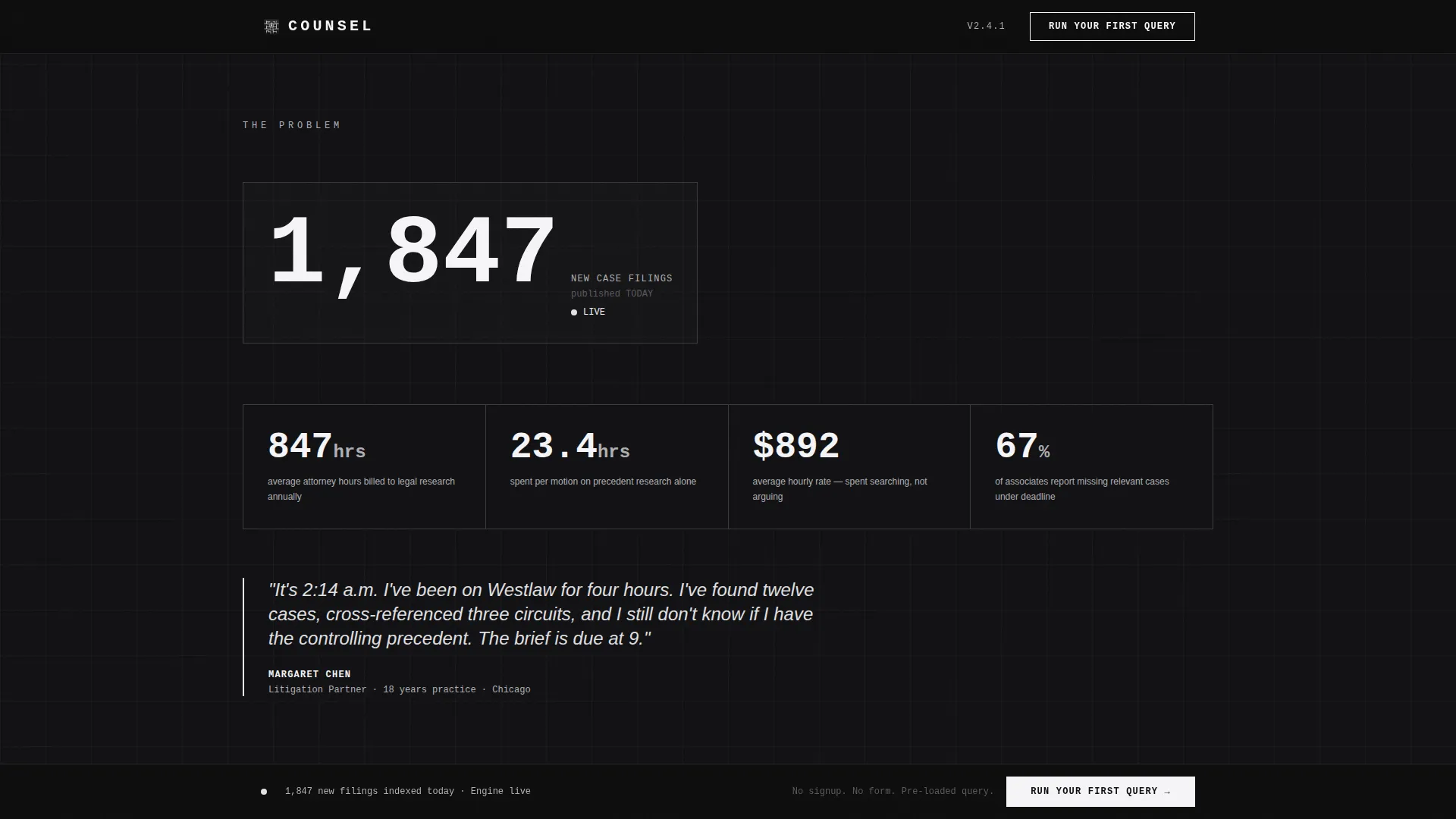
Section one renders the research problem viscerally. It includes a live counter tracking new case filings published today, a stat wall showing average hours spent on legal research per motion, and a practitioner quote about the 2 a.m. research spiral. This section creates emotional context before the solution is introduced.
Precedent Grid Module
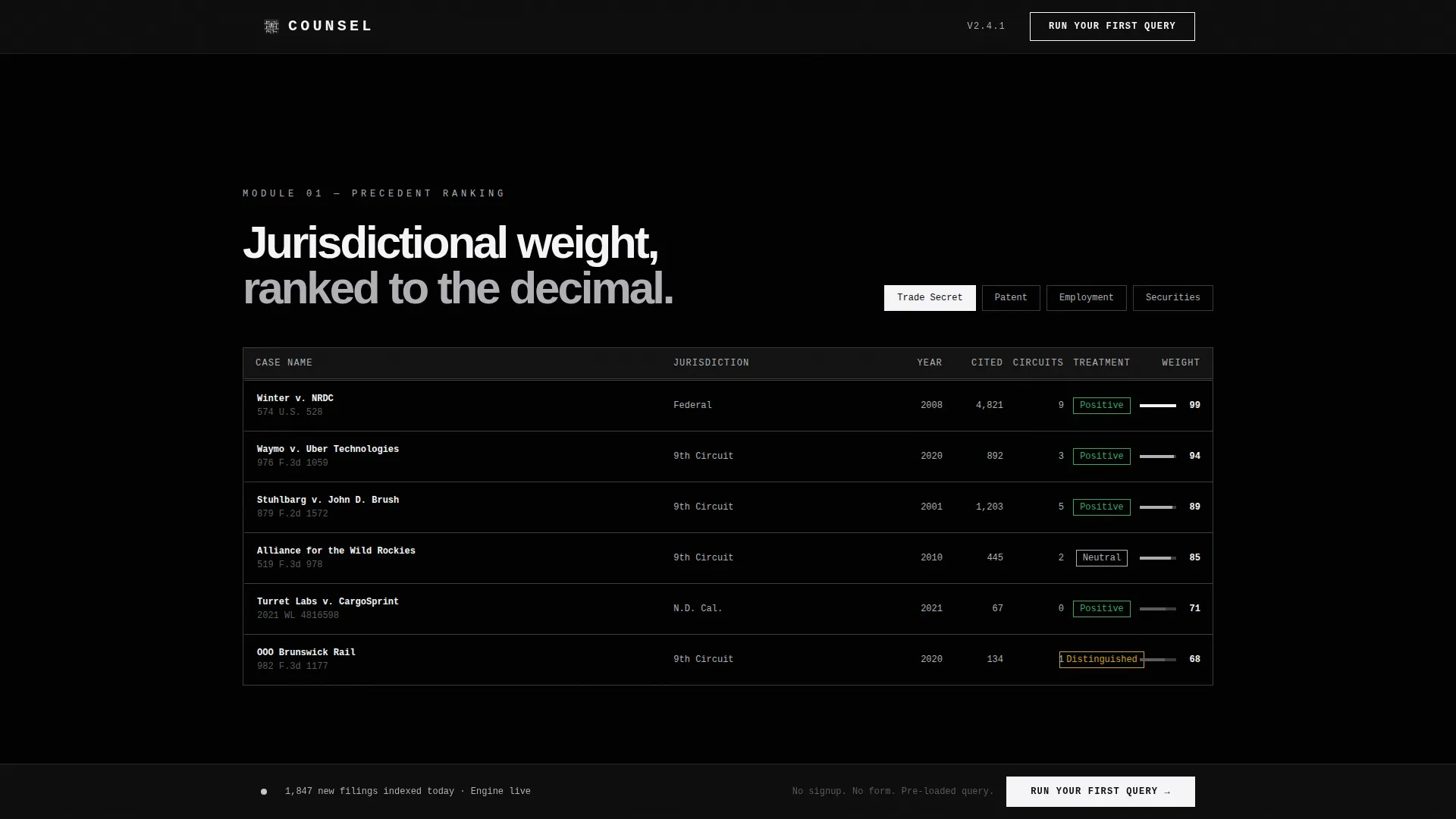
This data grid module shows how the engine ranks case precedents by jurisdictional weight. Hover states reveal additional detail on each result row. Practice area toggles let visitors switch between legal domains and see how the ranking logic adapts.
Citation Network Map
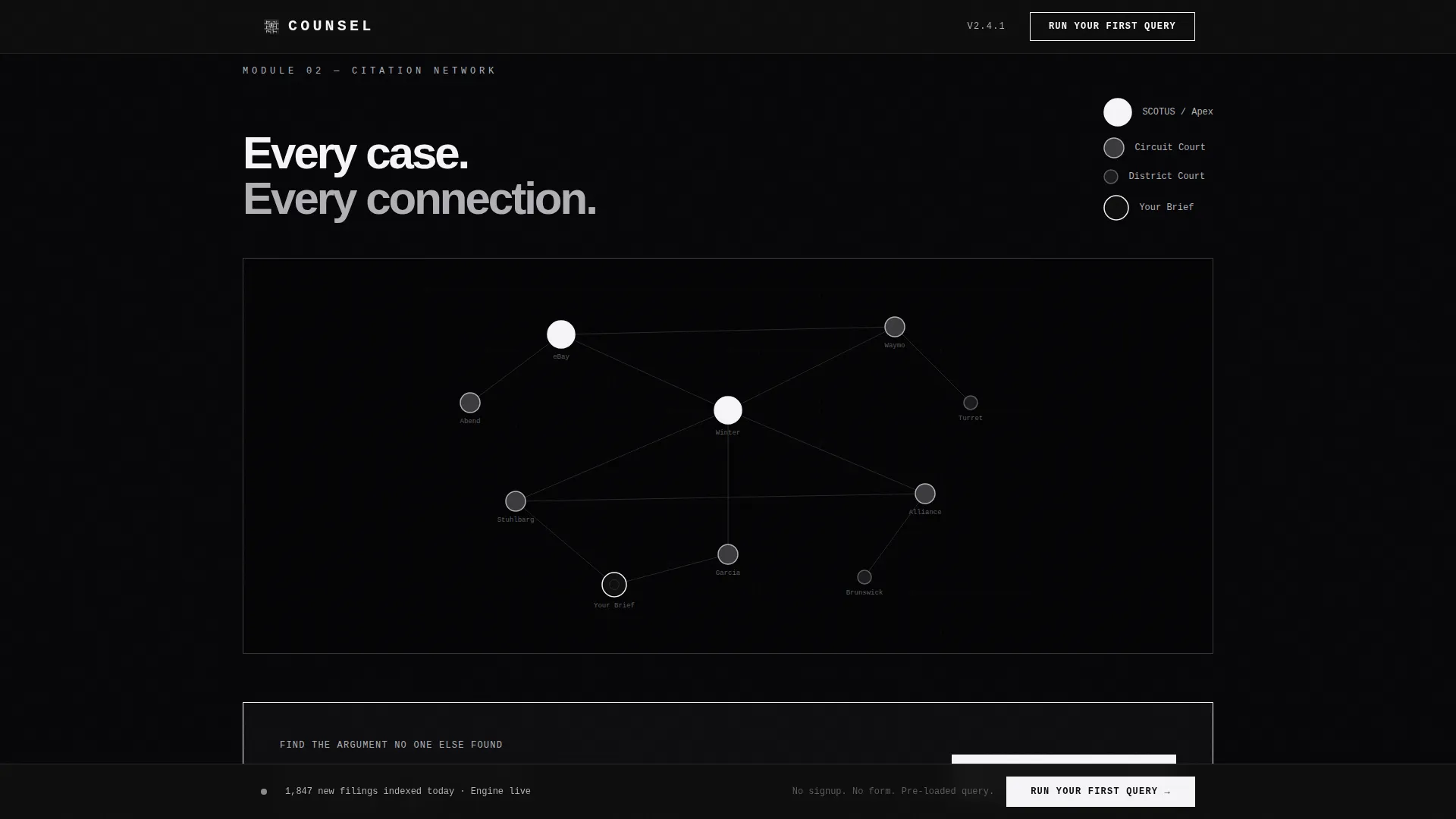
A node-based visualization renders case connections like a conspiracy board. Nodes link cases to statutes and related precedents. The map is interactive, giving visitors a tangible sense of how the engine surfaces hidden argument pathways.
Three-Point Call to Action Architecture
The primary call to action, "Run Your First Query," appears three times: inside the header preview after results load, mid-page after the citation network demo, and as a fixed bottom bar that activates after 40 percent scroll depth. Every click routes directly into a pre-loaded trial workspace with no form fields on the page.
Bold Brutalist Visual Framework
Typography uses JetBrains Mono for all data displays and Plus Jakarta Sans for prose. Type is oversized and slammed to grid edges. The structural black background shifts to pure black at the problem-to-solution break, using a hard horizontal rule as a visual and narrative hinge.
Page sections overview
| Section | Purpose |
|---|---|
| Interactive Hero Header | Live query parser with real-time jurisdiction tags, statute cascade, and citation panel |
| Problem Wall | Ticking case counter, research hours stat, and 2 a.m. practitioner quote |
| Precedent Grid Module | Jurisdictional ranking grid with hover reveals and practice area toggles |
| Citation Network Map | Node visualization connecting cases, statutes, and precedents interactively |
| Mid-Page Call to Action | "Run Your First Query" button with practice area toggles and social proof |
| Fixed Scroll Bar | Scroll-depth-triggered bottom bar activating at 40 percent depth |
| Footer | Horizontal flow footer pattern with minimal navigation |
Design & branding system
The visual identity follows a Bold Brutalist theme built on a Monochrome Steel color system. Every surface is intentional and load-bearing, with zero decorative ornamentation. The palette evokes poured concrete and the side of a brutalist courthouse.
- Colors: structural black (#0D0D0D), cold-rolled steel (#3A3A3C), brushed aluminum (#B0B0B4), and judicial white (#F5F5F7) reserved for interactive states and primary actions only
- Typography: JetBrains Mono for all data and code-style displays, Plus Jakarta Sans for all prose and navigation
- Layout: oversized type slammed to grid edges, strict column structure, hard horizontal rules used as narrative dividers between problem and solution
Mobile & speed optimization
The template is built desktop-first because the primary audience works on large screens in high-stakes legal environments. A responsive mobile fallback is included to maintain usability across all devices.
- Server Components handle static sections for faster initial load on key content blocks
- Client Components are scoped to interactive modules including the live search demo, citation map, and scroll-depth call to action
- GSAP ScrollTrigger and Intersection Observer power all scroll-based animations without blocking the main thread
How this template helps you convert
Counsel earns the conversion by making visitors feel the product speed before asking for any commitment. There are no form fields on the page. The entire structure is optimized to build trust through demonstration.
- The interactive header gives visitors a hands-on product experience in the first five seconds, removing the "I'll try it later" hesitation before it forms.
- The problem wall section validates the visitor's pain with real data points and a practitioner quote, creating emotional alignment before the solution is introduced.
- Three coordinated calls to action, including a scroll-depth-triggered fixed bar, maintain conversion pressure across the full scroll without interrupting the reading experience.
Other information about this template
This template is purpose-built for the legal AI recommendation engine market within the broader AI for legal technology category. It is a strong fit for teams launching B2B legal SaaS tools targeting US court system users. All terminology, layout logic, and conversion structure reflect US legal practice conventions.
- Template style: Dashboard and Data Grid, suited for data-dense SaaS products
- Creative direction: Problem-to-Solution Arc that escalates from time cost to competitive legal advantage
- Animation stack: GSAP ScrollTrigger and Intersection Observer for high-interactivity scroll storytelling
- Localization: English (US), USD pricing context, and US court system terminology throughout
- The template can support legal AI products competing in the same space as established legal research platforms, positioning speed and argument discovery as the core differentiators
Theme
Bold Brutalist
Creative direction
Problem→Solution Arc
Color system
Monochrome Steel
Style
Dashboard/Data Grid
Direction
Click-Through
Page Sections
Live Legal Query Parser
Problem Wall with Live Data
Precedent Ranking Grid
Citation Network Visualization
Three-point Call to Action Architecture
Bold Brutalist Layout System
Related questions
Does this template include real AI functionality?
Can I update the color scheme and typography?
How does the scroll-depth call-to-action bar work?
Is this template suitable for both solo practitioners and enterprise legal teams?
Can I change the default call-to-action text and destination URL?