Cover — Expert Commodity Insurance Landing Page Template
The Underwrite template is a precision-built landing page for bulk commodity insurance firms. It combines an engineering blueprint visual system with a zigzag spec-sheet layout to serve port authorities, agricultural cooperatives, and mining conglomerates. Every section delivers structured technical depth, guiding serious prospects through coverage classes, risk methodology, and claims timelines toward a gated Coverage Matrix download.
by Rocket studio
Quick summary
The Underwrite template is a single-page, desktop-first insurance landing page built for firms that cover grain elevators, ore stockpiles, and tanker fleets. It reads like a technical data sheet, not a brochure. The zigzag spec-sheet layout earns confidence from logistics directors, CFOs, and risk managers who are already searching for a credible, technically fluent insurance partner.
Who this template is for
This template is purpose-built for a very specific insurance company operating in bulk commodities. It speaks directly to operationally sophisticated buyers who expect depth, not decoration.
- Risk managers at mining conglomerates who need coverage that accounts for moisture migration and spontaneous combustion thresholds
- CFOs at agricultural cooperatives managing hundred-thousand-bushel silos and spoilage exposure
- Logistics directors at port authorities tracking vessel queues at berth and in-transit cargo risk
What problem this template solves
Most insurance landing pages struggle to convince visitors who arrive with deep operational knowledge. Standard templates overwhelm visitors with generic benefits or undersell technical capabilities entirely. A landing page for precision bulk commodity insurance must build immediate trust and clearly differentiate from standard carrier liability.
- Visitors searching for specialist coverage leave generic insurance landing pages without converting because the page cannot match their technical vocabulary
- Risk professionals require proof of methodology depth before they will sign a form or download a resource
- Generic insurance landing page examples fail to reflect all-risk coverage structures, named perils distinctions, or commodity-class specificity
What you get with this template
This template delivers a fully structured, spec-sheet-style insurance landing page with five primary sections, a gated lead form, and a persistent sidebar conversion path. Every element on this landing page works toward the goal of making the conversion process easy without sacrificing technical credibility.
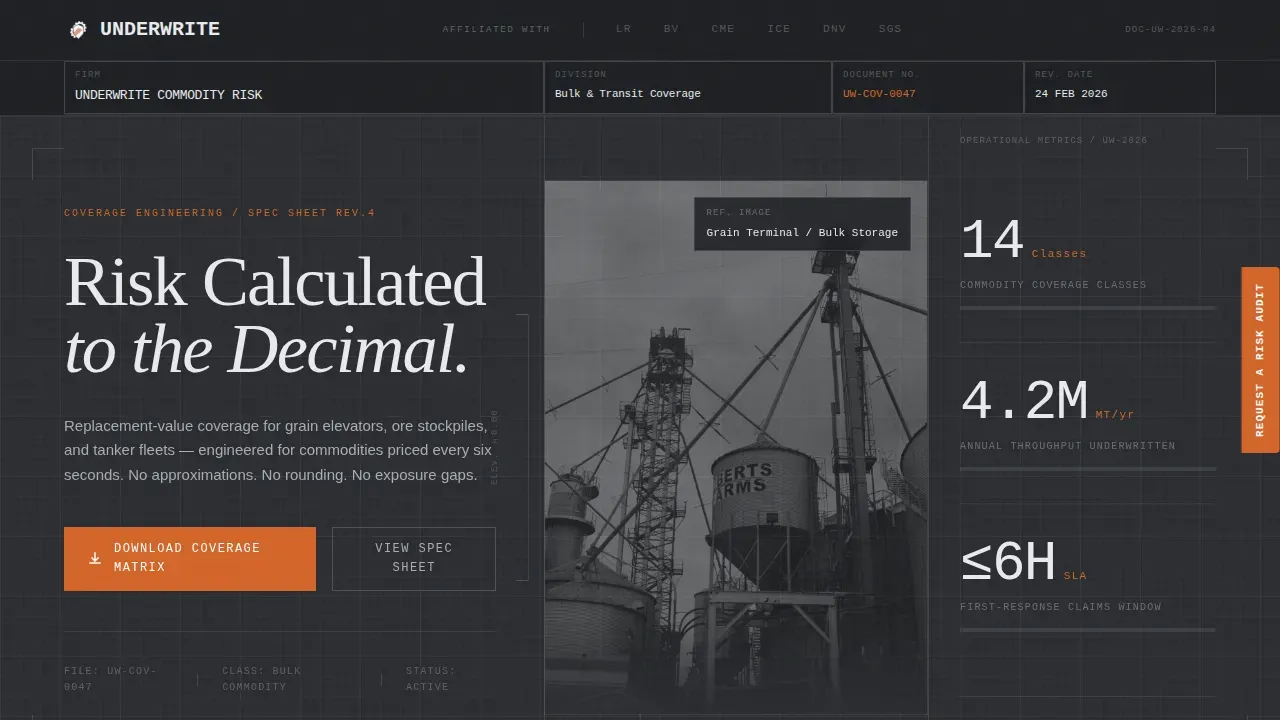
- A hero section formatted as an engineering title block, with a three-column asymmetric layout and an operational metrics sidebar
- Four alternating zigzag content sections covering coverage classes, risk assessment methodology, claims response SLA timelines, and a gated PDF download form
- A persistent Risk Audit sidebar panel that slides open without leaving the page, plus a footer styled in a developer-minimal pattern
Feature list
This template includes a focused set of components built for the insurance business of bulk commodity underwriting. Each feature below is present in the brief and delivered in the build.
Engineering Title Block Hero
The hero section is formatted exactly like the title block on a technical drawing. It displays company name, division, document number, and revision date. A three-column asymmetric layout sits below it, flanked by an operational metrics sidebar showing tonnage processed, commodity classes covered, and SLA response hours.
Zigzag Spec-Sheet Layout
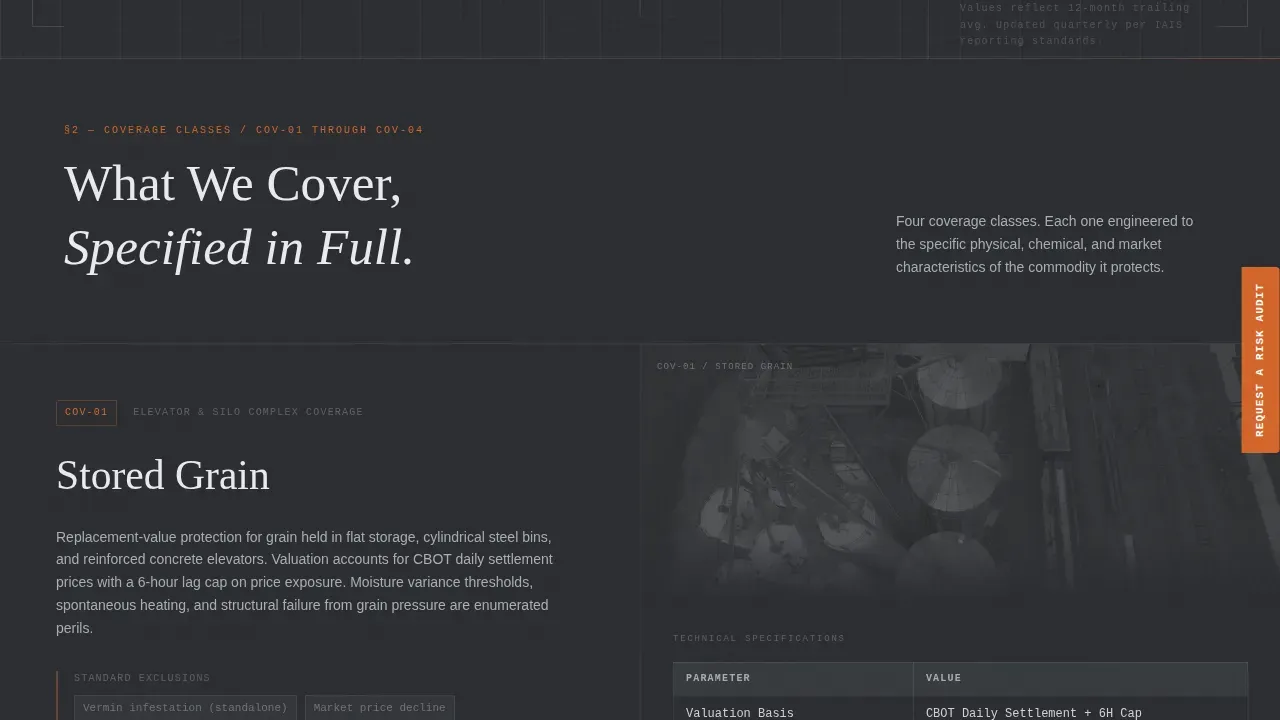
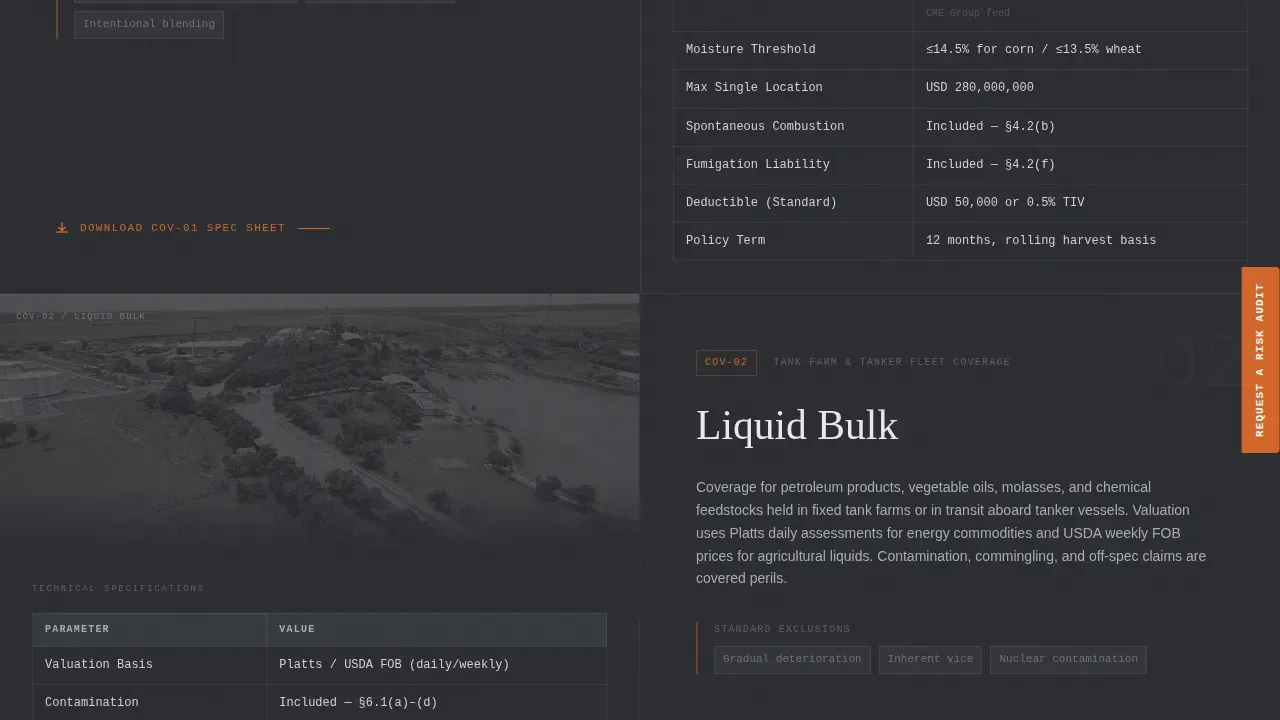
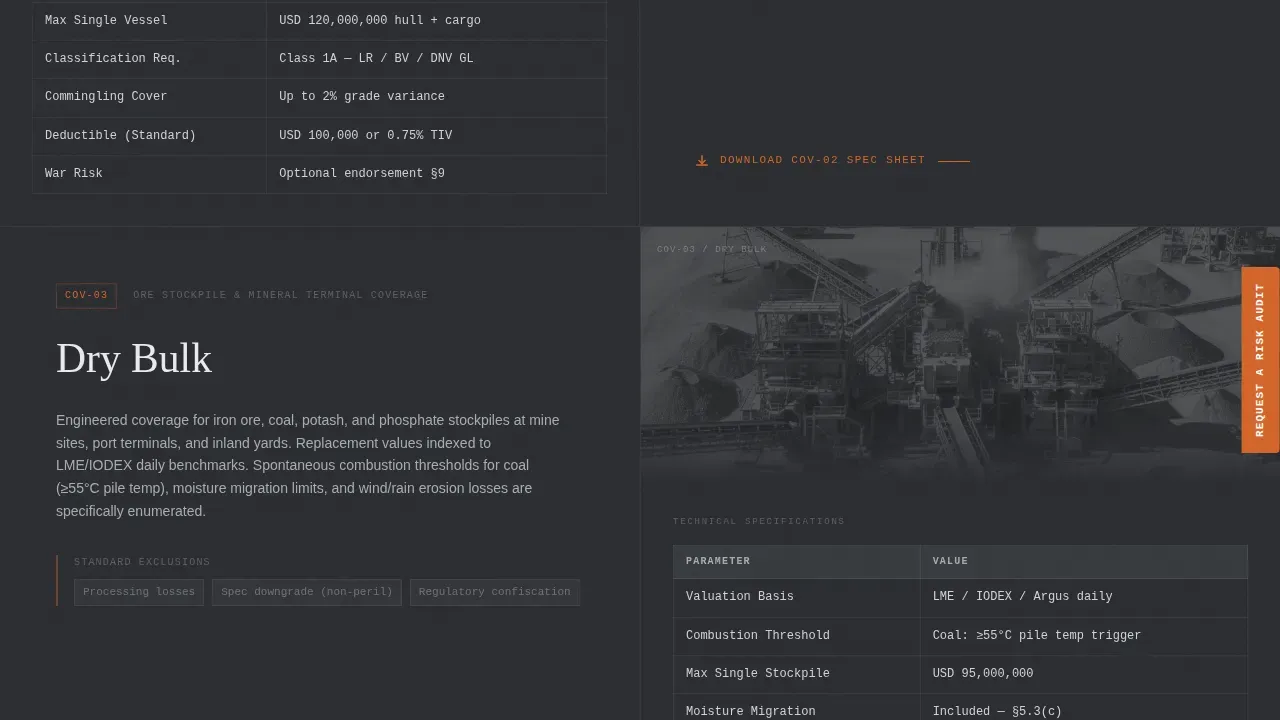
Four alternating sections follow a strict left-right-left-right pattern. Each section pairs body copy with specification tables, reversing alignment on each pass. This structure guides visitors through coverage classes, risk assessment procedures, and claims SLA grids without overwhelming visitors with a wall of unstructured text.
Coverage Class Specification Panels
Section one of the zigzag layout publishes a full breakdown of coverage classes: stored grain, liquid bulk, dry bulk, and in-transit commodity. Each class maps to its risk profile. This level of published detail differentiates the insurance company from competitors who do not disclose methodology.
Gated Coverage Matrix Download Form
The primary call-to-action path leads to a gated PDF download called the Coverage Matrix. The lead form captures commodity type via dropdown, annual throughput tonnage via range selector, and business email. The form fields are ordered to qualify leads by operational specificity before contact is requested, keeping the conversion rate high and time-wasters filtered out.
Risk Audit Sidebar Panel
A persistent sidebar tab is fixed to the page edge. Clicking it slides open a Risk Audit request form without navigating away from the page. This secondary path reduces friction for visitors who arrive already knowing what they need. The panel keeps prospects engaged and creates a second conversion lane alongside the primary download form.
Claims Response SLA Timeline Grid
Section three of the zigzag layout presents claims response commitments as an hour-based SLA timeline grid. Hard numbers replace vague reassurances. This approach is consistent with how the best insurance landing pages build trust: showing specific, verifiable service-level detail rather than marketing copy.
Page sections overview
| Section | Purpose |
|---|---|
| Logo Bar Header | Displays wordmark, partner logos, classification society affiliations, and commodity exchange badges in monochrome on zinc white |
| Engineering Title Block | Establishes the page as a spec sheet, with company name, division, document number, and revision date |
| Operational Metrics Sidebar | Shows live-style stat counters for tonnage processed, commodity classes, and SLA hours to reinforce credibility |
| Coverage Classes Zigzag | Specifies stored grain, liquid bulk, dry bulk, and in-transit coverage with alternating body copy and spec tables |
| Risk Assessment Section | Presents numbered procedural steps alongside specification tables in alternating alignment |
| Claims SLA Grid | Displays hour-based response commitments in a structured timeline format |
| Coverage Matrix Form | Gated lead form with commodity dropdown, throughput range selector, and email field |
| Risk Audit Sidebar | Persistent slide-open panel for direct audit request without page navigation |
| Developer Minimal Footer | Clean footer styled after a GitHub-pattern minimal layout |
Design & branding system
The visual identity is built on an Engineering Blueprint theme using a Monochrome Steel color system. Every color in the palette has a defined job. Nothing is decorative.
- Structural charcoal (#2B2D31) for primary backgrounds, mill-finish aluminum (#A8ADB3) for rule lines and secondary surfaces, bright zinc (#E8EAED) for content panels, and signal-orange (#D4652A) reserved exclusively for interactive states and download icons
- Typography uses Manrope for body and interface text, Fraunces as a display serif for section headers, and JetBrains Mono for all specification values, numbers, and codes
- White space is used deliberately to create breathing room between spec panels, preventing visual clutter and keeping the page readable for operations professionals at workstations
Mobile & speed optimization
The template is designed desktop-first, reflecting the primary users who are operations professionals reviewing technical documentation at workstations. Responsive behavior is still addressed to support B2B decision-makers who browse on mobile devices between sessions.
- Scroll reveals and beam border animations are built with medium animation weight, keeping page performance practical and the interactive experience purposeful
- Server Components handle all static content sections while Client Components manage the interactive form, sidebar panel, and coverage table, keeping the page structured for fast load delivery
- The template is structured so that the page loads fast enough to retain prospects who arrive via direct links, email referrals, or partner portals
How this template helps you convert
A good insurance landing page is a fusion between visuals, copy, layout, and function. This template converts by building confidence at every scroll step, not by relying on a single hero image or catchy headline.
- The gated Coverage Matrix form qualifies leads before capturing contact details, so every completed form represents a prospect who understands their own commodity exposure and throughput, improving downstream conversion rate for the insurance agency's sales team
- The persistent Risk Audit sidebar creates a second conversion path for visitors who arrive ready to act, reducing the chance they leave the page to find a contact page elsewhere on the site
- Social proof is embedded structurally through the Logo Bar header, which displays partner logos, classification society affiliations, and commodity exchange badges as trust signals before a visitor reads a single line of body copy
Other information about this template
This template belongs to a broader library of specialized insurance landing page examples built for niche commercial and industrial use cases. It is a great example of how an insurance landing page can carry engineering-spec depth without sacrificing usability. The following points cover additional context relevant to buyers comparing this template against general-purpose insurance landing pages.
- The Underwrite precision bulk commodity insurance landing page template is distinct from templates built for home insurance, auto insurance, health insurance, travel insurance, or life insurance landing page use cases; those audiences and those insurance products require simpler layouts and shorter form fields
- Teams searching for a good insurance landing page for a standard insurance agency offering home insurance, car insurance, or life insurance landing contexts will find this template too specialized; it is engineered for industrial commodity risk, not retail consumer insurance options
- A good insurance landing page for consumer contexts such as a health insurance landing page or life insurance landing typically uses a shorter headline, fewer spec panels, and a single-step form; this template intentionally inverts those conventions for a professional B2B target audience
- The best insurance landing pages in commodity and marine insurance focus on risk mitigation language, financial security framing, and specialized expertise rather than emotional appeals; this template is aligned with those best insurance landing practices throughout
- Builders can customize the coverage class panels, update the spec table values, and swap the partner logos to reflect their own underwriting affiliations; the template structure is designed for teams who want to start building without writing layout code from scratch
- The Logo Bar header is an insurance website convention borrowed from classification society documentation, making the page feel like an official industry document rather than a marketing asset; this is intentional and contributes directly to the trust signals that convince visitors to submit the form
- Companies using landing pages of this type generate more qualified leads because the form itself acts as a filter; potential customers who complete a throughput-range selector and commodity-type dropdown are self-identifying as serious prospects, not casual browsers
- Most people comparing insurance landing page examples for bulk commodity risk will not find a free template at this depth elsewhere; the Underwrite template fills a clear gap in the available library of industrial insurance landing page examples
- In most cases, an insurance landing page that publishes methodology at this granularity will earn industry awards recognition or be cited as a benchmark in trade publications covering logistics and commodity risk management
Theme
Engineering Blueprint
Creative direction
Spec Sheet
Color system
Monochrome Steel
Style
Zigzag/Alternating
Direction
Content/Resource
Page Sections
Engineering Title Block Hero Section
Zigzag Spec-sheet Content Layout
Gated Coverage Matrix Lead Form
Persistent Risk Audit Sidebar
Claims Response SLA Timeline Grid
Monochrome Steel Logo Bar Header
Related questions
Who is this landing page template designed for?
Can I customize the coverage class panels and spec tables?
How does the gated form qualify leads?
What is the Risk Audit sidebar and how does it work?
Is this template suitable for a general insurance agency or consumer insurance products?