Music & Performing Arts School Professional Website Template
The Crossfade Master The Dancefloor DJ Academy Landing Page Template is a single-page quiz and assessment funnel built for DJ schools. It guides visitors through seven interactive scenario questions, builds a personal skill profile, and delivers a recommended course track. The ultraviolet club aesthetic, scroll-triggered animations, and dynamic comparison table make every visitor feel like the academy already knows what they need.
by Rocket studio
Quick summary
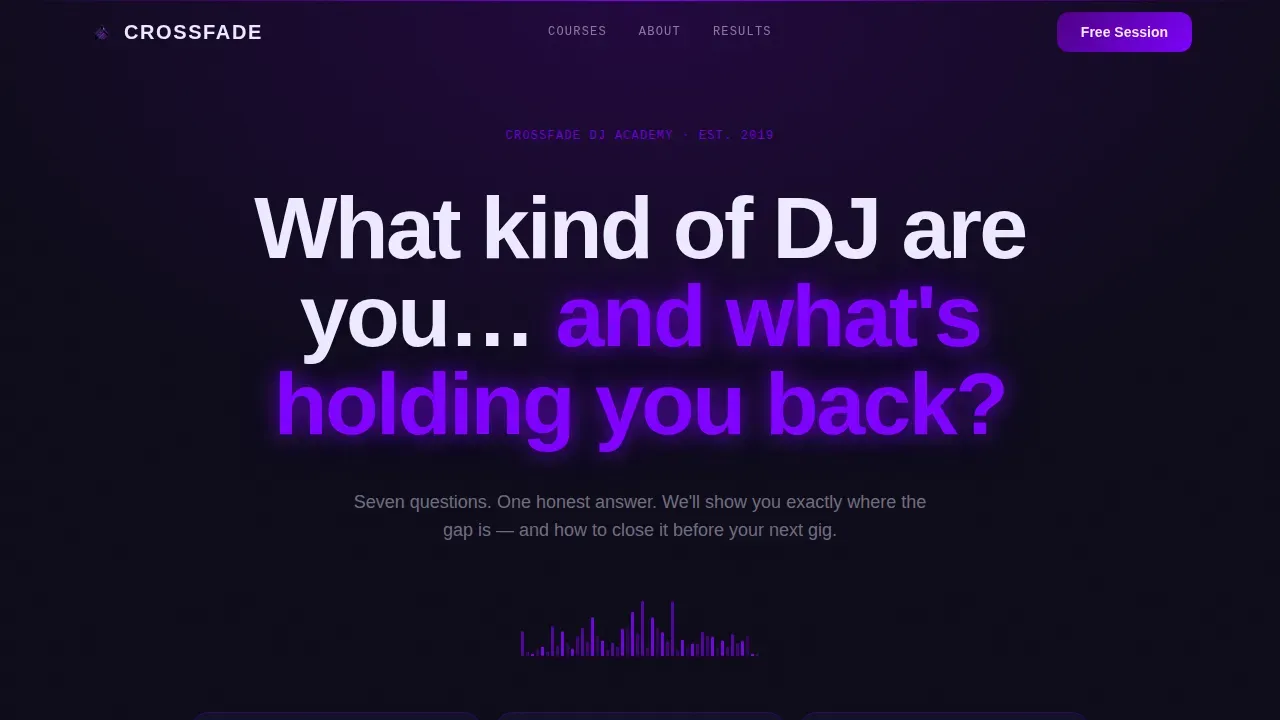
This template is a scroll-driven quiz funnel designed for a DJ academy. Visitors answer seven scenario questions, each one built around real djing challenges like reading a crowd, selecting the next track, or managing bass and mix energy. By the end, they receive a personalized DJ archetype, a skill gap summary, and a clear course recommendation. The deep booth black and UV violet aesthetic make the whole experience feel like standing inside a club booth at 1 AM.
Who this template is for
This template is built for music education businesses that teach djing in a hands-on, immersive way. It works especially well for academies targeting self-taught DJs who want to move beyond sync dependency and start playing music with real confidence. If your school positions skill development over gear sales, this layout speaks directly to your audience.
- Bedroom DJs stuck looping the same transitions who want to sound good on a real system
- Bar owners who want to stop hiring and start spinning their own nights
- Producers who can make great music in the studio but freeze behind the decks at a live performance
What problem this template solves
Most DJ academy pages look like generic course catalogs. They list modules, show a price, and hope the visitor connects the dots. That approach misses the point entirely. The real problem is that a potential student does not know which course fits their skill level. They do not know whether their issue is beatmatching by ear, tune selection, reading a crowd, or controlling the mixer under pressure. A static page cannot diagnose that. This template can.
- It replaces the passive browse experience with an active assessment, so the visitor discovers their own skill gaps
- It makes the comparison table meaningful by illuminating rows based on quiz answers, not just listing stuff in columns
- It earns the booking click by proving the academy understands the visitor's djing problem before asking for a commitment
What you get with this template
You get a fully structured single-page quiz funnel with five major content zones and a detailed visual system. Every component is purposeful. Nothing is decorative filler. The scroll itself is the assessment, and each section builds on the last until the visitor reaches a personalized results screen that names their archetype and recommended course track.
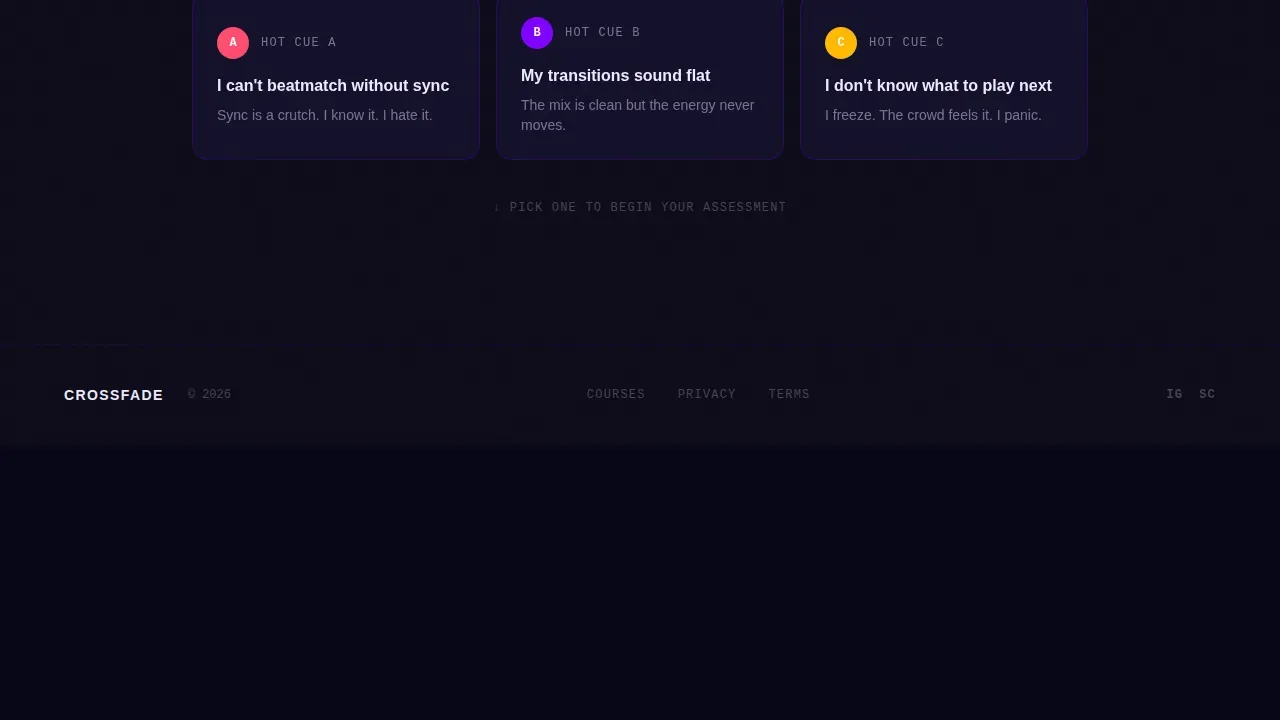
- Hero Quiz Starter with oversized question type, waveform animation, and three hot cue answer cards
- Seven-question scroll-driven assessment using waveform pairs, crowd energy graphs, and tracklist fork scenarios
- Dynamic comparison table for three course tracks: Foundations, Performance, and Residency
Feature list
This section covers the core functional and design capabilities built into the template based on the source brief.
Interactive Quiz State Machine
The template runs a client-side quiz state machine across seven scenario questions. Each question presents a visual scenario: a waveform pair showing two sources colliding, a crowd energy graph dropping mid-set, or a tracklist fork where the next song could go wrong in three different ways. The visitor picks a path. The page advances. Answers accumulate quietly into a skill profile without ever feeling like a test. By the time the results screen appears, the visitor has been paying attention for long enough that the personalization feels earned, not algorithmic.
Dynamic Comparison Table with Row Illumination
The comparison table covers three course tracks: Foundations for DJs who are still building basic mix confidence, Performance for DJs ready to handle a full night, and Residency for DJs targeting regular venue slots and club gigs. The rows map to specific skill clusters: beatmatching, tune selection, playlist programming, scratch technique, bass control, and live performance readiness. Based on quiz answers, rows illuminate in UV glow violet to highlight gaps. Skills the visitor already owns fade to grey. Unlike a standard feature table, this one acts as a mirror. The visitor sees their own djing profile reflected back in the column layout.
DJ Archetype Results Screen
After the seven questions, the page delivers a personalized results screen. It names the visitor's archetype: The Bedroom Selector, The Nervous Opener, or The Technical Ghost. It identifies their weakest skill cluster. It highlights the recommended course track in the comparison table. The primary call to action reads "See Your DJ Profile." A secondary call to action reads "Book Your Free Booth Session" with a calendar picker and a dropdown for preferred format: vinyl, CDJ, or controller. The quiz earns the click by proving the academy already understands what the visitor could not yet articulate.
Scroll-Triggered Glow Animation System
The template uses CSS custom properties to manage glow transitions across the entire page. Waveform animations pulse in the hero. Answer cards float up like hot cue points. Section dividers light up in electric indigo as the visitor scrolls. Table rows illuminate on cue. The animation system is designed to feel like the ultraviolet strip running along a club booth at 1 AM: everything outside the lit zone disappears, everything inside it pulses. Scroll-jacking activates when a visitor selects a quiz answer, advancing the page automatically to the next question.
Mobile-First Thumb-Driven Quiz Flow
Every quiz interaction is designed for mobile first. Answer cards are large enough for thumb taps. The waveform animations scale down gracefully on smaller screens. The scroll-driven assessment flow works with swipe gestures. The comparison table adapts for narrow viewports without losing the row illumination behavior. Most aspiring DJs who are young and self-taught browse on their phones, so the template treats mobile as the primary context, not an afterthought.
Hero Quiz Starter with Hot Cue Answer Cards
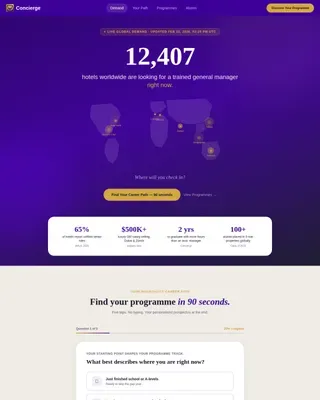
The header opens with a single provocative question in oversized white type against deep booth black: "What kind of DJ are you and what is holding you back?" Below the headline, a waveform animation pulses subtly. Three answer cards float up, each naming a real djing pain point: "I can't beatmatch without sync," "My transitions sound flat," and "I don't know what to play next." Selecting a card triggers a glow state in electric indigo. The page begins to scroll itself. That moment is the hook. It tells the visitor the academy already knows their world.
Page sections overview
| Section | Purpose |
|---|---|
| Hero Quiz Starter | Opens with provocative question, waveform animation, and three hot cue answer cards |
| Quiz Assessment Flow | Seven scroll-driven scenario questions building a personal DJ skill profile |
| Dynamic Comparison Table | Three course tracks illuminated by quiz answers, highlighting skill gaps in UV violet |
| Archetype Results Screen | Reveals DJ archetype, weakest skill cluster, and recommended course track |
| Booking Call to Action | "Book Your Free Booth Session" with calendar picker and format dropdown |
| Footer | Minimal pattern with copyright, privacy, terms, and social links |
Design & branding system
The visual identity follows an Educational Guide theme executed through an Electric Indigo color system. The palette is built to feel like a club environment at its most focused moment: deep, dark, and purposeful. Every color choice serves a functional role in the quiz flow.
- Deep booth black (#0D0B1A) forms the background across all sections, keeping the focus on content and reducing visual noise in a loud room
- Electric indigo (#4B0082) marks section dividers, active quiz states, and selected answer cards, signaling progress without breaking the immersive dark feel
- UV glow violet (#7F00FF) highlights skill gaps in the comparison table, marks progress indicators, and creates the signature glow effect that makes the template feel alive
- Hot cue white (#EDEAFF) carries all body text, table cell content, and data readouts, ensuring legibility against dark backgrounds across all devices
Mobile & speed optimization
The template treats mobile as the default context. Quiz flows are thumb-driven. Waveform animations scale down gracefully. The scroll-driven assessment uses touch-friendly tap targets throughout. Client-side state management handles the quiz logic, so the skill profile builds without any server round-trips between questions.
- Waveform pulse animations and card float effects use CSS custom properties, keeping transitions smooth without heavy JavaScript overhead
- The comparison table row illumination uses CSS-driven class toggling, so glow states respond instantly when quiz answers register
- The mobile-first layout ensures that a mobile DJ or any visitor browsing on a phone gets the full interactive experience without stripped-down fallbacks
How this template helps you convert
The template is structured as a conversion funnel where every section earns the next click. The visitor is never asked to commit before the page has already demonstrated value. By the time the call to action appears, the academy has already proven it understands the visitor's djing situation.
- The quiz hook creates immediate personal investment: the visitor chooses an answer card that names their exact problem, which makes every subsequent section feel relevant rather than generic
- The results screen delivers a named archetype, a specific skill gap, and a course recommendation that feels tailored, which lowers the perceived risk of booking a free booth session and makes the secondary call to action a logical next step
Other information about this template
This template is well-suited for any DJ academy that wants to move beyond a static course listing and create a genuine diagnostic experience for prospective students. The design and interaction system are built around real djing education concepts: reading a dancefloor, building tension across a long set, understanding when to drop a tune and when to hold back. Below are additional details that support the full picture of what this template covers.
- The quiz scenario questions reference real djing challenges: a visible waveform pair showing two sources colliding, a crowd energy graph losing momentum mid-set, and tracklist fork decisions where the next song could kill the room or keep the dance floor moving
- Many novice digital djs fall into the select-sync trap, relying on the sync button and never developing ear for the mix; this template's quiz is designed to surface exactly that gap and point toward the Foundations track
- Practicing manual beatmatching and scratch technique helps DJs develop jogwheel control; the Residency track in the comparison table targets students who are past the basics and ready for stage-level skills
- A good DJ setup typically includes a DJ controller, mixer, and speakers; the booking call to action includes a format dropdown covering vinyl, CDJ, and controller so each visitor can indicate their own equipment preference
- Most controllers come with bundled DJ software that includes beatmatching, looping, and effects; the template assumes visitors may already own equipment and focuses on the skills that software cannot teach automatically
- DJ software features like sync do not replace the ability to listen, phrase-count, and select the one tune that fits the moment; the quiz scenario questions are built around exactly that gap
- Building a diverse music library across genre styles, including house, techno, drum and bass, and trance, helps DJs keep sets engaging; the tune selection and playlist programming rows in the comparison table address this directly
- A DJ needs more than one track at the right tempo; a carefully chosen playlist built with variety across genre avoids the trap of playing the same song patterns night after night
- The template supports social proof placement through student archetype cards and course outcome metrics, for example noting that students landed their first paid gig within eight weeks
- Trust signals such as a satisfaction guarantee, instructor credentials, and outcome-focused copy reduce the perceived risk for a visitor who is unsure whether to drop thousands on a course before trying the free booth session
- The instructor authority section can include a photo, bio, and proof of club or stage experience, which establishes credibility for a visitor who is tired of watching tutorial videos that do not address their real djing gaps
- The footer follows a minimal developer pattern including copyright, privacy, terms, and links to social platforms where students and the academy share mixes and connect with the wider DJ community
- A high-converting landing page for a DJ academy combines high-energy visuals, clear educational outcomes, and social proof; this template delivers all three within a single scroll-driven flow
- The crossfade master the dancefloor dj academy landing page template is designed to turn a curious visitor into a booked student without requiring a separate enrollment page or external funnel tool
- Digital DJs who rely heavily on sync and never develop manual cue skills often sound good at home but lose control in a loud club environment; this template speaks to that exact frustration in the quiz
- A mobile DJ performing at events faces different pressures than a club resident; the course track comparison table can reflect those different contexts through its row-level skill mapping
- Video preview placement is supported within the template structure, allowing before-and-after clips that let visitors hear the difference between a flat transition and a fully controlled crossfade mix
- The transparent pricing structure for each course track, whether one-time or installment, can be presented within the Foundations, Performance, and Residency columns of the comparison table
- The page is localized for English (USA) usage with USD pricing and 12-hour time format in the booking calendar picker


Theme
Educational Guide
Creative direction
Quiz & Personalize
Color system
Electric Indigo
Style
Comparison Table
Direction
Quiz/Assessment
Page Sections
Scroll-driven Quiz Assessment
Dynamic Course Comparison Table
Personalized DJ Archetype Results
Glow Animation and Scroll Interaction System
Hero Quiz Starter with Waveform Animation
Mobile-first Thumb-driven Layout
Related questions
Does this template require a backend or server to run the quiz?
Can I customize the course tracks and skill rows in the comparison table?
Is the quiz flow fully usable on mobile devices?
How many questions does the quiz assessment include?
What does the personalized results screen show the visitor?