Fertility Vertical SaaS Specialist Professional Website Template
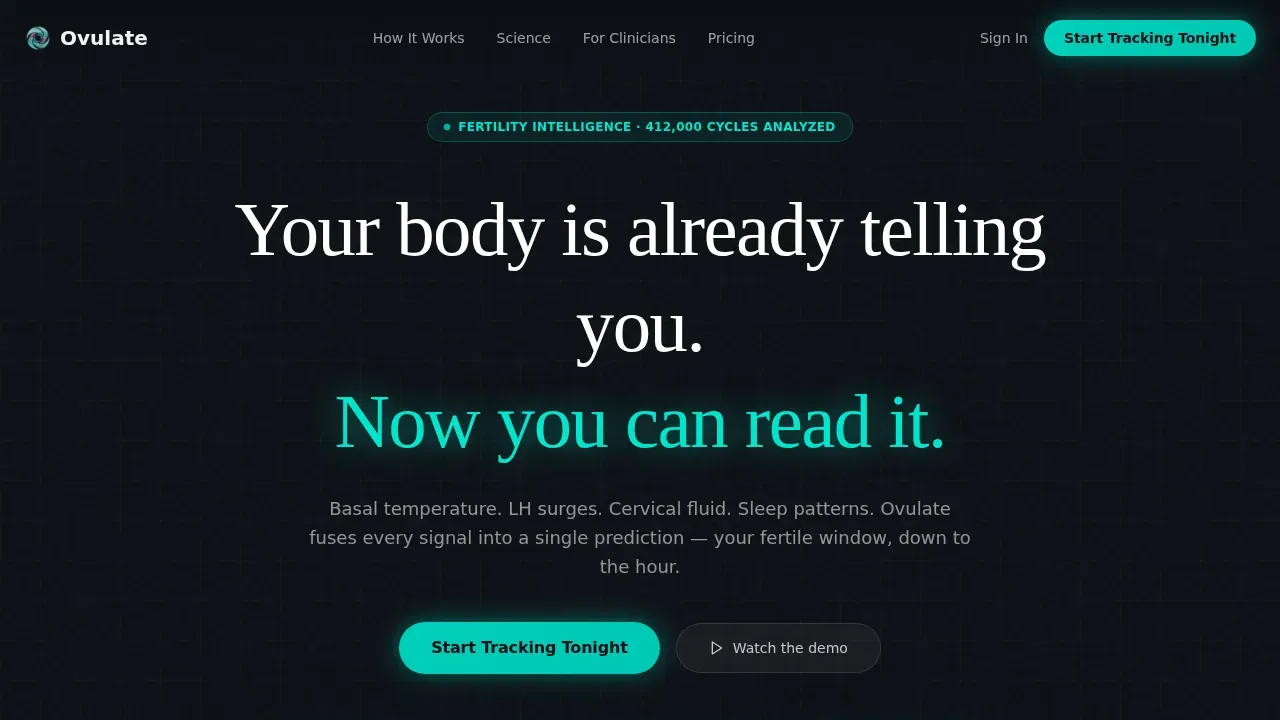
Ovulate is a dark glassmorphic landing page template designed for fertility analytics apps. It combines a live 28-day cycle chart, an interactive algorithm explorer, and a scrollable data grid to guide women through ovulation prediction down to the hour. The template drives app downloads with a sticky call-to-action and a frictionless import path for existing users.
by Rocket studio
Quick summary
Ovulate is a single-page landing page template built for femtech founders and fertility analytics products. It fuses a cinematic void-black aesthetic with frosted glass panels, teal glow accents, and live-feeling cycle data. Visitors scroll through an interactive demo, an algorithm explorer, and a data grid before a sticky call-to-action earns the download.
Who this template is for
This template is designed for a focused set of builders and product teams who need more than a generic app landing page. It speaks directly to the complexity of fertility data and the trust that audience requires.
- Femtech founders launching an ovulation or cycle tracking app who need a high-converting landing page that explains a complex product simply
- Digital health startups building an IVF companion or fertility analytics tool and looking for a polished, trust-building first impression
- Reproductive endocrinologists or clinic teams wanting a patient-facing resource that arrives with clean cycle data and clear information
What problem this template solves
Generic app landing pages fail fertility products. Women tracking ovulation and couples deep into family planning need to see the product working before they commit. A plain screenshot and a download button do not build that trust.
- Visitors cannot evaluate prediction accuracy from a static page, so they leave without downloading
- Fertility apps compete on credibility, and a template that feels clinical and precise helps a product stand out from calendar-only alternatives
- Switching from existing apps feels risky, so friction at the call-to-action kills conversions
What you get with this template
This template delivers a complete, scroll-driven landing page with five distinct sections, each designed to move a visitor from curiosity to download. Every element is grounded in real fertility data language and visual precision.
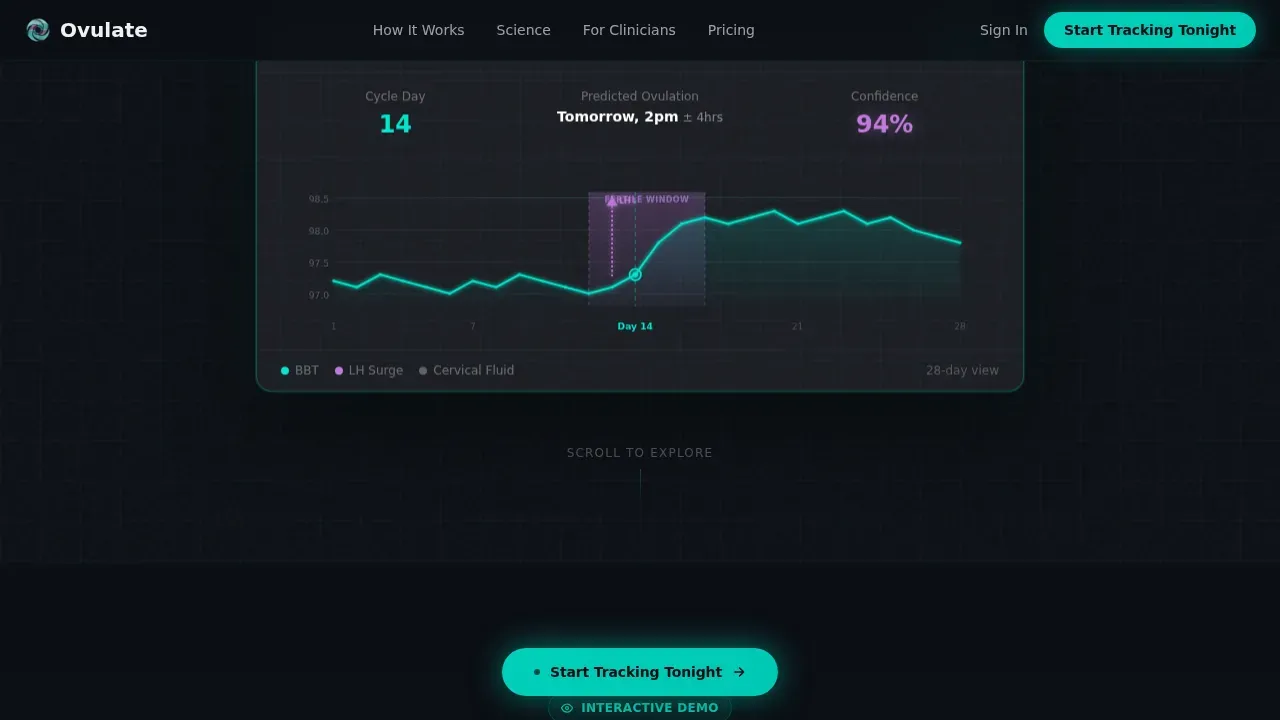
- A full-bleed hero with a frosted glass dashboard panel showing a live 28-day cycle chart, an LH spike marker, and an orchid-highlighted fertility window
- An interactive demo toggle, a confidence slider algorithm explorer, and a flip-card data grid with aggregate cycle statistics
- A sticky app download call-to-action with an iOS and Android interstitial, an email link option, and an existing-data import path for users migrating from other apps
Feature list
This section gives a closer description of each core feature built into the Ovulate landing page template.
Live 28-Day Cycle Chart Panel
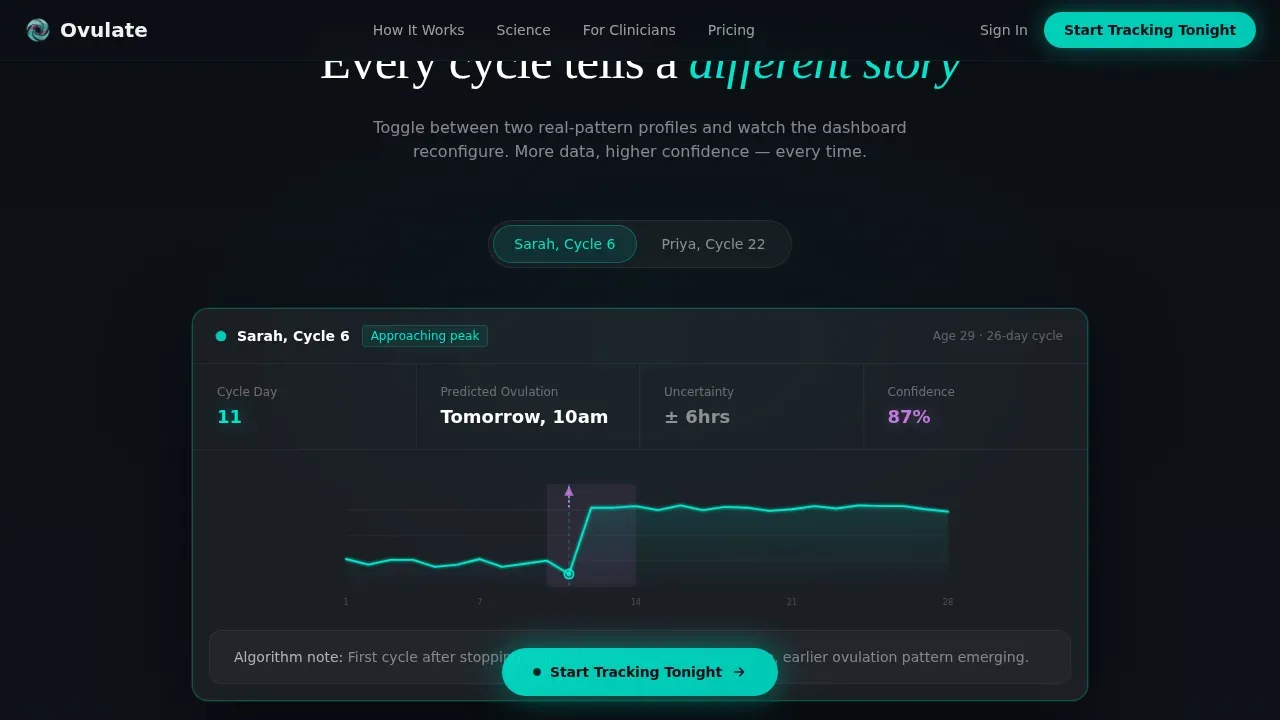
The hero section displays a floating glass dashboard panel designed to look like a real product interface. It shows basal body temperature curves, an LH surge marker on the correct day, and a glowing fertility window highlighted in orchid. Data labels read "Cycle Day 14," "Predicted Ovulation: Tomorrow, 2pm," and "Confidence: 94%," making the product's value immediately readable.
Interactive Sample User Toggle
Section two lets visitors toggle between two anonymized user profiles, watching the dashboard reconfigure with different curve shapes, different ovulation predictions, and different confidence scores. This hands-on demo helps women understand how the algorithm adapts to individual menstrual cycle patterns, building trust before any download prompt appears.
Algorithm Confidence Slider
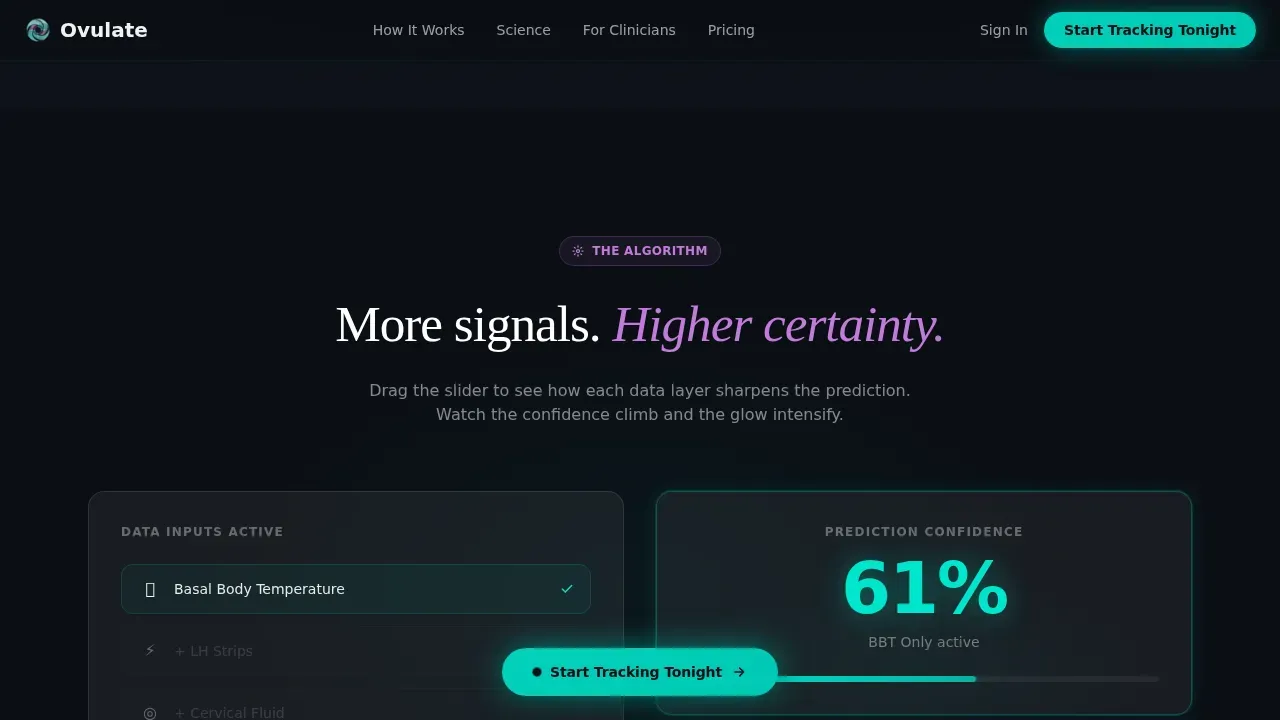
Section three is an interactive algorithm explorer. Dragging a slider adds data inputs one at a time: temperature only, then plus LH strips, then plus cervical tracking, then plus sleep data. The confidence percentage climbs visibly as each input is added. This teaches visitors exactly why multi-signal tracking is important for ovulation prediction accuracy.
Aggregate Data Grid
Section four presents anonymized statistics in a frosted card grid. Each card flips on hover to reveal a deeper insight, such as prediction accuracy by age bracket drawn from over 412,000 cycles analyzed. The grid reinforces the product's credibility with real numbers and cycle-level information.
Sticky App Download Call-to-Action
A teal-glow pill button labeled "Start Tracking Tonight" pins to the bottom of the viewport after the first scroll. Tapping opens a minimal interstitial for iOS or Android selection, plus a single-field email input for desktop visitors. A secondary path offers data import for users migrating from other cycle apps, reducing switching friction.
Educational Metric Context
The template includes space for educational content explaining the significance of key fertility metrics. Visitors learn why the LH surge matters, why knowing the fertility window starts five days prior to ovulation is useful, and why a positive ovulation predictor kit result does not guarantee that ovulation has occurred. This context guides users toward informed planning decisions.
Page sections overview
| Section | Purpose |
|---|---|
| Hero Dashboard Panel | Displays live cycle chart with teal glow and orchid fertility window to establish immediate product credibility |
| Interactive User Demo | Lets visitors toggle sample profiles to see how ovulation predictions adapt to different cycle patterns |
| Algorithm Explorer Slider | Shows confidence percentage climbing as data inputs are added, teaching the product's multi-signal logic |
| Aggregate Data Grid | Frosted flip cards reveal anonymized cycle statistics and prediction accuracy information |
| App Download Call-to-Action | Sticky teal button with iOS, Android, and email interstitial plus existing-data import path |
Design & branding system
The visual identity channels a Startup Velocity energy wrapped in a glassmorphic aesthetic. The overall effect is a lab instrument glowing in a dark room: clinical precision with something almost celestial beneath it.
- Color palette: void black (#0B0E14) background, frosted panel white at 8% opacity for glass cards, bioluminescent teal (#00E5CC) for primary glow accents and active states, and soft orchid (#C17BDB) for fertility-peak indicators
- Typography pairing: DM Sans for body text and user interface labels, Fraunces for editorial headlines, creating a contrast between clinical readability and expressive authority
Mobile & speed optimization
The template is built around a mobile-first mental model: the experience is designed to feel like unlocking your phone at 6 a.m. and seeing the answer glowing right there. Mobile-friendly design ensures the dashboard view and sign-up form are easily accessible on smartphones.
- Animations use CSS keyframe pulses and GPU-accelerated transforms, keeping the scroll-linked blur and staggered reveals smooth without heavy JavaScript overhead
- Sticky call-to-action and interstitial flow are optimized for thumb-reach on mobile screens, keeping the download path accessible at every scroll depth
How this template helps you convert
The scroll is the sales pitch. Visitors interact with real prediction mechanics before the download prompt ever appears, which means the call-to-action arrives when trust is already earned.
- The interactive demo and confidence slider let visitors evaluate the product's logic firsthand, making the fertility tracking value proposition tangible rather than claimed
- The data grid reinforces credibility with aggregate cycle statistics and real numbers, giving women and couples in active family planning a reason to trust the prediction engine
- The import path for users migrating from existing apps lowers switching friction, and the email-link option ensures desktop visitors can still complete the download on their preferred device
Other information about this template
This template is well suited to founders creating fertility analytics products who want a landing page that can serve multiple audience layers simultaneously. It works as a resource for women just starting ovulation tracking, as a guide for couples in extended trying-to-conceive cycles, and as a clinical-facing tool for reproductive specialists who want patients to arrive with organized data.
- The template supports a forward-looking ovulation calendar view, consistent with how ovulation calendars estimate future ovulation dates and fertility windows based on the last period start date and average cycle length
- The ovulation date is generally calculated to be 14 days prior to the start date of a period, and the fertility window is typically shown starting five days prior to ovulation; the template's data panels reflect this standard in their sample labels
- At-home fertility tests are screening tools, not diagnostic tools; the template includes space for messaging that encourages users to consult a fertility specialist or seek professional medical care when results are unclear or medications may be involved
- Ovarian reserve tests can measure Anti-Mullerian Hormone (AMH) to estimate remaining egg count, and the template's data grid section can surface this kind of aggregate information as a flip-card insight
- The template is designed to support a collaborative partner-access view, so both people in a couple can read the same cycle data and share responsibility in their fertility journey
- PDF report generation for doctors is a supported content concept within the template, bridging home tracking and professional medical care appointments
- This ovulate predictive fertility analytics dashboard landing page template is designed for digital health startups and is compatible with no-code platforms, allowing teams to build and launch without extensive coding knowledge
Theme
Startup Velocity
Creative direction
Interactive Explorer
Color system
Glassmorphic
Style
Dashboard/Data Grid
Direction
App Download
Page Sections
Live 28-day Cycle Chart Hero
Interactive Sample User Toggle
Algorithm Confidence Slider
Aggregate Flip-card Data Grid
Sticky App Download Call-to-action
Educational Metric Content Blocks
Related questions
Who is this template designed for?
Does the template include real data or sample data?
Can users import data from other cycle apps?
Is the template suitable for an IVF or clinical fertility context?
Should users consult a professional about their fertility results?