Premium Advanced Tech & AI Platforms Cost Estimator Website Template
Label is a high-velocity AI data labeling landing page template built for annotation services that need to prove speed and accuracy before asking for a lead. It combines a live stats wall, a modular capability card grid, an interactive cost estimator, and a focused pilot signup form, all inside a dark Dashboard Pro aesthetic powered by a Void and Violet color system.
by Rocket studio
Quick summary
Label is the Label High Velocity AI Data Labeling Landing Page Template, a single-page, lead-generation layout designed for annotation services targeting machine learning teams. It opens with an animated metrics wall, moves through modular capability cards, passes through an interactive cost estimator, and converges on a free pilot batch form. Every section is built to prove data labeling scale and accuracy before asking for contact details.
Who this template is for
This template is built for data labeling companies and annotation service providers that sell to technical buyers. Your clients are not generalists, they are machine learning practitioners, computer vision engineers at autonomous vehicle companies, and natural language processing researchers who need domain-expert data labelers fast. If your pitch lives or dies on throughput, consensus accuracy, and turnaround time, this layout is your front door.
The template fits teams in these situations:
- ML engineering leads at Series B startups drowning in unlabeled data who need a data labeling platform that proves speed before the sales call.
- Computer vision teams racing to hit annotation throughput targets for object detection, semantic segmentation, and bounding boxes work.
- NLP researchers at pharma or biotech organizations who require data labelers with genuine domain expertise in fields like oncology and electronic health records.
What problem this template solves
Most data labeling service pages bury their proof. A machine learning engineer lands on the page, sees a generic headline and a contact form, and leaves. The core problem is a trust gap: the visitor does not believe you can deliver accurately labeled data at the volume and velocity they need before you ask them to hand over their email.
This template solves that trust gap directly:
- It leads with hard numbers, annotation totals, consensus accuracy rates, and first-response time, so the machine learning model performance argument is made before a single word of marketing copy appears.
- It breaks the data labeling process into capability cards that show exactly which labeling tasks you handle: image segmentation, named entity recognition (NER) tagging, LiDAR point cloud annotation, reinforcement learning from human feedback (RLHF) ranking, video data labeling, and audio transcription.
- It places the cost estimator mid-page to intercept high-intent visitors who are quietly calculating budget, then soft-gates the result behind an email field rather than forcing a demo request too early.
What you get with this template
You get a fully structured, one-page layout that takes a skeptical technical buyer from "show me the numbers" to "start my pilot" in a single scroll. Every section of the data labeling process has a dedicated zone: proof, capability, cost, and conversion.
Built-in components and sections include:
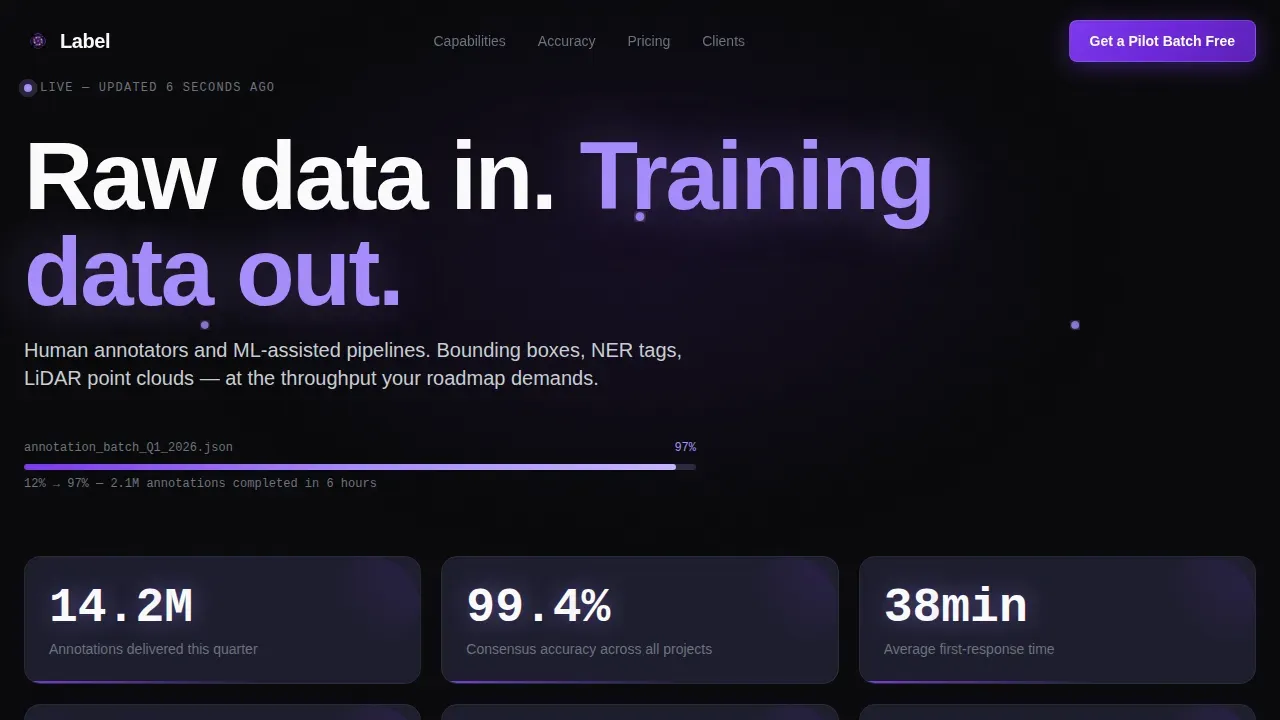
- An animated hero stats wall displaying live-counting metrics: 14.2 million annotations delivered this quarter, 99.4 percent consensus accuracy, and 38-minute average first-response time, rendered in oversized violet-white type against void black with particle trail connectors.
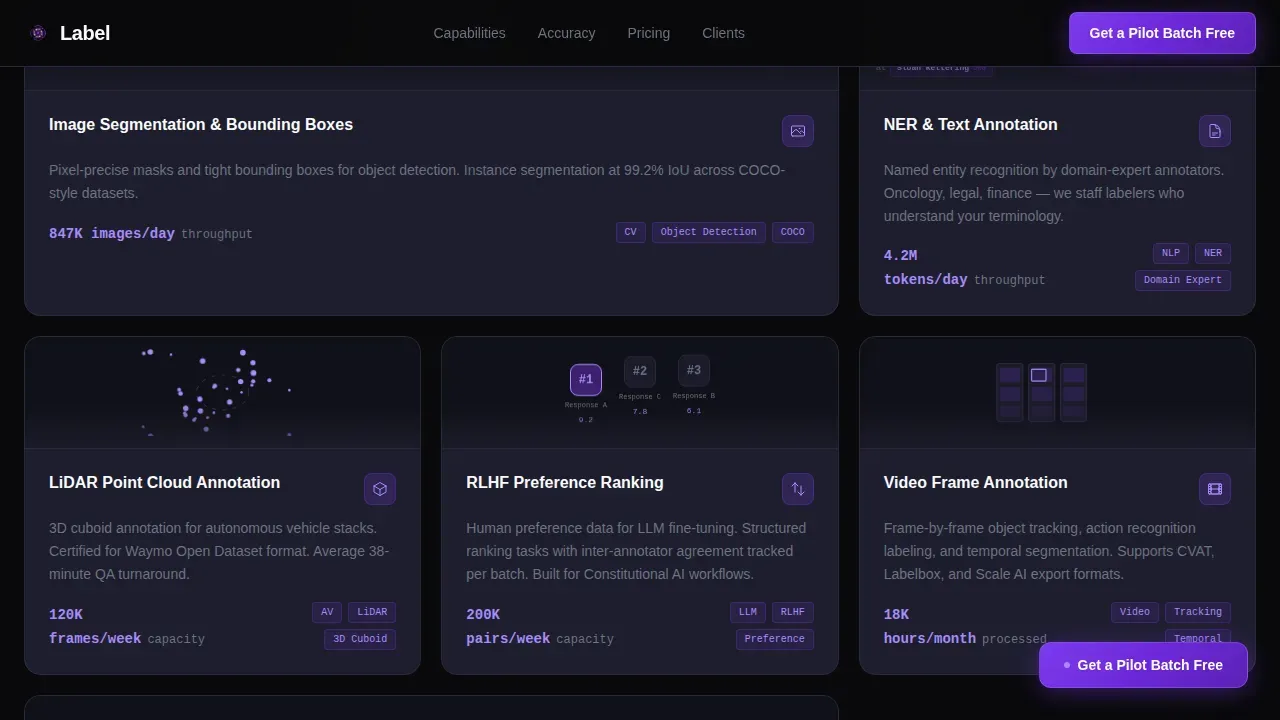
- A modular bento card grid with kinetic reveal animations for each annotation type, image segmentation, NER tagging, LiDAR point clouds, RLHF ranking, video, and audio, each card showing a micro-animation of the labeling task in progress.
- An interactive cost estimator card that collects data type and estimated monthly volume, outputs a per-unit price range, and soft-gates the result behind an email field.
- A convergence pilot signup form that asks for data type first, then estimated monthly volume, then a free-text field for annotation guidelines or a link to a sample training dataset.
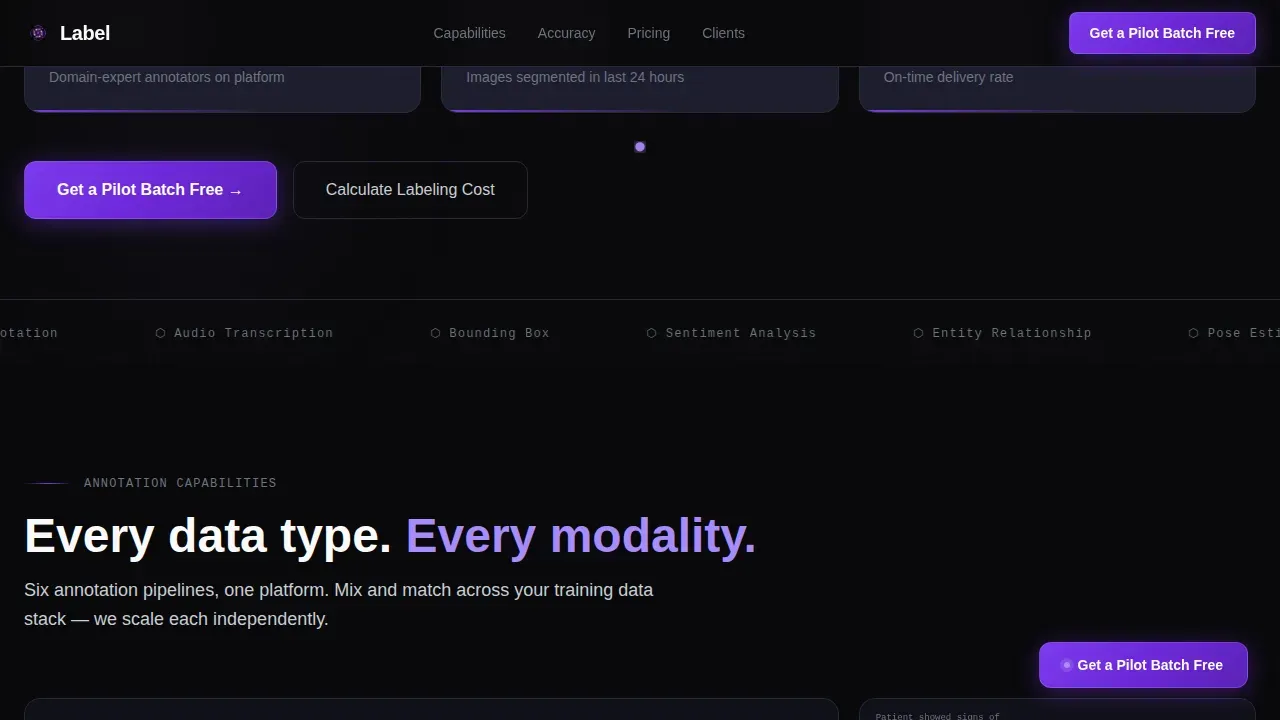
- A floating "Get a Pilot Batch Free" call-to-action button that persists on scroll and anchors to the convergence form section.
Feature list
This section describes the core built-in features of the Label template as specified in the source brief.
Animated Live Metrics Hero
The header is a live stats wall, a full-width grid of animated counters that tick upward in real time. Numbers are rendered in oversized violet-white type using JetBrains Mono against void black (#09090B). Subtle particle trails connect each metric like a neural graph, giving the impression that data labeling work is completing right now, while the visitor watches. No stock photography and no illustration, only the data points doing the talking.
Modular Capability Card Grid
Below the stats wall, a bento-style card grid snaps into view with staggered kinetic ease on scroll. Each card represents a distinct annotation capability: image segmentation, NER tagging, LiDAR point clouds, RLHF ranking, video labeling, and audio transcription. Cards include micro-animations showing the labeling task in motion, bounding boxes being drawn, entity tags being placed, point clouds being classified. The reveal sequence accelerates as the visitor scrolls, reinforcing a sense of velocity and scale.
Interactive Cost Estimator Card
An embedded interactive estimator card lets visitors self-qualify by selecting their data type and entering their estimated monthly volume. The card outputs a per-unit price range specific to their inputs. The result is soft-gated behind an email field, creating a low-friction lead capture moment that feels like a tool rather than a form. This intercepts budget-conscious machine learning practitioners early in their evaluation.
Convergence Pilot Signup Form
The page converges on a single focused form anchored in the "Your Project" section. The form collects data type first, image, text, video, audio, or multimodal, then estimated monthly volume, then a free-text field for annotation guidelines or a link to a sample dataset. The floating "Get a Pilot Batch Free" call-to-action button anchors to this section from anywhere on the page, giving the visitor a clear, persistent path forward.
Floating Persistent Call-to-Action
A floating button labeled "Get a Pilot Batch Free" appears on scroll and persists across all page sections. It ensures that a visitor who is convinced at the stats wall, the capability grid, or the trust section always has a visible, one-click path to the pilot form. The button uses the electric violet (#A78BFA) hover state to stay visually prominent without competing with content.
Dark Dashboard Visual System
The entire layout is built on the Dashboard Pro theme using a Void and Violet color system. Card surfaces use muted graphite (#1E1E2E), interactive elements pulse in deep ultraviolet (#7C3AED), and hover states fire in electric violet (#A78BFA). Typography combines DM Sans for interface text with JetBrains Mono for all metrics and numbers. The result reads like a monitoring terminal at 2 a.m., dark everywhere except where a metric demands attention.
Page sections overview
| Section | Purpose |
|---|---|
| Hero Stats Wall | Display animated live metrics to prove annotation scale and accuracy upfront |
| Capability Card Grid | Showcase all supported annotation types with kinetic micro-animations |
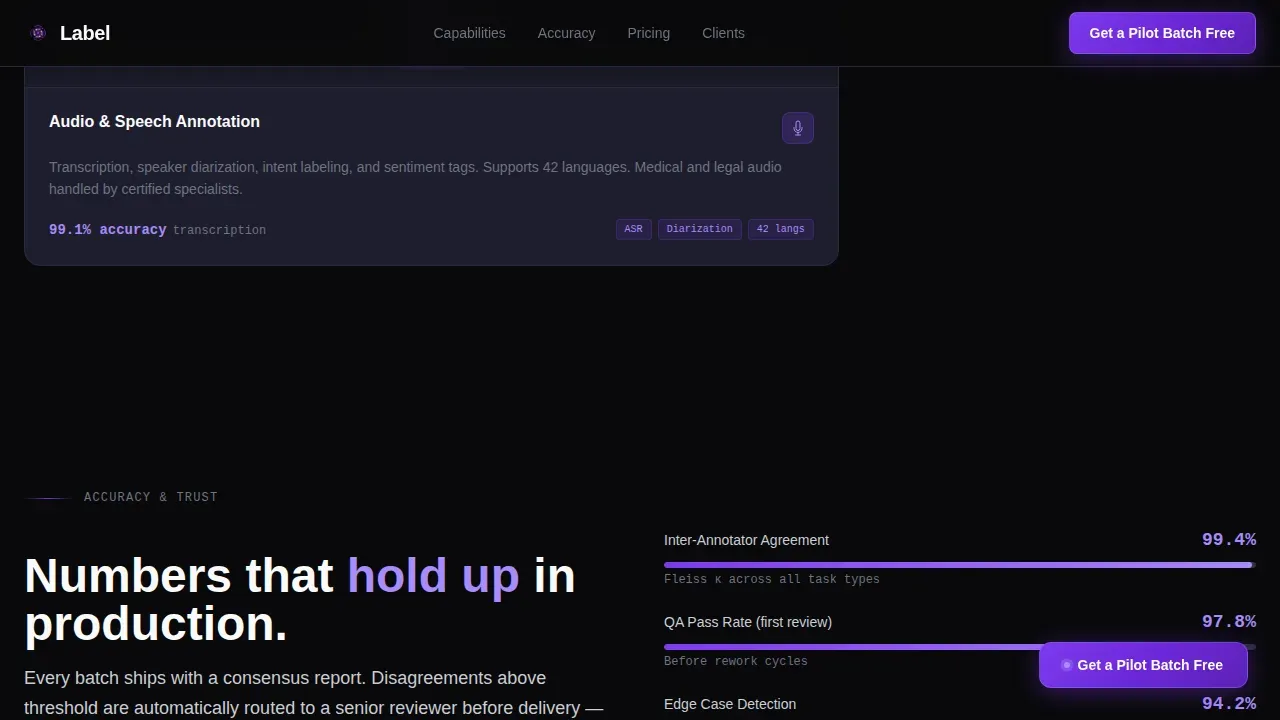
| Trust and Proof | Reinforce accuracy metrics, consensus methodology, and client archetypes |
| Cost Estimator Card | Let visitors self-qualify with an interactive price calculator |
| Pilot Signup Form | Converge lead intent into a focused, low-friction pilot request form |
| Footer (Linear Single-Row) | Close the page with minimal single-row footer pattern |
Design & branding system
The Label template uses the Dashboard Pro theme and a Void and Violet color system inspired by a monitoring terminal running overnight. Every color choice has a job: void black holds the background, graphite surfaces the cards, and violet signals action.
Design system details:
- Color palette: absolute void black (#09090B) for the page background, deep ultraviolet (#7C3AED) for primary interactive elements, muted graphite (#1E1E2E) for card surfaces, cool silver (#C9CDD4) for body text, and electric violet (#A78BFA) for hover states and active metric highlights.
- Typography pairing: DM Sans for all interface copy and body paragraphs; JetBrains Mono for all numeric metrics, counters, and data points to reinforce the terminal aesthetic.
- Animation approach: GPU-accelerated transforms power the animated counters, staggered card reveals use Intersection Observer triggers, and particle trail connectors between hero metrics use requestAnimationFrame for smooth real-time rendering.
Mobile & speed optimization
The Label template is designed desktop-first, because machine learning engineers and computer vision teams work on large monitors. The layout uses a multi-column card grid and a wide metrics wall that reads best at full resolution. A mobile fallback is included so the page remains functional and readable on smaller screens.
Mobile and performance considerations built into the template:
- The card grid reflows to a single-column stack on smaller viewports, keeping capability tiles readable without horizontal scrolling.
- The floating call-to-action button resizes and repositions on mobile to remain tappable without obscuring key content.
- Animations degrade gracefully on lower-powered devices, maintaining the visual hierarchy without blocking interaction.
How this template helps you convert
The Label template is structured to earn the click rather than demand it. It sequences proof, capability, cost transparency, and form in a deliberate order that mirrors how a skeptical machine learning engineer evaluates a vendor.
The conversion logic works in three stages:
- The animated stats wall delivers the proof argument before any marketing language appears, 14.2 million annotations, 99.4 percent accuracy, and a 38-minute first-response time are displayed as oversized live counters, so the visitor's first question ("can you handle my volume?") is answered in the first scroll position.
- The modular capability card grid and trust section move the visitor from "they have scale" to "they handle my specific annotation type," addressing the second question that any machine learning engineer or NLP researcher will ask before considering a pilot.
- The cost estimator intercepts budget evaluation mid-page with a low-friction tool that outputs a price estimate in exchange for an email, converting a passive browser into a qualified lead before the pilot form is ever reached.
Other information about this template
The Label template sits at the intersection of the data labeling industry's two hardest conversion problems: proving throughput to buyers who have been burned by low quality data before, and making the first contact feel like a tool rather than a pitch. This section covers additional context relevant to teams evaluating this template for their data labeling platform or annotation service landing page.
Data labeling is the activity of assigning context or meaning to raw data so that machine learning algorithms can learn from the labels to achieve the desired result. Data labeling can refer to tasks including data tagging, annotation, classification, transcription, and moderation. The data labeling process is a central part of the data pre-processing workflow for machine learning, and it structures unstructured data to make it meaningful for machine learning models. Organizations typically use a combination of software tools and trained people to label data at scale.
The data labeling process for a well-run annotation operation is iterative. Labeling platforms often include an AI model that will pre-label the data to some extent, which human data labelers then correct or refine. This combination of automated labeling assistance and human review is what allows a data labeling workforce to deliver accurately labeled data at high throughput without sacrificing data quality. The process of data labeling helps a machine learning engineer hone in on the factors that determine the overall precision and accuracy of their model, which is exactly why the Label template is structured to explain that process clearly before asking for a lead.
The demand for skilled human data labelers has grown significantly as generative AI models require more nuanced guidance. The quality of human feedback directly caps the quality of the AI. This means data labeling quality is not just a vendor differentiator, it is a ceiling on model performance. When a labeling team introduces labeling errors or inconsistent labels, low quality data flows into the training dataset and compounds over time. Human-in-the-loop (HITL) systems integrate human feedback into the data labeling process to enhance the accuracy and reliability of labeled datasets, and they are a standard expectation among enterprise buyers.
Data labeling plays a major role in fine-tuning large language models (LLMs). Fine-tuning LLMs requires high quality training data with accurate labeling, and fine-tuning can be done with smaller datasets that are curated and labeled by subject matter experts. The fine-tuning process involves additional training using domain-specific datasets, and the data labeling process for fine-tuning LLMs includes creating instruction-expected response pairs for training. For NLP researchers working with electronic health records or pharma-specific terminology, domain expertise in the labeling team is not optional, it directly determines whether the fine-tuned model performs in production.
Additional considerations for teams using or customizing this template:
- The template supports annotation types across all five modalities: image data, text data, video data, audio, and 3D point cloud, covering the full range of data annotation needs for computer vision, natural language processing, speech recognition, and multimodal machine learning.
- The data labeling tools and labeling tools represented in the capability card grid include bounding boxes, semantic segmentation, polygon annotation, entity recognition, RLHF ranking, and audio transcription, covering the core labeling tasks a data labeling operations team would need to demonstrate.
- For teams working with sensitive data, the template includes a trust and proof section where compliance indicators such as GDPR, CCPA, HIPAA, or ISO certifications can be placed to reassure enterprise clients.
- Active learning workflows and synthetic data use cases can be described in the capability cards, as both are relevant to machine learning practitioners who want to reduce manual labeling costs while maintaining high accuracy on ground truth validation.
- The cost estimator card is designed to measure quality of visitor intent by collecting data type and volume inputs before delivering a price output, making it a practical lead qualification tool for data labeling companies that handle both high-volume commodity tasks and specialized supervised learning projects.
- Teams building LLM training data pipelines, reinforcement learning from human feedback workflows, or test data generation programs will find the pilot form structure easy to adapt for their specific intake requirements.
- The template follows the Launch Energy creative direction, meaning the scroll sequence is designed to build momentum, quantities get larger, turnaround times get shorter, and the visual pace of card reveals accelerates as the visitor moves down the page, so the data labeling process feels faster just by watching it.
- Commercial data labeling platforms offer high-quality tooling, dedicated support, and an experienced labeling workforce to help teams scale. The Label template is designed to communicate exactly those advantages from the first viewport, using real metrics rather than marketing language to make the case for high quality data labeling.
- Many AI organizations use a combination of data labeling companies to cover different annotation needs. If your service covers a specific niche, such as medical imaging, autonomous vehicle LiDAR, or LLM training data, the capability card grid gives you a clear format to call that out and differentiate from generic providers.
- Data labeling is essential for training machine learning models across applications including computer vision and natural language processing. To train machine learning models effectively, every data point in the training dataset must carry an accurate label. The template is structured to make that argument visually and quantitatively before it ever makes it verbally.
Theme
Dashboard Pro
Creative direction
Launch Energy
Color system
Void & Violet
Style
Card Grid (Modular)
Direction
Lead Generation
Page Sections
Animated Live Metrics Hero Wall
Modular Annotation Capability Cards
Interactive Labeling Cost Estimator
Pilot Batch Convergence Form
Persistent Floating Call-to-action Button
Dashboard Pro Dark Visual System
Related questions
What annotation types does this template showcase?
Can I customize the metrics shown in the hero stats wall?
How does the cost estimator card capture leads?
Is this template suited for specialized services like pharma NLP or autonomous vehicle annotation?
Does the template include a footer?