Cybersecurity Landing Page Template for Contractors
Defense is a premium cybersecurity landing page template built for firms protecting military networks, intelligence platforms, and critical national infrastructure. It pairs an Industrial Raw visual identity with a Spec Sheet card grid layout, front-loading technical credentials and compliance metrics so defense procurement officers, CISOs, and program managers can evaluate your capabilities before they ever click a call to action.
by Rocket studio
Quick summary
Defense is a single-page cybersecurity template designed for contractors operating at the highest classification levels. It uses a modular card grid to present capabilities like Zero Trust Architecture, Endpoint Detection and Response, and air-gapped Security Operations Center deployment as structured technical data sheets. Every design choice signals precision, operational discipline, and earned trust.
Who this template is for
This template is built for organizations whose work cannot afford ambiguity. If your clients demand evidence before a conversation, this layout delivers it.
- Defense contractors seeking CMMC Level 3 certification support who need to demonstrate technical maturity to procurement teams
- CISOs and program managers at agencies managing zero-trust deployments inside air-gapped or classified environments
- Cybersecurity vendors targeting defense procurement officers who evaluate vendors against NIST 800-171 compliance matrices
What problem this template solves
Generic agency templates signal the wrong thing to defense buyers. A procurement officer evaluating a cybersecurity vendor needs structured proof, not narrative persuasion. This template replaces marketing copy with the kind of scannable, specification-driven evidence that belongs in a vendor evaluation spreadsheet.
- Buyers struggle to trust vendors who lead with brand story instead of compliance credentials and measurable outcomes
- Defense-sector landing pages often look indistinguishable from commercial IT sites, eroding credibility before the first scroll
- Procurement timelines are tight, and visitors need to confirm threshold requirements quickly without hunting for buried specifications
What you get with this template
The template delivers a fully structured, single-page layout optimized for a defense cybersecurity audience. Every section has a defined role, and every visual element is intentional.
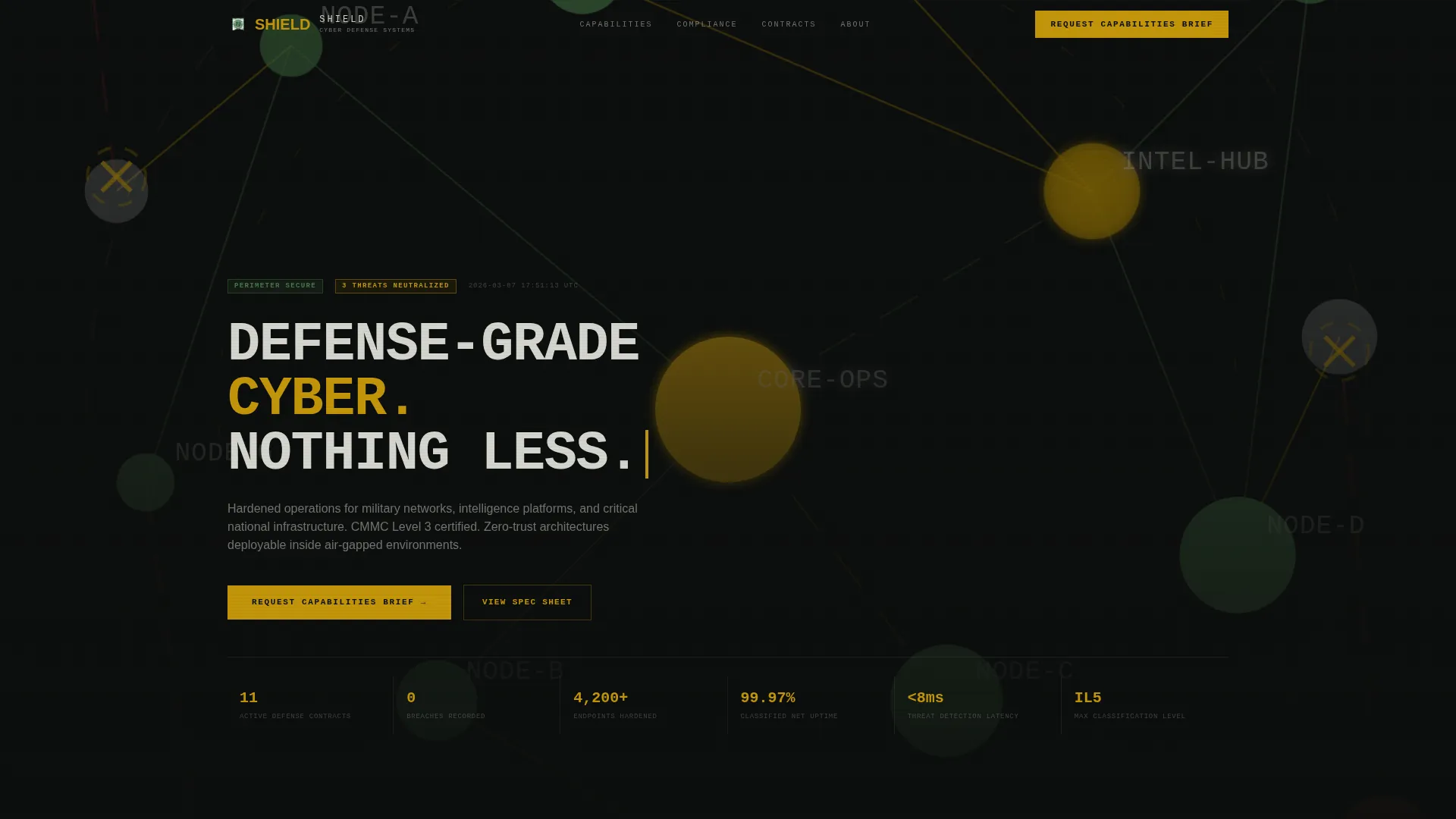
- A full-width threat topology map header styled as a real-time network diagram with embedded data callouts and a monospace headline
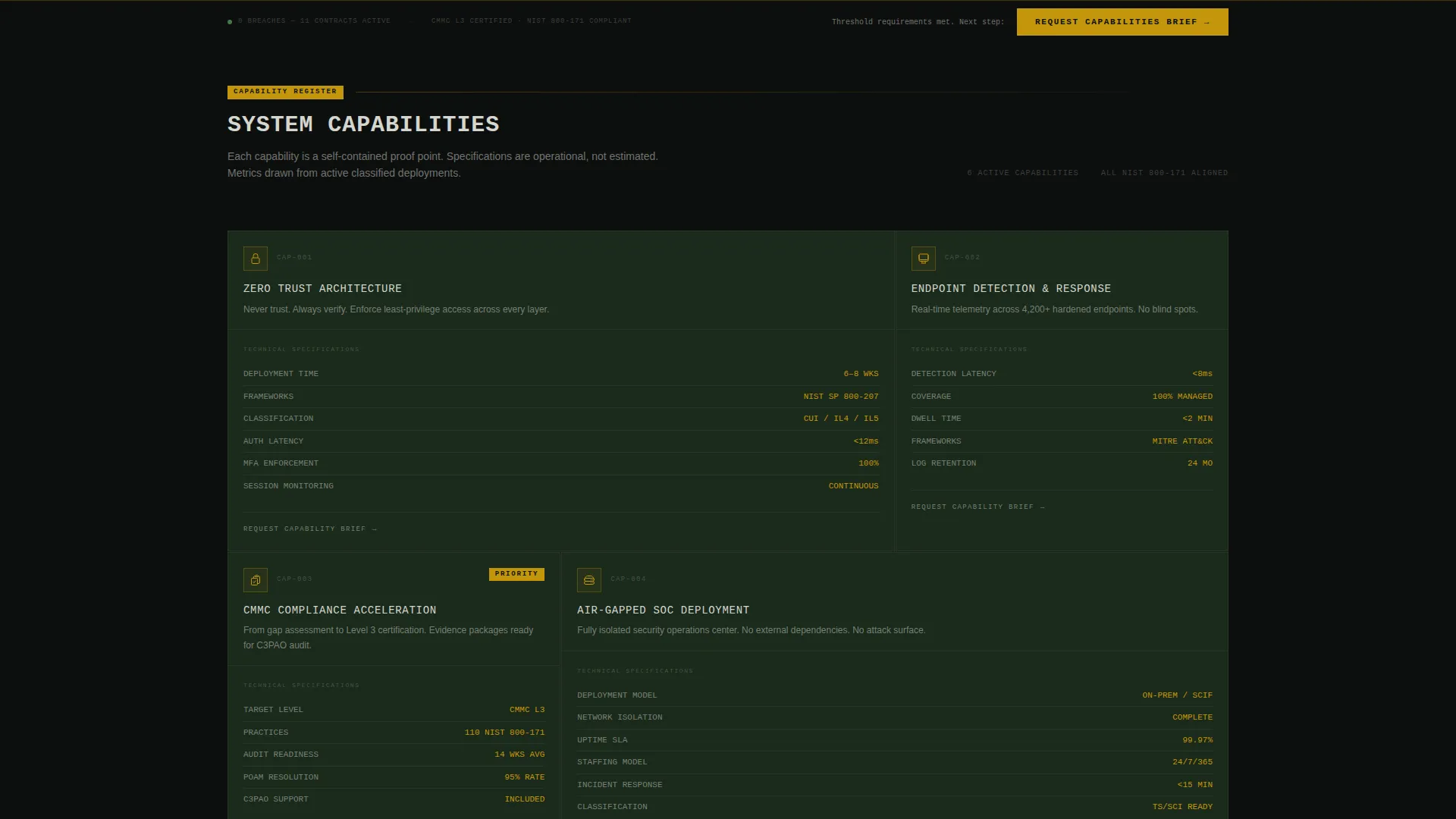
- A modular card grid where each card presents a capability with a specification table covering response times, compliance frameworks, classification levels, and deployment timelines
- A persistent bottom call-to-action bar that appears after the second card row, driving visitors toward a capabilities briefing request
Feature list
This section covers the core built-in components and layout capabilities delivered with this template.
Threat Topology Map Header
The header spans the full page width and renders as a real-time-styled network diagram. Thin amber and green lines trace network nodes, attack vectors, and defense perimeters against a command-console black background. Embedded data callouts display hardened endpoint counts, classified network uptime, and active contract breach records. A monospace uppercase headline fades in over the map.
Modular Capability Card Grid
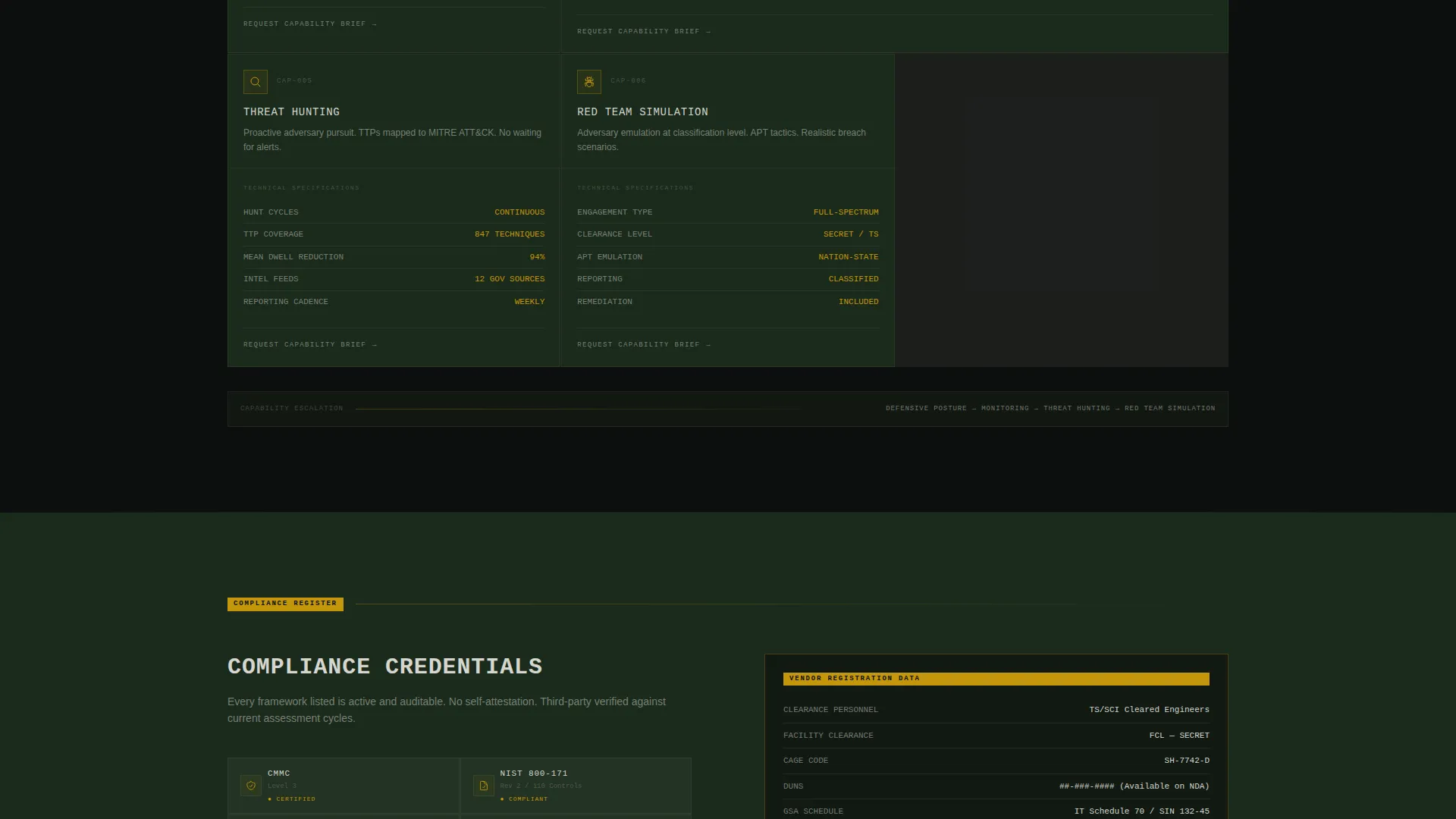
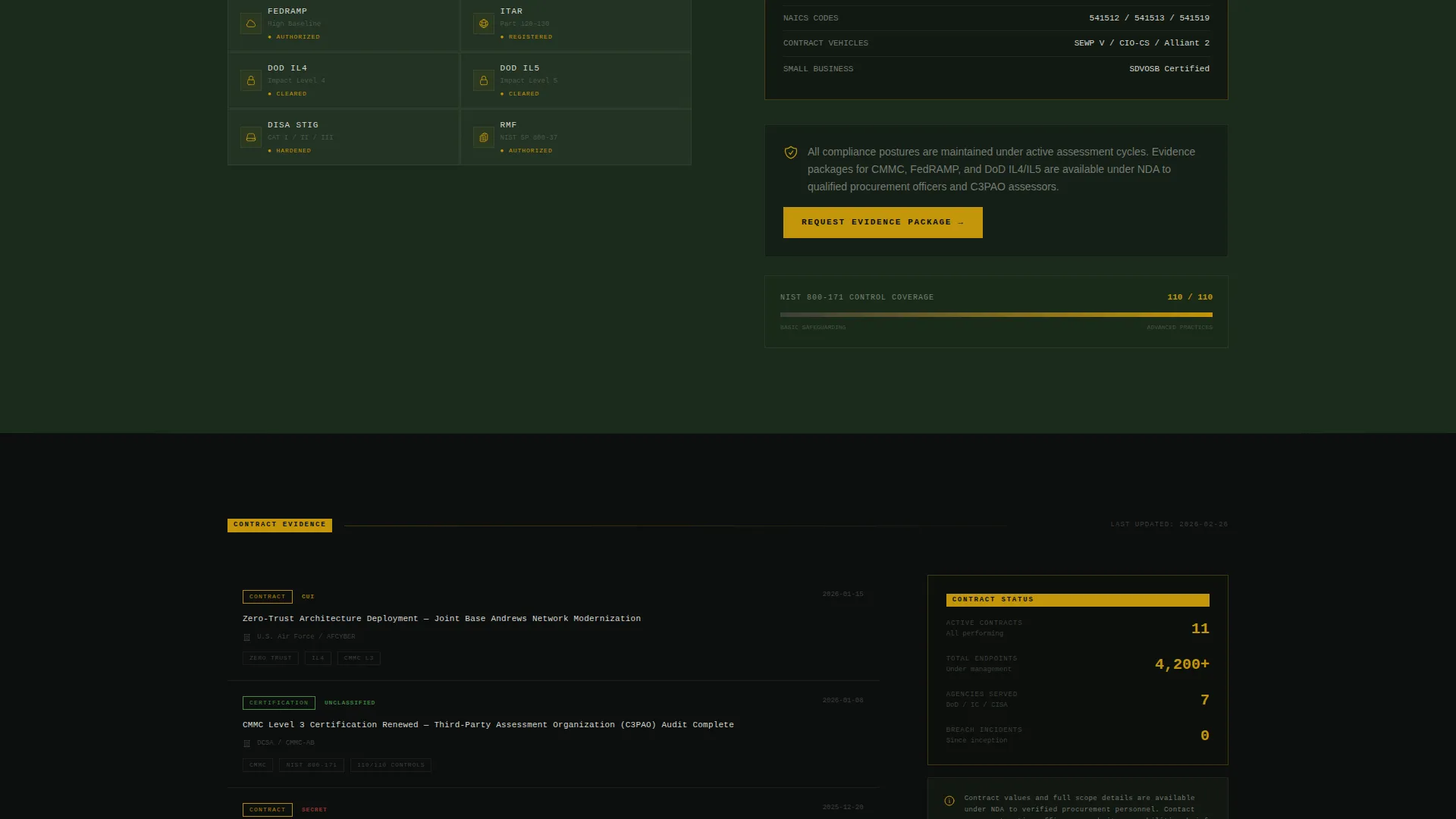
Each card in the grid functions as a self-contained technical data sheet. Capabilities covered include Zero Trust Architecture, Endpoint Detection and Response, CMMC Compliance Acceleration, and Air-Gapped Security Operations Center Deployment. Specification tables inside each card show metrics such as response time in milliseconds, supported classification levels, compliance frameworks met, and deployment timeline in weeks.
Escalating Capability Narrative
The card grid is structured so that cards escalate in scope as the visitor scrolls. The sequence moves from defensive posture through active monitoring, threat hunting, and red team simulation. This progression mirrors how a procurement officer reads a capabilities brief, confirming baseline coverage before evaluating advanced offensive capability.
Persistent Call-to-Action Bar
After the second row of cards, a persistent bottom bar locks into view. It carries the primary call to action in clearance-amber text on black, reinforcing the briefing request without interrupting the information flow. The bar remains visible as the visitor continues scrolling through remaining capability cards.
Classification-Style Amber Accent System
Interactive states, hover effects, and classification-style banners all use the clearance-amber accent color exclusively. This keeps the palette disciplined and gives every interactive element a distinct, recognizable signal. The amber glow references terminal cursor aesthetics and SCIF environment visual language.
Monospace and Sans-Serif Typography System
Data, metrics, and specification table values render in monospace typefaces to reinforce technical credibility. Narrative sections and section labels use clean sans-serif type. The two-typeface system creates a clear visual hierarchy between evidence and explanation without requiring additional styling.
Page sections overview
| Section | Purpose |
|---|---|
| Threat Topology Header | Establishes operational credibility with a network diagram, embedded data callouts, and a full-width monospace headline |
| Capability Card Grid | Presents each cybersecurity capability as a structured specification sheet with measurable metrics |
| Persistent call to action Bar | Locks a briefing request call to action into view after the second card row for continuous conversion visibility |
| Secure Intake Form | Receives the click-through from the primary call to action and collects qualified lead information |
Design & branding system
The template follows an Industrial Raw theme anchored by a Forest Trust color system. Every palette and typography decision reinforces the operational environment this firm inhabits.
- Core colors are deep operational green (#1B2A1B), command-console black (#0D0F0E), secure-channel gray (#3A3F3A), and off-white text (#D4D6CF); clearance-amber (#C4960A) is reserved strictly for interactive states and classification banners
- Surface treatments use matte finishes with no gradients, no reflections, and no decorative photography; the visual language is closer to a SCIF terminal than a commercial website
- Typography combines monospace fonts for data and specification values with sans-serif fonts for headings and descriptive text, maintaining a clear hierarchy throughout the grid
Mobile & speed optimization
The modular card grid is structured so each capability card stacks cleanly on smaller screens without losing its specification table layout. The template is built for environments where procurement officers may review vendor materials on secured mobile devices.
- Card components reflow from a multi-column grid to a single-column stack on narrow viewports, preserving all metric and specification data
- The persistent call-to-action bar remains anchored at the bottom of the viewport on mobile, keeping the briefing request accessible throughout the scroll
How this template helps you convert
This template earns the click before it asks for one. The page is structured so that by the time a visitor reaches the call to action, they have already confirmed that your capabilities meet their threshold requirements.
- The header front-loads three concrete performance claims, establishing immediate technical credibility and reducing the effort required to justify further engagement to a supervisor or contracting officer
- The escalating card grid mirrors the structure of an actual vendor evaluation, so procurement officers can move through the page the same way they move through a capabilities assessment, checking off requirements as they scroll
- The persistent bottom bar keeps the primary call to action visible without interrupting the evidence review, so the click happens at the moment of confirmation rather than after the visitor has had to search for next steps
Other information about this template
This template sits at the intersection of the Aerospace and Defense category, the Defense Contractor and Military subcategory, and the Defense Cybersecurity niche. It is purpose-built for firms whose clients operate under formal acquisition processes and compliance mandates.
- The template is optimized for a click-through conversion flow that terminates at a secure intake form, not a generic contact page
- The Spec Sheet creative direction means no stock photography, no illustration, and no decorative imagery appear anywhere in the layout
- The header concept is classified as an Infographic type, specifically a threat topology map, which is unique to defense and intelligence sector visual language
- The template style is a Card Grid with modular components, making individual capability cards easy to add, remove, or reorder as your service portfolio evolves
Theme
Industrial Raw
Creative direction
Spec Sheet
Color system
Forest Trust
Style
Card Grid (Modular)
Direction
Click-Through
Page Sections
Threat Topology Map Header
Modular Capability Card Grid
Escalating Capability Sequence
Persistent Bottom Call to Action Bar
Classification-style Accent System
Dual Typeface Data Hierarchy
Related questions
Who is the primary audience for this template?
Can I customize the capability cards for my specific services?
What does the call-to-action flow look like?
Does this template use stock photography or decorative imagery?
Is this template suitable for a firm still pursuing CMMC certification?