Automotive AI Document Processing Landing Page
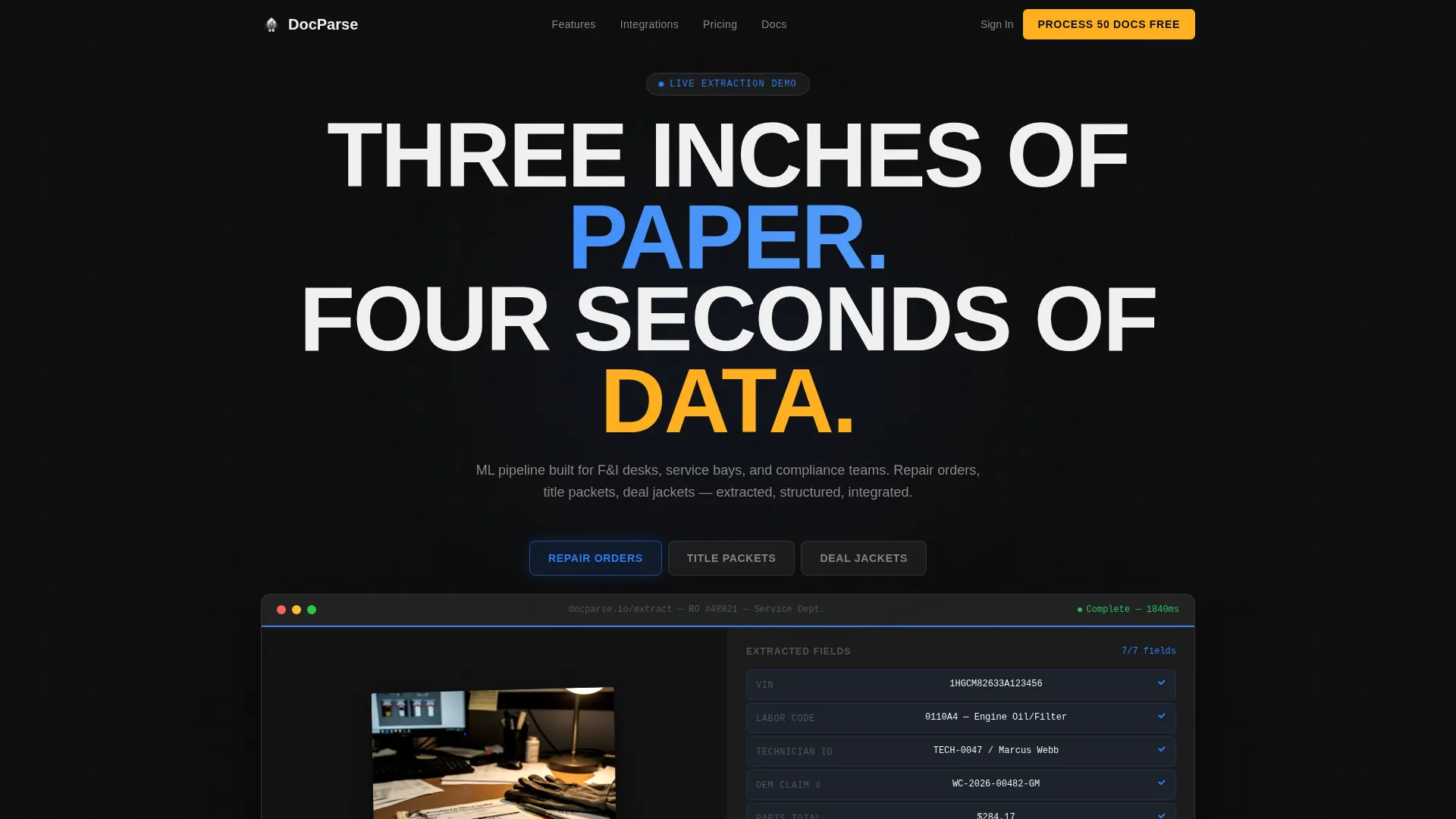
DocParse is a Bold Brutalist, glassmorphic landing page template built for automotive AI document processing platforms. It walks visitors from manual-keying pain to instant extraction clarity through a card grid layout, a live feature tab switcher, and a freemium trial funnel. The design converts skeptics before sign-up with a drag-and-drop sample upload that returns results on-page.
by Rocket studio
Quick summary
DocParse is a single-page, card grid landing page template for automotive AI document processing tools. It uses a Bold Brutalist design with a glassmorphic color system to guide F&I managers, service directors, and compliance officers from document chaos to structured extraction in one controlled scroll.
Who this template is for
This template is purpose-built for teams selling or launching AI-powered document processing tools in the automotive space. It speaks directly to the people drowning in paperwork at dealerships every day.
- Finance and Insurance (F&I) managers handling deal jackets at closing time
- Service directors reconciling warranty claims against Original Equipment Manufacturer (OEM) portals
- Compliance officers at dealer groups auditing thousands of documents monthly
What problem this template solves
Manual document keying at dealerships is slow, error-prone, and expensive. Repair orders, title packets, and dealer invoices pile up while staff re-key vehicle identification numbers (VINs), line items, and lien data by hand. This template frames that pain precisely before presenting the solution.
- No clear visual proof of extraction accuracy before a prospect commits to signing up
- Conversion friction caused by asking for credit card details too early in the funnel
- Skeptical visitors who need to see the product work before they trust it
What you get with this template
You get a fully structured, single-page landing page layout designed to move a cold visitor toward a free trial in one scroll. Every section is pre-built and purposeful.
- A Feature Tab Switcher header with three glass tabs and a live demo panel beneath each
- A Problem-to-Solution Arc that tightens across the page, shifting tone and card styling as it descends
- A two-step glass modal for freemium sign-up and a drag-and-drop sample upload for on-page live extraction
Feature list
This template ships with six distinct interactive and structural components, each grounded in the brief.
Feature Tab Switcher Header
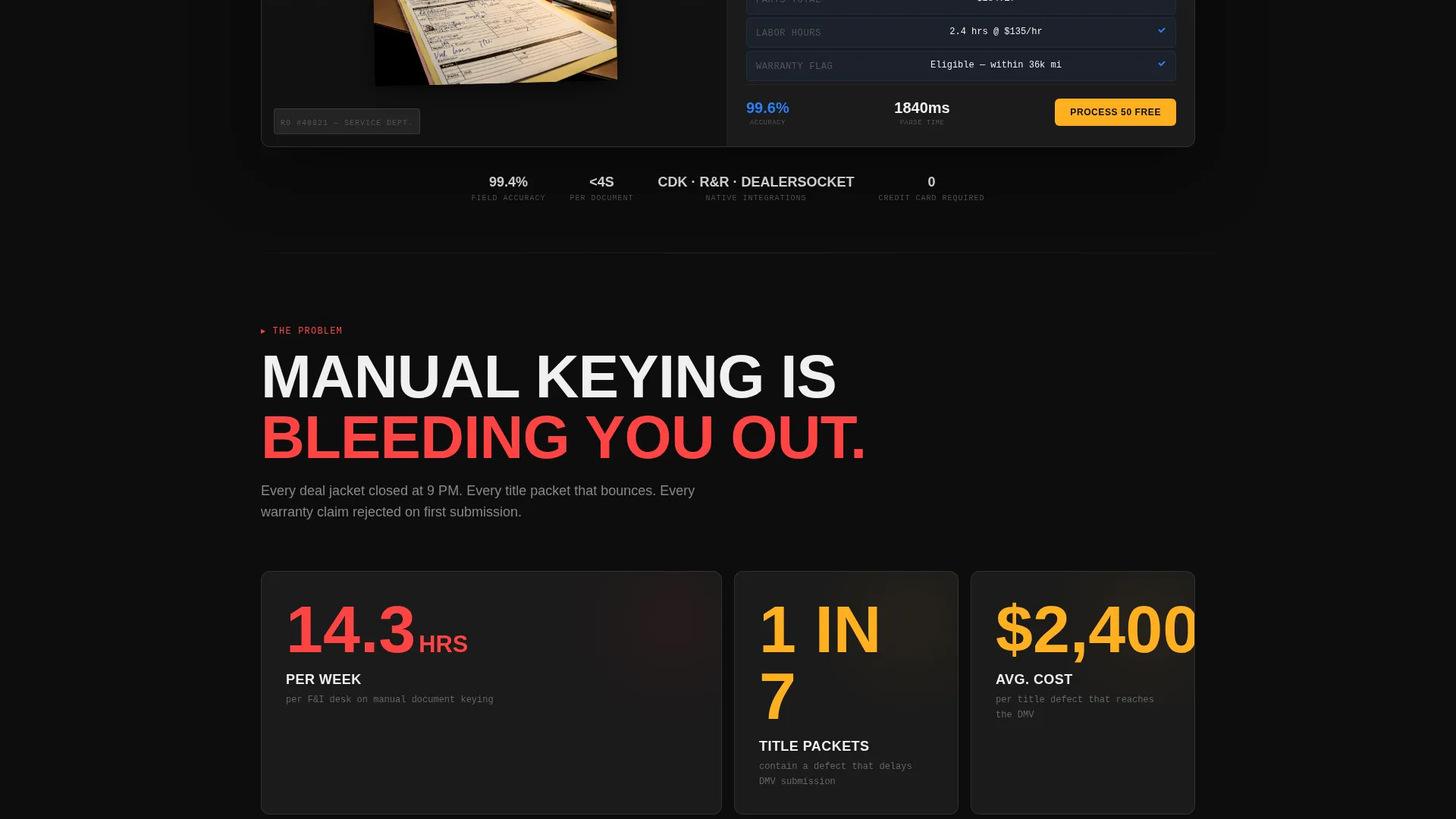
Three oversized glass tabs labeled "Repair Orders," "Title Packets," and "Deal Jackets" sit at the top of the page. Each tab activates a live demo panel showing a document thumbnail on the left and extracted structured data on the right. Fields highlight in electric blue as they populate in a staggered animation. The first tab auto-plays on load.
Problem-to-Solution Arc Layout
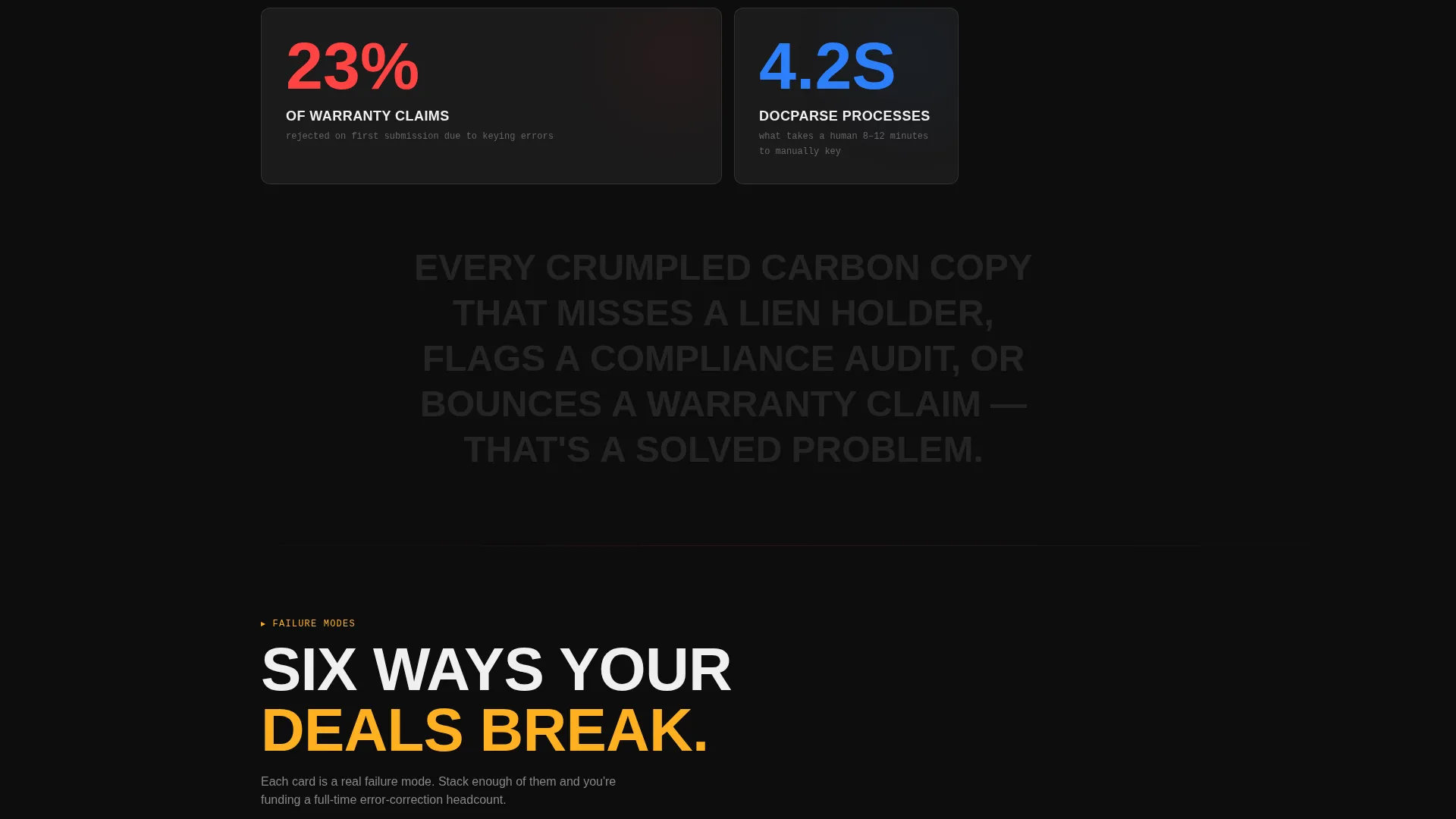
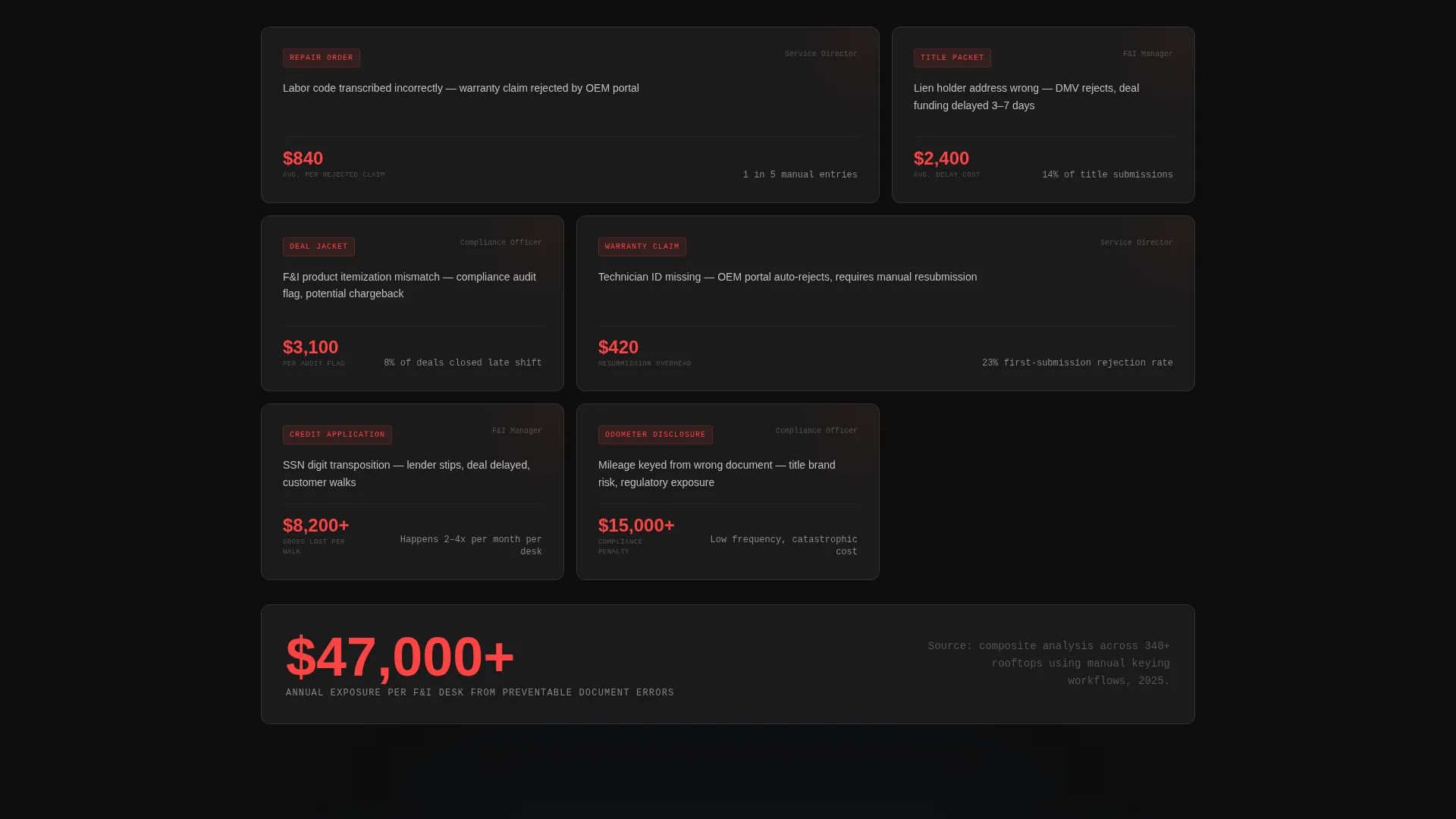
The page opens with a brutalist stat card showing average hours spent on manual document keying per week. It then breaks into a modular card grid where each card presents a document type, the error it causes, and its dollar cost. After the pivot section, the same document types reappear as resolved extraction cards, flipping the emotional register from stress to relief.
Drag-and-Drop Sample Upload
A secondary conversion path below the main card grid lets a visitor upload a real repair order. The template runs a live extraction and returns structured results on-page. This removes skepticism without requiring account creation first.
Two-Step Freemium Sign-Up Modal
Clicking the primary call to action opens a glass modal. Step one captures dealership name and Dealer Management System (DMS) provider via dropdown. Step two asks for a work email only. No credit card is required at any point.
Sticky Call-to-Action Bar
After the page pivot section, a sticky bottom bar appears with the primary call to action in hazard amber. It keeps the conversion trigger visible as the visitor continues scrolling through the lower card sections.
Modular Card Grid System
Every content section uses a repeating card grid built on frosted glass panels with backdrop blur and one-pixel luminous borders. Cards stack cleanly into rows and shift visual weight as the page descends, becoming brighter and more resolved with each section.
Page sections overview
| Section | Purpose |
|---|---|
| Tab Switcher Header | Demonstrates live document extraction before the visitor scrolls |
| Pain Stat Card | Shows average weekly hours lost to manual keying in oversized numerals |
| Problem Card Grid | Maps each document type to its specific error and dollar cost |
| Solution Card Grid | Shows the same document types resolved with accuracy rates and processing times |
| Sample Upload Field | Lets visitors run a live extraction without creating an account |
| Primary call to action Bar | Sticky bottom bar driving freemium sign-up after the pivot |
| Sign-Up Modal | Two-step glass modal collecting dealership name, DMS provider, and work email |
Design & branding system
The visual identity pairs Bold Brutalist typography with a glassmorphic color system. Heavy condensed sans-serif type stamps itself onto the viewport like part numbers on a dealer invoice, while glass cards float above the dark background.
- Deep asphalt black (#0D0D0D) as the primary background, frosted white at 12% opacity for glass cards, and electric dealer-lot blue (#2D7FF9) for active states and progress indicators
- Hazard amber (#FFB020) used exclusively for calls to action and error-state demo highlights
- Cards use backdrop blur and one-pixel luminous borders; the background shifts one shade lighter after the pivot section to signal the transition from chaos to order
Mobile & speed optimization
The card grid layout is built to reflow cleanly across screen sizes. Modular cards collapse into single-column stacks on smaller viewports without losing the visual hierarchy.
- The brutalist type system uses condensed weights that remain legible at smaller font sizes on mobile screens
- Glass card panels and blur effects are scoped to the layout layer so they do not disrupt the reading flow on narrow viewports
How this template helps you convert
The page is structured as a single conversion funnel with two parallel paths: a freemium trial sign-up and an on-page live extraction demo.
- The auto-playing tab demo in the header shows extraction happening before the visitor makes any decision, building immediate credibility without requiring a click.
- The drag-and-drop sample upload removes the last objection by letting a skeptical prospect prove accuracy to themselves before ever entering an email address.
Other information about this template
This template is designed for the automotive AI document processing niche and works well for platforms integrating with common Dealer Management System providers. The brief specifically references compatibility signals with DMS platforms including CDK, Reynolds and Reynolds, and DealerSocket in the solution card section, where integration confirmations appear alongside extraction accuracy percentages and processing times in milliseconds.
- The template's card grid style makes it straightforward to update document types, cost figures, and accuracy stats without restructuring the layout
- The freemium and trial conversion direction means no payment barrier is presented at the first sign-up step, which aligns with the no-credit-card positioning in the brief
- The Problem-to-Solution Arc creative direction is paired with the glassmorphic color system to create a visual shift mid-page, using the background lightening and blue card glow as a design signal that the product has resolved the documented pain
Theme
Bold Brutalist
Creative direction
Problem→Solution Arc
Color system
Glassmorphic
Style
Card Grid (Modular)
Direction
Freemium/Trial
Page Sections
Feature Tab Switcher with Live Demo Panel
Problem-to-solution Arc Card Grid
Drag-and-drop Sample Upload
Two-step Freemium Sign-up Modal
Sticky Hazard Amber Call to Action Bar
Glassmorphic Modular Card System
Related questions
Can I customize the document types shown in the card grid?
Does the drag-and-drop upload section require a backend to function?
Is the two-step sign-up modal editable?
What type of businesses will connect with this landing page?
Can the sticky call-to-action bar be repositioned or hidden on certain sections?