Economics Education Careers & Recruitment Website Template
The Econ quiz landing page template turns economics study into an addictive, five-minute practice habit. Built for university students, A-Level pupils, and career-switchers, it pairs a live stats dashboard, real-feeling social proof, and a friction-free freemium flow. The Playful Geometric design balances academic authority with arcade energy, driving visitors straight into their first quiz.
by Rocket studio
Quick summary
This is a single-column-flow landing page template built for an economics practice and quiz app. It combines a live stats dashboard header, a people-driven scroll narrative, and a freemium conversion model. The result is a page that feels credible enough for exam-season students and exciting enough to make them tap "Start Practising Free" before they finish reading.
Who this template is for
This template is designed for EdTech founders, course creators, and independent educators who want to promote an economics quiz or practice platform. It speaks directly to a defined audience and guides each visitor toward taking a free quiz without friction.
- University students cramming for midterms who need fast, targeted practice on microeconomics and macroeconomics topics.
- A-Level pupils chasing top grades who want concise quiz rounds covering supply and demand, production costs, and market economy theory.
- Career-switchers preparing for MBA interviews who need to refresh their understanding of inflation, monetary policy, and economic decisions quickly.
What problem this template solves
Economics is a subject where re-reading the chapter rarely moves the needle. Students know the theory exists; what they lack is a structured, engaging way to test themselves on it. This template solves the cold-start problem for an economics quiz platform by making the value instantly visible before any sign-up is required.
- Visitors land on a page full of real-feeling data, streak counters, and leaderboard details, so they trust the platform before they create an account.
- The zero-friction quiz flow removes the barrier of a sign-up form, letting the product sell itself through the quiz experience.
- Educators and teachers who want to assign the platform as homework can see the classroom analytics view, making the template relevant to multiple audience segments.
What you get with this template
You get a fully structured, single-column landing page with five core sections and a footer. Every section is purposefully sequenced to move a visitor from curious to converted. The template includes layout, copy direction, visual hierarchy, and a clear freemium conversion plan.
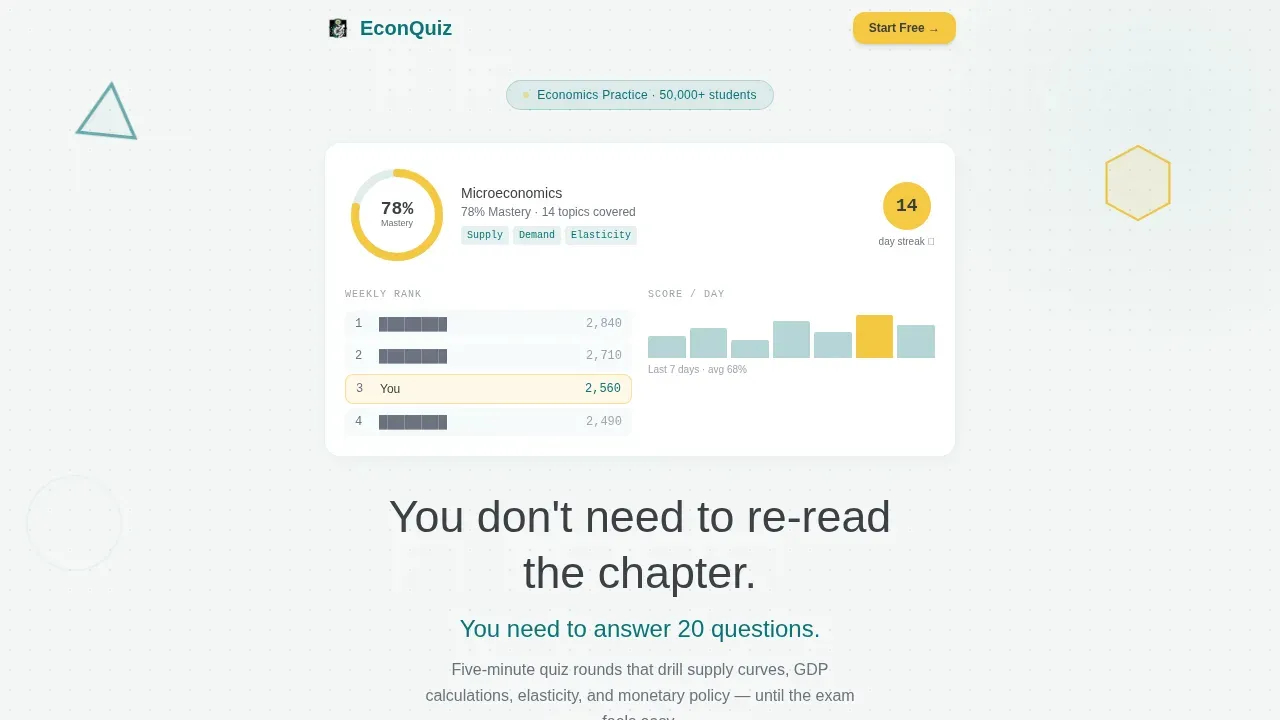
- A live stats hero with a radial progress ring, streak counter, leaderboard snippet, and animated bar chart, followed by a benefit-driven headline and a primary call-to-action above the fold.
- Three people-led social proof sections that escalate from solo learner to educator proof to community leaderboard, each ending with a repeated call-to-action.
- A pricing section with a free-versus-Pro comparison table where the free tier is generous enough to make upgrading feel like a reward.
Feature list
This template delivers a set of carefully designed components. Each one supports the goal of converting visitors into active quiz users.
Live Stats Dashboard Hero
The hero section functions as a frozen mid-session dashboard. It displays a radial progress ring labelled with a mastery percentage, a streak counter showing consecutive practice days, a leaderboard snippet with highlighted usernames, and a small animated bar chart. Numbers are specific enough that a student recognises their own study process in the data.
People-Led Scroll Narrative
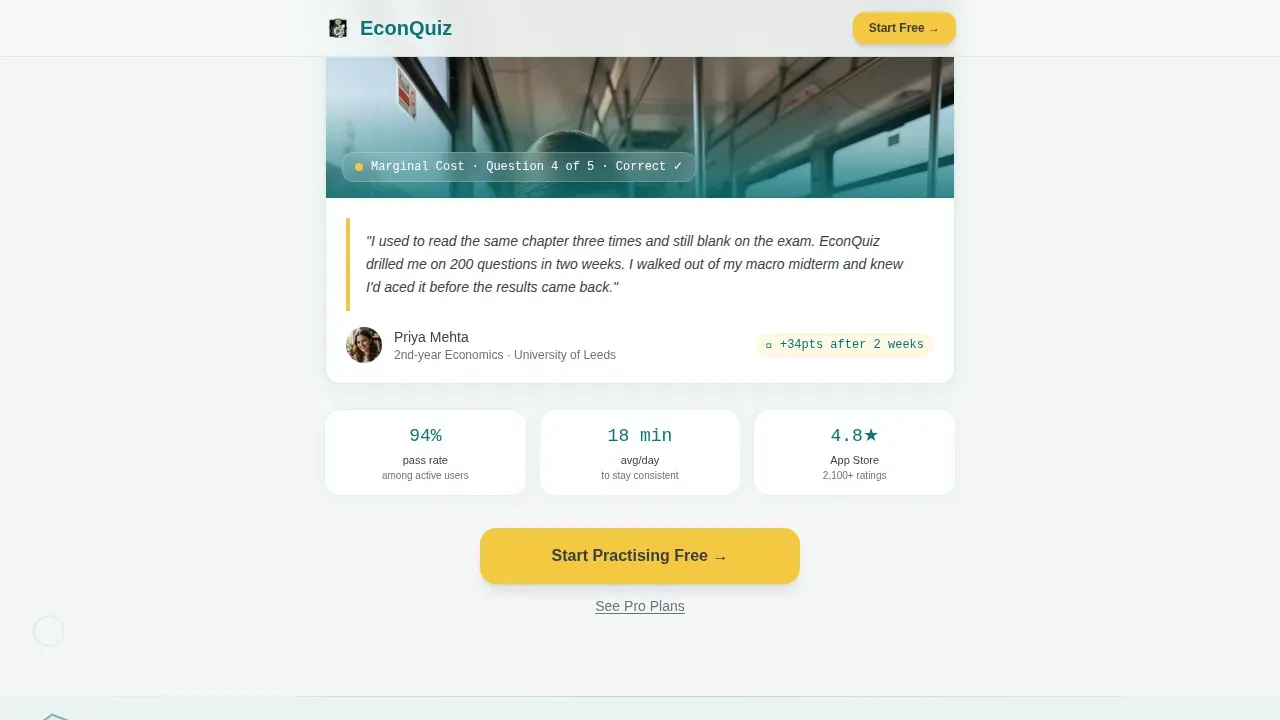
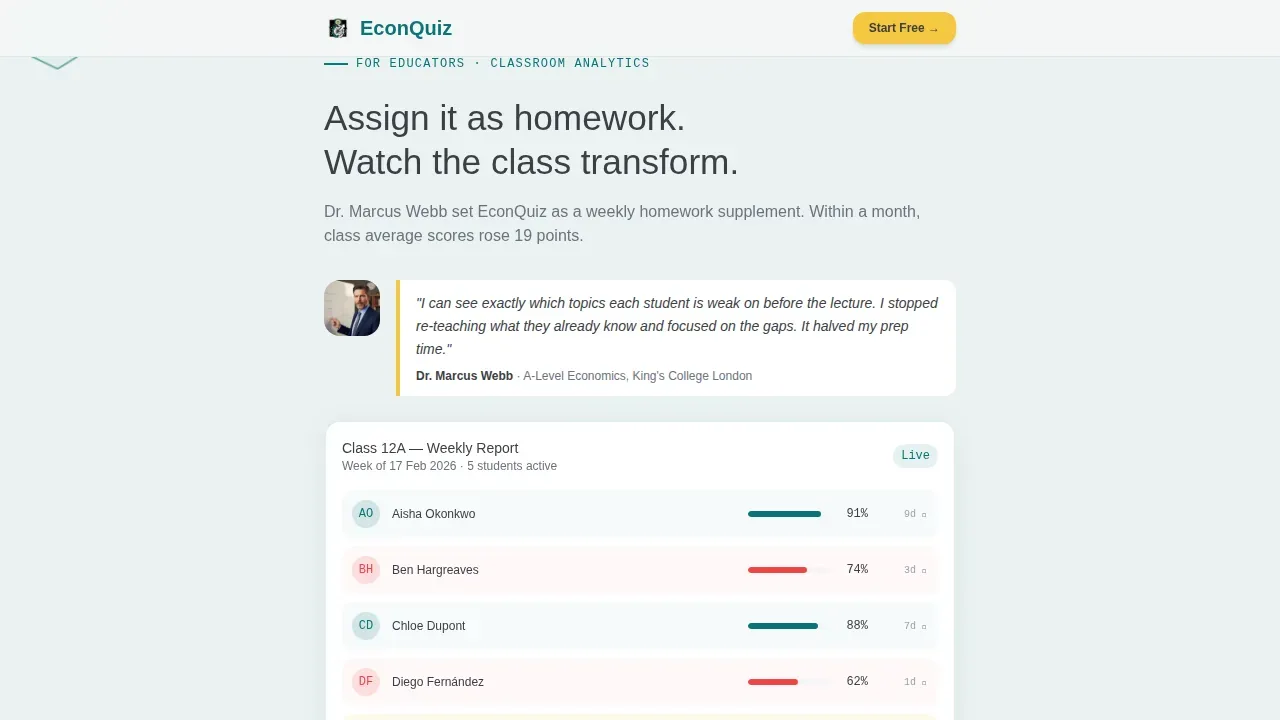
Three sequential story sections introduce real-feeling human moments. A student on a bus with a pull-quote about passing her exam, a tutor showing classroom analytics, and a cohort leaderboard with geometric confetti around the top scorer. Each section ends with a "Start Practising Free" call-to-action, so the conversion opportunity appears naturally after each story.
Freemium Conversion Flow
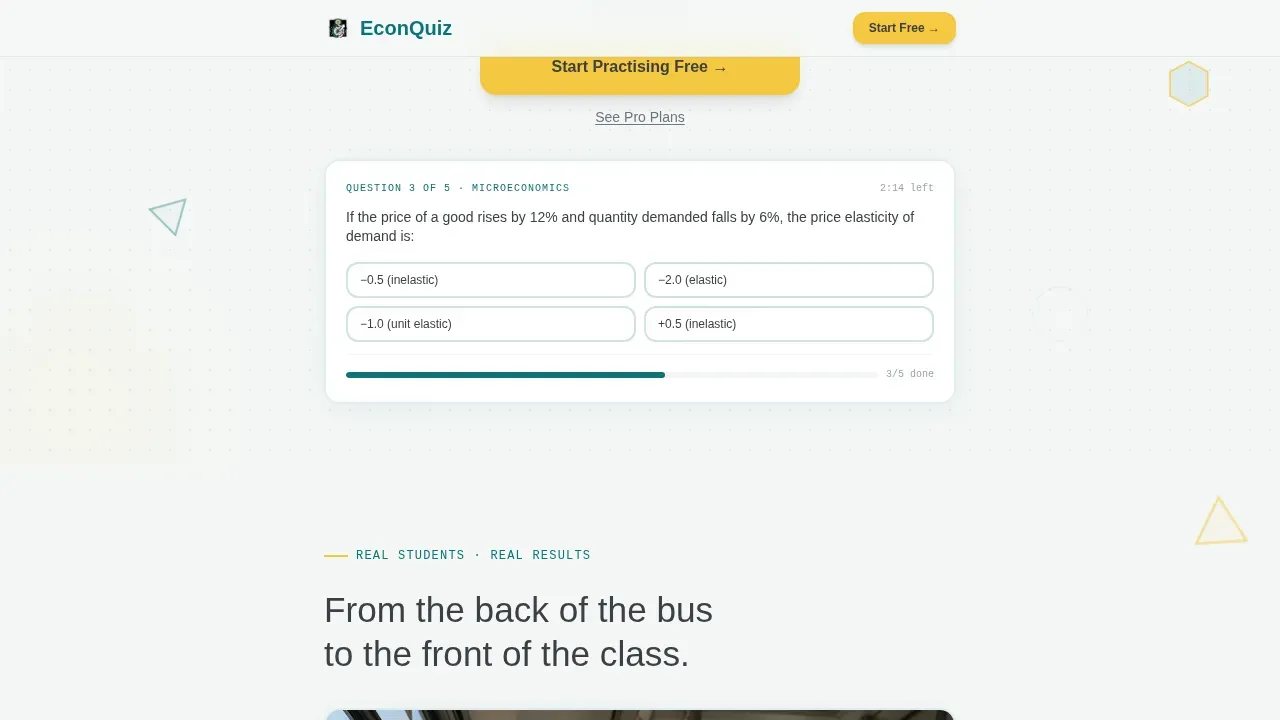
The primary call-to-action drops visitors directly into a five-question sample quiz with no sign-up form on the page. The platform captures only an email after the visitor sees their score. A secondary "See Pro Plans" link in graphite text sits below the primary button for visitors who are already sold and want to review pricing details.
Free versus Pro Comparison Table
The pricing section contains a structured comparison table. The free tier is designed to feel genuinely useful, not artificially limited. The Pro tier details are presented as an upgrade reward rather than a gate, making economic decisions around the subscription feel low-risk.
Animated Geometric Visual System
Floating triangles, hexagons, and grid dots drift behind sections throughout the page. Catalyst yellow fires on correct answers, hover states, and call-to-action buttons. Geometric confetti bursts around the leaderboard top scorer. Every animation uses CSS-preferred techniques to keep the initial load fast.
Mobile-First Single Column Layout
The template is built around a single-column flow optimised for mobile screens. Students on a commute are the primary audience, so every section stacks cleanly on small screens. Touch targets, readable type, and vertically sequenced content mean the page works as well on a phone as it does on a desktop.
Page sections overview
| Section | Purpose |
|---|---|
| Hero Stats Dashboard | Display live-feeling quiz progress data and place the primary call-to-action above the fold |
| Student Story Section | Show a relatable solo-learner moment with a pull-quote and a repeat call-to-action |
| Tutor Analytics Section | Build educator trust by showing a classroom analytics view and a repeat call-to-action |
| Community Leaderboard Section | Create social proof through a friends leaderboard with confetti and a repeat call-to-action |
| Pricing Comparison Table | Present free and Pro tiers side by side with a clear upgrade path |
| Footer | Provide a linear single-row footer with essential links |
Design & branding system
The visual identity follows a Playful Geometric theme. It balances the academic seriousness of an economics subject with the energy of a game, so the page feels rigorous and fun at the same time.
- Color system: deep lecture-hall teal (#0D7377) as the primary brand anchor, chalk-dust white (#F4F7F6) for open backgrounds, graphite pencil gray (#3B3F45) for body text, and catalyst spark yellow (#F5C842) for call-to-action buttons, hover states, and correct-answer highlights.
- Typography: Plus Jakarta Sans for headings, DM Sans for body paragraphs, and JetBrains Mono for stats and numbers, creating a clear hierarchy between data, narrative, and action.
- Geometric shapes including triangles, hexagons, and floating grid dots drift behind sections, referencing supply-and-demand diagrams without cluttering the reading experience.
Mobile & speed optimization
The template is built mobile-first because the core audience includes students practising economics on a commute or between lectures. Every layout decision prioritises a clean experience on small screens.
- Single-column flow means content stacks naturally without horizontal scrolling or cramped layouts on mobile devices.
- CSS-preferred animations for the radial ring, animated bar chart, confetti burst, and scroll reveals keep the initial load light and the experience smooth.
- Staggered scroll reveals and animated counters activate progressively as the visitor scrolls, maintaining engagement without demanding heavy resources up front.
How this template helps you convert
This template is structured around a single conversion objective: get the visitor into a quiz before asking for anything. Every design and copy decision serves that goal.
- The primary call-to-action appears above the fold directly beneath the hero stats dashboard, so visitors see the offer before they scroll. Placing the call-to-action above the fold is a proven practice for quiz landing pages, and this template applies it structurally.
- The people-led scroll narrative creates escalating social proof. Each person's story adds a new layer of trust: a peer who passed her exam, a tutor who assigns the platform as homework, and a community leaderboard that makes the quiz feel like a shared experience rather than a solo test.
- The zero-form entry model means a visitor can participate in a five-question sample quiz with no input required upfront. The email capture happens only after they see their score, at the moment when motivation and curiosity are highest.
Other information about this template
This template is designed to support the promotion of an economics quiz platform across a range of audience segments and use cases. Below are additional details relevant to builders, educators, and product teams evaluating this template.
- The econ master every question economics quiz landing page template is suited to platforms that offer quiz resources covering microeconomics, macroeconomics, market economy dynamics, and economic growth indicators such as gross domestic product (GDP).
- The template structure supports lesson plans for teachers who want to assign quiz rounds as homework. A tutor analytics section provides the visual evidence educators need to trust the platform.
- Topics that economics quizzes commonly cover include supply and demand, the Production Possibility Frontier (PPF), opportunity cost, inflation, wages, exports, production costs, price elasticity, and economic decisions at both the individual and country level.
- The platform concept behind this template aligns with research showing that 79% of marketers planned to use more interactive content including quizzes and assessments. Interactive quiz assessments are also key tools for lead generation and audience engagement.
- Quiz difficulty levels can be set to Easy, Medium, or Hard, and users can typically choose how many questions appear in a session, ranging from 5 to 20 or more. This flexibility makes the platform relevant for quick review sessions and full practice economics tests alike.
- The concept of ceteris paribus is a foundational idea in economic modeling, and quizzes that test this kind of analytical thinking can also test understanding of concepts like Pareto-optimality, the Phillips Curve relationship between inflation and unemployment, and asymmetric information in market economy scenarios.
- AI-powered quiz creation platforms can generate customized economics quizzes from uploaded educational materials, including lecture slides, PDFs, and PowerPoint presentations. AI technology used in quiz creation can analyze educational content to extract key concepts and generate relevant multiple choice questions automatically.
- Master's-level economics quizzes should test rigorous analytical thinking, theoretical application, and econometric understanding. For example, heteroscedasticity can negatively affect the efficiency of ordinary least squares (OLS) estimators in regression models, and a well-designed quiz platform can test this level of knowledge.
- The Solow growth model includes components such as labor, capital, and technology, and quizzes that cover advanced economic models help users develop the depth of understanding expected at postgraduate level.
- A personalized results page should offer immediate feedback, including specific course recommendations based on quiz answers. This approach is consistent with best practices for quiz landing page conversion and user retention.
- This template suits any company or independent educator building a quiz-based economics services offer, whether the business focuses on exam preparation, corporate training, or professional development.
- The budget for accessing this template is a one-time purchase. No recurring platform fee is required to use the design files.
Theme
Playful Geometric
Creative direction
Team & People
Color system
Teal Catalyst
Direction
Freemium/Trial
Page Sections
Live Stats Dashboard with Animated Metrics
People-led Social Proof Sections
Zero-friction Freemium Entry Flow
Free Versus Pro Comparison Table
Playful Geometric Animation System
Related questions
What quiz topics does this landing page template cover?
How many questions can visitors answer in the free sample quiz?
Can teachers and tutors use this template to promote a classroom tool?
Is the template designed for mobile users?
Does this template support a freemium pricing model?